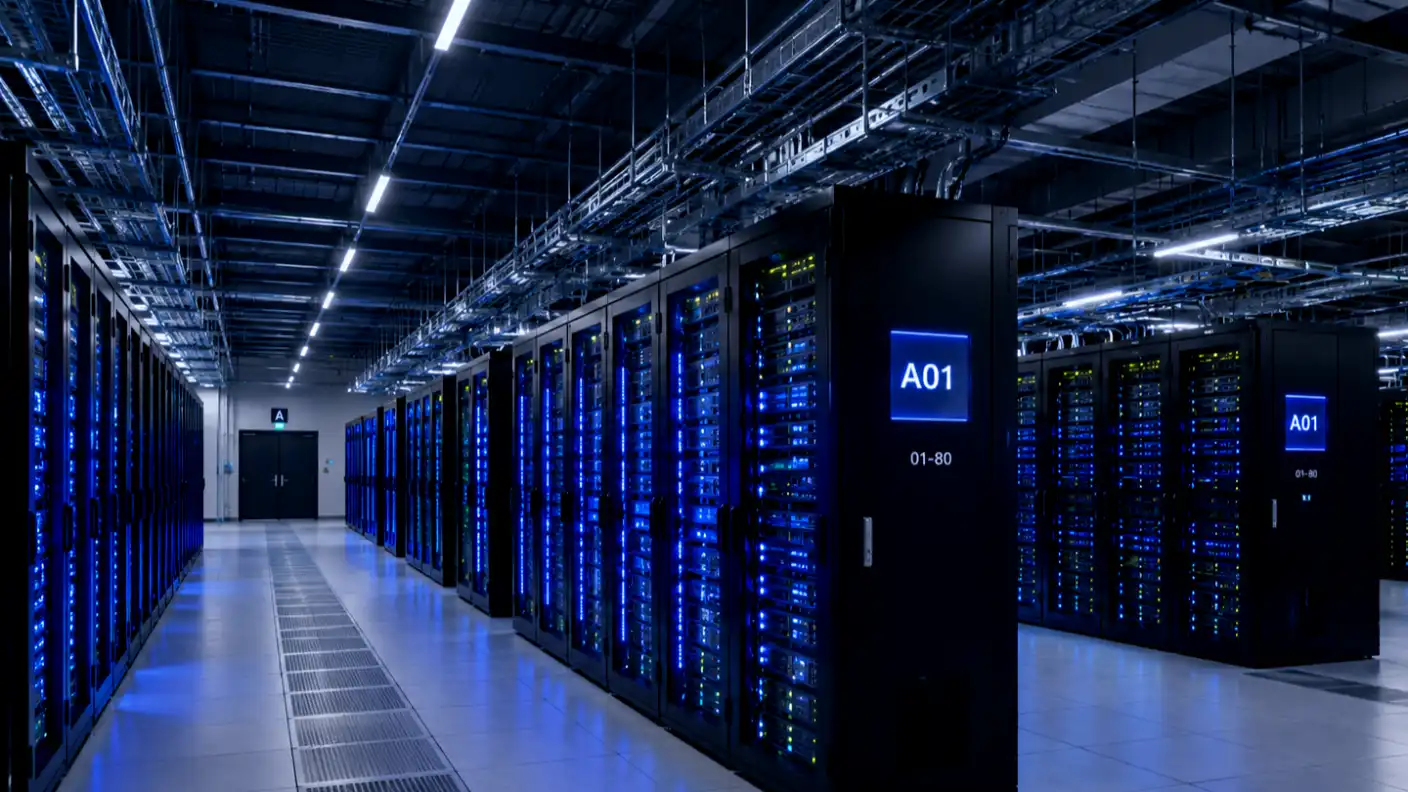
The physical infrastructure that supports the global digital economy is preparing for its most significant public market milestone. In a move that has electrified Wall Street and the technology sector, data center operator Switch has tapped investment banks to prepare for an initial public offering. According to sources familiar with the matter, the company’s private equity owners are targeting an extraordinary valuation of up to $80 billion, including debt, when the business returns to public stock exchanges.
This planned public listing represents a historic turning point for the infrastructure investment sector. For years, the market viewed data centers as a specialized, relatively quiet niche of the real estate industry. The explosive rise of generative artificial intelligence and high-performance computing has completely rewritten those old assumptions. Data centers are no longer treated as passive digital storage warehouses. Instead, they are recognized as the indispensable, highly capital-intensive power engines of the modern world.
The scale of the targeted valuation highlights the incredible wealth generation occurring at the physical layer of the technology sector. If Switch completes its public listing at the targeted $80 billion mark, it will represent one of the largest financial turnarounds and wealth-creation events in recent corporate history. By taking the company public again, its private equity backers are preparing to cash in on an insatiable global demand for massive computing clusters, proving that the companies laying the concrete and securing the electricity are the real winners of the artificial intelligence boom.
The Road Back to Public Markets: Switch’s $80 Billion Strategic Pivot
To understand why the proposed initial public offering has generated such immense excitement, observers must analyze the company’s rapid, highly successful corporate trajectory over the past decade. Switch, which was founded in 2000 by inventor and technology designer Rob Roy, has always operated with a distinct, highly independent philosophy. The company first went public in 2017, trading on the New York Stock Exchange under the ticker symbol SWCH, where it built a solid reputation for operating the most advanced, highly secure data center campuses in the country.
However, the public markets of that era struggled to fully value the company’s master-planned, long-term expansion model. Realizing that the company could scale faster and access cheaper capital in the private markets, private equity giant DigitalBridge Group and an affiliate of infrastructure investor IFM Investors completed an $11 billion buyout in December 2022 to take the company private.
The transformation achieved during this brief, four-year private window is extraordinary. By restructuring the company’s capital allocation models, expanding its physical footprint, and shifting its focus entirely toward high-density computing for artificial intelligence workloads, DigitalBridge and IFM turned a mid-sized data center operator into a global infrastructure titan. The proposed $80 billion valuation target represents an incredible 7.2-fold increase over the $11 billion buyout price, demonstrating how quickly the value of physical computing power has surged in the era of generative intelligence.
The Role of DigitalBridge and IFM Investors
The rapid scaling of Switch was made possible by the deep pockets and specialized expertise of its private equity owners. DigitalBridge has spent the last decade transforming itself from a traditional real estate firm into a pure-play digital infrastructure manager, building a massive global portfolio of mobile towers, fiber-optic networks, and data center assets.
Under the stewardship of DigitalBridge and IFM Investors, Switch transitioned away from legacy enterprise retail colocation toward hosting massive, custom-built environments for the world’s largest hyperscale technology companies. The private equity firms provided the massive capital injections required to purchase hundreds of advanced cooling systems, secure gigawatts of electricity, and construct massive new cleanrooms. This aggressive expansion de-risked the business, turning it into a highly attractive, institutional-grade target ready for a massive public listing.
Monetizing the Trillion-Dollar AI Capital Expenditure Boom
The primary macro driver behind the high-multiple valuation target is the ongoing, global corporate arms race for artificial intelligence supremacy. Technology giants like Microsoft, Alphabet, Meta Platforms, and Amazon are collectively spending hundreds of billions of dollars annually on capital expenditures to build out their artificial intelligence networks.
A significant portion of this capital flows directly into renting space inside third-party data centers, as the tech giants cannot build their own facilities fast enough to keep pace with demand.
By taking Switch public again in this high-growth environment, its private equity owners are offering public market investors a highly liquid, pure-play vehicle to participate in the physical layer of the AI boom.
Wall Street is currently willing to pay premium valuation multiples for data center operators that can guarantee immediate, high-volume capacity, making it the perfect strategic window for Switch to launch its public debut.
Inside Switch’s Proprietary Infrastructure: The SUPERNAP Blueprint
The primary reason why Switch commands such a massive valuation premium compared to generic real estate investment trusts is its proprietary, highly differentiated technology. The company does not simply lease space inside empty warehouses; it designs and operates some of the most technologically advanced, highly secure, and energy-efficient data center environments in the world under its famous “SUPERNAP” blueprint.
The entire physical architecture of a Switch data center is built on a foundation of patented innovations developed by founder Rob Roy. These include the specialized Thermal Shield Chimney (T-SCIF) system, which uses advanced pressure containment to isolate and remove heat generated by high-power server racks, and the multi-system, tri-redundant power delivery networks that guarantee absolute, 100% operational uptime.
This technological edge allows Switch to support the most demanding, power-dense computing workloads on the market, establishing an impenetrable competitive moat that traditional real estate developers cannot easily replicate.
The Clean Energy Advantage: 100 Percent Green Power
A major competitive differentiator for Switch is its long-standing, uncompromising commitment to environmental sustainability. Since January 2016, all of the company’s domestic data center operations have been powered by 100% renewable energy, utilizing massive local solar, wind, and geothermal projects to run its facilities.
This clean energy advantage has become incredibly valuable in the modern regulatory environment. Technology giants are facing intense public and governmental pressure to reduce their carbon footprints and manage the massive environmental impact of their artificial intelligence operations.
By leasing space inside Switch’s green-certified facilities, tech companies can scale their artificial intelligence workloads rapidly without violating their own corporate sustainability goals, making Switch’s green data centers some of the most highly coveted real estate in the technology sector.
The Power-Density Challenge of Next-Generation AI Racks
The rapid evolution of artificial intelligence processors is pushing traditional data center infrastructure to its physical limits. Next-generation processor architectures, including Nvidia’s Blackwell platform, require up to 100 kilowatts of electrical power per individual server rack. In comparison, a traditional cloud server rack historically consumed between 5 and 10 kilowatts.
Running these high-power racks in close proximity generates an extraordinary amount of heat that traditional air-cooling systems cannot manage.
To prevent the delicate silicon components from literally melting, data center operators must transition to advanced, liquid-cooling technologies.
Switch’s patented cooling architectures, which utilize proprietary liquid-to-air heat exchangers and multi-stage cooling loops, are uniquely engineered to support these intense power densities, allowing tech companies to pack their high-power AI servers tightly together without risking thermal failure or operational downtime.
The Geography of Compute: Mapping Switch’s Strategic Campuses
Data centers are fundamentally geographic assets. To operate efficiently, they must sit close to major transcontinental fiber routes, possess access to reliable, low-cost power grids, and be located in areas that are safe from natural disasters. Switch has built its entire business around these geographic principles, constructing massive, master-planned “Citadel” campuses in highly strategic, low-risk regions across the United States.
The company’s primary operational hubs are distributed across key regional markets:
- The Citadel Campus (Tahoe Reno, Nevada): Spanning up to 1.4 million square feet of active data center space, it is the largest, most advanced single data center campus in the world.
- The Las Vegas Campus (Las Vegas, Nevada): The birthplace of the company’s SUPERNAP technology, serving as a primary Western connectivity hub.
- The Keep Campus (Atlanta, Georgia): Providing secure, high-density computing services to the Eastern United States.
- The Pyramid Campus (Grand Rapids, Michigan): Transforming a historic, iconic structure into one of the most secure, advanced data centers in the Midwest.
This geographic distribution ensures that the company can offer its customers unparalleled low-latency connectivity, robust regional disaster recovery options, and access to diverse, highly secure electrical grids.
The Nevada Shield: Low Taxes and Seismically Safe Zones
The company’s heavy concentration of assets in Nevada is a masterpiece of strategic site selection. Nevada offers some of the most favorable business conditions in the country, including no state income tax, low property taxes, and robust sales tax exemptions specifically designed for data center equipment purchases.
Furthermore, the state of Nevada is one of the most seismically stable regions in the Western United States, virtually free from the risk of hurricanes, earthquakes, and tornadoes that threaten data center operations in California, Texas, and Florida.
By building its largest campuses in this seismically safe zone and connecting them directly to the primary fiber lines that travel between Silicon Valley and the rest of the country, Switch has built a secure, low-latency haven for global data storage that is highly prized by corporate and government clients alike.
Evaluating the $80 Billion Valuation: Wall Street’s Financial Calculus
While the strategic and technological story of Switch is highly compelling, the proposed $80 billion valuation target has raised some eyebrows among traditional financial analysts. To achieve an $80 billion market capitalization, the company’s investment banks must convince public markets to price the stock at a highly premium EBITDA multiple, potentially stretching as high as 25 to 30 times forward earnings.
This premium valuation relies on the assumption that the artificial intelligence infrastructure boom will continue unabated for the next decade. If the major hyperscale tech companies successfully monetize their new software models, they will continue to lease data center space at an accelerating rate, easily justifying the high valuations of infrastructure operators.
However, if the expected return on AI investments takes longer to materialize, tech companies may slow their data center expansions, posing a significant risk to anyone buying infrastructure stocks at the peak of the cycle.
Furthermore, the industry must navigate significant physical and macroeconomic headwinds. The era of high interest rates has made debt-financed real estate expansion significantly more expensive, while global supply chain shortages for high-voltage transformers and electrical switchgear continue to delay construction timelines.
If Switch struggles to secure the critical equipment and electrical power necessary to expand its campuses on schedule, its revenue growth could slow, making it difficult to defend an $80 billion valuation in a highly competitive market.
The upcoming public debut of Switch represents much more than a simple corporate milestone. It is a defining test of the public market’s belief in the long-term, multi-billion-dollar future of the artificial intelligence physical layer. By offering investors a pure-play, highly profitable vehicle to participate in the physical infrastructure of compute, the IPO plans are poised to reshape the financial dynamics of the technology and real estate sectors.
As the company’s investment banks prepare the registration documents and line up institutional buyers, the message to the market is clear: the physical data center has emerged as the most critical asset of the 21st century.
The companies that can design the most efficient cleanrooms, secure the largest amounts of green power, and construct the most advanced cooling systems will continue to command the highest valuations in the global economy, proving that the digital future remains firmly anchored in the physical reality of the industrial cleanroom.