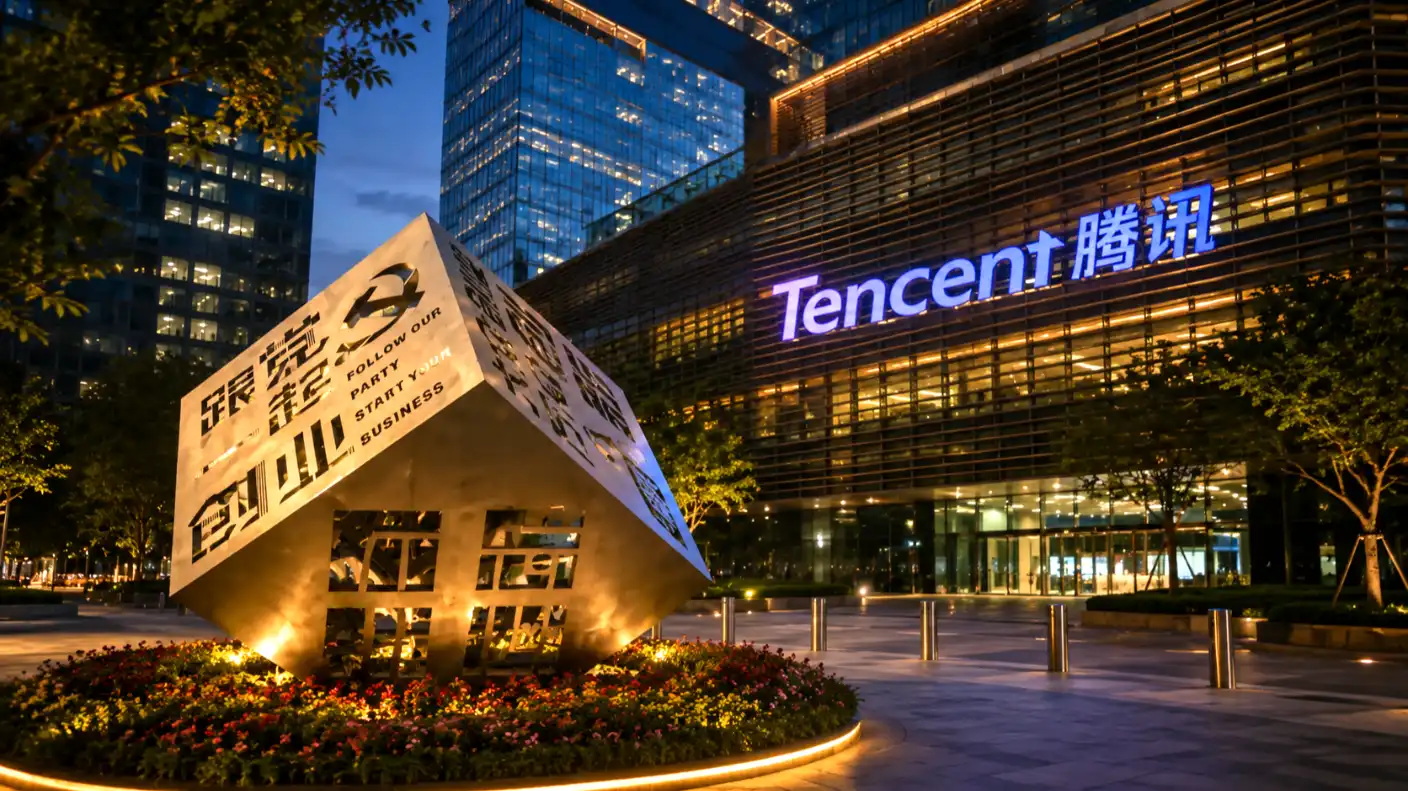
The global artificial intelligence investment boom is facing its first major period of investor skepticism. Following a massive stock market rout that wiped out over $2 trillion in valuation from the United States “Magnificent Seven” technology giants, investors are turning their attention to China’s leading internet companies. In August 2026, the spending plans of Shenzhen-based Tencent Holdings Ltd. came under intense scrutiny as market participants prepared for the company’s upcoming midyear earnings report.
This heightened focus reflects a broader shift in investor sentiment. In recent weeks, public markets cooled dramatically on the lavish artificial intelligence outlays announced by Western hyperscalers, demanding immediate financial returns instead of long-term technology promises. Because Tencent is due to release its financial results next Wednesday, its capital expenditure plans have become a crucial test case for whether global tech giants can successfully monetize their AI investments without damaging their operating margins.
Unlike its Western rivals, who are committing hundreds of billions of dollars to build massive public cloud networks, Tencent is pursuing a highly targeted strategy. By focusing on internal demand, leveraging its massive social media user base, and adopting a low-cost distribution model, the company wants to prove that artificial intelligence can drive immediate profitability. Whether this conservative, application-focused strategy satisfies nervous investors will determine the direction of the Asian technology market for the rest of the year.
The Magnificent Seven Reality Check: Why Investors Are Cautious
For the past two years, the technology sector enjoyed an unprecedented rally, driven by the belief that artificial intelligence would rapidly transform the global economy. This optimism pushed the valuations of megacap tech stocks to historic heights, but the recent earnings season has delivered a severe reality check.
The Peak-Capex Backlash in Western Markets
The primary source of the market’s current anxiety is the massive capital expenditure guidance provided by Western technology giants. During recent quarterly reports, companies like Microsoft, Alphabet, and Meta announced soaring infrastructure budgets, with Microsoft projecting capital expenditures of $190 billion for the upcoming fiscal year.
While these companies reported strong revenues, their immediate AI-related returns were not large enough to justify the immense capital spending. This discrepancy triggered a sharp market correction. The Bloomberg Magnificent 7 Index tumbled, wiping out over $2 trillion in market capitalization within weeks, as investors realized that the monetization of generative AI would take much longer and cost far more than initially anticipated.
The Focus on Practical Monetization of AI Investments
This stock market rout has fundamentally changed how investors analyze technology balance sheets. Wall Street is no longer willing to underwrite unconstrained spending on computing power.
Instead, analysts are demanding concrete evidence of AI revenue generation, focusing on metrics like software subscription additions, cloud margin improvements, and automated cost savings.
As a result, any technology company announcing an increase in capital expenditures must now provide a clear, near-term pathway to profitability, placing immense pressure on corporate boards to justify their hardware procurement decisions.
Tencent’s Doubled AI Budget: Balancing Growth with Capital Discipline
Tencent is not immune to the pressures of the global AI arms race. To compete with domestic rivals like Alibaba Group Holding and ByteDance, the company has had to scale up its technological investments significantly, forcing its management team to make difficult capital allocation decisions.
Shifting Capital from Buybacks to Silicon
To fund its artificial intelligence ambitions, Tencent has signaled a major change in its capital management strategy. During its previous earnings calls, the company’s management confirmed plans to more than double its AI-related investments in 2026, pushing its annual AI-specific spending past $5 billion.
To fund this expansion while maintaining its high dividend payouts, Tencent’s chief financial officer indicated that the company will likely buy back a lower volume of its own shares compared to the $10.2 billion it spent on share repurchases in 2025.
While the shift from share buybacks to technology investment has raised concerns among short-term investors, the company argues that the long-term returns from AI integration fully justify the capital reallocation.
Furthermore, investment banks like Goldman Sachs project that Tencent’s total capital expenditures could hit 165 billion yuan (approximately $24 billion) by 2027, representing a massive expansion of its physical data center and hardware networks.
Navigating the US Chip Sanctions
Tencent’s spending plans have also been shaped by intense geopolitical tensions. In 2025, the company’s capital spending fell below its internal expectations, largely because United States export controls restricted its ability to acquire advanced Nvidia processing chips.
To bypass these supply bottlenecks, Tencent has adjusted its hardware strategy, relying increasingly on domestic, Chinese-made silicon.
As home-grown AI processors from domestic manufacturers and in-house research labs begin to reach commercial scale in the second half of 2026, Tencent is rapidly ramping up its capital spending. This transition to domestic hardware allows the company to secure its supply chain, protecting its data center projects from foreign regulatory changes while significantly lowering its hardware procurement costs.
The Strategic Divergence: Internal Demand and the “Distribution Over Scarcity” Model
As the cost of raw computing power declines, a stark contrast is emerging between the AI strategies of Western technology giants and Chinese internet companies.
Prioritizing Internal Integration Over Raw Cloud Infrastructure
While Western hyperscalers are investing hundreds of billions of dollars in “infrastructure as power”—attempting to dominate the physical supply of chips and public cloud compute—Tencent is prioritizing internal demand.
Rather than focusing solely on selling raw computing power to external enterprise clients, the company is systematically integrating AI capabilities across its vast portfolio of existing applications.
Tencent’s primary target for AI integration is WeChat, its dominant messaging, social media, and payment platform, which boasts over 1.4 billion active users. The company is currently developing advanced AI agents capable of executing complex, multi-step tasks directly within WeChat on behalf of users.
By upgrading its core consumer applications, Tencent wants to drive user engagement and advertising revenues, ensuring that its AI investments translate directly into higher-margin operating profits.
Championing the Low-Cost, Agentic AI Workspace
Tencent is also pursuing a “distribution over scarcity” model, offering accessible, low-cost AI solutions designed to capture massive market share. The company’s flagship large language model, Hunyuan, and its highly popular consumer chatbot, Yuanbao, have already achieved significant commercial scale, with Yuanbao crossing 50 million daily active users in 2026.
More recently, Tencent fully integrated its advanced Hy3 model into the international edition of WorkBuddy, its agentic AI workspace. To drive adoption, the company made the workspace free to all users worldwide through August, followed by an aggressive pricing structure of $0.1288 per million input tokens.
This pricing undercuts Western flagship models by an order of magnitude, allowing Tencent to capture a dominant share of the global agentic software market. In fact, Hy3 has already topped global tool-call volume rankings on OpenRouter, processing roughly 33 million autonomous agent executions daily and proving that practical, deployable AI can outperform benchmark leaders in real-world business tasks.
The Upcoming Midyear Earnings Test
As Tencent prepares to release its interim financial results next Wednesday, August 12, 2026, the company faces a high-stakes examination from the investment community. Analysts will be watching closely to see if the firm’s AI-related revenues are beginning to justify its heavy infrastructure outlays.
Analyzing the High Cost of the AI Transition
While Tencent’s core video gaming and digital advertising businesses remain highly profitable, previous financial disclosures highlight the high costs of the AI transition. In the first quarter of the year, the company’s capital expenditures rose 16% to 31.9 billion yuan, representing a sharp 63% increase from the preceding quarter.
At the same time, the company’s operating profits fell short of their full potential due to the heavy upfront investments required for new AI products.
Excluding the development and promotional costs of Hunyuan, Yuanbao, and its new enterprise tools, Tencent’s operating profit margin would have been significantly wider, standing at 43% instead of the reported 39.9%. This gap shows the real-world financial friction of the AI transition, and analysts will scrutinize the upcoming midyear numbers to see if this profit margin pressure is beginning to ease as the company’s new AI tools gain commercial traction.
The Market Valuation and Long-Term Stock Re-Rating
Despite these short-term margin pressures, the broader investment community is becoming increasingly bullish on Chinese internet stocks. Following years of trading in the shadow of major semiconductor manufacturers, investors are realizing that falling AI processing costs will ultimately shift the industry’s value toward the companies that own the applications and services people use daily.
This realization has triggered a powerful market rotation. Since reaching a low in late June, the KraneShares China Internet exchange-traded fund has surged by more than 20%, about twice the advance of the broader Hang Seng Index, while the Philadelphia Semiconductor Index has declined.
Because China’s cloud and internet stocks are only beginning to be re-rated as key beneficiaries of the AI deployment phase, a strong earnings report from Tencent next week could accelerate this rotation, establishing the company as a prime defensive asset in the global technology landscape.
Securing the Next Frontier
Tencent’s upcoming midyear earnings report represents a defining moment for the global technology market. As investors around the world retreat from the aggressive, high-risk capital spending patterns of Western hyperscalers, Tencent’s practical, application-focused strategy offers a highly compelling alternative.
By prioritizing internal demand, leveraging its massive social media user base, and championing low-cost, deployable AI agents, the company is demonstrating that technological leadership does not require unlimited computing budgets.
As the artificial intelligence revolution shifts from a hardware infrastructure race into a commercial software battle, Tencent’s ability to turn its vast user ecosystem into durable, high-margin cash generation will prove that the ultimate winners of the digital age will be the companies that can deliver practical, useful, and affordable AI to the global marketplace.