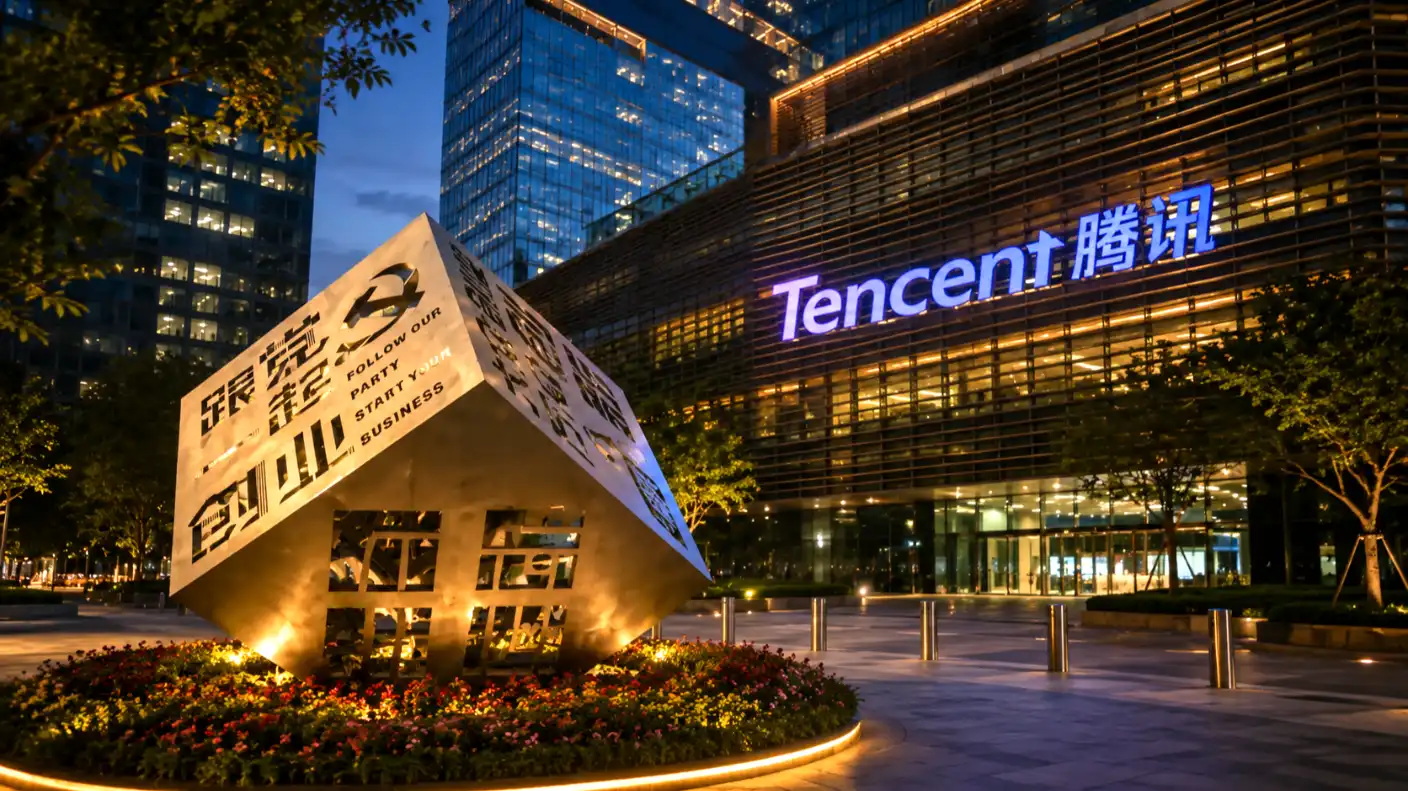
Tencent Holdings has officially initiated internal testing for a brand-new artificial intelligence assistant embedded directly inside WeChat, China’s most dominant messaging and lifestyle platform. The feature, named Xiaowei, represents the tech conglomerate’s most aggressive push yet to transform its flagship super app from a passive digital directory into an active, automated action engine. While Western tech giants race to build standalone artificial intelligence applications, Tencent is taking a fundamentally different approach. The company is wiring generative AI directly into the nervous system of an application that roughly 1.4 billion people already use every single day to chat, pay bills, order groceries, and hail taxis.
The financial markets reacted immediately to the early development signals. When initial reports regarding the internal testing surfaced earlier this month, Tencent shares trading on the Hong Kong Stock Exchange under ticker 0700 surged by as much as 10.5% in a single trading session. That jump marked the company’s largest one-day stock gain since January 2021, adding tens of billions of dollars to its valuation and signaling massive investor appetite for practical consumer AI monetization. By moving beyond simple question-and-answer chatbots, Tencent wants Xiaowei to act as a personal digital concierge capable of executing multi-step tasks across the sprawling WeChat ecosystem.
Inside Xiaowei: How Tencent Is Turning Chatbots Into Action Engines
Most consumer artificial intelligence tools on the market today operate as isolated conversationalists. A user types a prompt into a text box, the software generates a paragraph of text or an image, and the interaction ends. Xiaowei breaks this mold by operating as an agentic command layer built directly on top of WeChat’s existing infrastructure. During the current limited testing phase, selected users can trigger the assistant using both natural voice commands and typed text.
Instead of merely drafting an email or summarizing an article, Xiaowei can navigate menus, interact with third-party services, and complete transactions on the user’s behalf. For example, a user can instruct the assistant to find a ride to the nearest train station, order a specific meal from a local restaurant, and split the resulting bill with a contact list. The assistant processes the spoken intent, opens the relevant ride-hailing and food delivery utilities behind the scenes, fills out the order parameters, and presents the final confirmation screen to the user for a single fingerprint or facial scan approval.
Bridging the Gap Between Intent and Execution
The secret to Xiaowei’s practical utility lies in WeChat’s famous mini-program architecture. First introduced several years ago, mini-programs are lightweight applications that run instantly inside the main WeChat interface without requiring separate app store downloads. Today, the platform hosts more than 410,000 active mini-programs covering almost every commercial sector in the Chinese economy, from municipal government services and airline ticketing to boutique e-commerce shops and hyper-casual video games.
Historically, navigating this massive library required users to remember specific brand names, swipe through endless drop-down menus, or scan physical QR codes taped to restaurant tables. Xiaowei effectively eliminates this interface friction. By serving as an intelligent bridge between raw human intent and software execution, the AI assistant maps spoken requests directly to the corresponding software endpoints of these mini-programs. If a user asks to book a tennis court for Tuesday evening, Xiaowei scans local venue mini-apps, checks real-time availability schedules, compares hourly rental rates, and holds the reservation. This agentic workflow turns the super app into an invisible operating system where the user interface is simply a human conversation.
The Technology Stack Behind the Curtain
Powering an agent capable of interpreting messy human context and executing flawless financial transactions requires a robust, multi-tiered artificial intelligence framework. Tencent built Xiaowei primarily on top of its proprietary foundation models, specifically utilizing its upgraded Hunyuan large language model alongside its specialized WeLM architecture. The Hunyuan model handles the broad natural language understanding, sentiment analysis, and conversational memory, allowing the assistant to maintain context over long, multi-turn dialogues.
However, Tencent’s engineering team made a pragmatic architectural choice to ensure maximum reliability. Internal customer service documentation confirms that while WeChat relies on its in-house models for the vast majority of daily tasks, the system dynamically routes certain highly complex coding or logical reasoning queries to DeepSeek. By adopting a hybrid routing strategy, Tencent avoids relying solely on a single monolithic architecture. The software evaluates incoming user prompts in real time, determines the required computational weight, and assigns the task to whichever underlying neural network offers the highest accuracy and the lowest latency. This backend flexibility ensures that Xiaowei remains responsive even during peak network traffic hours when millions of users simultaneously query the system.
The Strategic Economics Behind WeChat’s AI Upgrade
Tencent’s decision to embed Xiaowei directly into its core product highlights a massive structural advantage that legacy tech conglomerates hold over pure-play artificial intelligence startups: distribution. Over the past three years, venture-backed AI companies across the globe have burned through billions of dollars in marketing capital simply to acquire active users. Standalone applications face steep uphill battles against user churn, subscription fatigue, and app store discovery limits.
Tencent bypasses the customer acquisition cost entirely. With a built-in audience of 1.4 billion monthly active users, WeChat offers immediate global scale on day one. Even if only 10% of WeChat’s existing user base adopts Xiaowei during its initial rollout, Tencent will instantly operate one of the largest deployed artificial intelligence agents on the planet, boasting 140 million regular users. This immediate scale creates a powerful data flywheel. Every voice command, corrected transaction, and successfully automated workflow feeds anonymized training data back into the Hunyuan foundation model, accelerating its learning curve far faster than competitors relying on synthetic data or smaller user pools.
Monetizing the 1.4 Billion User Funnel
Beyond data collection, Xiaowei unlocks a massive new financial monetization channel for Tencent. The company currently boasts a market capitalization exceeding $505 billion, driven largely by its dominant mobile gaming division and its digital payment infrastructure, WeChat Pay. However, traditional digital advertising growth across mobile platforms has begun to mature. To maintain its aggressive financial momentum—highlighted by the company recently allocating HK$5.01 billion toward share buybacks—Tencent must extract higher gross merchandise value from its existing digital real estate.
Xiaowei acts as a high-conversion sales funnel. When users manually search for products or services inside an app, they often abandon their shopping carts due to complex checkout screens or slow load times. An automated agent that handles browsing, price comparison, and data entry drastically increases transaction completion rates. Tencent collects a small service fee and payment processing cut on every commercial transaction routed through WeChat’s mini-programs. By making it effortlessly simple for consumers to spend money via voice commands, Xiaowei directly inflates the total transaction volume flowing through Tencent’s fintech ecosystem.
Reviving the Xiaowei Brand Identity
Longtime observers of the Chinese technology sector will recognize the name Xiaowei. Tencent originally launched an artificial intelligence product under the same moniker back in 2017. That earlier iteration functioned primarily as a traditional smart speaker voice assistant, designed to compete with Amazon’s Alexa and Apple’s Siri by playing music, reading weather forecasts, and answering basic trivia questions.
While the 2017 hardware experiment achieved moderate consumer awareness, it suffered from the same limitations that plagued early first-generation voice assistants: poor contextual memory and an inability to perform real-world tasks. The current relaunch of Xiaowei represents a complete conceptual pivot. Tencent stripped away the standalone hardware focus and reimagined the brand purely as an enterprise-grade software agent. By shifting the identity of Xiaowei from a novelty living room speaker into an indispensable productivity engine living inside every citizen’s smartphone, Tencent has successfully salvaged a dormant brand asset and positioned it at the cutting edge of modern software engineering.
China’s High-Stakes Artificial Intelligence Arms Race
Tencent does not operate in a vacuum. The launch of Xiaowei comes at a moment of intense competitive friction across the Chinese domestic technology sector. For the past two years, Tencent has faced growing criticism from industry analysts who argued that the Shenzhen conglomerate was trailing its primary domestic rivals in foundation model development and consumer AI deployment.
ByteDance, the parent company of TikTok and Douyin, currently leads the Chinese consumer market in raw app downloads with its flagship AI chatbot, Doubao. By aggressively marketing Doubao across its dominant short-video networks, ByteDance captured millions of young, digital-native users. Meanwhile, search giant Baidu continues to push its Ernie Bot ecosystem, and e-commerce titan Alibaba Group Holding has poured immense resources into its Qwen model series.
The battle lines are drawing most clearly in the super app sector. Alibaba’s financial technology affiliate, Ant Group, is actively conducting limited testing of a rival AI agent embedded inside the Alipay mobile wallet. Much like Xiaowei, the Alipay agent aims to help users book airline tickets, order food delivery, and manage personal investments through conversational prompts. This parallel development proves that Chinese consumer tech giants have reached a consensus: standalone chatbots are a transitional phase, and the future belongs to deeply integrated action agents living inside everyday financial and social platforms.
To prevent user churn and defend its position as China’s primary digital habit, Tencent had no choice but to accelerate Xiaowei’s testing schedule. If a consumer can organize their entire daily itinerary using an AI assistant inside Alipay or Douyin, their daily screen time inside WeChat will inevitably drop. By turning WeChat into an automated agent ecosystem, Tencent builds a defensive wall around its core user attention metrics.
Hardware Partnerships and System-Wide Integration
A software agent is only as useful as its accessibility. If a user must manually unlock their phone, locate the WeChat icon, open the application, and navigate to a specific chat tab just to speak to Xiaowei, the convenience of AI automation evaporates. Recognizing this interface bottleneck, Tencent has initiated deep technical collaborations with major domestic smartphone manufacturers.
Industry reports indicate that Tencent engineering teams are working closely with hardware giants, including Huawei and Xiaomi, to bake Xiaowei access directly into the operating system layer of mobile devices. These partnerships aim to allow users to trigger WeChat’s AI assistant from anywhere on their smartphone—whether they are looking at their lock screen, browsing a web browser, or playing a mobile game.
For instance, a user reading a restaurant review inside a third-party web browser could hold down their smartphone’s physical power button or swipe from the corner of the screen to summon the Xiaowei overlay. The user could then say, “Book a table for two at this restaurant for tonight via WeChat.” The assistant would scrape the context from the open web browser, identify the restaurant, match it to its corresponding WeChat mini-program, and finalize the booking without requiring the user to manually switch applications. This level of cross-app integration blurs the line between the smartphone’s native software and Tencent’s platform, solidifying WeChat’s status as the primary operating system of daily life in China.
The Road to the Q3 Rollout: Compliance and Grayscale Testing
Currently, Xiaowei remains strictly in what Chinese software developers call grayscale testing. This staged release methodology involves rolling out a new software feature to a tiny, randomized percentage of live users—often starting at 0.1% or 1%—before slowly widening the access gate over several weeks or months. Grayscale testing allows engineering teams to monitor server loads, identify edge-case software crashes, and observe real-world user interaction patterns without risking a catastrophic platform failure across 1.4 billion devices.
Beyond technical stability, the staged rollout provides Tencent with crucial time to navigate China’s complex regulatory environment. Unlike Western markets, where software companies can launch generative AI tools with minimal prior government oversight, artificial intelligence deployment in China requires strict adherence to administrative guidelines. The Cyberspace Administration of China enforces comprehensive rules governing generative artificial intelligence services, requiring companies to submit their foundation models and security algorithms for official government reviews before public release.
Tencent must prove to regulators that Xiaowei’s training data adheres to strict content standards, that its automated transactions protect consumer financial privacy, and that its dynamic routing to models like DeepSeek does not introduce unverified data leaks. Company representatives have targeted a broad public rollout across the entire WeChat user ecosystem by the third quarter of this year. If Tencent successfully clears these regulatory and technical hurdles on schedule, the official public launch of Xiaowei will mark one of the most consequential software updates in the history of consumer mobile technology.
What This Means for Global Technology Markets
For international investors and software developers reading TechGolly, Tencent’s experiment offers a live preview of where mobile computing is heading globally. While Apple slowly works to integrate Apple Intelligence into Siri and Google embeds Gemini deeper into the Android ecosystem, Tencent is executing the agentic super app vision at massive scale right now.
The success or failure of Xiaowei will answer critical existential questions for the entire software industry. Can consumers truly be trained to abandon traditional tap-and-swipe visual interfaces in favor of conversational voice commands? Can an artificial intelligence agent reliably handle complex financial transactions without generating costly software errors? And most importantly, does embedding AI into an existing 1.4 billion user base create an insurmountable monopoly that locks standalone software startups out of the consumer market entirely? As the third quarter approaches, the eyes of the global tech community remain fixed firmly on Shenzhen.