
Key Points:
- The Fourth Tianjin International Shipping Industry Expo brought together over 400 global exhibitors to discuss supply chain resilience amid rising geopolitical trade tensions.
- China has built 30 automated container terminals, accounting for 27% of the world’s total, and currently operates the largest fleet with over 500 million deadweight tonnes.
- Tianjin Port showcased the world’s first smart, zero-carbon terminal, utilizing remote cranes, autonomous yard vehicles, and an AI-driven scheduling system with 95% accuracy.
- Despite trade uncertainties, the integration of automation has slashed average vessel transit times by 10.3% and reduced overall logistics costs by 10% to 20%.
As the international shipping industry grapples with rising unilateralism, trade protectionism, and severe geopolitical tensions, global maritime leaders have gathered in northern China to forge a more resilient logistics framework. The Fourth Tianjin International Shipping Industry Expo officially commenced in the major port city of Tianjin on Tuesday, June 3, 2026. Running through Friday, the major event has drawn over 400 exhibitors from home and abroad under the forward-looking theme “Shipping to the World and Navigating towards the Future: AI Leads New Opportunities for the Development of Ports and Shipping.” Against a backdrop of global economic fragmentation, the expo has emerged as a critical platform to explore how automated ports and artificial intelligence can stabilize the international flow of goods.
Delegates and international trade experts at the expo commended China’s substantial shipping sector, citing the country’s robust port infrastructure and immense fleet as vital anchors of stability. Li Xinghu, China’s Vice Minister of Transport, revealed during an opening address that China has successfully developed the world’s largest port cluster, with its total port cargo and container throughput ranking first globally for over 20 consecutive years. Furthermore, Chinese-owned shipowners operate a massive commercial fleet with a total capacity exceeding 500 million deadweight tonnes—the largest in the world. With China’s share of international shipping volume accounting for nearly one-third of the global total, its vast maritime logistics network now stretches to every corner of the globe.
The massive scale of this maritime ecosystem translates directly into immense economic value. A comprehensive report released on Tuesday at the expo showed that in 2025, the added value of the port economy in China’s coastal port cities reached 7 trillion yuan, which equals approximately 1 trillion U.S. dollars. While the initial container terminal investments currently represent roughly 1.5% of the country’s total infrastructure spending, the domestic port economy generated a massive share, accounting for 13.6% of the total economic output of these coastal cities. Despite widespread global trade uncertainties, China’s ports handled a staggering 18.34 billion tonnes of cargo and 350 million TEUs (twenty-foot equivalent units) of containers in 2025, representing a steady year-on-year growth of 4.2% and 6.8%, respectively.
Global maritime analysts argue that China’s logistical resilience provides a much-needed buffer during international crises. Johannah Christensen, co-founder and chief executive officer of the Global Maritime Forum, noted that while the world has shown signs of fracturing in recent years, China’s role in global shipping remains key. Christensen highlighted that China currently hosts nearly one-fifth of the world’s announced green shipping corridors and leads much of today’s zero-emission maritime energy production. Additionally, Xu Kai, chief information officer of the Shanghai International Shipping Institute, emphasized that amid geopolitical conflicts driving sharp fluctuations in the shipping market, the sheer size of China’s fleet provides global traders with highly reliable and predictable freight capacity.
This structural stability delivers highly practical, real-world benefits to international food trade and consumers. At the Zhenghe Food Technology Industrial Park near the Tianjin Port, automated transport networks swiftly distribute containers of fresh food—ranging from South American grass-fed beef and premium Wagyu to fresh whiteleg shrimp—nationwide. Chinese customs data showed that the Tianjin Port imported 621,000 tonnes of meat during the first four months of 2026, marking a 5.8% year-on-year increase. The total value of these imports reached 16.55 billion yuan, representing a massive 20.5% year-on-year surge. This trade has boomed thanks to the port’s high-speed clearing infrastructure, which has enabled partners in 25 countries and regions to double their trade volumes over the past five years.
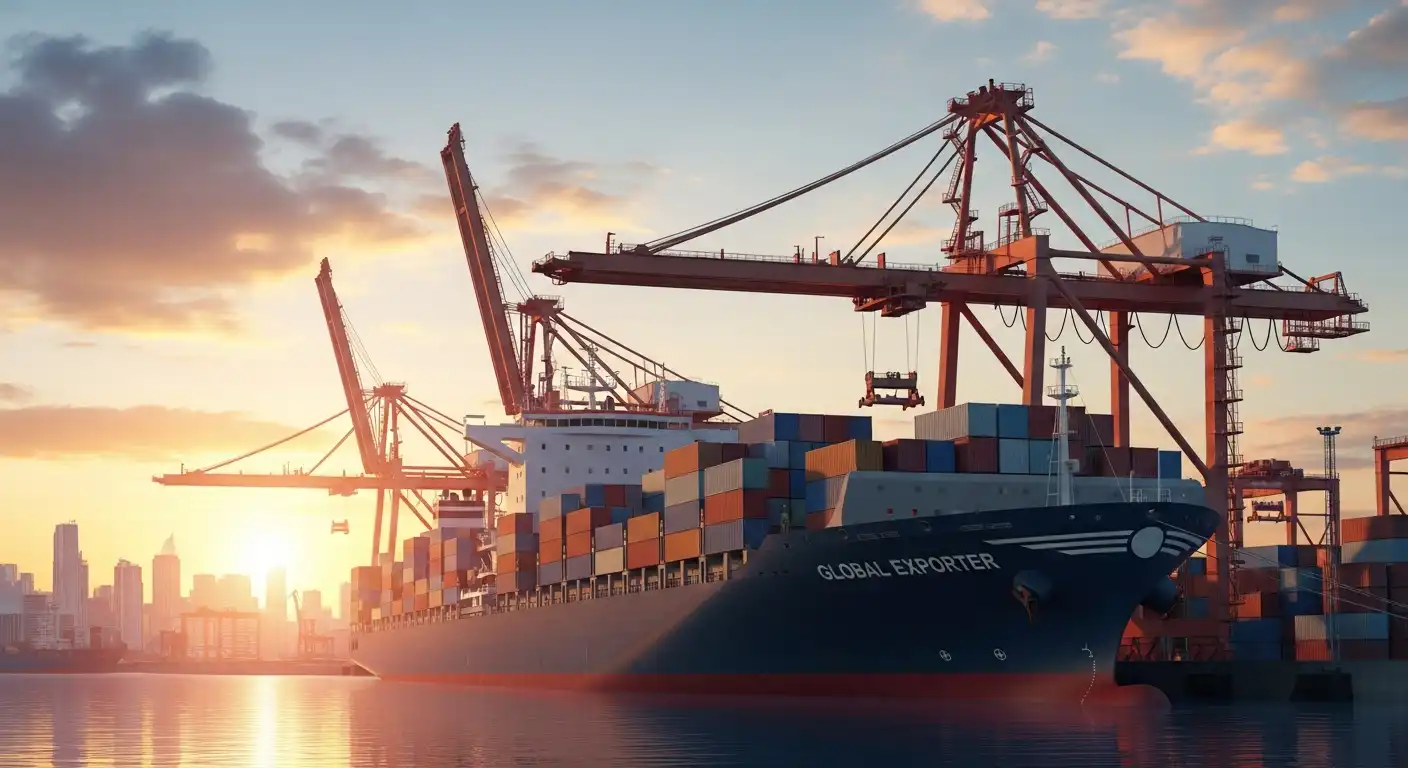
The secret behind these rapid turnaround times lies in the progressive automation of China’s port operations. The Tianjin Port showcased several of its cutting-edge smart systems at the expo, giving visitors an inside look at its world-first, smart zero-carbon terminal. At this futuristic facility, crane operators handle heavy shipping containers remotely from control rooms located several hundred meters away, while fleets of autonomous yard vehicles transport cargo across the docks. In 2025, the book value of the automated systems stood out as the port processed over 24 million TEUs of containers across its 150 active shipping routes. The facility has achieved a major equipment automation rate exceeding 80 percent, allowing it to maintain its position among the world’s top 10 ports for cargo throughput.
The port’s technology division has also integrated artificial intelligence directly into its logistics management. The port developed an intelligent scheduling system that uses advanced AI algorithms to analyze historical vessel trajectories, achieving a spectacular 95% accuracy rate in arrival time predictions. Zhang Jiang, deputy manager of the business department at Tianjin Port Holdings Co., Ltd., revealed that this smart system has successfully reduced average transit times for mid-sized vessels—specifically those with capacities between 6,000 and 8,000 TEUs—by 10.3%. This rapid, automated coordination has significantly reduced fuel wastage, lowered port congestion, and decreased overall transit costs.
According to technology experts attending the expo, China’s smart port innovations are establishing a highly replicable blueprint for maritime infrastructure developers worldwide. Waqas Samad, Chief Executive Officer of Lloyd’s List Intelligence, praised China’s forward-looking approach, noting that the country represents the future of shipping through its unique combination of connectivity, technology, and intelligence. According to the Chinese Ministry of Transport, the country has built 30 automated container terminals, accounting for 27% of the world’s total, and 30 automated dry bulk terminals. These advanced technologies are already spilling over into other international ports, as Shanghai Port has successfully deployed its proprietary automated terminal software at more than a dozen maritime facilities both at home and abroad.
Ultimately, the Fourth Tianjin International Shipping Industry Expo has demonstrated that advanced automation and artificial intelligence are the ultimate tools for stabilizing a turbulent global economy. By transforming traditional, labor-intensive docks into highly efficient, digitized, and zero-carbon hubs, China is providing a resilient anchor for international supply chains. As global trade continues to face geopolitical conflicts and protectionist policies, the widespread adoption of these smart port solutions will play an increasingly prominent role. For the international shipping community, the future of trade depends not just on building larger container ships but also on embracing smart digital networks that keep global commerce moving smoothly.