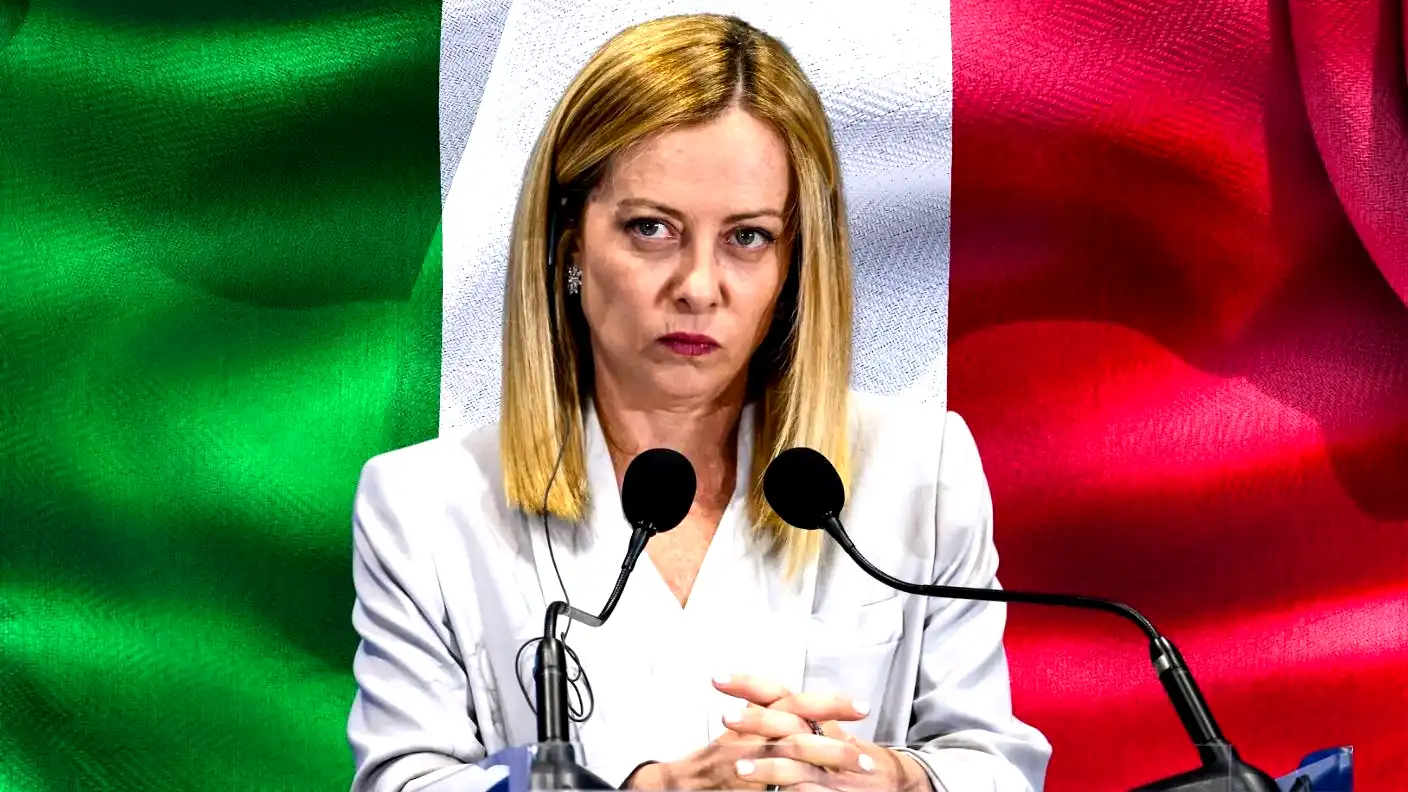
A major diplomatic crisis has erupted between Washington and Rome, transforming what was meant to be a unifying Group of Seven summit in Évian, France, into an unusually personal public feud. The growing friction between US President Donald Trump and Italian Prime Minister Giorgia Meloni has laid bare deep divisions over national sovereignty, military cooperation, and international alliances. What began as a dispute over a simple photograph has rapidly escalated into a full-scale diplomatic row, threatening the future of security cooperation between the United States and its European allies.
The immediate trigger for this unprecedented public spat was a television interview given by the US president, in which he claimed the Italian leader had repeatedly begged him for a joint photograph at the G7 summit. Meloni quickly issued a fierce public rejection, calling the claim completely fabricated and asserting that neither she nor Italy would ever beg. Within hours, the personal insult led Italy’s Foreign Minister, Antonio Tajani, to cancel a planned official visit to the United States, calling the president’s remarks grave and offensive to the entire Italian nation. The rapid deterioration of the relationship has exposed a deep rift between two right-wing leaders who were once seen as potential ideological partners.
As both sides double down on their respective positions, the dispute has moved far beyond a simple disagreement over a photograph. The public insults have pulled back the curtain on months of simmering geopolitical tensions, particularly regarding Italy’s refusal to assist the United States during its recent military conflict with Iran. The fallout from this photo dispute has highlighted the fragile nature of transatlantic relations and raised serious questions about the future of security cooperation within the North Atlantic Treaty Organization.
The Spark: The Battle over a G7 Handout Photograph
The timeline of the public dispute began when Donald Trump sat down for an interview with the Italian broadcaster La7 during the G7 summit in France. In the interview, which aired on Friday, June 19, 2026, the US president claimed that Meloni had approached him during a working lunch and begged for a photograph. Trump asserted that he only agreed to the picture because he felt sorry for her, implying that the Italian leader was desperate to associate herself with his global brand.
Meloni’s response was immediate and uncompromising. Speaking from a European Union leaders’ meeting in Brussels, she rejected the story as a total fabrication. In a highly public post on her personal Instagram account, the Italian prime minister addressed the US president directly, stating that her domestic popularity does not depend on her relationship with him and suggesting that he focus on his own political challenges. Her sharp counter-attack signaled a dramatic break from her previous efforts to maintain a cordial and cooperative relationship with the US administration.
The public exchange has stunned diplomatic observers in both Washington and Rome. For years, Meloni had carefully positioned herself as a pragmatic conservative who could act as a vital bridge between the European Union and the newly returned Trump administration. By refusing to back down and delivering a direct, personal rebuke to the US president, Meloni has demonstrated that her commitment to defending Italy’s national pride overrides any desire to maintain a smooth political alliance with Washington.
The Collapse of a Right-Wing Bridge
Meloni’s rise to power as Italy’s first female prime minister was watched closely by conservative movements worldwide. Unlike many of her European peers, she sought to balance her nationalist, right-wing domestic platform with a highly constructive approach to international institutions, including the European Union and NATO. This pragmatic strategy allowed her to build significant diplomatic credibility in Washington, making her a key player in shaping Western policy toward Eastern Europe and the Mediterranean.
However, the current public dispute threatens to permanently dismantle this diplomatic bridge. By publicly accusing Meloni of begging and suggesting that she is politically weak, Trump has made it virtually impossible for the Italian government to cooperate closely with his administration without appearing subservient to Washington. This personal fallout leaves European right-wing movements highly divided, ending any hopes of a unified conservative alliance across the Atlantic and pushing Italy closer to its traditional partners within the European Union.
A Public Display of Strategic Impatience
The personal nature of Trump’s public attack is a classic demonstration of what analysts call strategic impatience. Throughout his political career, the US president has prioritized immediate, public displays of loyalty and strength over long-term, quiet diplomatic alliances. When a foreign leader challenges his policies or refuses to provide absolute support, his natural reaction is to launch a direct, public attack designed to undermine their domestic standing.
By claiming that Meloni begged for a photograph, Trump sought to project an image of absolute dominance to his domestic base, showing that even the most prominent European leaders must seek his favor. However, this strategy has backfired by forcing the Italian government to take a hard, defensive stance to protect its national sovereignty. Instead of isolating Meloni, the public attack has united the Italian political establishment in her defense, demonstrating that the president’s confrontational style can often create unnecessary diplomatic crises with America’s closest allies.
The Strategic Undercurrent: Italy’s Refusal to Join the Iran War
While the dispute over the G7 photograph provided the immediate spark for the public feud, the true source of the tension lies in a much deeper geopolitical conflict. Over the past several months, Rome and Washington have been locked in a quiet but intense disagreement regarding Italy’s refusal to participate in or support US military operations against Iran.
The military conflict, which erupted earlier this year, saw the United States launch a series of intensive air and naval operations to degrade Iran’s military and nuclear capabilities. While several traditional allies provided logistical and operational support, Italy took a hard, non-cooperative stance. The Meloni government made it clear that it opposed the military intervention from the beginning, warning that a war in the Middle East would destabilize global energy markets and spark a massive wave of migration toward Southern Europe.
The Battle for Sigonella Airbase
The most significant point of military friction occurred in March of this year, when the United States requested permission to use the Sigonella airbase in Sicily for direct combat operations against Iranian targets. Sigonella is a strategically vital installation, serving as a key hub for US and NATO naval aviation and drone operations in the Mediterranean.
Meloni’s cabinet flatly denied the US request, refusing to allow American fighter jets or combat drones to launch strikes from Italian soil. In defending this decision, the Italian government cited bilateral security agreements dating back to the 1950s, which explicitly restrict the use of shared military installations for combat operations that are not directly tied to the collective defense of the Italian nation or the NATO alliance.
This refusal has deep historical resonance. In 1985, the Sigonella airbase was the site of a famous military standoff between Italian military police and US Delta Force operators during the Achille Lauro hijacking crisis, when Italian Prime Minister Bettino Craxi famously asserted Italy’s national sovereignty against direct US military demands. By invoking the 1950s treaty rules, Meloni demonstrated that she was willing to follow in this tradition, prioritizing Italy’s constitutional limits and national security over Washington’s military objectives.
The Pope Leo XIV Defense
The tensions between Meloni and Trump were further exacerbated earlier this year by a highly public dispute involving the Vatican. As the military conflict with Iran escalated, Pope Leo XIV issued a series of passionate encyclicals and public addresses calling for an immediate ceasefire, warning that a wider war would bring untold suffering to civilian populations across the Middle East.
Trump responded to the Pope’s messages with characteristic bluntness, delivering a series of public speeches in which he criticized the pontiff for opposing the war and suggesting that his calls for peace were unrealistic and counterproductive. Meloni immediately stepped forward to defend the Pope, issuing a formal statement calling the US president’s criticisms of the spiritual leader unacceptable.
Trump was reportedly shocked by Meloni’s public defense of the Vatican, viewing it as a personal betrayal from a leader he had previously supported. In private conversations and subsequent interviews, the US president accused Meloni of lacking courage and failing to understand the strategic realities of the global fight against terrorism. This religious and political clash set the stage for the intense personal animosity that would later boil over during the G7 summit in France.
Trump’s Truth Social Escalation and the Domestic Backlash
Rather than working to defuse the growing diplomatic row, Trump chose to escalate the conflict over the weekend. Writing from the Camp David presidential retreat, the US president launched a blistering attack on Meloni on his personal social media platform, Truth Social, on Saturday, June 20, 2026.
In his post, in which he initially misspelled the Italian prime minister’s first name as “Gigiorgia” before correcting it, Trump doubled down on his claim that she had asked over and over for a photograph during the G7 meeting. He linked the personal dispute directly to Italy’s lack of cooperation during the war with Iran, accusing her of turning down the United States when it came to preventing a hostile nation from developing nuclear weapons.
“Now, after the United States defeated Iran militarily, she wants to be friends again to get her ‘numbers up.’ No thanks!!!” Trump wrote, suggesting that Meloni’s government was doing poorly in local popularity polls and was attempting to exploit an association with him to boost her domestic standing.
Italy Cancels US Trip in Diplomatic Protest
The reaction in Rome to Trump’s social media tirade was a mixture of anger and disbelief. The Italian government viewed the public attack as an unacceptable insult to the country’s national sovereignty and its democratic institutions.
In an immediate display of diplomatic protest, Italian Foreign Minister Antonio Tajani announced the cancellation of his highly anticipated official trip to the United States, which had been scheduled to begin on Friday, June 19, 2026. Tajani, who also serves as Italy’s deputy prime minister, issued a stinging statement in which he called Trump’s words grave and offensive, stating that they offended the whole of Italy.
The cancellation of the ministerial visit is a significant diplomatic escalation, representing the most serious fracture in US-Italian relations in decades. Tajani’s decision to boycott the Washington meetings was supported by political leaders across the spectrum in Italy, proving that Trump’s aggressive rhetoric has succeeded in uniting a traditionally divided Italian parliament against what is perceived as foreign bullying.
The Populist Paradox: Defense of the National Interest
The public clash between Trump and Meloni highlights a fundamental paradox within modern right-wing populist movements. Both leaders have built their political brands on the principles of national sovereignty, borders, and putting their respective countries first. For Trump, this means an America First foreign policy that demands absolute cooperation from allies while rejecting international multilateral commitments. For Meloni, it means putting Italy First, protecting the country’s constitutional limits, and refusing to drag the nation into foreign military adventures that do not serve its direct national interests.
When these two nationalist ideologies collide, conflict is almost inevitable. Because neither leader can afford to appear weak or subservient to a foreign power before their domestic audiences, any minor disagreement can quickly spiral into a major national crisis. Meloni’s refusal to allow the use of Italian airbases and her defense of the Vatican are logical expressions of her commitment to Italian sovereignty, just as Trump’s public attacks are logical expressions of his confrontational, transaction-based foreign policy. The current spat proves that a shared conservative ideology is not enough to overcome the structural conflicts built into nationalist political platforms.
NATO Funding and the Future of US-European Relations
Beyond the immediate diplomatic fallout between Washington and Rome, the public dispute has significant implications for the broader NATO alliance. In his social media posts and public addresses over the weekend, Trump revived his long-standing complaints that the United States spends heavily to protect so-called allies who refuse to contribute their fair share to collective defense.
The US president pointed out that Washington contributes hundreds of billions of dollars to defend Italy and other European nations, while those countries routinely fail to meet the alliance’s defense spending target of 2% of gross domestic product. He suggested that if Italy wants the protection of the United States, it must show greater cooperation during international crises and allow the US military to utilize shared bases without restriction.
This line of attack has renewed deep concerns across European capitals regarding the reliability of the US security guarantee. For decades, Western Europe has operated under the assumption that the US nuclear umbrella and conventional military presence were permanent, unconditional commitments to the defense of the democratic world. By linking military protection to absolute political subservience and base access during non-NATO conflicts, Trump has confirmed the worst fears of European strategists.
The dispute is likely to accelerate efforts within the European Union to achieve strategic autonomy. European leaders are increasingly realizing that they can no longer rely on a predictable relationship with Washington to guarantee their security. If a major European ally like Italy can face public insults, base access disputes, and threats of defense withdrawal over a simple photograph and a disagreement over an extra-regional war, then no European nation is safe from foreign policy coercion. This realization is driving calls for increased European defense spending, the creation of unified European military procurement programs, and a more independent foreign policy stance that reduces the continent’s reliance on the United States.
In Short
The diplomatic row triggered by the G7 photo dispute between Donald Trump and Giorgia Meloni is a significant turning point in transatlantic relations. What appeared to be a minor, personal disagreement has exposed a deep, structural fracture between the United States and one of its most important European allies. By publicly accusing the Italian leader of begging and linking the dispute to Italy’s refusal to assist in the war with Iran, the US president has prioritized short-term domestic showmanship over long-term strategic alliances.
Meloni’s fierce defense of Italian sovereignty and the subsequent cancellation of Foreign Minister Tajani’s US visit demonstrate that European allies are no longer willing to tolerate public coercion from Washington. As the central bank, national governments, and defense departments across Europe navigate this turbulent new era, the need for a more independent, self-reliant European security strategy has never been more obvious. The path ahead will require careful diplomacy and mutual respect, but the boundary between traditional American leadership and European sovereignty has permanently shifted.