

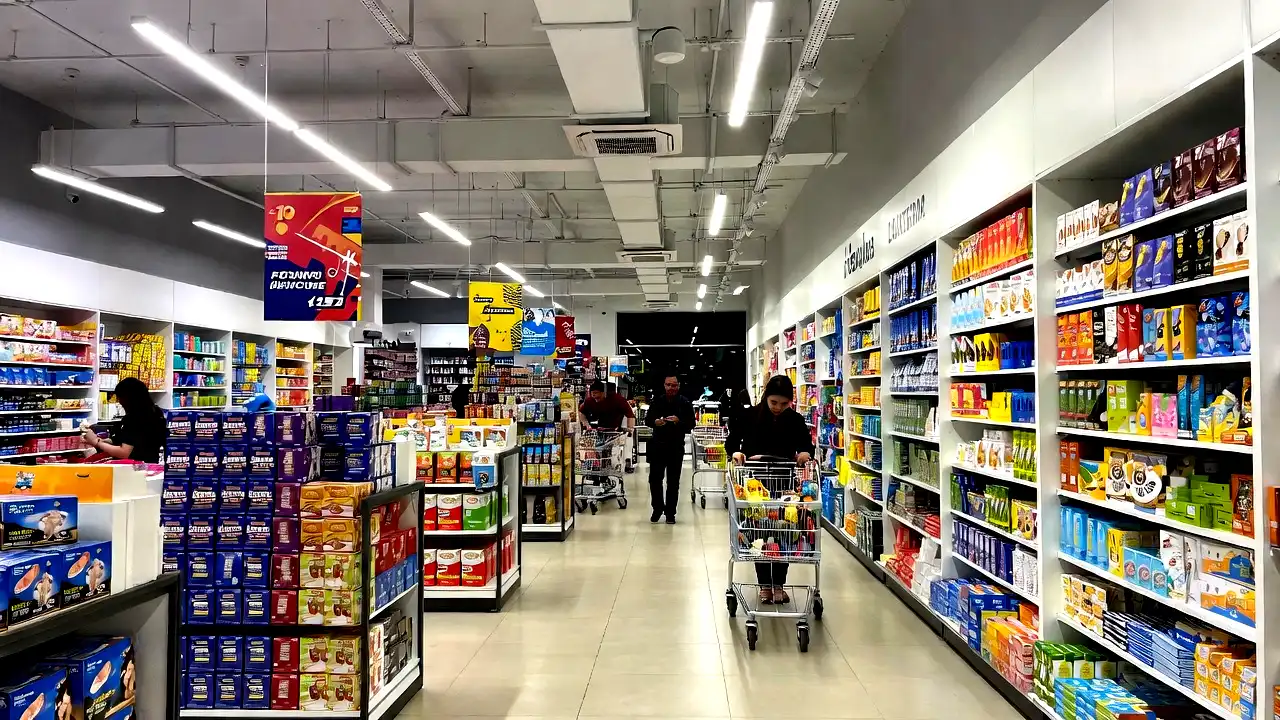
The American retail sector is experiencing a highly significant, transitional phase as consumer spending habits adjust to changing energy costs, persistent geopolitical tensions, and an increasingly divided labor market. According to the advance monthly sales report released by the U.S. Census Bureau, retail and food services sales in the United States rose by a modest 0.2% month-over-month in June to reach a seasonally adjusted $768.6 billion.
While this represents the weakest monthly expansion in five months, the underlying data reveals that the consumer engine remains fundamentally healthy, with citizens quickly redirecting their savings from lower gasoline prices into online shopping, vehicle purchases, and recreational goods.
This modest headline print follows a highly robust, upwardly revised 1.0% surge in May, which was originally reported as a 0.9% increase. This transition from a rapid spring acceleration to a more measured summer pace did not catch Wall Street by surprise, matching the baseline predictions of most market economists.
On an annual basis, total retail sales for June were up an impressive 6.7% compared to the same period last year, demonstrating that the consumer continues to serve as the primary defensive shield protecting the broader economy from a recession.
However, the flat headline numbers mask a highly dynamic shifting of capital within the retail ecosystem. The primary drag on the June report was a massive 5.3% plunge in gasoline station receipts, driven by a temporary, shaky ceasefire in the Middle East that dragged retail fuel prices down across the country.
Excluding this volatile energy component, remaining retail sales rose by a highly robust 0.7% month-over-month, proving that when Americans save money at the pump, they do not hoard the cash; they immediately recycle it back into the retail economy, buying electronics, upgrading their vehicles, and preparing for the upcoming back-to-school shopping season.
The Geopolitical Reliever: Easing Energy Costs Free Up Retail Wallets
The primary catalyst behind the changing spending patterns in June was a brief, highly critical diplomatic breakthrough in the Middle East. Since the outbreak of active military hostilities earlier in the year, global energy markets have been highly volatile, with the blockade of the strategic Strait of Hormuz cutting off a significant portion of the world’s daily oil supply and driving average retail gasoline prices to painful highs of $4.61 per gallon in May.
This energy-driven tax on consumer income was temporarily eased in June when the United States and Iran signed a tentative Memorandum of Understanding. Although the fragile ceasefire collapsed in early July, sending oil and gas prices back onto an upward trajectory, the brief diplomatic window allowed global crude prices to retreat significantly during the month of June.
This temporary relief at the pump acted as an immediate financial stimulus for American households, freeing up discretionary income that went straight into retail cash registers.
The Five-Point-Three Percent Drop in Service Station Receipts
The impact of the temporary Middle East truce was felt immediately at the gas pump. Data from the U.S. Energy Information Administration showed that average gasoline prices fell to $4.18 a gallon in June, representing a substantial decline from the $4.61 average recorded in May.
This price decline resulted in a steep 5.3% month-over-month drop in total receipts at gasoline stations. While this drop dragged down the overall retail sales figure, it represents a positive development for the broader economy.
Because gasoline is a non-discretionary purchase that consumers must buy to commute to work and run their households, high gas prices act as a direct, highly regressive tax on consumer income.
When the price of fuel declines, it immediately increases the disposable income of families, allowing them to allocate those savings to other discretionary retail categories.
The Rebound in Non-Gasoline Consumer Spending
The reallocation of these energy savings is clearly visible when analyzing the non-gasoline retail categories. Excluding service stations, overall U.S. retail sales rose by a highly robust 0.7% month-over-month in June, continuing a solid upward trend that has seen non-gasoline sales expand by 5.7% on an annual basis.
This solid non-gasoline performance proves that consumer demand remains highly resilient. Instead of saving their windfall from cheaper fuel, consumers used the extra cash to upgrade their personal electronics, purchase sporting goods, and dine out at restaurants.
This constant, high-speed recycling of capital within the domestic market has allowed the retail sector to maintain its momentum, proving that the American consumer remains the most reliable driver of global economic activity.
The Bifurcated Economy: Wealth Gaps and the “Trading Down” Phenomenon
While the aggregate numbers paint a picture of resilience, a deeper analysis of the retail data reveals a highly polarized, bifurcated consumer landscape. The combination of persistent, accumulated inflation and high borrowing costs is creating a stark division between higher-income households, who continue to spend freely, and lower-income families, who are being forced to implement aggressive defensive budgeting strategies.
This consumer split has been highlighted by major financial institutions. Internal debit and credit card transaction data analyzed by the Bank of America Institute showed that lower-income households are experiencing severe financial strain under the weight of high price levels, forcing them to systematically alter their buying habits to protect their household finances.
Low-Income Households and the Rush to Discount Apparel
The primary defensive strategy utilized by budget-conscious consumers is “trading down”—replacing name-brand products and premium retail experiences with cheaper, private-label alternatives and discount options.
The Bank of America report showed that lower-income households are experiencing spending growth at discount clothing stores and value grocers at a rate that is five times faster than higher-income households.
This massive surge in discount retail traffic has been a major boon for mass-market retailers like Walmart, Target, and Dollar General, which have aggressively focused their marketing campaigns on value and daily discounts.
As the cost of basic groceries and household necessities remains highly elevated compared to pre-pandemic levels, families are systematically cutting back on non-essential, “frivolous” purchases like brand-name apparel and expensive home furnishings, choosing instead to focus their limited budgets strictly on essential survival goods.
High-Income Resiliency and the AI Stock Market Boost
In sharp contrast to the struggles of lower-income families, higher-income households are continuing to spend at an incredibly healthy pace, completely unaffected by the rising cost of fuel or groceries.
This resilience is being supported by a massive, highly lucrative rally in the global stock markets, where the artificial intelligence infrastructure boom has driven tech valuations to record heights, dramatically increasing the personal net worth of affluent families.
These wealthier consumers are driving the demand for premium retail categories, luxury travel, and high-end services. This extreme polarization is creating a challenging environment for mid-tier retailers, who find themselves caught in an uncomfortable middle ground—losing their budget-conscious customers to discount stores while failing to attract the high-spending affluent demographic.
The Federal Reserve’s latest Beige Book report confirmed this structural divide, noting that several regional districts reported a distinct “trading down” to more affordable product varieties among lower-income shoppers, while luxury spending remained stable.
Dissecting the Winners and Losers of the June Sales Report
The June retail sales report was characterized by high dispersion, with different sectors experiencing vastly different levels of demand. The transition to a more measured spending pace, coupled with mid-summer promotional events, created clear winners and losers across the retail landscape.
E-Commerce Dominance: Non-Store Retailers Surge
The undisputed winner of the June sales report was the non-store retail sector, which includes online e-commerce platforms. Sales at online retailers surged by an impressive 1.9% month-over-month, capturing a massive share of the consumer’s discretionary wallet.
This online surge was heavily boosted by highly successful, mid-summer promotional events. Major e-commerce platforms, led by Amazon’s high-profile Prime Day toward the end of the month, launched aggressive discount campaigns that prompted millions of consumers to accelerate their summer and early back-to-school shopping.
Other national retailers were forced to launch competing online promotions to defend their market share, creating a highly competitive, digital shopping frenzy that successfully drew in billions of dollars in consumer spending.
Automobiles and Sports Gear Capture Freed-Up Cash
The second-largest growth category was the automotive sector, with sales at motor vehicle and parts dealers rising by an impressive 1.9% month-over-month. This strong performance indicates that consumer credit remains accessible and that buyers are still willing to take on significant financing commitments to upgrade their personal vehicles, despite high average interest rates on auto loans.
Additionally, sporting goods, hobby, musical instrument, and book stores recorded a robust 1.3% monthly gain, while electronics and appliance retailers posted a solid 0.8% increase, proving that consumers are still willing to spend on leisure, hobbies, and personal tech when they find good deals.
The food services and drinking places sector also recorded modest gains, likely supported by high turnout at restaurants and bars during the FIFA World Cup tournament broadcasts, which served as a major social and cultural draw across the country.
The Retail Categories Facing the Chopping Block
While online shopping and auto sales surged, other retail categories faced significant declines as consumers systematically cut back on non-essential home improvements and personal care products.
Sales at health and personal care stores fell by 0.8% month-over-month, marking one of the steepest declines in the report.
Similarly, miscellaneous retailers recorded a 0.3% monthly decline, while sales at food and beverage stores slipped by 0.2%, as consumers optimized their grocery budgets and shifted their purchases toward value brands.
Furniture and home furnishing stores reported completely flat, unchanged sales, proving that high mortgage rates and a sluggish housing market continue to depress demand for big-ticket home goods.
These selective declines show that the modern consumer is making highly calculated choices, prioritizing technology and essential mobility while delaying furniture upgrades and luxury personal care purchases.
Macroeconomic Projections: What This Means for GDP and the Fed
The underlying resilience of the June retail sales report has significant, highly positive implications for the broader U.S. GDP outlook. For economists and policy planners, the most critical number in the entire report is the “Retail Control Group.”
This specialized control group excludes volatile categories like food services, automobile dealers, building material stores, and gasoline stations, providing a highly accurate measure of the underlying consumer demand that the Bureau of Economic Analysis uses to calculate the consumer spending component of Gross Domestic Product.
The retail control group rose by a highly encouraging 0.5% month-over-month in June, following an upwardly revised 0.8% monthly increase in May.
For the second quarter as a whole, this core spending metric expanded at an annualized rate of 9.2%, indicating that consumer spending, which accounts for more than two-thirds of the total U.S. economy, has successfully reaccelerated after nearly stalling during the first quarter of the year.
The Atlanta Fed’s GDPNow Forecast
The robust performance of the retail control group has forced economists to raise their second-quarter growth forecasts. The Atlanta Fed’s highly respected GDPNow model, which integrates real-time economic data as it is released throughout the quarter, is currently forecasting annualized U.S. GDP growth of 1.3% for the second quarter, recovering from a slower pace earlier in the year.
While a 1.3% growth rate is more measured than the blockbuster growth rates recorded in previous years, it represents a healthy, sustainable non-inflationary expansion.
The economy is successfully cooling down from its previous, overheated state without falling into a recession, proving that the Federal Reserve’s long-running high-interest-rate campaign is successfully achieving a soft landing for the national economy.
Keeping the Federal Reserve on Hold
The mix of cooling headline inflation and resilient underlying consumer spending is highly likely to keep the Federal Reserve’s policy path on a stable, predictable trajectory. Under the leadership of newly appointed Chairman Kevin Warsh, the central bank has adopted an unyielding, data-dependent stance, explicitly refusing to offer markets any forward guidance or promises of rapid interest rate cuts.
While the cooling inflation data released earlier in the week initially sparked market hopes for a rate cut at the upcoming September meeting, the resilient June retail sales report gives the Fed plenty of reason to remain patient.
The data proves that the high borrowing costs are successfully slowing down discretionary demand without triggering an economic or labor market collapse.
By maintaining interest rates at their current, stable levels of 3.5% to 3.75%, the central bank can continue to squeeze inflation out of the system while allowing the resilient consumer to support the economy’s gradual recovery, ensuring a stable, non-inflationary future for the global financial system.
The U.S. retail sector has demonstrated remarkable, highly encouraging adaptability in the face of significant global and domestic headwinds. By successfully absorbing the cost pressures of the Middle East energy shocks, adapting to higher-for-longer interest rates, and utilizing mid-summer promotions to find value, the American consumer has proved once again that it is the ultimate engine of global economic growth.
While the severe divisions between high- and low-income households will continue to present serious social and retail challenges, the overall economic picture remains one of gradual, healthy stabilization.
As the country navigates the remainder of the year, this underlying consumer strength will remain the most critical, highly reliable defensive shield protecting the nation’s economic prosperity, ensuring a stable, prosperous, and highly resilient digital world for generations to come.






