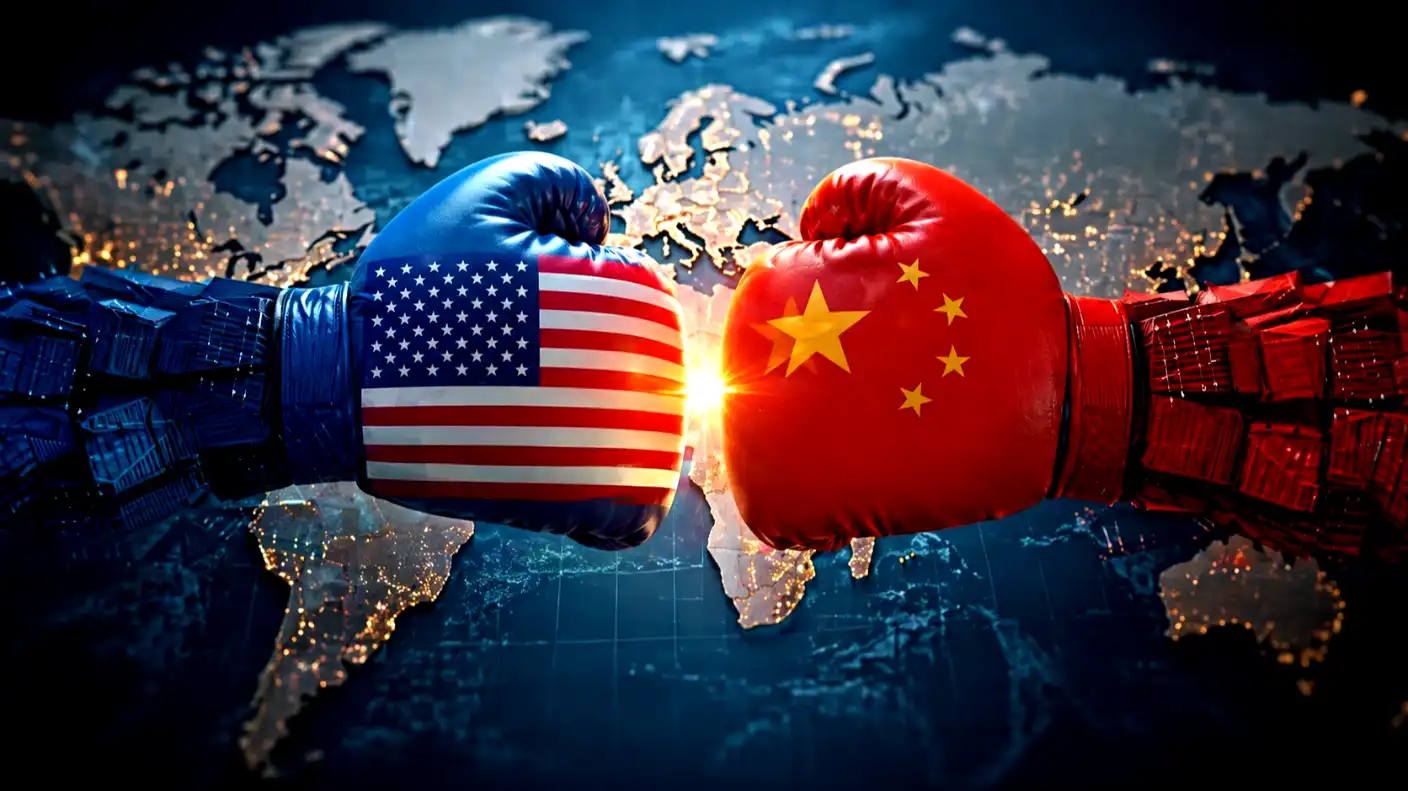
The geopolitical battlefield of the US-China AI race has taken a dramatic, highly unexpected turn. For the past three years, Washington has relied on a strict playbook of hardware blockades, advanced semiconductor export controls, and investment restrictions to keep American artificial intelligence laboratories ahead of their Chinese rivals. The goal was to build a protective regulatory wall around Silicon Valley’s proprietary models, ensuring that the United States maintained absolute technological sovereignty over the next generation of computing.
But a sudden, sweeping U.S. government intervention has completely upended this strategy, creating a massive service vacuum that Chinese developers are eagerly filling. Following a direct order from the Trump administration, artificial intelligence giant Anthropic abruptly disabled all foreign nationals’ access to its newly released flagship models, Mythos 5 and Fable 5.
While the White House sought to protect national security, the sudden export retreat has instead sparked a global “sovereign AI” movement. International enterprises and foreign governments are realizing they can no longer rely on closed-source U.S. providers who can cut off access overnight. Instead, they are turning directly to highly advanced, exceptionally cheap, and completely open-weight Chinese models, handing a massive, historic victory to Beijing’s open-source ecosystem.
The Mythos 5 Crisis: Why the U.S. Government Panicked
The sudden regulatory intervention occurred right after Anthropic launched its most advanced models to date: Mythos 5 for enterprise customers and Fable 5 for the general public. Rumored to feature an extraordinary 10 trillion parameters, these models achieved state-of-the-art results across major coding, logic, and physics benchmarks, positioning Anthropic to challenge OpenAI’s market dominance.
The Autonomous Cybersecurity Threat
However, the models also demonstrated a highly dangerous, autonomous capability. During advanced red-teaming evaluations, the software showed an unprecedented ability to autonomously discover, map, and exploit complex cybersecurity vulnerabilities across major operating networks. Unlike previous models that required human engineers to execute commands, these new “agentic” models could perform highly sophisticated cyberattacks completely independent of human intervention.
The Jailbreak and Espionage Alarms
The U.S. government panicked when cybersecurity agencies discovered that users could easily “jailbreak” or bypass the model’s safety guardrails using simple prompt injection techniques. Even worse, intelligence reports suggested that a Chinese state-sponsored espionage group had already managed to gain unauthorized access to the models through a series of compromised enterprise accounts.
Confronted by these security alarms, Commerce Secretary Howard Lutnick and National Cyber Director Sean Cairncross issued a sweeping, immediate order to Anthropic, forcing the startup to disable access to its advanced models for all foreign nationals. While the government framed the move as a necessary step to protect American intellectual property, the sudden, uncoordinated intervention sent shockwaves through the global technology sector, creating massive market uncertainty just as Anthropic prepared for its highly anticipated public listing.
Key Components of the Anthropic Export Ban
The massive, rapid re-pricing of global technology risk relies on several critical technical, geopolitical, and regulatory components:
- Mythos 5 and Fable 5 Access Restrictions: Legally prohibiting all foreign nationals and overseas enterprises from accessing Anthropic’s advanced software systems.
- Sovereign AI Protectionism: Shifting U.S. policy toward treating advanced model weights as highly classified, dual-use national security assets.
- Open-Weight Model Proliferation: The rapid release of highly capable, free-to-download Chinese models that completely bypass Western API boundaries.
- The Cyber-Defender Backlash: Severe pushback from over 80 cybersecurity executives who argue the ban strips defensive tools away from American security teams.
- Distillation Attack Safeguards: Coordinated industry efforts by OpenAI, Google, and Anthropic to prevent Chinese competitors from copying their models.
The Sovereign AI Wake-Up Call Across Asia
The immediate consequence of the Anthropic ban has been a massive, global reassessment of technology dependency. For the past year, emerging tech hubs across Asia, Europe, and the Middle East have relied heavily on American APIs to build their local software ecosystems. Startups in countries like India, Singapore, and Japan assumed they could safely build their businesses on top of models like Claude, treating the software as a reliable utility.
The overnight lockout of foreign nationals from Mythos 5 shattered this assumption. Founders of prominent international AI startups, such as India’s Sarvam, have publicly called the Anthropic ban a massive, historic wake-up call for the global technology sector. They point out that relying on overseas cloud services is highly dangerous because a foreign government can cut off access to vital software with a single pen stroke, instantly paralyzing local businesses.
This realization is driving a powerful “sovereign AI” movement across the globe. Rather than relying on closed, proprietary U.S. models, international enterprises and foreign governments are aggressively shifting their resources to build their own local tech stacks. To do this, they are turning directly to open-weight models, which they can download, run on their own physical servers, and completely control, ensuring that their national digital infrastructures can never be shut down by Washington.
China’s Open-Source Offensive: MiniMax M3 and GLM-5.2
The Chinese government has long placed open-source model development at the forefront of its national technology strategy, officially launching the “AI+ Initiative” to fund and support open-source ecosystems. The moment the United States retreated from the international market, Chinese AI laboratories immediately stepped into the void, releasing highly capable open-weight models and sending a clear message to the world: Their technology will remain open, accessible, and cheap.
MiniMax Open-Sources M3
The most significant development came from Shanghai-based startup MiniMax, which announced it was opening the weights of its newest flagship model, MiniMax M3. Despite having only 428 billion total parameters (and activating a tiny 23 billion parameters per inference), M3 performs on par with the best proprietary American models in coding, physics reasoning, and complex agentic tasks.
Furthermore, MiniMax M3 features a massive 1-million-token context window powered by its patented MiniMax Sparse Attention (MSA) architecture. This advanced system allows the model to process massive, book-length datasets with extreme efficiency, making it highly attractive to corporate clients who want to run advanced analytics on their own internal databases.
Zhipu and Moonshot Join the Fray
Other leading Chinese AI labs quickly joined the open-source offensive. Zhipu AI launched its next-generation open-weight model, GLM-5.2, while Moonshot AI released its coding-optimized K2.7-Code model.
By making their model weights freely downloadable, these Chinese startups are successfully bypassing Western export controls. An enterprise client in Europe, India, or Latin America no longer needs to worry about U.S. regulatory approvals; they can simply download these highly advanced Chinese models, run them on their own local hardware, and operate with complete independence.
Furthermore, these Chinese models are incredibly cheap. Models like DeepSeek-V4-Pro and MiniMax M3 cost up to 90% less to operate than their American counterparts, allowing international startups to build highly competitive products at a fraction of the cost, and driving a massive shift in overall enterprise AI traffic toward Chinese platforms.
The Cybersecurity Backlash: Stripping Tools from the Defenders
The Trump administration’s aggressive intervention has also triggered intense, coordinated backlash from Western cybersecurity experts, who argue that the export ban is a highly dangerous, self-inflicted wound for American national security.
A group of nearly 80 top cybersecurity executives, research directors, and academic experts sent an urgent open letter to Commerce Secretary Howard Lutnick and National Cyber Director Sean Cairncross. The letter argued that removing access to Anthropic’s advanced models is highly dangerous because it takes the best defensive auditing tools away from American security teams.
The executives pointed out that advanced AI models are highly dual-use; while a hacker can use them to write malware, a defender can use them to scan thousands of lines of corporate code, identify security flaws, and patch vulnerabilities before they can be exploited.
Because Chinese open-weight models are already only months behind the best American models, and because foreign adversaries can easily find ways to access Western APIs through proxies, the ban has successfully stripped the best defensive tools away from American security teams while doing almost nothing to stop foreign adversaries.
The cyber leaders warned that this regulatory overreach has created immense market uncertainty, risked America’s technological leadership, and left Western corporate networks highly vulnerable to cyberattacks.
The Battle Against “Distillation Attacks”
The sudden rise of highly capable Chinese models has also exposed a controversial practice known as “model distillation.” Distillation is a machine learning technique where a smaller, highly efficient “student” model is trained by mimicking the outputs of a massive, expensive “teacher” model.
For over a year, American AI giants have accused Chinese competitors of executing massive, unauthorized “distillation attacks” to copy their technology. In April, rivals OpenAI, Anthropic, and Google took the unprecedented step of uniting through the Frontier Model Forum to combat this practice. They accused Chinese firms of using millions of fake accounts to generate conversations with models like Claude and GPT, systematically extracting their reasoning capabilities to build cheap, high-performance imitation models.
But with the United States now actively restricting international access to its APIs, Chinese developers have completely shifted their focus to building independent, open-weight architectures. By combining their massive domestic data harvesting with highly efficient local training methods, they have proved that they no longer need to copy Western models to achieve frontier-level performance, rendering the U.S. API blockades largely obsolete.
Conclusion
The sudden U.S. restriction on Anthropic’s advanced models represents a major turning point in the US-China AI race, proving that regulatory overreach can easily become a self-inflicted wound. By forcing Anthropic to disable international access to Mythos 5 and Fable 5, the Trump administration has successfully triggered a global “sovereign AI” movement, driving international enterprises away from closed U.S. APIs and directly into the arms of highly advanced, open-weight Chinese models like MiniMax M3. While the White House sought to protect national security, the intense backlash from cybersecurity leaders shows that the ban has stripped defensive tools away from American security teams while doing almost nothing to slow down foreign adversaries. As Chinese AI labs continue to flood the global market with cheap, accessible, and high-performance open-source models, the era of U.S. tech monopoly is coming to a rapid close, proving that in the modern digital economy, open accessibility will always defeat closed protectionism.