

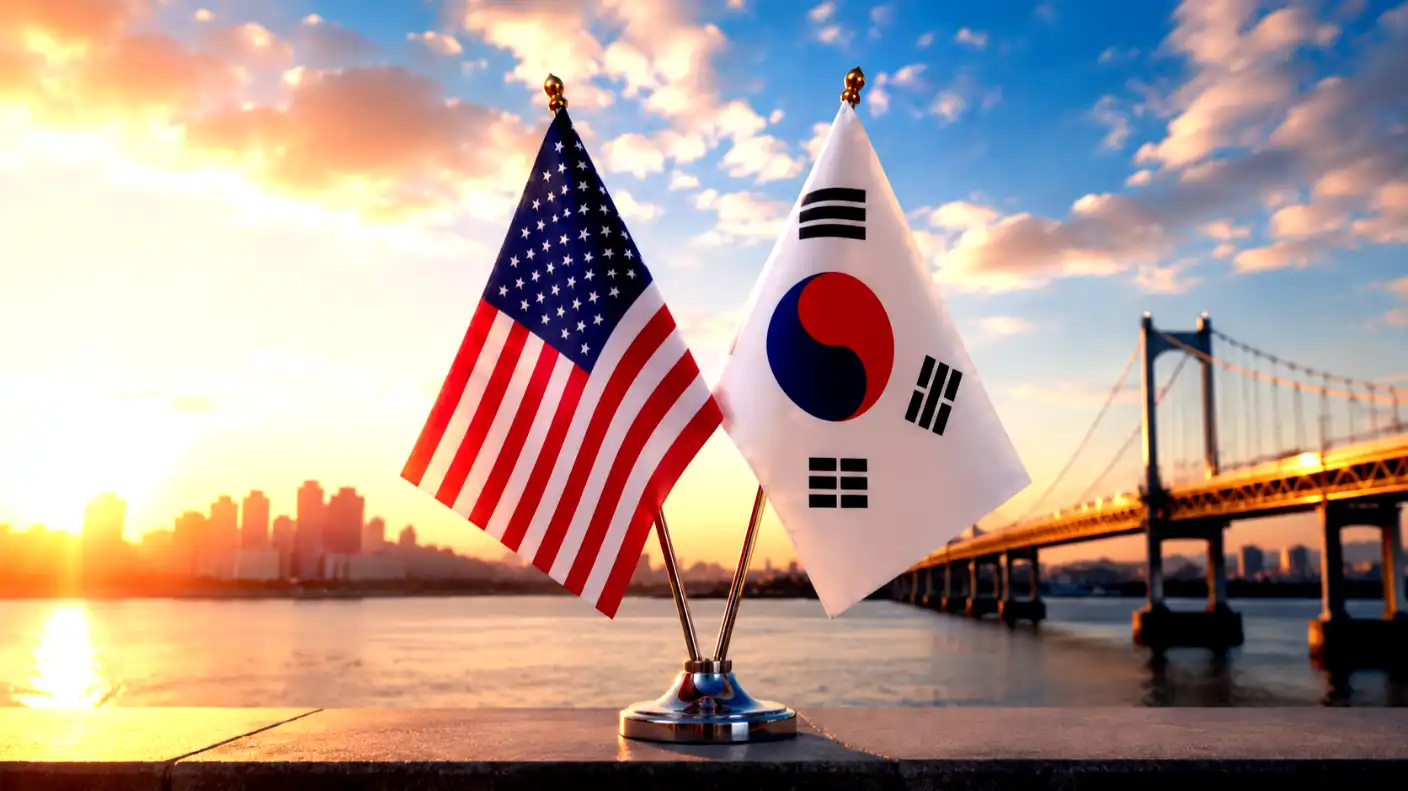
The security partnership between the United States and South Korea is undergoing a fundamental transformation. Rather than remaining a traditional mutual defense pact designed primarily to deter regional aggression, the alliance is shifting toward a comprehensive, high-tech, and nuclear energy partnership. During a speech at a reception hosted by the U.S. Embassy in Seoul to mark the 250th anniversary of American independence, South Korean Foreign Minister Cho Hyun outlined this vision for a modernized, future-oriented alliance. He emphasized that strategic cooperation in civil nuclear energy and cutting-edge technologies will deliver significant mutual benefits, creating a more capable and forward-looking partnership.
This diplomatic address highlights a new phase in bilateral relations following a landmark agreement reached between South Korean President Lee Jae Myung and U.S. President Donald Trump in late 2025. Cho compared the historic 1953 Mutual Defense Treaty, which marked the birth of the alliance, to the “joint fact sheet” signed during the late 2025 summit, calling the latter a crucial guide for the future of the partnership. By modernizing their cooperative framework, both nations aim to better secure their borders and address emerging global technological and security challenges.
The Historical Genesis of a Technological Alliance
For over seven decades, the relationship between Washington and Seoul rested almost entirely on a military foundation. Signed in the aftermath of the 1950-53 Korean War, the Mutual Defense Treaty committed the United States to defend South Korea from external threats, establishing a permanent presence of American troops on the peninsula. While this security umbrella allowed South Korea to rebuild its war-torn economy, the relationship was historically one-sided, with Washington acting as the protector and Seoul as the dependent beneficiary.
In the modern economic era, however, that dynamic has changed. South Korea has emerged as an industrial and technological powerhouse, home to some of the world’s most advanced semiconductor, battery, and automotive companies. The joint fact sheet signed in late 2025 recognizes this shift, transforming the alliance into a symmetrical partnership. South Korean conglomerates have committed over $100 billion to build advanced manufacturing facilities on American soil, demonstrating that a stronger South Korea that actively pulls its weight makes the overall alliance far more capable and mutually beneficial.
Breaking Down the Strategic Nuclear Breakthroughs
The most sensitive and strategically significant portion of the modernized partnership involves the expansion of South Korea’s nuclear capabilities. Historically, the United States maintained strict limits on South Korea’s nuclear programs to prevent regional proliferation, managing these restrictions through bilateral agreements like the Civil Nuclear Cooperation Agreement (the 123 Agreement).
However, the rapid accumulation of regional security threats and the growing complexity of global energy markets have forced both Washington and Seoul to re-evaluate these legacy limits. The late 2025 joint fact sheet outlines a new framework for discussions on expanding Seoul’s strategic capabilities across three highly critical nuclear domains: nuclear-powered submarines, civil uranium enrichment, and spent nuclear fuel reprocessing.
Unlocking the Path to Nuclear-Powered Submarines
For years, South Korean defense strategists have advocated for the acquisition of nuclear-powered submarines. Unlike conventional diesel-electric submarines, which must surface frequently or use noisy air-independent propulsion systems to recharge their batteries, nuclear-powered submarines can remain submerged almost indefinitely. This unlimited underwater endurance is critical for tracking and deterring silent North Korean ballistic missile submarines and monitoring maritime corridors in the highly contested waters of East Asia.
Under the new strategic framework, the United States and South Korea have initiated formal discussions to clear the legal and regulatory pathways for Seoul to acquire or build nuclear-powered vessels. While this does not mean South Korea will possess nuclear weapons, utilizing nuclear reactors to propel its naval fleet represents a major leap in its regional defense posture. This development aligns with the broader U.S. strategy of empowering capable allies to share the burden of regional maritime security, mirroring similar arrangements like the AUKUS security pact in the Indo-Pacific.
Civil Uranium Enrichment and Fuel Sovereignty
South Korea is one of the world’s most prominent users of nuclear energy, operating 26 commercial nuclear reactors that generate approximately 30% of the nation’s total electricity. The country is also a leading exporter of nuclear technology, famously constructing the Barakah nuclear power plant in the United Arab Emirates. Despite this advanced industrial capability, South Korea does not possess its own domestic uranium enrichment facilities, relying instead on foreign suppliers—including Russia and European consortia—to enrich the fuel required for its reactors.
The late 2025 agreement initiates a process to grant South Korea the right to conduct civil uranium enrichment up to a low-enriched level of 20%, which is the standard threshold for commercial power reactors. Acquiring this capability would grant Seoul complete fuel sovereignty, securing its domestic energy supply chain against geopolitical disruptions and significantly boosting its competitiveness in the global nuclear export market. It would also allow South Korea to manufacture the specialized fuel required for its planned nuclear-powered submarines and next-generation small modular reactors (SMRs).
Spent Nuclear Fuel Reprocessing and the Waste Dilemma
The third nuclear pillar of the modernized alliance addresses a growing environmental and logistics crisis in South Korea: the management of spent nuclear fuel. Because the country has been unable to reprocess or permanently store its high-level radioactive waste, the cooling pools at its active nuclear power plants are rapidly filling up, with several key facilities projected to reach maximum capacity within the next few years.
To resolve this issue, Seoul and Washington are exploring advanced, proliferation-resistant reprocessing technologies, such as pyroprocessing. Pyroprocessing allows South Korea to recover usable uranium and transuranic elements from spent fuel rods to recycle them into new fuel, while reducing the overall volume and radioactivity of the remaining high-level waste by up to 95%. Historically, Washington resisted granting reprocessing rights to Seoul due to fears that the technology could be diverted to extract weapons-grade plutonium. However, by focusing on pyroprocessing—which does not isolate pure plutonium—the modernized alliance can address South Korea’s waste storage crisis while strictly adhering to global non-proliferation standards.
Navigating the Geopolitical Tightrope with Washington and Beijing
The shift toward a more independent, technologically advanced South Korean defense posture aligns with the transactional foreign policy of the Trump administration. Under the “America First” doctrine, Washington has frequently pressured its allies to pay their fair share for defense and reduce their reliance on U.S. military assets. Foreign Minister Cho’s speech directly addressed this political reality, stating that a stronger, more capable South Korea that actively contributes to its own defense makes the overall alliance far more resilient and forward-looking.
By investing heavily in its own defense and economic infrastructure, Seoul is demonstrating its value as a strategic partner. This capability is critical as South Korea navigates a delicate geopolitical tightrope between its primary security guarantor, the United States, and its largest trading partner, China. By building its own high-tech defense capabilities, including advanced submarines and independent nuclear fuel cycles, South Korea can deter regional threats while maintaining a degree of strategic autonomy, reducing the risk of being caught in the middle of a direct confrontation between Washington and Beijing.
Economic Synergy and Job Creation on American Soil
The modernized alliance is as much an economic partnership as it is a defense pact. Over the past several years, South Korean firms have launched some of the largest industrial projects in modern American history, helping to revitalize the U.S. manufacturing base and drive technological innovation.
These massive investments are creating thousands of high-paying jobs across the United States:
- Samsung Electronics: The technology giant is investing $44 billion to construct a massive semiconductor manufacturing and packaging hub in Taylor, Texas, securing the domestic supply chain for advanced logic chips.
- Hyundai Motor Group: The automaker is investing $7.6 billion to build its massive “Metaplant” electric vehicle and battery facility in Georgia, creating a major clean energy manufacturing center in the American South.
- Joint Venture Battery Plants: Firms like LG Energy Solution, SK On, and Samsung SDI have partnered with U.S. automakers to build over a dozen gigafactories across the country, investing tens of billions of dollars to support the transition to electric mobility.
These projects demonstrate that South Korea’s economic cooperation is delivering tangible benefits to the American workforce, reinforcing the alliance as a mutually beneficial economic engine rather than a one-way defense guarantee.
The Internal Democratic Resilience of South Korea
In his address, Foreign Minister Cho also highlighted the shared values of freedom and democracy that underpin the alliance, referencing how the late U.S. President George Washington described liberty as a “sacred fire” in his first inaugural address. Cho noted that these democratic values have become deeply embedded in the Korean national character, leading the public to reflexively oppose any attempts to undermine them over the decades.
This statement was a clear reference to the dramatic political turmoil that South Korea recently overcame. In December 2024, former President Yoon Suk Yeol shocked the nation by declaring a sudden state of emergency and imposing martial law, a move that threatened to derail the country’s hard-won democratic progress.
However, the response from South Korea’s democratic institutions and the public was swift and decisive:
- Legislative Resistance: Members of the National Assembly bypassed military barricades to vote unanimously to lift the martial law decree within hours of its declaration, upholding the constitution.
- Peaceful Public Protests: Hundreds of thousands of citizens gathered in peaceful, orderly protests to demand the preservation of the rule of law and the resignation of the president.
- Judicial Accountability: The Constitutional Court acted decisively, officially removing Yoon Suk Yeol from office in April 2025, paving the way for a smooth, democratic transition.
- The Lee Jae Myung Administration: The country successfully held a peaceful democratic election, leading to the inauguration of President Lee Jae Myung in 2025 and restoring political stability.
By successfully navigating this unprecedented constitutional crisis without descending into violence or economic collapse, South Korea proved the deep resilience of its democratic institutions. This internal stability is highly valuable to Washington, demonstrating that South Korea is not just a capable military and industrial partner, but a highly stable, reliable democracy that shares America’s core political values.
Conclusion
The modernized partnership between the United States and South Korea represents a significant evolution in Indo-Pacific security and technology policy. By expanding their strategic cooperation into civil nuclear energy, uranium enrichment, spent fuel reprocessing, and advanced submarine technologies, both nations are building a more capable, future-oriented alliance. Driven by the agreements outlined in the late 2025 joint fact sheet, South Korea is successfully transitioning from a protected dependent into a highly capable, symmetrical partner.
While the path to fully realizing these advanced nuclear and defense capabilities will require navigating complex regulatory hurdles and geopolitical sensitivities, the economic and security benefits for both nations are clear. Supported by massive South Korean industrial investments on American soil and backed by a shared commitment to democratic resilience, the modernized alliance provides a powerful shield and economic engine for the Indo-Pacific. As the two nations continue to shape the future together, South Korea’s transition into a highly capable, self-reliant defense partner will ensure that the alliance remains a cornerstone of regional stability for decades to come.






