Key Points:
- China has transformed its municipal waste strategy by closing traditional landfills and converting old dumps into commercial digital industry parks.
- As of late 2025, modern waste-to-energy incineration plants process 78.1 percent of China’s urban household waste, up from just twenty percent in 2010.
- The country now commands 60% of the world’s total waste incineration capacity, surpassing the combined capacity of Europe, the United States, and Japan.
- By-products from modern high-temperature incinerators find new life as industrial materials, with facilities recycling hundreds of thousands of tonnes of combustion ash into paving bricks.
A massive environmental and industrial revolution is quietly reshaping metropolitan landscapes across China. Not long ago, an eyesore resembling a 30-story skyscraper—a towering 110-meter-high mountain of municipal garbage—dominated Shenzhen’s horizon in Guangdong Province. Today, engineers have cleared that waste mountain to make way for a state-of-the-art digital industry park and a lush ecological valley. This dramatic turnaround represents a broader, highly coordinated national shift away from simply burying urban garbage to mining old waste sites for green energy, secondary raw materials, and valuable urban real estate.
The scale of China’s historical waste crisis was once staggering, forcing cities to find creative ways to escape what local planners called a “garbage siege.” The country’s four largest first-tier megacities—Beijing, Shanghai, Guangzhou, and Shenzhen—each generate more than 20,000 tonnes of household waste every single day. If piled one meter high, the daily garbage from just one of these cities would completely cover 20 standard football fields. However, the days of dumping this trash into giant open landfills have officially ended, as the nation pioneers advanced urban mining and energy recovery technologies.
To reclaim the land, Shenzhen launched the nation’s largest active landfill excavation project at the old Yulong waste dump. Municipal crews operated the landfill from 1983 to 1997, packing 2.55 million cubic meters of waste into a canyon that eventually became surrounded by high-rise residential towers as the city expanded. Rather than letting the site sit as a permanent hazard, heavy machinery now digs up 6,000 tonnes of aged waste daily. Crews separate the excavated material on-site, sending light combustibles like rubber and plastics directly to nearby waste-to-energy plants to generate electricity for the local grid.
Engineers expect to complete the massive Yulong restoration project by the end of 2026. This monumental effort will ultimately reclaim 300,000 square meters of high-value urban land, turning a historical hazard into a high-tech corporate cluster. Similar green transformations are happening across northern China as well. In the capital city of Beijing, urban planners recycled millions of tonnes of construction debris to rebuild the terrain of the Beijing Garden Expo Park, converting a source of dry sandstorms into a scenic wetland park in just three years.
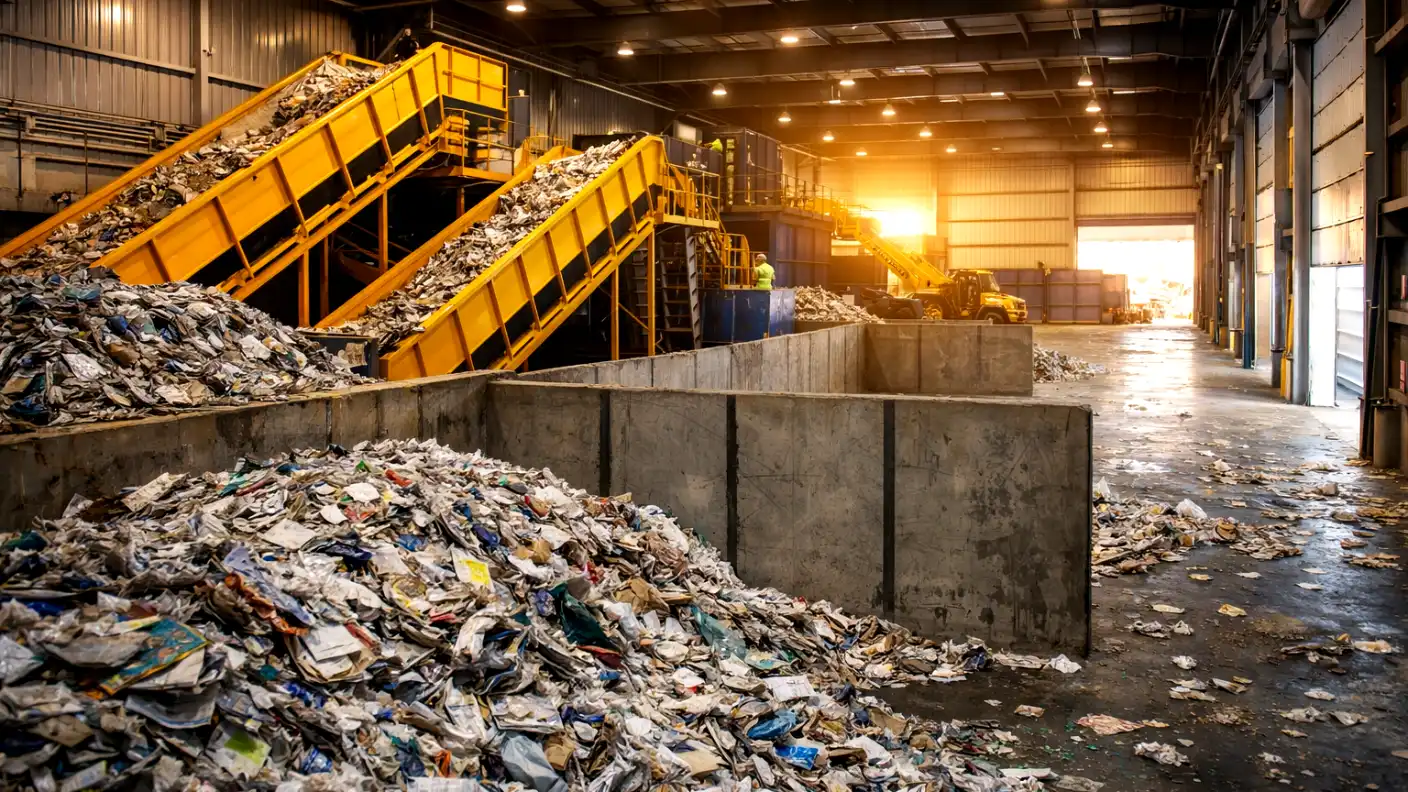
The dramatic clearing of old landfills leaves many wondering where China’s daily mountain of fresh municipal waste actually goes. Instead of burying fresh trash, urban waste networks now route most household garbage to high-tech waste-to-energy incineration plants. In Foshan City, a massive eco-industrial facility processes 4,500 tonnes of household waste daily. The plant does more than generate basic electricity; it captures high-temperature steam and delivers it through a regional pipeline network to power nearby manufacturing facilities, thereby replacing fossil fuels in a highly efficient energy cycle.
To ensure safety and gain public trust, modern Chinese incinerators operate under incredibly strict technical standards. At the Shanghai Laogang Waste Disposal Base, the entire process runs on automated, unmanned systems that monitor emissions in real time. The facility maintains internal furnace combustion temperatures well above 850 degrees Celsius, which completely decomposes toxic compounds such as dioxins. Specialized carbon and bag filters trap any remaining heavy metals and acidic gases before they can escape the stack, ensuring the plant releases only clean, harmless water vapor and carbon dioxide into the atmosphere.
The technological sophistication of these plants extends even to how they handle the residual combustion ash. Bottom ash, which accounts for roughly 20 percent of the total incinerated waste volume, contains valuable deposits of copper, aluminum, and iron, as well as trace amounts of precious metals such as gold and silver. At the Fushan Circular Economy Industrial Park in Guangzhou, technicians process this bottom ash to extract metals, then recycle the remaining mineral matter. In 2025, the facility successfully processed 600,000 tonnes of residual ash into durable, eco-friendly paving bricks for regional road and construction projects.
Official figures from the Ministry of Ecology and Environment highlight the incredible speed of this transition. By late 2025, incineration accounted for 78.1 percent of China’s urban household waste treatment capacity, marking a massive 19.2 percentage point increase from the end of 2020. This is a dramatic leap from 2010, when the country operated only 119 waste-to-energy plants that managed a mere 20 percent of national trash. Today, China controls approximately 60 percent of the world’s total waste-to-energy capacity, easily eclipsing the combined capacities of Europe, the United States, and Japan.
This rapid industrial shift requires massive capital commitments from both state and private investors. Municipalities currently allocate roughly 1.5% of their annual public infrastructure budgets toward circular economy systems, pushing total national investment in high-tech waste treatment past $15 billion. By directing public funds toward these high-performance sorting and recovery hubs, China is proving that green technology can turn a major municipal liability into a highly lucrative resource recovery engine.
During the current 15th Five-Year Plan period, running from 2026 to 2030, China’s environmental sector plans to transition fully from simple harmless waste disposal to complete resource recovery. The success of these initial megacity projects proves that modern, high-temperature direct-current systems and advanced circular grids can successfully bridge the gap between heavy urban consumption and green resource regeneration. By showing the world how to dismantle and recycle historical landfills systematically, China is writing a highly practical blueprint for the future of global urban waste management.