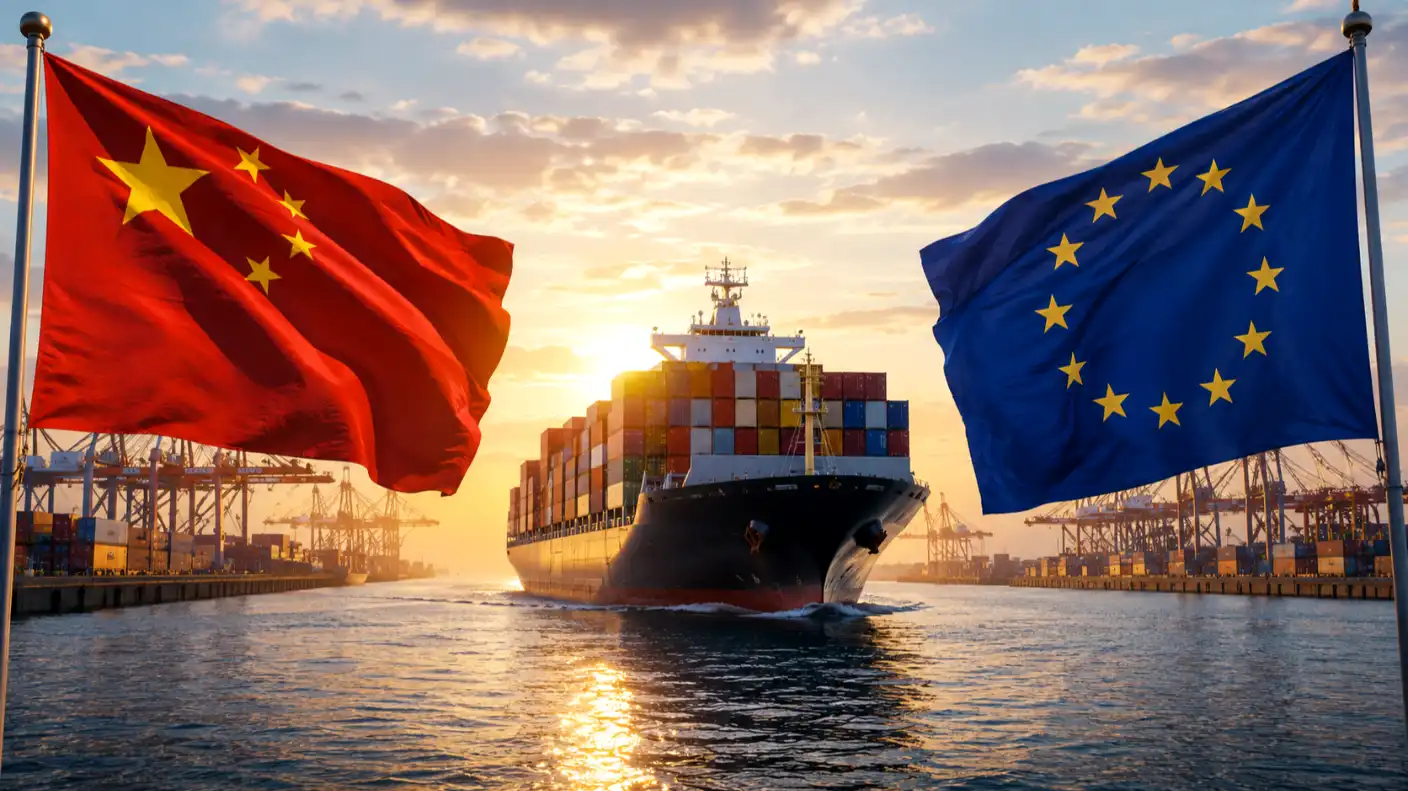
The European Union is heading into a major confrontation phase with Beijing if a trade deal to reduce its soaring trade deficit cannot be reached by autumn. During a television interview on July 1, 2026, Manfred Weber, the President of the European People’s Party (EPP), issued this warning, signaling a sharp escalation in the economic and geopolitical rivalry between the two trading blocs. Weber, who leads the largest political group in the European Parliament, made it clear that European capitals are prepared to take highly defensive, protective actions to shield domestic industries from unfair competition.
This political warning aligns with the tight timeline established by EU Trade Commissioner Maroš Šefčovič, who is pushing for a concrete trade agreement with Beijing by October 2026. The looming deadline highlights growing concern among European policymakers over a “China Shock 2.0,” where industrial overcapacity from Beijing—ranging from cheap consumer goods to highly subsidized electric vehicles (EVs)—threatens to underwrite European manufacturers, put high-productivity jobs at risk, and decimate Europe’s fragile industrial base. By establishing a soft autumn deadline, the center-right political leadership in Brussels has made it clear that the era of passive trade relations is over.
The Staggering Reality of the Daily €1 Billion Trade Deficit
At the heart of the European Union’s aggressive new stance is a massive economic imbalance that has become politically unsustainable. The EU recorded a goods trade deficit with China of €359.9 billion (approximately $411 billion) in 2025. This staggering deficit translates into an imbalance of nearly €1 billion every single day across the 27 EU member states. For European leaders, this figure is not just an abstract statistical worry; it represents a direct transfer of wealth and manufacturing capacity out of Europe and into Chinese state-backed corporations.
The center-right political family, led by Weber, has moved to abandon its historical commercial pragmatism in favor of a much tougher, security-focused trade policy. This shift carries immense weight in Brussels, as the EPP is the same political family that includes European Commission President Ursula von der Leyen and prospective German Chancellor Friedrich Merz. Weber has warned that the current trade deficit is actively jeopardizing Europe’s industrial foundation and high-quality jobs, declaring that the continent must either fight back or stand by as Chinese industrial overcapacity cripples major sectors of its domestic economy.
Dismantling Subsidies: The Core of the EPP’s Defensive Playbook
To counter the threat of Chinese overproduction, the EPP is calling for a radical re-evaluation of Europe’s trade rules. Weber has demanded a strictly level playing field, stating that state-directed subsidies must not be allowed to act as a normal part of a free market economy. If a foreign government uses massive public subsidies to artificially lower the production costs of its goods, those products cannot be allowed to enter the European single market duty-free.
The European Commission has already begun deploying its trade policy instruments to address this distortion. In late 2024, the EU officially implemented five-year anti-subsidy tariffs of up to 35.3% on imported Chinese electric vehicles, which were designed to offset the unfair competitive advantage provided by Beijing’s state subsidies. However, European trade officials recognize that applying these defensive tariffs carries significant risks, as Beijing could choose to retaliate by restricting exports of critical rare earth elements and advanced semiconductors, which are essential for Europe’s own tech and automotive industries. Balancing these defensive tools with the need to avoid a destructive trade war remains one of the most delicate challenges facing European negotiators.
Shutting the Chinese Backdoor in Global Procurement
Beyond tariffs, the EPP’s defensive playbook includes plans to restrict Chinese access to European public procurement and international development funds. Weber has called for a major policy change that would prevent Chinese companies from winning development projects outside the EU that are financed by European taxpayer money.
To highlight the need for this change, Weber pointed to a recent case where European development funds were used to purchase 380 natural gas buses for Senegal. A cheaper, state-subsidized Chinese bid won the public tender, beating out a competitive European bus manufacturer. European policymakers argue that using EU development funds to buy Chinese goods directly undermines Europe’s industrial base and serves to strengthen a geopolitical rival. By closing these procurement loopholes, Brussels hopes to ensure that European taxpayer money is used to support European businesses and workers, reinforcing the economic security of the bloc.
Securing European Sovereignty Over 6G Networks
The EPP’s push for technological sovereignty also extends to the next generation of telecommunications infrastructure. Weber has proposed the complete exclusion of Chinese telecommunications firms from the development of Europe’s 6G networks, arguing that the creation of next-generation critical networks should remain an exclusively European endeavor.
This proposal is driven by deep national security and data privacy concerns. During the rollout of 5G infrastructure, several European nations faced intense pressure from Washington to exclude Chinese vendors like Huawei over fears of espionage and state surveillance. By establishing an explicit ban on foreign equipment for 6G networks from the outset, the EPP aims to build a secure, independent digital infrastructure that is less vulnerable to foreign interference or strategic supply chain blockades.
The Green Deal Dilemma: Protecting Industry Amidst Climate Shocks
The push for a more defensive trade policy has also forced European leaders to confront a difficult internal contradiction: the tension between industrial competitiveness and ambitious climate action. The European Union has long prided itself on its global leadership in fighting climate change, establishing the European Green Deal to target net-zero greenhouse gas emissions by 2050. However, the high costs of complying with strict environmental regulations have put European manufacturers at a significant disadvantage compared to global competitors operating under looser standards.
This dilemma has triggered a major political battle within Brussels. During his interview, Weber made the provocative statement that Europe cannot destroy its own industry in the name of climate action, pointing out that environmental goals are meaningless if they result in the deindustrialization of the continent. This debate has intensified as a severe heatwave across Europe was linked to approximately 1,300 deaths, bringing the climate crisis back to the forefront of public discussion. The EPP has increasingly moved to scale back or delay key Green Deal policies, arguing that the bloc must prioritize economic growth and industrial survival during a period of intense global competition.
Watered-Down Car Fleet Targets and the Push for Technical Openness
The primary battleground for this industrial-climate debate is the automotive sector. Under the original Green Deal guidelines, the EU planned to implement a complete ban on the sale of new internal combustion engine cars by 2035, mandating a 100% reduction in vehicle CO2 emissions. This policy aimed to force a rapid transition to electric vehicles, but it left European automakers highly vulnerable to cheaper, state-subsidized Chinese EV brands that could produce batteries at a fraction of the cost.
To protect the domestic auto industry, the EPP led a successful legislative push to water down these targets. Under the revised rules:
- The 2035 Target: The mandatory CO2 reduction target for car manufacturers’ fleets was reduced to 90%, eliminating the 100% zero-emission requirement.
- The 2040 Target: The European Council eliminated the proposed 100% reduction target for 2040, allowing internal combustion engines to remain a viable option for the foreseeable future.
- Technological Openness: The revised rules emphasize the need to remain “technologically open,” allowing consumers to decide which powertrain technology best meets their needs rather than forcing a state-mandated shift to electric vehicles.
By relaxing these emission targets, the EPP aims to shield legacy European automakers from being completely outpaced by Chinese competitors, giving them more time to adapt their production lines and build independent battery supply chains.
The Fragile Unity of G7 and EU Capital Alliances
As the EU prepares for a potential trade confrontation with Beijing, maintaining a unified front with its international allies is a critical priority. During the recent G7 summit in Évian, France, the world’s leading industrial democracies pledged an ambitious target to diversify their supply chains away from China, adding significant international momentum to the European Union’s defensive trade push.
However, executing this strategy is complicated by deep internal divisions among the 27 EU member states. Some countries, led by France, are pushing for an aggressive, protectionist stance to defend their domestic manufacturers from cheap imports. Other nations, particularly Germany, are highly cautious about trade confrontation. German automakers like BMW, Mercedes-Benz, and Volkswagen are deeply integrated into the Chinese market, relying on local sales for a massive portion of their global profits. They fear that aggressive European tariffs will invite swift, painful retaliation from Beijing, directly targeting German exports and harming their domestic economy. Navigating these internal splits remains one of the most difficult challenges for the European Commission as it attempts to present a united front in trade talks.
Sefcovic’s Crunch Negotiations: The October Deadline Demands
The responsibility for resolving this trade crisis falls squarely on the shoulders of the EU’s chief trade negotiator, Maroš Šefčovič. Following a series of high-level meetings with Chinese trade envoy Li Chenggang in Paris, Šefčovič confirmed that the current trade relationship is unsustainable, warning that the status quo is not an option.
The upcoming autumn negotiations represent a critical crunch period for both powers. Šefčovič’s team is pushing Beijing to make real, verifiable concessions on industrial subsidies and state-directed overproduction before the October deadline. If the talks fail to yield concrete results, the EU is prepared to deploy its new defensive trade instruments, potentially triggering a broad wave of tariffs across multiple industrial sectors. While both sides are eager to avoid a full-scale trade war, the deep structural imbalances in the bilateral trade relationship suggest that finding a mutually acceptable compromise will require significant, difficult concessions from both Brussels and Beijing.
Conclusion
The European Union’s impending trade conflict with China represents a defining moment for the future of global commerce. By establishing a firm autumn deadline to resolve the unsustainable daily €1 billion trade deficit, the center-right political leadership in Brussels has made it clear that the era of passive trade relations is over. Under the guidance of EPP President Manfred Weber and aligned with Commission President Ursula von der Leyen, the EU is preparing a robust, defensive trade playbook that includes anti-subsidy tariffs, procurement restrictions, and technological exclusions to protect its industrial base and high-quality jobs.
While these defensive measures are necessary to counter Chinese overproduction, they will require European leaders to navigate complex geopolitical and internal challenges. Balancing industrial survival with ambitious climate goals under the Green Deal will require careful cost management and policy flexibility. Furthermore, the European Commission must work to maintain unity among its 27 member states, preventing internal divisions from weakening its hand during crunch negotiations. As the October deadline approaches, the outcome of the trade talks will determine whether the two economic superpowers can find a path toward a balanced, fair trading relationship, or whether they are headed for a prolonged, destructive trade war that will reshape global supply chains for decades to come.