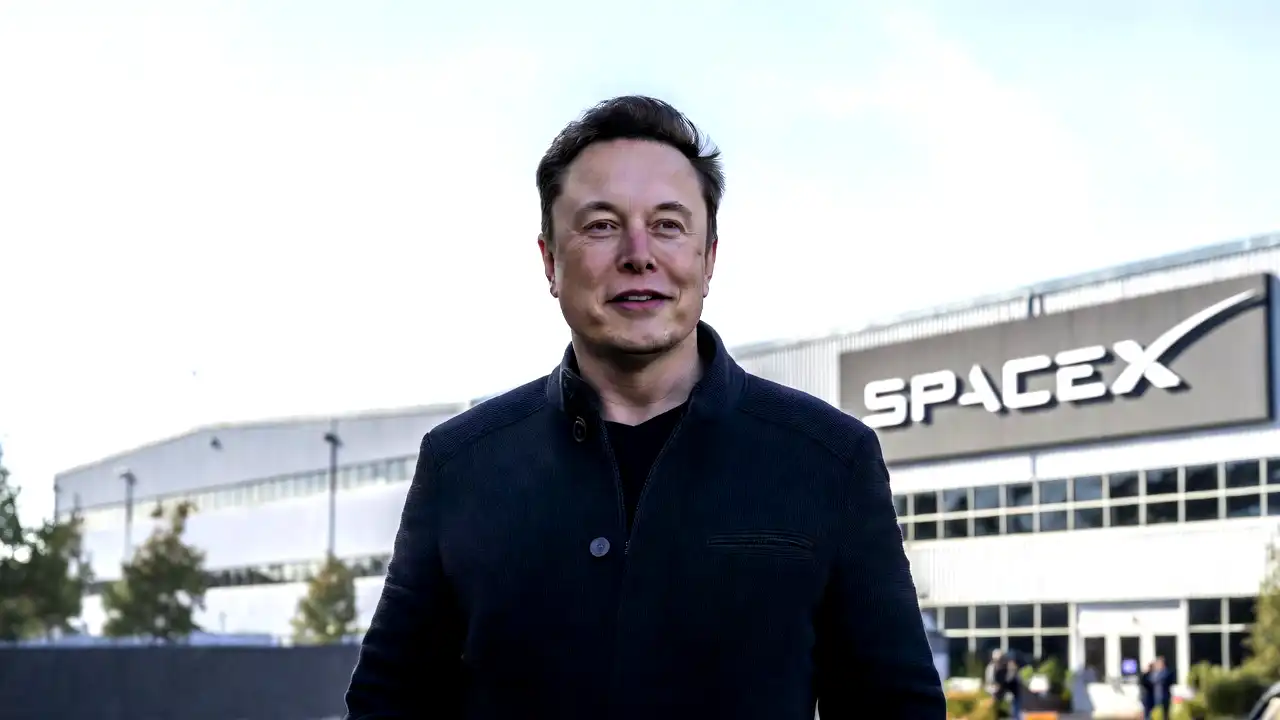
The financial euphoria surrounding the largest public market debut in history has officially met the harsh reality of Wall Street. In a dramatic reversal of fortunes for early backers of Space Exploration Technologies Corporation, financial tracking data reveals that short sellers targeting the aerospace giant have accumulated a staggering $8.7 billion in paper profits. This massive windfall follows a persistent, multi-week selloff that pushed the company’s stock price below its historic June initial public offering price of $135.
Trading on the Nasdaq under the ticker SPCX, the company’s market debut on June 12 initially captivated global financial markets. The stock surged from its IPO price to peak near $220, briefly pushing the company’s total valuation past $2.1 trillion and cementing its status as the world’s most valuable aerospace and logistics conglomerate. However, as the initial retail-driven buying frenzy cooled, institutional investors began to scrutinize the company’s astronomical valuation, massive capital expenditures, and highly speculative merger with Elon Musk’s artificial intelligence startup, xAI.
According to data compiled by financial intelligence firm Ortex, the subsequent share price decline below $125 has triggered one of the largest short-selling payouts of the year. While early tech bulls spent the previous month celebrating the record-breaking $75 billion initial offering, short sellers who bet against the company’s high-multiple valuation have quietly secured billions in gains. This rapid transition highlights a growing realization among market participants that even the most innovative company on earth is not immune to the laws of financial gravity and cash-flow reality.
The Gravity-Defying Valuation Meets Market Reality
The decline of SpaceX stock below its IPO price represents a significant, highly visible correction for the entire technology and growth investing sectors. A $5,000 investment opened at the peak of the post-IPO rally has already lost more than a quarter of its value, illustrating the immense danger of chasing high-flying “story stocks” during their initial, hype-driven trading phases.
The correction was driven by a complete re-evaluation of the company’s valuation metrics. At its peak price of $220, the company traded at an implied price-to-sales multiple exceeding 100 times its trailing twelve-month revenue. For comparison, the average price-to-sales ratio for the broader technology sector sits near 9 times, while legacy aerospace defense firms typically trade between 1.5 and 2 times sales. Even after accounting for the company’s unique, high-growth monopolies in space launch and satellite internet, a multiple of 100 times sales left the stock priced for absolute perfection, leaving it highly vulnerable to any potential operational delays or financial disappointments.
Furthermore, the physical supply of tradable shares is preparing for a massive expansion. Because the company only recently completed its public listing, the market has been operating with a very small free float of just 4.2% of total outstanding shares. This limited supply artificially inflated the initial post-IPO price, as frantic buying demand collided with a lack of available shares.
As the regulatory lockup periods begin to expire, the supply of shares in the public market is set to expand rapidly, creating a massive technical overhang that is driving short sellers to expand their positions.
The Extreme Valuation and the Price-to-Sales Trap
The massive price-to-sales multiple of 100 times represents a critical financial headwind for the company. To justify a valuation of nearly $2 trillion, a business must prove to Wall Street that it can rapidly scale its revenues while maintaining high, software-like profit margins.
While the company’s satellite internet division, Starlink, successfully generates high-margin cash flows, the core rocket launch business remains an incredibly capital-intensive endeavor that operates on relatively thin margins.
By pricing the entire conglomerate like a highly scalable software-as-a-service provider, the market ignored the massive physical and financial costs of building rockets, managing launch sites, and shipping physical satellite terminals.
As investors begin to separate these distinct business units, they realize the company’s overall margin profile will likely remain significantly lower than the pure-play software multiples currently priced into the stock.
The Impending Lock-up Expirations
The technical selling pressure on the stock is expected to intensify over the coming weeks as the first major insider lockup expiration approaches. The company implemented an unusual, highly complex staggered lockup structure to manage the transition of its massive pre-IPO shareholder base into the public markets.
Under the terms of this agreement, the first major tranche—representing approximately 20% of all insider and pre-IPO shares—is scheduled to unlock immediately after the company releases its first quarterly earnings report, which is expected in late July or early August.
Subsequent tranches will unlock at various intervals over the following 180 days.
With hundreds of millions of newly tradable shares set to flood the market, institutional short sellers are aggressively positioning themselves to capitalize on the expected selling pressure, as early employees and venture capital backers look to cash in on their multi-billion-dollar paper gains.
Unpacking the Multibillion-Dollar Cash Burn of Starship and xAI
The financial anxiety driving the short-selling campaign is rooted in the company’s extraordinary rate of capital consumption. To maintain its technological lead in both deep-space logistics and advanced artificial intelligence infrastructure, the company is burning through cash at an unprecedented velocity, requiring continuous, multi-billion-dollar capital injections to keep its programs funded.
During the previous fiscal year, the company’s total capital expenditures reached a historic $20.7 billion, representing a massive 86% increase year-on-year.
This capital burn has shown no signs of slowing down, with the company consuming a staggering $10 billion in capital expenditures in the first quarter of the year alone.
While the company raised $75 billion during its June initial public offering, the sheer scale of its ongoing development projects has forced it to seek additional debt financing, recently launching a massive $25 billion corporate bond offering that has raised concerns among credit rating agencies.
The Capital-Intensive Launch Division
The core rocket launch division remains a massive, non-profitable financial drag on the company’s balance sheet. While the Falcon 9 and Falcon Heavy programs successfully generate consistent, reliable revenues by launching commercial satellites and government payloads, the profits from these legacy systems are being entirely consumed by the development of the Starship launch platform.
Starship is the largest and most powerful rocket ever constructed, designed to be fully reusable to reduce the cost of space transport to less than $100 per kilogram.
However, achieving this technological milestone requires an extraordinary amount of capital.
The launch division recorded a massive operating loss of $2.6 billion last year, as the company spent billions of dollars on engine development, launch pad construction, and highly expensive flight tests that frequently end in spectacular, explosive failures.
Until Starship achieves full commercial maturity and begins executing high-frequency orbital flights, the launch division will continue to operate as a massive, capital-devouring cost center.
The xAI Merger and the Staggering Quarterly Loss
The financial pressure on the company escalated significantly following its controversial, all-stock merger with Elon Musk’s artificial intelligence startup, xAI. The merger, completed in February, combined the aerospace business with Musk’s social media platform X and his AI developmental teams under a single corporate banner at a combined valuation of $1.25 trillion.
This integration has introduced an entirely new, highly expensive risk profile to the company’s balance sheet. The development of advanced artificial intelligence models requires an extraordinary investment in computing infrastructure.
The AI division consumed a massive $12.7 billion in capital expenditures last year, while generating just $3.2 billion in revenue.
The financial toll of this high-burn rate was laid bare in the company’s first-quarter filings, which revealed that xAI contributed to a staggering $4.28 billion net loss for the quarter.
With artificial intelligence operational losses running at a consistent $2.5 billion per quarter, short sellers argue that the company is taking on an unsustainable level of financial risk, betting its entire corporate future on a highly speculative orbital data center program that is years away from generating meaningful revenues.
Starlink’s High-Margin Shield: Is It Enough to Defend the Moat?
To defend its premium valuation against the aggressive short-selling campaign, the company must rely heavily on the financial strength of its satellite internet division, Starlink. Starlink represents the true, highly profitable crown jewel of the company’s business, generating the steady, high-margin cash flows needed to subsidize the development of Starship and the xAI division.
In 2025, Starlink generated approximately $11.4 billion in revenue, accounting for a massive 61% of the company’s total sales of $18.7 billion.
More importantly, the connectivity business operates with exceptional profitability, recording a stellar 39% operating margin that translated into roughly $4.4 billion in operating income.
The company is working to expand Starlink’s global footprint rapidly, securing high-value enterprise contracts across the maritime, aviation, and defense sectors, while launching advanced direct-to-cell partnerships with major mobile carriers to capture millions of new users worldwide.
The Challenge of Saturated Markets and Regional Competition
However, short sellers point out that Starlink is beginning to face significant growth bottlenecks. In its primary, highly profitable residential markets across North America and Western Europe, subscriber growth has begun to slow as the service reaches natural saturation among rural households.
To continue expanding, Starlink must target lower-income developing nations, where the average consumer cannot afford the expensive upfront hardware costs or the $120 monthly subscription fees, forcing the company to offer steep subsidies and lower-tier pricing plans that compress its average revenue per user.
Furthermore, the company is facing rising competition from other global satellite networks.
Amazon’s Project Kuiper is preparing to launch high-volume commercial services, while state-backed satellite constellations in China and Europe are beginning to establish their own regional networks, threatening to trigger a massive price war in the global satellite broadband market and erode Starlink’s high-margin cash flow shield.
The Macroeconomic Headwinds: High Rates and Corporate Governance Concerns
The final factor driving the short-selling campaign is a challenging macroeconomic and regulatory environment. The global economy is currently navigating a prolonged period of high interest rates and sticky inflation, a combination that is highly punishing for capital-intensive, high-debt businesses.
As central banks maintain their hawkish postures, the cost of servicing the company’s massive debt load continues to rise. Every new bond offering or credit facility the company secures carries significantly higher interest rates than the cheap debt available during the previous decade, draining valuable cash from its operational divisions and raising its overall financial risk profile.
Furthermore, corporate governance concerns continue to weigh heavily on institutional investor sentiment. Elon Musk maintains absolute, unchallenged control over the company, holding between 82% and 85% of the total voting power through super-voting stock despite owning only 42% of the common equity.
This structural imbalance has created significant hesitancy among conservative pension funds and mutual fund managers, who are reluctant to invest billions of dollars in a company where public shareholders have virtually no voice in corporate governance or executive compensation decisions.
As these institutional allocators remain on the sidelines, the market’s support for the stock has softened, leaving the share price highly vulnerable to the aggressive, coordinated short-selling campaigns that have yielded historic profits over the past month.
The successful stabilization of the company’s stock price will ultimately depend on its ability to transition from a speculative “story stock” into a highly disciplined, cash-generative enterprise. While the company undoubtedly possesses some of the most advanced, highly valuable technologies in human history, Wall Street operates on a cold, unforgiving financial calendar.
If Elon Musk and his executive team cannot prove that their massive, multi-billion-dollar investments in Starship and the xAI division can successfully generate real, high-margin revenues on schedule, the short sellers will continue to hold the upper hand, proving that in the public markets, actual cash flow performance will always be more valuable than grand technological promises.