

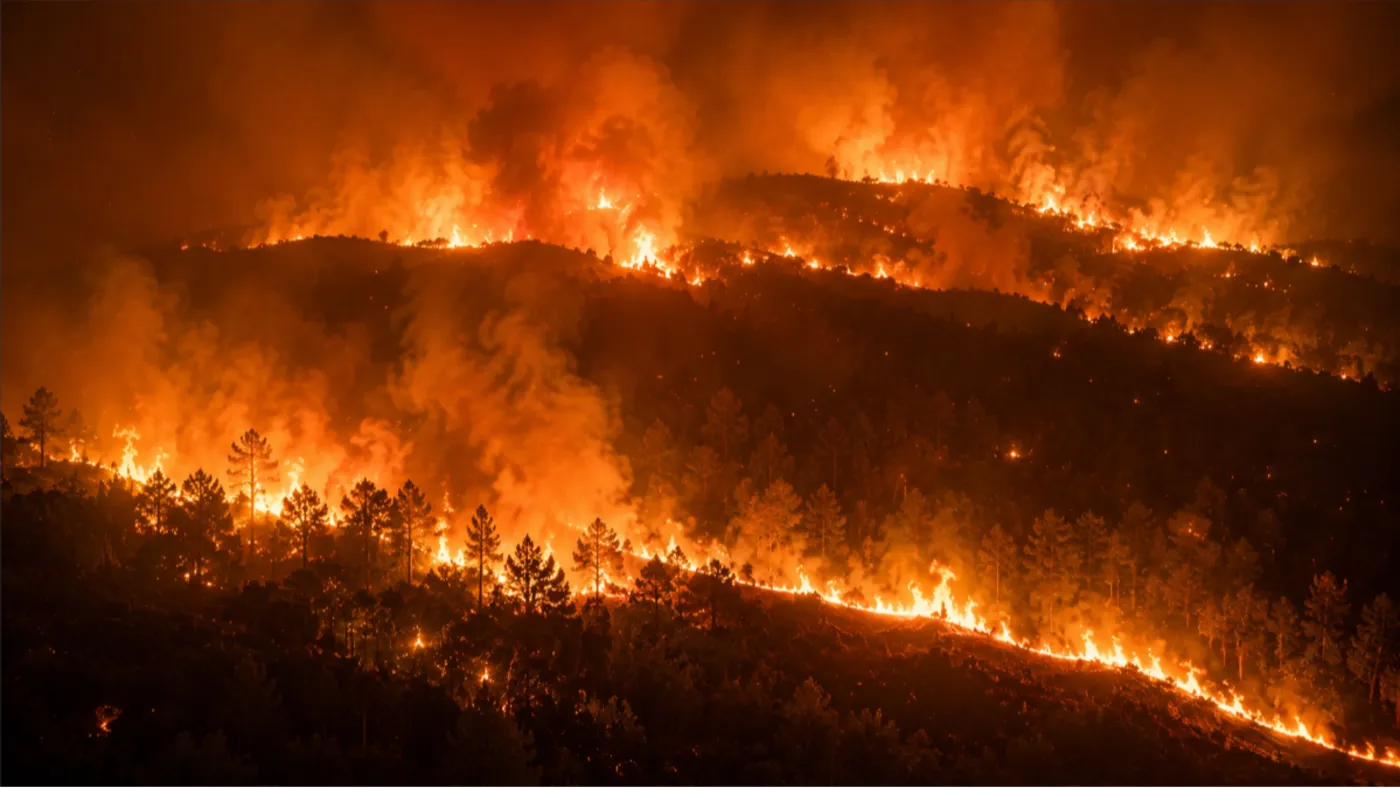
Extreme wildfires across France and Spain have exposed an alarming reality for the European continent: Europe’s civil protection systems, forestry management policies, and emergency fleets are fundamentally unprepared for a climate-driven era of explosive megafires. As record-breaking heat domes push summer temperatures past 42°C (108°F) across Southern and Central Europe, vast tracts of timberland, agricultural acreage, and residential communities are burning at unprecedented speeds. Firefighting services across the Mediterranean basin are operating at complete operational exhaustion, finding that traditional ground suppression techniques are largely ineffective against fast-moving, high-intensity blazes.
The physical and economic damage across Western Europe has reached historic proportions. In Spain, wildfire activity burned over 300,000 hectares of land in a single summer season, forcing the emergency evacuation of more than 45,000 residents and tourists across Catalonia, Castile and León, Galicia, and Extremadura. In France, massive fires swept through the pine forests of Gironde, Aude, and Var, destroying historic timber reserves and driving direct economic losses past 3.5 billion euros in property destruction, emergency response operations, and lost tourism revenue.
However, environmental experts and emergency managers emphasize that these disasters are not merely natural accidents. They represent the predictable outcome of decades of structural policy failures. Europe is confronting a dangerous combination of chronic rural depopulation, massive biomass accumulation, an acute shortage of specialized water-bombing aircraft, and a persistent political refusal to execute proactive forestry management. As extreme fire weather expands northward into Central France, Germany, and Scandinavia, European policy makers are being forced to execute a fundamental overhaul of civil protection strategies.
TechGolly provides a comprehensive analysis of the European wildfire crisis, evaluating fire physics, aerial firefighting shortages, land abandonment, AI-driven early detection technologies, property insurance risks, and long-term climate adaptation frameworks.
Unpacking the Scale of the French and Spanish Wildfire Crises
To understand why recent European wildfires have proven so destructive, forestry specialists point to the emergence of the “megafire”—an explosive, high-intensity wildfire category that exceeds traditional human suppression capabilities. Megafires occur when multi-month severe droughts, high wind velocities, extremely low relative humidity, and temperatures exceeding 40°C combine with dense, unmanaged vegetation.
In Southern France, where pine plantations and dry Mediterranean scrub dominate the landscape, wildfires have displayed unprecedented behavior. During the height of the Gironde and Aude blazes, fire fronts moved at speeds exceeding 5 kilometers per hour, generating localized firestorms that created their own weather phenomena. Intense thermal energy produced massive pyrocumulonimbus clouds—giant columns of smoke and hot air that reach 10 kilometers into the atmosphere, generating erratic wind gusts and lightning strikes that ignite secondary spot fires miles ahead of the main fire perimeter.
In Spain, the crisis has affected multiple autonomous regions simultaneously, paralyzing national emergency response services. In Catalonia and Castile and León, fires consumed thousands of hectares of oak, pine, and farmland in less than 24 hours. The rapid spread of these blazes repeatedly trapped ground crews, forcing civil defense authorities to execute emergency sea and air evacuations for thousands of beachgoers and rural villagers.
The human and economic toll extends far beyond immediate burned acreage. Smoke plumes carrying high concentrations of toxic fine particulate matter drifted across major European urban centers, triggering severe public health warnings for tens of millions of citizens. In coastal resort towns along the French Riviera and the Spanish Costa Brava, local hospitality businesses suffered an immediate 40% drop in tourist bookings, destroying summer revenues for regional small businesses.
The Aerial Firefighting Shortage: The Canadair Bottleneck
A critical operational vulnerability exposed during the recent wildfire wave is Europe’s severe shortage of specialized aerial firefighting aircraft. When ground crews face fast-moving megafires in steep, inaccessible mountain terrain, amphibious water-bombing aircraft—specifically the Canadair CL-415 and DHC-515 water scoopers—represent the only effective tool capable of dropping thousands of liters of water directly onto active fire fronts.
However, the European Union’s joint emergency fleet, operating under the RescEU civil protection framework, maintains fewer than 24 operational water-scooping airplanes to protect 27 member nations. During peak summer fire events, when dozens of major blazes erupt simultaneously across France, Spain, Greece, Italy, and Portugal, the central aerial fleet is overwhelmed by competing national requests for emergency air support.
Manufacturing bottlenecks have compounded the aerial capacity crisis. De Havilland Canada, the exclusive manufacturer of Canadair water bombers, halted production for several years before restarting assembly lines to fulfill new orders from European governments. Because manufacturing specialized amphibious aircraft requires complex supply chains and hand-assembled structural components, newly ordered DHC-515 water scoopers will not arrive in operational volumes until 2028 or 2030.
Lacking sufficient dedicated water-scooping aircraft, European civil defense departments have been forced to rely on lightweight agricultural spray planes and military transport helicopters equipped with flexible water buckets. However, smaller helicopters carry only a fraction of a Canadair’s 6,000-liter payload and cannot operate safely in the high-wind, high-turbulence environments generated by megafires.
Land Management Failures: Rural Depopulation and Fuel Accumulation
While climate change provides the environmental heat spark, the primary fuel powering Europe’s megafires is the result of a multi-decade socio-economic shift: the complete abandonment of traditional European rural land management.
Over the past half-century, industrialization and urban economic growth drove millions of young Europeans away from mountain villages and rural farming communities toward major metropolitan cities. Across inland Spain and rural Southern France, millions of hectares of traditional terraced farmland, olive groves, livestock pastures, and harvested oak woodlands were abandoned by agricultural families.
In the absence of active human management, abandoned agricultural land underwent rapid, unmonitored ecological succession. Former open pastures and stone-terraced vineyards were colonized by fast-growing, highly flammable pioneer species—such as eucalyptus, invasive scrub, and dense maritime pine. These unmanaged forests accumulated continuous layers of dead wood, dry brush, and fallen pine needles over decades without periodic clearing.
Furthermore, the collapse of traditional pastoral livestock grazing removed a vital natural firebreak. Historically, millions of grazing goats, sheep, and cattle roamed European mountain slopes, consuming understory brush and maintaining open, clear gaps between forest stands. Without livestock grazing, under-story brush grows unchecked, creating dense vegetation ladders that allow ground fires to climb rapidly into tree canopies, transforming manageable surface fires into destructive crown fires.
Policy barriers have exacerbated the fuel accumulation problem. Forestry services face strict regulatory restrictions and intense public opposition when attempting to execute prescribed hazard-reduction burns during winter months. Many European urban residents and environmental groups oppose controlled burns due to temporary air quality concerns or misunderstandings of fire ecology. As a result, European forests carry fuel loads up to five times higher than historical norms, creating tinderboxes waiting for a spark.
Geographical Migration: Fire Seasons Shift Northward into Central Europe
A profound structural shift altering European emergency planning is the geographical expansion of fire weather. Wildfires are no longer a localized seasonal hazard restricted to Southern Europe’s Mediterranean coastline.
Climatological tracking data confirms that severe drought conditions and prolonged summer heatwaves are shifting steadily northward. Regions that historically experienced cool, damp summers—including Northern France, central Germany, Poland, the Czech Republic, and southern Scandinavia—are experiencing high-risk fire weather conditions every summer.
Northern European municipalities face severe operational vulnerabilities because their emergency response services were designed exclusively for structural urban firefighting rather than wildland suppression. Regional fire departments across Northern France and Germany lack specialized off-road 4×4 fire engines, lightweight protective wildland suits, specialized forest communications networks, and subsea water-pumping infrastructure.
When major forest blazes erupted in Northern France and East Germany, local fire crews struggled to contain the flames, requiring emergency technical assistance from specialized wildland firefighting units deployed from Southern European nations. This geographical shift proves that wildfire adaptation must become a continent-wide priority rather than a regional Mediterranean concern.
Technological Countermeasures: AI Detection, Drones, and Satellite Grids
To overcome physical equipment shortages and manage vast forested territories, European forestry agencies and technology enterprises are deploying advanced digital technologies to detect, track, and contain wildfires before they expand into uncontrollable megafires.
A primary technological intervention is the deployment of artificial intelligence-powered early warning networks. Environmental tech startups are installing high-definition optical and thermal infrared camera systems on top of telecommunication towers, elevated mountain peaks, and forest lookouts across France and Spain.
Powered by computer vision algorithms trained on thousands of hours of atmospheric data, these automated camera towers continuously scan 360-degree horizons, analyzing atmospheric clarity and thermal signatures. The AI systems can detect microscopic smoke plumes or localized heat anomalies at distances up to 15 kilometers within 3 minutes of ignition, automatically transmitting GPS coordinates to regional fire dispatch centers.
Satellite constellation monitoring provides a secondary layer of real-time intelligence. Forestry agencies are utilizing European Space Agency Sentinel satellites alongside commercial thermal imaging constellations to map active fire perimeters through dense smoke cover. Satellite data feeds into predictive machine learning software that combines real-time wind speed telemetry, atmospheric humidity metrics, and vegetation dryness maps to predict fire movement direction over 6-to-12-hour horizons.
On the front lines of suppression, heavy-payload autonomous drones are emerging as valuable force multipliers. Unmanned aerial vehicles equipped with thermal vision sensors can fly directly through dense smoke plumes during night operations—when traditional piloted aircraft are grounded due to low visibility—dropping specialized chemical fire-retardant charges onto spot fires to isolate blazes before ground crews arrive.
Economic Costs, Insurance Liabilities, and Tourism Squeezes
The escalating frequency and intensity of European megafires are generating severe macroeconomic repercussions, threatening regional property values, municipal budgets, and critical service industries.
The insurance sector is bearing immediate financial strain. International reinsurance firms report that cumulative insured losses from European wildfires over recent years have crossed 8 billion euros, prompting property underwriters to execute sweeping risk re-assessments across Southern Europe.
In fire-prone regions across Southern France and rural Spain, insurance companies are raising home and commercial property insurance premiums by 30% to 70%, while introducing strict conditional coverage requirements. Property owners are forced to install fire-resistant roofing, clear 30-meter brush buffer zones around structures, and install private water storage tanks to maintain valid insurance policies.
The Mediterranean tourism industry, which accounts for over 12% of total gross domestic product in Spain and Southern France, faces a long-term structural threat. As extreme summer heat domes and smoke-choked skies become regular summer occurrences, international travel agencies report a gradual shift in traveler preferences, with European tourists increasingly selecting cooler Northern European destinations for summer vacations.
Strategic Outlook for European Climate Policy and Civil Protection
Adapting to Europe’s new wildfire reality requires a multi-decade commitment to transforming civil protection infrastructure, land-use planning, and rural economic policy.
European Union policymakers are advancing comprehensive legislative reforms to build a resilient continent-wide defense system. Key strategic priorities include:
First, expanding the RescEU joint emergency fleet. European authorities are allocating over 600 million euros in federal funds to purchase 12 new dedicated Canadair DHC-515 water bombers and lease additional heavy-lift firefighting helicopters, creating a permanent, rapid-response air fleet capable of deploying anywhere in Europe within two hours.
Second, enacting mandatory “fire-smart” land management laws. European agricultural policies are being updated to subsidize controlled winter prescribed burning, restore native broadleaf hardwood forests—such as oak and chestnut trees, which burn at significantly lower temperatures than highly flammable pine plantations—and provide financial incentives for young farmers to re-establish livestock grazing in rural mountain corridors.
Third, updating municipal building codes and urban planning frameworks along the wildland-urban interface. Local governments must enforce strict safety buffer zones around suburban developments, prohibit new residential construction in high-risk forest zones, and mandate fire-resistant building materials for all new structures.
Ultimately, surviving the new era of European wildfires requires recognizing that emergency response alone cannot solve a structural environmental crisis. By uniting cutting-edge digital technology with traditional, proactive land management, Europe can protect its citizens, safeguard its ecosystems, and adapt to a changing planet.
Key Takeaways for European Leaders, Emergency Agencies, and Tech Innovators
The wildfire crisis sweeping across France and Spain delivers vital strategic lessons for public policymakers, emergency managers, forestry directors, and technology developers.
First, aerial firefighting capacity must be treated as a strategic national security asset. European governments must accelerate joint aircraft procurement, expand shared pilot training academies, and fund next-generation water-scooping technologies to eliminate current fleet deficits.
Second, proactive land management is far more cost-effective than emergency suppression. Investing public funds in controlled prescribed burns, clearing overgrown brush, and supporting pastoral livestock farming eliminates combustible fuel loads, preventing manageable ground fires from escalating into catastrophic megafires.
Third, early detection technology is the key to minimizing wildfire damage. Integrating AI-powered thermal camera networks, real-time satellite mapping, and autonomous fire-retardant drones allows emergency services to locate and extinguish spot fires within minutes of ignition.
Finally, long-term climate adaptation requires multi-jurisdictional collaboration. By coordinating national emergency response assets, sharing real-time environmental data, and enforcing consistent fire-smart land regulations, European nations can build a resilient, united defense against the escalating threat of global wildfires.






