

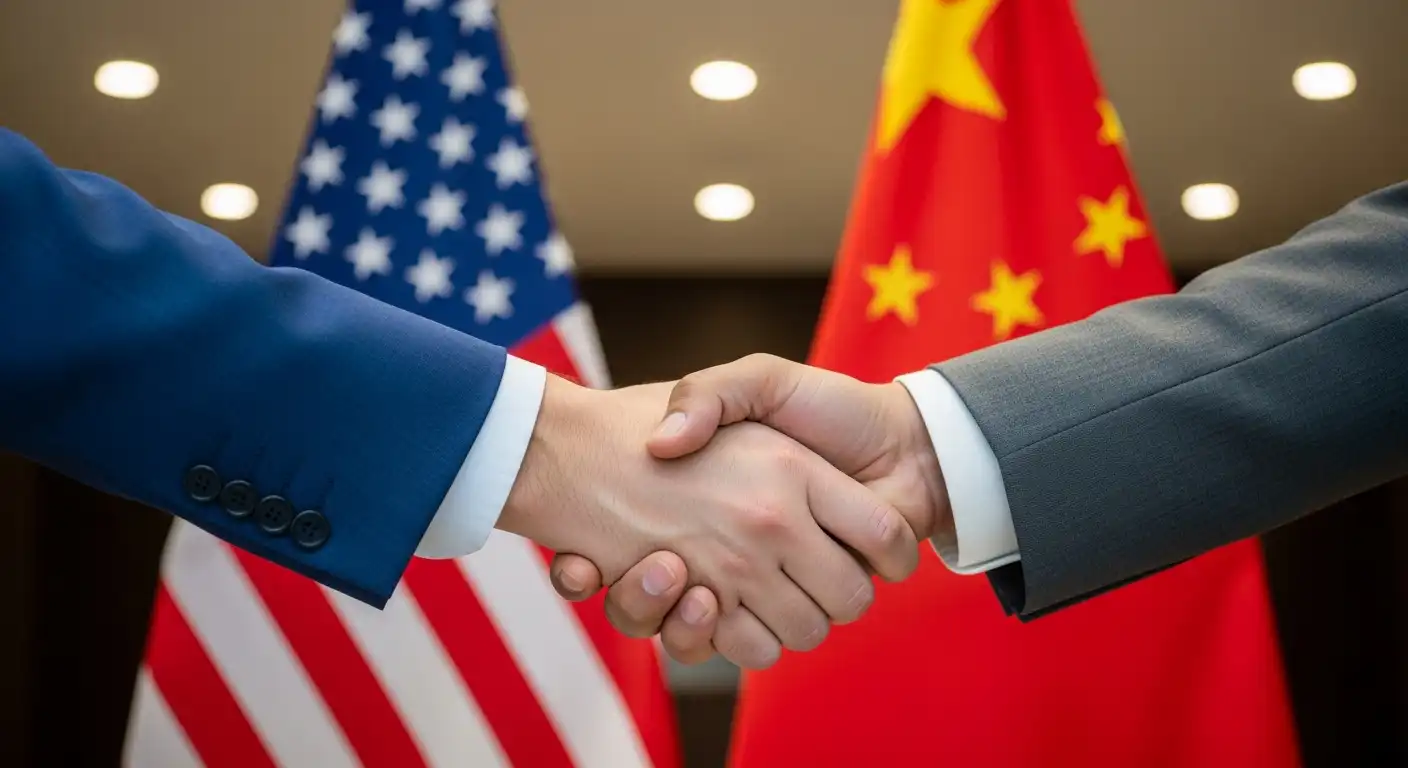
Chinese diplomatic and economic officials have issued a stern warning to Washington, formally accusing the United States of practicing “AI hegemonism” and threatening firm, reciprocal countermeasures if American regulators launch new trade investigations targeting Chinese artificial intelligence enterprises. The sharp escalation in rhetoric from Beijing’s Ministry of Foreign Affairs and Ministry of Commerce marks a high-stakes standoff in the global technology war, as both superpowers compete for dominance in artificial general intelligence, advanced microprocessors, and global digital infrastructure.
The immediate catalyst for Beijing’s official warning is a series of prospective administrative probes under consideration by the United States Department of Commerce, the Federal Trade Commission, and the Department of the Treasury. American policymakers are evaluating formal investigations into Chinese artificial intelligence laboratories—including high-profile open-source developers like DeepSeek, alongside technology giants Huawei, Alibaba, and Baidu—focusing on allegations of synthetic data harvesting, automated API model distillation, and potential circumvention of semiconductor export controls.
In response, Chinese officials accused the United States of weaponizing national security concepts to maintain a unilateral monopoly over critical technologies and suppress legitimate international competition. Ministry representatives stated that if Washington imposes fresh sanctions, expands its Entity List restrictions, or attempts to restrict global access to Chinese open-weights artificial intelligence models, Beijing will deploy firm countermeasures. Potential retaliation options include expanding China’s Unreliable Entity List, launching antitrust reviews into American technology firms, and tightening export restrictions on critical green energy minerals.
TechGolly provides a detailed analysis of the diplomatic confrontation between Beijing and Washington, evaluating the rhetoric of AI hegemonism, prospective US model distillation inquiries, China’s critical mineral leverage, domestic semiconductor substitution programs, and the long-term bifurcation of the global technology economy.
Unpacking the Charges of US AI Hegemonism and Trade Coercion
The phrase “AI hegemonism” represents a deliberate framing choice by Chinese foreign policy strategists, designed to rally international support against American technology restrictions. In formal diplomatic statements, Chinese officials argued that the United States is attempting to establish a closed, unilateral digital order that denies developing nations access to transformative technological tools.
Beijing’s core argument asserts that American trade policy relies on coercive economic practices that violate basic principles of international trade and fair market competition. Chinese trade negotiators point to a multi-year sequence of United States trade interventions—including strict export controls prohibiting ASML from shipping immersion DUV lithography machines to Chinese foundries, bans on advanced Nvidia graphics processing units, and restrictions on outbound American venture capital investments—as evidence of a systematic strategy to freeze China’s technological development.
Furthermore, Chinese diplomats are positioning their domestic artificial intelligence sector as a champion of global open-source technology. By releasing high-capability models like DeepSeek-R1 and DeepSeek-V3 under permissive, open-source licenses, Chinese research laboratories allow enterprise developers, academic institutions, and governments across the Global South to download model weights directly, host systems on private infrastructure, and build localized software applications without paying high per-token API fees to Western cloud conglomerates.
Chinese officials contend that United States attempts to investigate or restrict open-source model releases are designed to protect the high-margin monopolies of Silicon Valley cloud providers. By framing the conflict as a choice between inclusive, open-source technological democratization and closed, proprietary Western control, China seeks to build diplomatic alliances with emerging economies across Asia, Africa, Latin America, and the Middle East.
The Impending US Probes: Model Distillation and Cloud API Scraping
At the technical center of the dispute between Washington and Beijing are prospective United States investigations targeting a practice known as knowledge distillation or API output harvesting.
Over recent months, Western technology executives and security analysts have alleged that Chinese artificial intelligence laboratories accelerated their research progress by executing automated prompt campaigns against commercial APIs operated by Western artificial intelligence pioneers like OpenAI and Anthropic. By harvesting millions of detailed reasoning chains and step-by-step problem-solving outputs generated by frontier models, Chinese developers built rich synthetic training datasets, using them to train open-weight student models like DeepSeek-R1 for a tiny fraction of traditional pre-training compute costs.
United States regulatory agencies are evaluating whether synthetic data harvesting from commercial APIs violates private corporate Terms of Service, breaches United States intellectual property frameworks, or constitutes an unfair international trade practice under Section 301 of the Trade Act of 1974. Federal investigators are also probing whether Chinese technology entities used third-party cloud proxy networks or overseas shell companies to access advanced Nvidia GPU clusters hosted in neutral international jurisdictions, bypassing Department of Commerce export limits.
Beijing firmly rejects these allegations, maintaining that model distillation is a standard, globally recognized machine learning technique utilized by computer scientists worldwide. Chinese legal scholars argue that outputs generated by artificial intelligence models are not protected by traditional human copyright laws, and that attempting to penalize international developers for learning from publicly accessible text sets a dangerous legal precedent that threatens global scientific progress.
China’s Countermeasure Arsenal: Critical Minerals and Entity Lists
If the United States executes fresh trade sanctions or regulatory bans against Chinese artificial intelligence firms, Beijing maintains an extensive array of retaliatory tools that could inflict immediate financial and operational pain on American technology supply chains.
The primary physical economic lever held by China is its dominant command over global critical minerals. China controls approximately 70% of global rare earth element mining output and commands over 90% of global refining and permanent magnet manufacturing capacity. Furthermore, Beijing exercises near-total control over global supplies of specialized high-tech metals, including gallium, germanium, antimony, and synthetic battery-grade graphite.
These critical minerals are irreplaceable inputs for high-technology manufacturing in the United States. High-performance permanent magnets containing Chinese dysprosium and terbium are required to build electric vehicle motors, offshore wind turbines, commercial jet engines, and guidance systems for military hardware. Gallium and germanium are essential components for manufacturing advanced military radar arrays, fiber-optic communications, and power semiconductors.
If China’s Ministry of Commerce executes strict export permit bans or total export embargoes on refined rare earth elements and specialized technical metals bound for the United States, American defense contractors, automotive manufacturers, and semiconductor fabrication plants would face immediate physical supply chain stoppages.
A secondary retaliatory mechanism is the active deployment of China’s Unreliable Entity List and Anti-Foreign Sanctions Law. Chinese regulatory agencies can place major American technology conglomerates, software vendors, and semiconductor equipment makers on national blacklists, prohibiting them from doing business in China, revoking corporate operating licenses, imposing severe administrative fines, and restricting executive travel.
Exclusion from the mainland Chinese commercial market would inflict severe top-line financial damage on Western technology giants. Historically, mainland China accounts for 20% to 40% of global corporate revenues for leading American semiconductor designers and equipment manufacturers. Losing access to Chinese commercial buyers would compress corporate profit margins and reduce the capital available for domestic American research and development.
The Domestic Semiconductor Substitution Drive: Big Fund III
A key factor giving Beijing the confidence to threaten reciprocal countermeasures is the rapid progress of its domestic semiconductor substitution drive, designed to insulate domestic industries from Western trade shocks.
To accelerate equipment localization, the Chinese government registered the third phase of its National Integrated Circuit Industry Investment Fund, known as Big Fund III. Commanding a registered capital of 344 billion yuan ($47.5 billion USD), Big Fund III represents the largest state-backed equity pool in Chinese corporate history, drawing capital from the Chinese Ministry of Finance, state-owned commercial banks, and municipal technology funds in Shanghai, Beijing, and Shenzhen.
Big Fund III is directing capital into critical upstream supply chain vulnerabilities:
- First, advanced domestic lithography systems. Chinese toolmakers, led by Shanghai Micro Electronics Equipment (SMEE), are field-testing homegrown 193-nanometer argon fluoride immersion DUV lithography tools capable of processing wafers at mature 28-nanometer nodes and scaling to 7-nanometer nodes via multi-patterning techniques.
- Second, electronic design automation (EDA) software, funding domestic software alternatives to Western market leaders.
- Third, high-purity chemical photoresists, electronic gases, and synthetic quartz photomasks.
- Fourth, domestic AI accelerator production, supporting the mass production of Huawei’s Ascend 910B and 910C processors.
By pairing domestic silicon fabrication with its national Six Networks computing strategy—which links energy grids, optical fiber backbones, and data center clusters into a unified national compute network—China is building a self-sustaining technological ecosystem that can survive complete decoupling from Western hardware supply chains.
The Open Source vs Proprietary Cloud Strategic Divide
The diplomatic clash between Washington and Beijing highlights a widening operational and philosophical divide regarding how artificial intelligence infrastructure should be constructed, funded, and commercialized globally.
The Western technology model relies primarily on a capital-intensive, market-driven architecture dominated by mega-cap cloud hyperscalers. American technology giants spend over $200 billion annually in corporate capital expenditures, constructing massive proprietary data centers and hosting closed-source frontier models accessible through subscription APIs. While this private commercial model drives rapid software innovation, it creates high API token costs for enterprise buyers and requires immense electrical power capacity that strains local utility grids.
In contrast, China is advancing a state-directed, utility-style architecture paired with an open-source software ecosystem. Chinese policymakers treat raw computing power as a basic public utility, constructing state-funded national computing hubs in energy-rich western provinces to supply low-cost processing power to domestic businesses.
Simultaneously, Chinese AI research laboratories release open-weights models under permissive open-source licenses. Open-weights models allow enterprises worldwide to download model parameters directly onto private servers, capturing 100% data sovereignty, total user privacy, and zero per-token API fees.
This open-source deployment strategy threatens the commercial monetization models of Western technology giants. If compact, open-source models like DeepSeek-R1 allow enterprise buyers to achieve 90% of frontier reasoning capability at 10% of the cost on private servers, corporate demand for expensive proprietary cloud APIs will decline. This economic reality explains why Western technology firms are lobbying federal trade authorities to treat open-source output harvesting as an unfair trade practice.
Global Market Reactions and Supply Chain Bifurcation
As diplomatic friction between the world’s two largest economies intensifies, global technology markets, financial investors, and corporate supply chain directors are preparing for a permanently bifurcated global technology landscape.
Multinational corporate enterprises operating across international borders are being forced to adopt a “one company, two systems” operational model:
In Western markets, corporate technology infrastructure relies on American cloud providers, proprietary Western AI models, and hardware complying with United States export regulations.
In mainland China and aligned emerging markets, corporate technology infrastructure utilizes domestic Chinese cloud platforms, open-weight Chinese foundation models, and domestic hardware stacks powered by localized silicon.
This structural bifurcation increases operational complexity and elevates corporate software development costs, as multinational firms must maintain duplicate software engineering teams, separate data center environments, and distinct compliance frameworks to satisfy conflicting legal mandates in Washington and Beijing.
Furthermore, international technology investment flows are re-aligning along geopolitical lines. Western venture capital firms are withdrawing from early-stage Chinese technology investments to avoid federal regulatory penalties, while Chinese technology firms are turning to internal hedge fund capital, municipal guidance funds, and Middle Eastern sovereign wealth funds to finance long-term research and development.
Strategic Outlook for the Global Technology Economy
The confrontation between China and the United States over AI hegemonism marks a permanent end to the era of hyper-globalized, single-chain technology manufacturing that governed international commerce for the past three decades.
Looking forward through the late 2020s, global competition in artificial intelligence will be defined by strategic state industrial policy, critical material controls, sovereign computing grids, and ideological battles over open-source technology distribution.
Neither country can easily achieve a total, decisive victory in this technological standoff. While the United States retains an undisputed lead in top-tier semiconductor design, extreme ultraviolet lithography, and frontier foundation model capabilities, China possesses unmatched physical manufacturing scale, control over critical mineral supply chains, abundant engineering talent, and massive public capital reserves.
In this environment of permanent technological nationalism, international corporate leadership will belong to business leaders who build flexible, resilient, and geographically adaptable technology architectures capable of navigating trade shocks, regulatory inquiries, and shifting geopolitical alliances in an increasingly divided world.
Key Takeaways for Tech Executives, Policy Analysts, and Investors
The escalation of diplomatic and trade tensions over artificial intelligence delivers vital strategic insights for corporate decision-makers, software architects, supply chain directors, and institutional investors.
First, geopolitical risk must be integrated into technology planning. Enterprise technology teams can no longer assume uninterrupted access to single-region cloud APIs or global semiconductor supply chains; building hybrid, multi-cloud architectures with local data hosting options is essential for operational continuity.
Second, critical mineral supply chains represent a primary corporate vulnerability. Industrial, automotive, and technology manufacturers must audit their reliance on Chinese rare earth elements, refined battery materials, and specialized technical metals, actively diversifying component sourcing to protect against potential export embargoes.
Third, open-source models offer permanent strategic flexibility. Corporate Chief Information Officers should evaluate high-performance open-weight models for internal deployment, capturing complete data sovereignty, zero vendor lock-in, and significant operational cost reductions compared to proprietary commercial APIs.
Finally, global technology competition has entered an era of sovereign industrial strategy. Corporations and investors that align capital allocation with long-term national policy priorities, invest in supply chain resilience, and master localized regulatory compliance will secure market leadership in the evolving global digital economy.






