

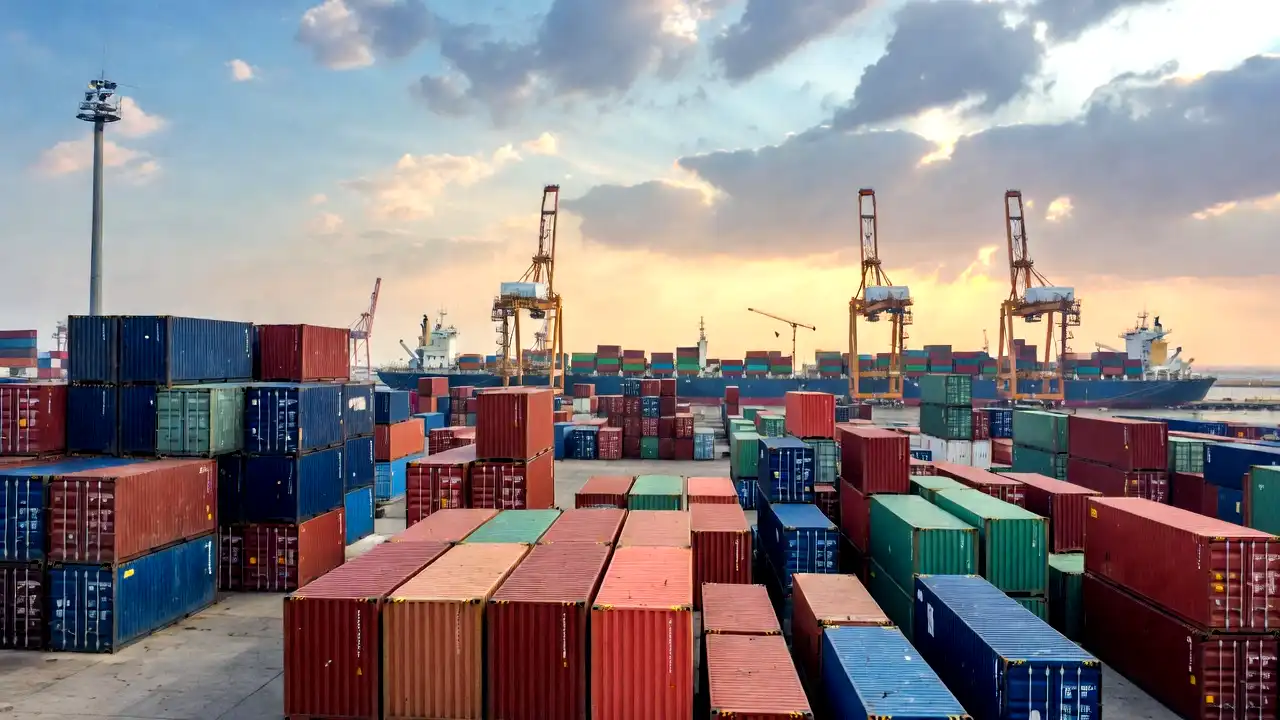
South Korea’s monthly export growth surged past Wall Street forecasts in July, propelled by an extraordinary global appetite for artificial intelligence memory chips and advanced electronic components. Official trade statistics published by the Ministry of Trade, Industry and Energy confirmed that total exports expanded 13.9% year-over-year to reach $57.49 billion. The strong double-digit growth marked the 10th consecutive month of total export expansion for the country, easily beating consensus economist estimates that had projected a more modest 11.8% to 13.0% increase.
The trade performance delivered a healthy $3.6 billion net trade surplus, securing South Korea’s 14th consecutive month of positive trade balances. The primary engine driving the trade surplus was the semiconductor sector, where microchip exports jumped 50.4% year-over-year to reach $11.3 billion. This recorded the highest July semiconductor export total in South Korean history and extended the sector’s double-digit export growth streak to nine consecutive months. Global cloud hyperscalers building liquid-cooled artificial intelligence data centers continued to place massive orders for high-bandwidth memory and high-density server storage modules.
Geographical trade patterns revealed robust demand across the world’s two largest economies. Exports shipped to the United States rose 17.0% year-over-year to $10.2 billion, achieving a record high for any July month, driven by North American artificial intelligence infrastructure investments. Simultaneously, exports to China expanded 14.9% to $11.4 billion, hitting a 21-month high as Chinese electronics manufacturers imported high volumes of South Korean memory components and intermediate industrial materials for local assembly.
TechGolly provides a detailed financial and trade analysis of South Korea’s July export beat, evaluating semiconductor memory price supercycles, high-bandwidth memory supply chains, United States and China destination trade flows, automobile export adjustments, petroleum refining margins, and long-term implications for global technology supply chains.
Unpacking the July Trade Performance and 13.9 Percent Export Growth
South Korea’s July trade performance demonstrates the remarkable momentum powering the global technology hardware supply chain. As an export-oriented economy that manufactures intermediate components for global supply chains, South Korea’s monthly trade statistics are widely recognized by institutional investors as a real-time health indicator for global industrial production.
The 13.9% year-over-year export expansion to $57.49 billion marks an acceleration from June’s 5.1% growth rate. The total trade volume was supported by strong double-digit gains in key technology categories, which easily compensated for temporary seasonal slowdowns in traditional heavy manufacturing sectors.
On the import side, total imports into South Korea rose 10.5% year-over-year to $53.88 billion during the month. The import increase was driven primarily by corporate purchases of capital equipment, raw industrial metals, and imported energy products needed to sustain domestic manufacturing operations. Despite higher import bills driven by international crude oil spot prices hovering near $100 per barrel, South Korea’s high-margin semiconductor exports generated a $3.6 billion monthly trade surplus.
Maintaining a trade surplus for 14 consecutive months reflects a fundamental structural recovery for South Korea’s balance of payments. In prior years, volatile global energy prices caused severe trade deficits as energy import costs expanded. Today, the high dollar value of advanced memory chip exports provides a permanent financial cushion, ensuring that South Korea maintains a positive trade balance throughout varying commodity price cycles.
The Semiconductor Supercycle: 50.4 Percent Chip Export Explosion
The central pillar supporting South Korea’s trade beat is the ongoing supercycle in semiconductor memory. Microchip exports generated over $11.3 billion in monthly revenue, representing an extraordinary 50.4% year-over-year increase.
The primary driver behind this chip export explosion is an acute physical supply shortage in High-Bandwidth Memory (HBM3e and HBM4) and high-density server DRAM. High-bandwidth memory stacks, which are vertically integrated directly alongside artificial intelligence graphics processing units, deliver the extreme memory bandwidth required to run multi-trillion-parameter large language models without processing bottlenecks.
This supply shortage has triggered an aggressive pricing supercycle across global memory markets:
- Contract prices for high-density server DRAM surged 40% quarter-over-quarter, while NAND flash storage prices climbed 53%.
- Because advanced memory fabrication requires complex 3D Through-Silicon Via packaging, chipmakers cannot easily expand physical output without multi-billion-dollar cleanroom expansions.
South Korea’s two semiconductor giants—SK Hynix and Samsung Electronics—control over 85% of the global high-bandwidth memory market. SK Hynix, which commands over 50% of global HBM shipments and recently raised $26.5 billion in a historic U.S. listing, has fully committed its HBM production capacity through late 2027. Samsung Electronics reported a 19-fold operating profit jump in its quarterly results, allocating $40 billion in capital expenditures to build dedicated HBM packaging lines. These multi-billion-dollar order backlogs guarantee that South Korea’s semiconductor exports will maintain strong upward momentum through the remainder of the year.
Furthermore, exports of display panels and wireless communication equipment recorded positive gains. Display exports rose as smartphone manufacturers prepared for fall product launches, while wireless communication exports benefited from global 5G network infrastructure upgrades.
Regional Export Destination Dynamics: Record US Demand and China Recovery
Analyzing geographical trade channels reveals strong, synchronized demand across South Korea’s primary export destinations, with both the United States and China recording major shipment gains.
Exports to the United States expanded by 17.0% year-over-year to $10.2 billion, setting a record for the month of July. American technology hyperscalers—including Alphabet, Amazon Web Services, Microsoft, and Meta Platforms—are committing over $200 billion collectively in annual capital expenditures to construct liquid-cooled AI data centers, importing massive volumes of South Korean memory modules, solid-state drives, and high-voltage electrical hardware.
Concurrently, exports to China rose 14.9% year-over-year to $11.4 billion, marking the highest monthly export value to the Chinese market in 21 months. Chinese technology enterprises and contract electronics assemblers are importing record volumes of South Korean memory chips, advanced display panels, and specialized petrochemical materials to support domestic smartphone manufacturing and artificial intelligence development.
The simultaneous expansion of export volumes to both Washington and Beijing highlights South Korea’s unique, strategic position as an indispensable hardware supplier for both Western and Asian technology ecosystems.
Exports to the European Union and Southeast Asian trade corridors also maintained positive growth trajectories. Shipments to the European Union grew, supported by demand for green energy technology, medical equipment, and industrial machinery, while trade corridors across ASEAN nations recorded high volume growth as contract electronics manufacturers in Vietnam, Malaysia, and India imported South Korean components for local device assembly.
Automobile Export Moderation and Summer Plant Retooling
While semiconductor exports achieved exponential gains, non-technology export categories experienced an expected period of growth moderation due to seasonal factory maintenance and high comparison baselines.
Automobile exports dropped 9.1% year-over-year to $5.4 billion following record-breaking sales performance in the previous year. The temporary decline in vehicle exports was driven by scheduled summer maintenance and retooling shutdowns across domestic assembly plants operated by Hyundai Motor Group and Kia.
During July, automakers temporarily paused assembly lines to upgrade machinery, install new industrial robotics, and reconfigure production tracks for upcoming vehicle model years. As domestic auto plants complete retooling cycles and resume full operational capacity, vehicle export volumes are expected to rebound during subsequent months.
Conversely, petroleum and chemical exports delivered strong secondary support to total trade numbers:
- Petroleum product exports grew 16.8% year-over-year to $4.5 billion, supported by high international refining margins and strong global demand for transportation diesel and aviation jet fuel.
- Petrochemical exports expanded 9.6% to $4.2 billion, benefiting from steady demand for synthetic resins and industrial plastic feedstocks across Asian manufacturing hubs.
- Shipbuilding and marine engineering exports also delivered positive contributions, as South Korean shipyards executed high-value delivery manifests for eco-friendly dual-fuel container ships and liquefied natural gas carriers.
The AI Data Center Supercycle and Memory Price Supercharges
The fundamental driver sustaining South Korea’s trade performance is the multi-year infrastructure buildout supporting global artificial intelligence development.
Deploying frontier artificial intelligence models requires massive physical computing infrastructure. Unlike traditional web-hosting servers that require modest memory capacity, an artificial intelligence server rack housing high-power GPUs requires up to 8 times more high-speed DRAM and 10 times more high-capacity flash storage to process complex reasoning algorithms without latency bottlenecks.
This extreme memory intensity has transformed the semiconductor industry’s financial dynamics. Memory chips are no longer treated as low-cost commodities; they have evolved into specialized, high-margin technology components that command premium contract pricing.
To meet this structural demand surge, South Korean memory makers are making historic capital commitments:
- SK Hynix is allocating tens of billions of dollars to construct advanced fab capacity in South Korea while expanding its advanced packaging footprint.
- Samsung Electronics is executing a $40 billion capital expenditure program to expand domestic cleanroom facilities and scale HBM4 mass production.
Together with government-backed infrastructure support, South Korea is constructing a $518 billion national semiconductor mega-cluster in Yongin, ensuring that domestic chipmakers maintain an insurmountable 2-to-3-year technology lead over global competitors.
Currency Exchange Dynamics: The Weak Won and Export Margins
South Korea’s trade beat was further enhanced by favorable foreign exchange conditions, as the domestic currency traded at competitive levels against the United States dollar.
The Korean Won traded in a competitive range between 1,350 and 1,390 Won per US Dollar throughout the reporting period. While a weaker domestic currency elevates the local-currency cost of imported crude oil, natural gas, and raw food commodities, it provides a major profit boost to South Korea’s export-oriented conglomerates.
When major exporters like SK Hynix, Samsung, and Hyundai sell products in United States dollars or Euros, converting those foreign currency revenues back into domestic Won generates massive top-line gains. Favorable exchange rate dynamics allow South Korean exporters to offer competitive pricing in global markets while expanding domestic operating profit margins.
Furthermore, sustained trade surpluses provide a strong financial buffer for the national economy. The continuous influx of foreign currency from export sales strengthens South Korea’s foreign exchange reserves, allowing monetary policy makers at the Bank of Korea to navigate global financial volatility with confidence.
Strategic Outlook for South Korea’s Export-Led Economy
Looking ahead through the second half of the year and into 2027, South Korea’s export-led economic outlook remains exceptionally bright, anchored by the structural expansion of the global artificial intelligence economy.
Government economic planners and private financial analysts project that sustained high-bandwidth memory demand, strong semiconductor pricing power, and a recovery in automotive shipments will keep South Korea’s monthly exports on an upward trajectory, ensuring a multi-billion-dollar monthly trade surplus.
However, international trade experts highlight several external risk factors that require careful management:
- First, potential trade policy shifts and rising import tariffs in major Western markets. If importing nations implement new statutory tariffs on technology hardware or automobiles, South Korean manufacturers must utilize their global production hubs in North America, Europe, and Southeast Asia to maintain market access.
- Second, ongoing geopolitical disruptions in maritime shipping corridors. Escalating conflicts in the Red Sea and the Strait of Hormuz have pushed international air and sea freight rates higher, increasing transportation expenses for global exporters.
- Third, domestic technology substitution efforts in China. As Chinese foundries invest heavily in domestic mature-node semiconductor capacity, South Korean chipmakers must continuously advance their technology lead, transitioning production toward cutting-edge HBM4 and sub-2-nanometer memory architectures where foreign competitors cannot easily follow.
By maintaining its lead in advanced semiconductor engineering, investing in high-value green infrastructure, and deepening commercial partnerships across North America, Europe, and Asia, South Korea is well-positioned to sustain its export-led economic growth for years to come.
Key Takeaways for Tech Executives, Trade Analysts, and Investors
The strong July export report from South Korea delivers vital strategic insights for corporate decision-makers, technology architects, global trade analysts, and institutional investors.
First, semiconductor memory is the irreplaceable foundation of the digital economy. As artificial intelligence models scale in complexity, high-bandwidth memory and server DRAM become critical physical bottlenecks, making memory producers primary beneficiaries of technology capital spending.
Second, South Korean trade statistics provide the ultimate leading indicator for global technology trends. Investors and corporate strategists tracking the artificial intelligence boom should monitor monthly South Korean memory export metrics as a real-time gauge of global hardware demand.
Third, supply chain scale creates an unassailable competitive moat. The immense capital and technical requirements of manufacturing HBM3e and HBM4 memory ensure that established market leaders will capture the vast majority of economic profits during technology supercycles.
Finally, geographic trade balance is essential for long-term resilience. Exporters that maintain strong, balanced trade channels to both Western developed markets and Asian manufacturing hubs can successfully navigate global geopolitical shifts and sustain long-term commercial growth.






