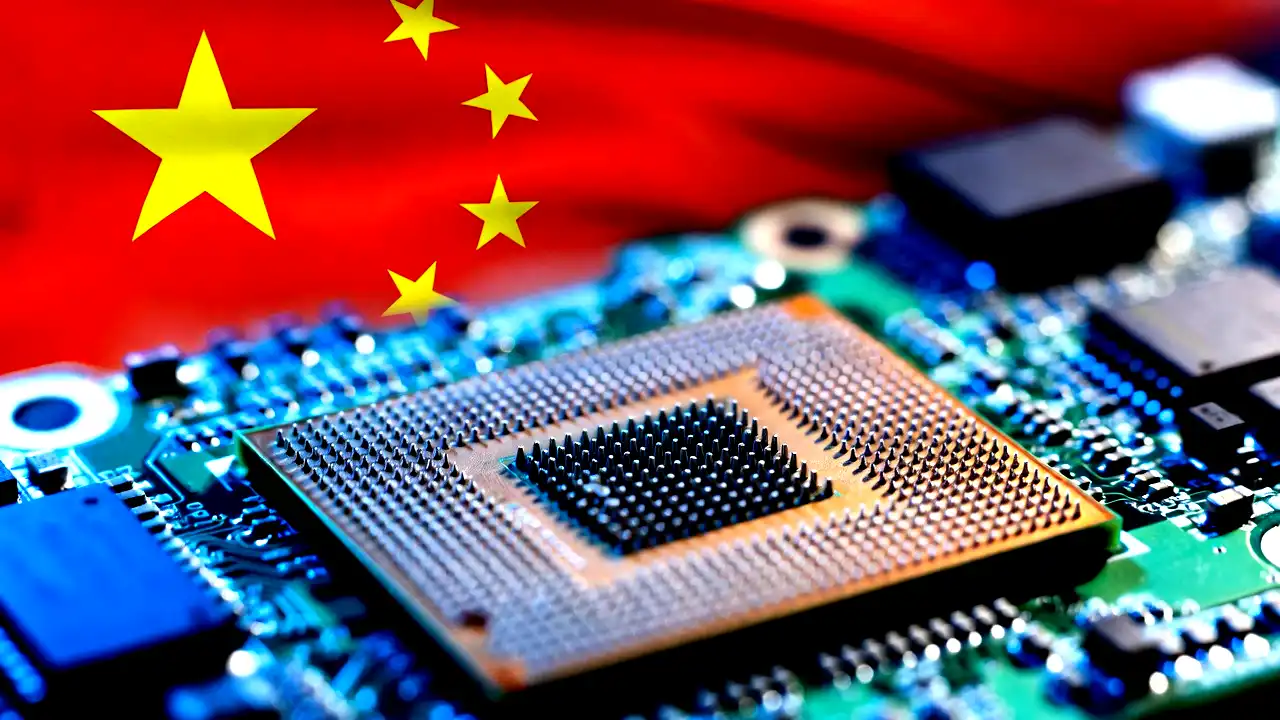
A massive shift in industrial purchasing is taking place inside China’s technology sector, triggering a historic financial boom for domestic semiconductor companies. In August 2026, financial market data revealed that Chinese artificial intelligence chip designers are preparing for an unprecedented surge in revenues during the upcoming corporate earnings season. This financial windfall is the direct result of a highly coordinated, aggressive campaign by Beijing to force domestic technology giants to replace American hardware with homegrown components.
For years, China’s largest internet and cloud providers, including Baidu, Tencent, Alibaba, and ByteDance, relied heavily on graphics processors made by United States chip giants Nvidia and Advanced Micro Devices. However, as Washington continues to tighten its technology export controls and threaten broader trade blockades, Beijing has issued quiet but firm directives to its domestic tech leaders. The government is requiring these companies to cut their reliance on foreign components and purchase locally designed semiconductors instead.
This local replacement push has completely transformed the fortunes of China’s domestic chip designers. By redirecting billions of dollars in procurement budgets from Silicon Valley to local fabricators, Beijing is successfully building a self-reliant technological ecosystem. The resulting surge in demand has allowed Chinese semiconductor firms to scale up their production lines to historic heights, establishing a highly resilient domestic supply chain that can withstand external geopolitical pressures.
The Regulatory Push: Beijing’s Mandate for Self-Reliance
The pressure on Chinese technology giants to adopt domestic silicon is no longer a suggestion; it has become an absolute requirement for corporate survival inside China’s highly regulated market. Beijing recognizes that its long-term economic and military security depends entirely on its ability to manufacture advanced computer processors within its borders.
Breaking the Dependency on American Silicon
The US government’s persistent efforts to block China’s access to advanced semiconductors have had an unexpected consequence. Instead of paralyzing China’s artificial intelligence development, the restrictions have acted as a powerful catalyst, forcing Chinese companies and state agencies to work together to build a completely independent semiconductor industry.
To achieve this goal, Beijing has utilized its immense regulatory influence over the country’s private technology sector. Government agencies have instructed major cloud and internet platforms to systematically reduce their procurement of foreign-designed chips, even those custom-designed by Nvidia to comply with US export rules.
Instead, these companies must allocate a significant portion of their hardware budgets to domestic alternatives. This state-mandated demand ensures that local chip designers have a guaranteed, highly lucrative domestic market, providing them with the massive revenues necessary to fund their next generation of advanced research and development.
Financial Trajectory of China’s Integrated Circuit Industry
The economic scale of this domestic replacement campaign is visible in China’s national export and manufacturing data. In the first quarter of 2026, China’s integrated circuit exports surged by an astonishing 77% year-over-year.
This rapid expansion is part of a longer-term upward trend. Over the 12 months ending in July 2026, China’s integrated circuit exports reached a record-breaking $234 billion, representing a 43% increase compared to the preceding year.
Furthermore, during peak periods of global hardware demand, Chinese shipments abroad climbed 14% year-over-year to a monthly record of $359 billion. This massive export engine allowed Chinese technology companies to reel in an average of $500 million every single hour of the day.
With chip exports surging by 100% in certain months, the semiconductor sector has become the primary driver of China’s national export growth, easily compensating for a prolonged domestic property downturn and lifting other major technology-heavy Asian economies, including South Korea and Taiwan.
Microeconomic Champions: Cambricon, CXMT, and Huawei
The financial windfall from Beijing’s local purchasing push is concentrated around a handful of elite Chinese semiconductor designers and memory manufacturers, who are rapidly expanding their physical manufacturing capacities to meet the sudden influx of domestic orders.
Cambricon’s Triple Production Campaign
Beijing-based Cambricon Technologies Corporation has emerged as one of the primary beneficiaries of this state-sponsored procurement shift. The company, which specializes in designing advanced processors optimized for artificial intelligence workloads, is set to triple its production capacity in 2026.
Under its current scaling plans, Cambricon wants to deliver half a million (500,000) advanced AI accelerators to Chinese cloud providers and enterprise developers.
This massive production target represents a monumental industrial achievement for a company that was once considered a minor player in the global chip market. By tripling its output, Cambricon is proving that Chinese designers can successfully manufacture complex, high-density AI accelerators at scale, saving local technology companies over $1 billion in foreign licensing fees and hardware costs while securing an unbreakable grip on the domestic market.
CXMT and Hefei: The Memory-Chip Boomtown of China
The boom in domestic chip demand is also transforming entire regional economies within China, creating highly prosperous “AI boomtowns” that stand in sharp contrast to the rest of the country. The city of Hefei, the capital of the eastern Anhui province, has become the undisputed heart of China’s memory chip industry.
Hefei is home to CXMT Corporation (ChangXin Memory Technologies), China’s leading manufacturer of high-bandwidth memory chips. The company’s technological progress and strategic importance to the national economy were on full display during its highly anticipated public market debut.
On July 27, 2026, CXMT Corp. listed shares on the Shanghai Stock Exchange, with its stock price soaring by a jaw-dropping 470% on its first day of trading. This spectacular market debut highlights the immense investor enthusiasm for Chinese hardware firms, as both retail and state-owned institutional investors rush to back the companies that are building the physical baseline of China’s digital economy.
Huawei’s Novel Design Path and the Tau Scaling Law
While companies like Cambricon and CXMT focus on scaling up existing designs, technology giant Huawei Technologies Company is exploring completely new scientific paths to bypass Western chipmaking restrictions.
In a rare and highly watched four-hour public interview in late July, Huawei’s top semiconductor scientist, Liao Heng, expounded on the physical limits facing Western chip giants. Liao argued that the decades-long practice of continuously shrinking and making integrated circuits more dense—which has allowed firms like Nvidia and foundries like Taiwan Semiconductor Manufacturing Company to deliver more powerful processors every year—will soon run out of physical runway.
Liao warned that once Western chipmakers cross this physical limit, the industry will face a sudden, chaotic technological barrier, or an “avalanche,” because they cannot make silicon transistors any smaller.
To prepare for this physical limit and overcome its lack of access to advanced extreme ultraviolet lithography machinery from Dutch manufacturer ASML, Huawei has developed a novel design philosophy called the “Tau Scaling Law”.
Instead of focusing solely on shrinking transistors, Huawei’s engineering teams are prioritizing architectural innovation, advanced packaging, and software optimization. By combining multiple less-advanced chips into a single, highly optimized package and using specialized AI models to manage data flow, the company can deliver processors that match the performance of Western rivals while utilizing older, more accessible manufacturing equipment. This practical, creative approach allows Huawei to build highly competitive AI hardware, demonstrating that a 1.5% reduction in software latency can make domestic chips highly competitive with restricted Western processors.
The “Split-Screen” Economy: Boomtowns and Rustbelts
While the artificial intelligence boom has generated massive wealth for China’s technology hubs, it is also creating a highly stark, “split-screen” economy within the country. The rapid concentration of wealth and capital around high-tech manufacturing is widening the economic divide between different regions.
The Economic Divergence of “Smart” Cities
According to a research note published by Nomura Holdings, the economic benefits of the global AI boom are being concentrated within a very small, select group of metropolitan areas. Nomura economists tracked seven “smart” cities—including Beijing, Shanghai, Shenzhen, and Hefei—which host the country’s leading semiconductor, artificial intelligence, and robotic research labs.
The data revealed that the weighted average GDP growth of these seven smart cities picked up to 5.6% during the first half of the year.
This blistering performance represents a major share of China’s national economic growth, helping the country meet its full-year GDP targets. However, the rest of the country is ceding ground rapidly. Traditional industrial regions, such as the automotive-producing rustbelt city of Changchun, are facing unprecedented economic difficulties as consumer demand shifts away from gasoline-powered vehicles and older manufacturing technologies.
Domestic Households Left Behind Amid High Automation
Even within the highly prosperous AI boomtowns like Hefei, the local population is not experiencing a significant financial windfall. While factories are running at maximum capacity to produce memory chips and AI accelerators, local retail sales are actually shrinking in several of these cities.
This disconnect occurs because modern chip manufacturing is highly automated, relying on robotic arms, advanced sorting machines, and software systems rather than human labor. The few manual jobs available on the factory floor are often filled by temporary labor agencies, which keep wages low and offer limited job security.
Consequently, the massive profits generated by the AI hardware boom are being reaped almost entirely by a small group of tech executives, corporate shareholders, and local governments, leaving everyday households with very little direct benefit from the technology revolution. This economic disparity is forcing Beijing to consider new policy efforts in the second half of the year to support struggling consumer markets.
Geopolitical Shockwaves and Silicon Valley’s Dilemma
The rapid progress of China’s domestic semiconductor industry is creating severe anxiety in Silicon Valley and Washington. American technology executives are realizing that their own government’s export controls may have inadvertently created a powerful, self-reliant competitor that could eventually challenge US dominance in the global market.
Open-Source AI and the Low-Cost Software Threat
The threat to Silicon Valley is not limited to hardware. Chinese startups are also releasing highly advanced, open-source artificial intelligence models that are completely free to download and use globally.
Models like Moonshot AI’s Kimi K3, which features 2.8 trillion parameters, are now powerful enough to compete directly with expensive, proprietary systems offered by American developers like OpenAI and Anthropic.
The emergence of these low-cost Chinese alternatives has caused deep divisions within both the White House and the US technology sector. On one side, American chip manufacturers want to maintain access to the massive Chinese market, arguing that restrictive export controls are cutting off their primary source of research and development revenue. On the other side, security hawks and proprietary AI developers argue that Chinese-made hardware and open-source models pose severe national security risks.
With US Treasury Secretary Scott Bessent suggesting that the government could implement sweeping sanctions against Chinese AI firms, the geopolitical battle over the future of technology is set to remain highly volatile for years to come.
Establishing a Self-Reliant Technological Future
The pricing of China’s domestic AI chipmakers represents a landmark moment in the global technology race. By implementing strict, quiet directives that force domestic tech giants to purchase homegrown silicon, Beijing has successfully transformed the threat of US trade sanctions into a powerful catalyst for industrial self-reliance.
Through the rapid scaling of companies like Cambricon and CXMT, and the architectural innovations developed under Huawei’s Tau Scaling Law, China is proving that it can build, cool, and operate its own advanced artificial intelligence infrastructure without relying on Silicon Valley.
As the country’s high-tech export engine continues to generate record-breaking revenues, the success of this local replacement campaign will serve as a powerful signal to developers, competitors, and policymakers worldwide, proving that the future of technology will be defined by those who can control, protect, and manufacture their own physical computing infrastructure.