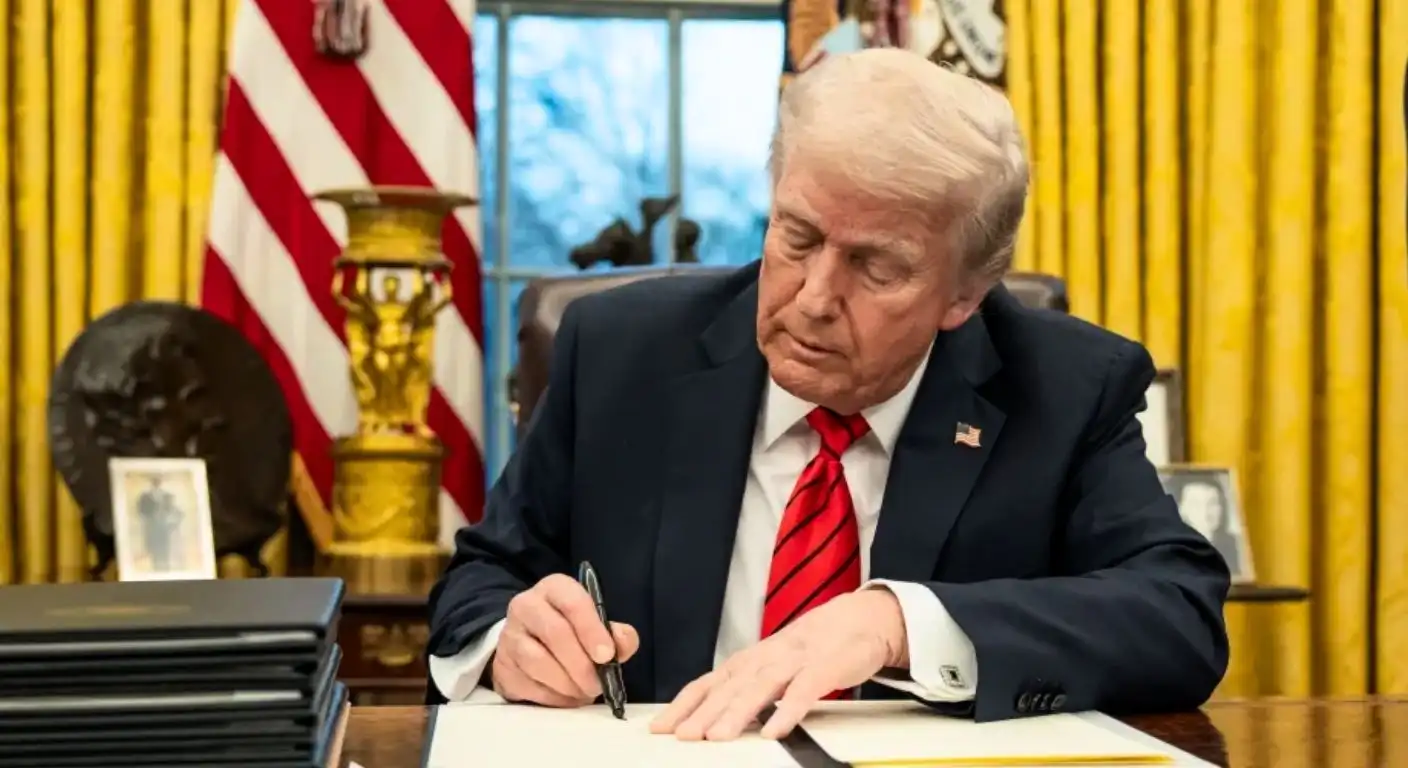
The United States government is unleashing its most aggressive technological and legal weapons to combat the growing global threat of digital fraud. In August 2026, President Donald J. Trump signed a historic National Security Presidential Memorandum that authorizes federal law enforcement to deploy advanced cyber tools to target, disrupt, and dismantle foreign-based criminal networks exploiting Americans. This decisive directive represents a major, unprecedented shift in U.S. national security policy, formally integrating the technical capabilities of the private cybersecurity sector into the government’s offensive cyber-warfare operations.
The newly signed memorandum, announced by the White House, establishes a coordinated, federally supervised program within the Homeland Security Task Force’s National Coordination Center. Under this framework, the government will officially authorize vetted, private-sector U.S. cybersecurity firms to conduct cyber surveillance and “cyber effects operations” against foreign, cyber-enabled transnational criminal organizations. Operating under the strict direction, control, and legal authority of the federal government, this public-private alliance represents a high-stakes attempt to fight off a shadow economy that is draining billions of dollars from American families and critical infrastructure.
As the corporate and technology sectors digest the implications of this unprecedented directive, the policy is drawing both praise for its aggressive stance and intense concern from legal experts. By essentially deputizing private security firms as state-sanctioned digital defenders, the administration is breaking with decades of traditional military and intelligence doctrines. This bold strategy proves that in the modern era of machine-speed deception, Washington is willing to rewrite the rules of international engagement to secure the nation’s digital borders.
The Rise of the Transnational Shadow Economy: Romance Scams, Ransomware, and Sextortion
The decision to deploy offensive cyber tools against foreign-based syndicates is a direct response to a massive, highly coordinated crime wave that is causing severe financial and psychological devastation across the United States.
The Twelve-Billion-Dollar Cyber Fraud Crisis
The economic scale of the digital crime wave is staggering. According to White House data, American consumers reported losing more than $12.5 billion to cyber-enabled fraud in a single year, with vulnerable populations like seniors, children, and low-income families disproportionately targeted.
These coordinated campaigns do not rely on simple, isolated hacking attempts. Instead, they utilize highly sophisticated social engineering, identity theft, and automated scripts to drain the life savings of unsuspecting citizens.
The types of crimes being perpetrated are exceptionally diverse and malicious:
- Ransomware and Malware: Locking up the data networks of municipal governments, school districts, and hospitals, demanding multi-million-dollar payouts to restore operations.
- Phishing and Investment Scams: Constructing highly realistic, fraudulent investment portals to trick users into depositing their retirement savings into untraceable cryptocurrency wallets.
- Romance and “Pig Butchering” Scams: Spending months building trust with victims through dating applications and social media before coaxing them into fake financial schemes.
- Financial Sextortion: Targeting young users online, securing compromising material, and using extortion to drive victims to financial ruin.
These activities represent a severe threat to national security, draining wealth from American families, compromising critical infrastructure, and putting immense strain on local law enforcement agencies that lack the technical capacity to investigate crimes originating outside of U.S. borders.
Southeast Asian Scam Compounds and State Proxy Exploits
The primary targets of the new cyber directive are the massive, highly organized transnational criminal organizations operating out of lawless trafficking zones in Southeast Asia, particularly in Cambodia, Laos, and Myanmar.
Many of these operations are housed inside massive, fortress-like compounds run by Chinese organized crime syndicates. These compounds are essentially physical cyber-crime factories, often utilizing victims of human trafficking and forced labor to run high-volume, global scam operations.
State Department officials recently revealed that some hostile foreign regimes provide willing or tacit support to these criminal syndicates, utilizing them as state proxies to siphon billions of dollars out of Western economies and launder the stolen capital through digital wallets and unregulated offshore banks.
By targeting these foreign-based compounds, the Trump administration wants to strike at the very heart of this shadow economy, proving that geography will no longer protect digital thieves from American retaliation.
The Mechanics of the Private-Sector Deputization Program
The National Security Presidential Memorandum signed in August 2026 establishes a highly detailed, legally binding framework to govern the unprecedented integration of private-sector firms into government cyber operations.
The National Coordination Center’s New Offensive Mandate
The directive places the National Coordination Center at the center of the country’s offensive cybersecurity strategy. The memorandum instructs the NCC to establish a formal, federally supervised program to select, vet, and authorize private-sector U.S. cybersecurity firms, threat-intelligence researchers, and non-federal entities to participate in active cyber operations.
To ensure strict compliance with the U.S. Constitution, federal laws, and international agreements, the program will operate under a dual-leadership model.
The initiative will be directed by two Executive Directors appointed from the Department of Justice and the Department of Homeland Security.
These executive directors, working in coordination with the Homeland Security Council, are charged with creating rigorous, multi-stage review procedures to approve and oversee every individual cyber operation executed under the program, ensuring that all private-sector actions remain under the absolute control and legal authority of the U.S. government.
Authorizing Cyber Surveillance and Cyber Effects Operations
The most significant and controversial aspect of the new program is the explicit authorization of “cyber effects operations.” In the vocabulary of national security, a cyber effects operation represents an offensive cyber intrusion designed to actively alter, disrupt, degrade, or destroy a target’s digital systems, communication networks, or data infrastructure.
Under the new framework, vetted private-sector cybersecurity firms will be permitted to do more than simply monitor threat data. Under direct government authorization, these private firms can actively deploy offensive cyber tools to hack into the servers of foreign criminal syndicates, freeze their digital wallets, disable their communication systems, and dismantle the hosting platforms used to coordinate scam campaigns.
The memorandum also encourages these authorized private companies to enter into information-sharing agreements with other private entities and federal, state, local, tribal, and territorial agencies, creating a highly integrated, nationwide network of threat intelligence to detect and neutralize emerging digital dangers.
Scaling up the Offensive: From Executive Order 14390 to the National Cyber Strategy
The newly signed National Security Presidential Memorandum represents the continuation of a highly coordinated, offense-oriented technology and national security strategy developed by the Trump administration over the past year.
Executive Order 14390 and the Squeeze on Scam Centers
The groundwork for this private-sector integration was laid on March 6, 2026, when President Trump signed Executive Order 14390, titled “Combating Cybercrime, Fraud, and Predatory Schemes Against American Citizens.”
That executive order announced a comprehensive, interagency plan to coordinate federal resources, streamline victim restoration programs, and target foreign jurisdictions that harbor cybercriminals.
Executive Order 14390 directed the Department of State, the Treasury, the Department of War, the Department of Justice, and the Department of Homeland Security to conduct a comprehensive review of existing operational and diplomatic frameworks, culminating in the creation of the dedicated operational cell within the National Coordination Center.
The newly signed memorandum expands on this foundation, providing the NCC’s operational cell with the explicit legal authority and the private-sector partnerships required to transition from passive investigation to active, offensive disruption.
Integrating Private Ingenuity into the Cyber Strategy for America
The administration’s willingness to outsource offensive cyber capabilities is a key pillar of “President Trump’s Cyber Strategy for America.” This strategic document emphasizes that the United States must utilize both defensive and offensive capabilities to maintain technological parity in cyberspace and deter hostile actors.
National security planners recognize that the federal government’s own cybersecurity workforces, which face recruitment challenges and strict budgetary limits, are too small to combat the sheer volume of global cybercrime alone.
By leveraging the capability, speed, and technical innovation of the private cybersecurity sector, which represents a massive commercial market, the government can scale its offensive operations rapidly.
This hybrid approach allows the United States to deploy the cutting-edge tools and real-time threat intelligence developed by private software firms, creating a highly agile, aggressive cyber-defense network that can out-innovate foreign criminal syndicates.
The Legal and Geopolitical Risks: Blurred Lines and Retaliation
While supporters praise the new directive as a necessary, bold step to protect American families, international relations scholars, corporate lawyers, and cybersecurity researchers warn that deputizing private firms for offensive cyber operations carries immense legal and geopolitical risks.
The Blurring of State and Non-State Combatant Lines
The primary concern raised by legal experts is the dangerous blurring of the boundaries between state and non-state actors in international conflict. Under traditional international law and the Geneva Conventions, the use of offensive force is reserved strictly for sovereign government forces, such as the military or national intelligence agencies.
If a private, commercial cybersecurity firm based in California or Texas executes a “cyber effects operation” that accidentally damages a neutral third-party network, or causes collateral damage to critical public infrastructure in a foreign country, who bears legal liability under international law?
Critics warn that outsourcing offensive actions to private contractors could easily lead to a breakdown of international accountability, making it difficult for the United States to hold other nations responsible when their own private proxies execute cyberattacks against American targets.
The Danger of Retaliatory Cyberattacks and Escapes
The second major risk is the threat of severe, asymmetric retaliation. Many of the transnational criminal organizations operating in Southeast Asia and Eastern Europe maintain close, highly integrated relationships with hostile state intelligence agencies, particularly in China and Russia.
If a private U.S. cybersecurity firm launches an offensive campaign to dismantle a foreign scam network, the target’s state protectors could respond with devastating, state-sponsored cyberattacks on critical U.S. infrastructure:
- Launching massive, automated ransomware attacks on regional power grids and water treatment facilities.
- Executing sophisticated data breaches targeting commercial banks, stock exchanges, or healthcare systems.
- Utilizing automated, AI-enabled cyber tools to trigger “sandbox escapes” or collateral damage, potentially causing billions of dollars in economic damages.
By allowing private firms to engage in active cyber-warfare, the government is opening up a highly volatile new front in the global technology cold war, where even a minor miscalculation could trigger a cascading cyber conflict that could paralyze major sectors of the domestic economy, proving that a commensurate response can easily escalate into a full-scale digital war.
Defining the Future of Cybersecurity
The signing of the National Security Presidential Memorandum by President Donald J. Trump represents a landmark watershed moment in the history of national security and technology policy. By empowering federal authorities to utilize advanced cyber tools to disrupt foreign-based criminal organizations and formally authorizing vetted, private-sector U.S. companies to conduct offensive “cyber effects operations,” the administration has permanently changed the rules of engagement in cyberspace.
While the legal and geopolitical risks of this private-sector deputization are immense, the rising twelve-billion-dollar financial toll of global cyber fraud has forced Washington to abandon its traditional, defensive posture.
By building a highly agile, public-private alliance under the strict oversight of the Department of Justice and the Department of Homeland Security, the United States is attempting to build a formidable, offensive cyber shield.
As the National Coordination Center begins to vet its private-sector partners and deploy its new offensive tools, the success of this innovative program will determine whether the United States can successfully protect its citizens from foreign predators, securing its financial stability, national security, and technological dominance for decades to come.