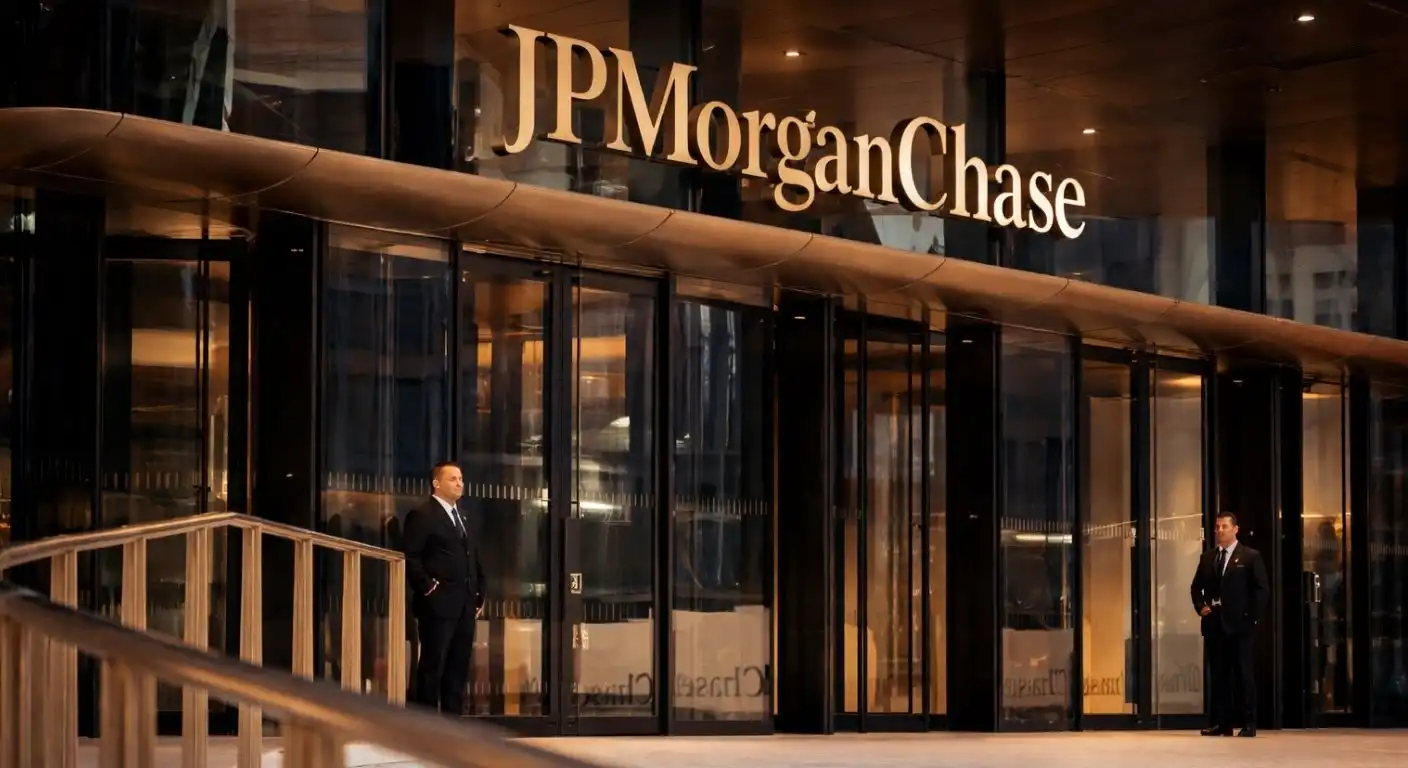
The relationship between traditional Wall Street banks and the fast-growing decentralized economy is experiencing a period of intense, highly complex friction. Recent financial disclosures reveal that JPMorgan Chase & Co., the largest bank in the United States, terminated its primary banking relationship with decentralized prediction market platform Polymarket. The decision, executed quietly, underscores the persistent caution major financial institutions maintain toward crypto-adjacent businesses, even as these emerging platforms achieve unprecedented commercial scale and pursue multi-billion-dollar valuations.
The corporate split has exposed a fascinating double standard at the heart of modern finance. While JPMorgan’s compliance officers deemed Polymarket’s deposits too risky to hold, directing the company to find a different banking partner, the bank’s investment division has continued to aggressively pursue a highly lucrative role in underwriting a potential Polymarket initial public offering. This complex, split-screen relationship proves that while major banks remain highly sensitive to regulatory and compliance risks, they are equally reluctant to walk away from the massive fee opportunities generated by the booming digital asset economy.
As Polymarket relocates its active customer fund flows and operational accounts to an undisclosed, unnamed banking partner, the dispute has also added fuel to a highly volatile political battle in Washington over “debanking.” With technology investors complaining about systemic banking blockades, and federal regulators actively investigating whether major commercial banks are unfairly denying financial services to emerging businesses, the JPMorgan-Polymarket split has become a landmark case study in the high-stakes struggle over who gets to participate in the modern financial system.
The Mechanics of the Split: Why JPMorgan Shuttered Polymarket’s Accounts
The decision by JPMorgan to terminate its banking services for Polymarket was not an arbitrary move; it was a direct response to a highly visible, multi-year regulatory battle between the prediction market operator and United States commodities regulators.
The Regulatory Scrutiny of the 2022 CFTC Settlement
The root of the platform’s regulatory troubles dates back to January 2022, when the Commodity Futures Trading Commission issued a major enforcement action against the company behind Polymarket. The regulator accused the company of operating an unregistered facility for the trading of event-based binary options contracts, effectively running an illegal derivatives exchange.
To resolve the dispute, Polymarket agreed to pay a $1.4 million civil penalty, cooperate with ongoing regulatory audits, and implement strict, geofenced restrictions to completely block all U.S.-based users from accessing or trading on its platform. While this settlement allowed the company to continue operating its international business, the regulatory black mark remained a significant concern for traditional financial institutions, which must comply with strict federal anti-money laundering and know-your-customer laws when hosting corporate deposits.
The Move to an Undisclosed Banking Partner
Faced with this ongoing regulatory cloud, JPMorgan’s compliance department concluded that the risk of hosting Polymarket’s primary corporate accounts outweighed the commercial value of the relationship. In October 2025, the bank officially notified the prediction market operator that it would shut down its accounts, directing the company to find a new banking partner.
Polymarket has since moved its active customer fund flows and operational bank accounts to another, unnamed financial institution, ensuring that its global services continue to operate without interruption.
While both companies declined to comment publicly on the specific details of the account closure, the split highlights a persistent, unresolvable tension: even when an emerging technology startup is fully compliant with its legal settlements, traditional commercial banks remain highly reluctant to host their deposits, fearing that any future regulatory actions could expose the bank to severe civil penalties, reputational damage, and federal audits.
The Wall Street Paradox: Severing Ties while Pursuing IPO Underwriting
While JPMorgan’s compliance officers were busy closing Polymarket’s deposit accounts, the bank’s investment banking division was executing a completely different, highly aggressive capital-market strategy to secure a piece of the startup’s future.
Inviting Shayne Coplan to the Exclusive Miami Conference
The complex, contradictory nature of the relationship was on full display recently, just months after the bank closed Polymarket’s accounts.
JPMorgan’s private banking division invited Polymarket’s 28-year-old Chief Executive Officer, Shayne Coplan, to speak at an exclusive, high-profile conference for wealthy private-banking clients in Miami.
Coplan was featured prominently on the conference stage, delivering a joint presentation alongside former NFL superstar Tom Brady.
This high-profile invitation sent a clear, confusing message to the market: while the bank was legally barred from holding the company’s operating cash, it was highly eager to introduce the company’s young founder to its wealthiest private clients, proving that Wall Street is highly willing to embrace the glamour and commercial potential of the prediction economy even as it distances itself from the underlying operational risks.
Positioning for a Multi-Billion Dollar Public Listing
The primary driver behind this double-standard strategy is the massive, multi-million-dollar fees associated with underwriting a public stock market listing.
Despite the regulatory challenges facing the sector, prediction markets have experienced an explosive, record-breaking surge in popularity, turning platforms like Polymarket into highly valuable commercial properties.
Recent financial reports reveal that Polymarket is actively in talks with international venture capital firms and institutional investors to raise more than $1 billion in fresh funding, targeting an extraordinary valuation of $20 billion. This target represents a massive expansion compared to the company’s previous valuation of approximately $8 billion.
With a potential initial public offering on the horizon, JPMorgan’s investment bankers are working quietly to ensure the bank remains in prime position to secure a lead underwriting role on the deal, which could generate millions of dollars in lucrative fee revenues, proving that on Wall Street, the pursuit of capital market profits can easily coexist with strict, risk-averse compliance gates.
The Political Squeeze: The Debanking Battle and Fair Access Investigations
The account closure at Polymarket does not occur in an isolated corporate vacuum. It is deeply connected to a highly volatile national political battle in Washington over the practice of “debanking” in the United States.
The Technology Industry’s Fight Against Operation Choke Point
For years, prominent technology investors, venture capital firms, and cryptocurrency startups have argued that major commercial banks are engaged in a quiet, systemic campaign to deny financial services to businesses operating in emerging, politically sensitive industries.
Industry advocates claim that banks frequently utilize vague “regulatory risk” explanations to close the accounts of compliant companies, effectively locking out entire technology sectors from the traditional banking system.
Critics compared this practice to “Operation Choke Point,” a controversial government-sponsored program that reportedly pressured banks to cut ties with legally compliant businesses in the firearms, payday lending, and short-term credit industries.
By forcing startups like Polymarket to constantly scramble to find alternative, often less-secure banking partners, these financial blockades create significant operational friction, making it exceptionally difficult for young companies to manage payroll, pay taxes, and process customer funds, leading to calls for federal legislative intervention.
Federal Probes into Fair Access and Trump’s Lawsuit
This regulatory friction has caught the immediate attention of federal policymakers and political leaders, turning debanking into a central issue for the upcoming legislative sessions. The United States government is currently investigating several of the country’s largest commercial banks, including JPMorgan, over whether they have violated “fair access” guidelines by systematically denying banking services to legally compliant cryptocurrency and energy companies.
At the same time, Donald Trump has filed a major, personal lawsuit against JPMorgan Chase and its prominent Chief Executive Officer, Jamie Dimon.
The lawsuit alleges that the bank closed several of Trump’s personal and business-related accounts for purely political reasons, violating consumer protection laws and attempting to use its financial power to influence national political campaigns.
While JPMorgan has rejected the allegations as completely meritless, the high-profile lawsuit has placed the bank’s internal account closure and risk-assessment procedures under intense public scrutiny, making any new debanking disclosures highly sensitive.
The Prediction Market Gold Rush: Reaching Two Hundred Fifty Billion in Volume
The regulatory and banking battles facing the industry are occurring against a backdrop of historic, unprecedented commercial success, as prediction markets rapidly transform into the most popular and highly traded platforms of the digital age.
The Post-2018 Sports Betting Boom as a Catalyst
The explosive growth of the prediction market sector is closely linked to a broader, nationwide expansion of the legal betting economy in the United States. Following a historic 2018 Supreme Court ruling that struck down the federal ban on sports betting, individual states have rushed to legalize and regulate sportsbooks, completely normalizing speculative, event-based betting in the American cultural consciousness.
Prediction markets have successfully capitalized on this cultural normalization by applying the same speculative mechanics to real-world global events.
Instead of betting on sports matches, users on platforms like Kalshi and Polymarket use real-time digital trading tools to buy and sell “shares” in the outcomes of international elections, central bank interest rate decisions, corporate mergers, and geopolitical conflicts.
Since the beginning of 2026, the notional trading volume of the global prediction market sector has surpassed a staggering $250 billion, proving that these decentralized platforms have successfully tapped into a massive, highly lucrative market of active retail and institutional traders.
The Persistent Fight with State Regulators and the CFTC
Despite this massive commercial success, prediction markets continue to face a hostile, highly volatile regulatory environment in the United States, with multiple federal and state agencies actively working to restrict their operations.
The industry is currently facing a series of coordinated regulatory challenges:
- Over a dozen U.S. state attorneys general and local regulators have launched coordinated civil lawsuits against major platforms, alleging that they are operating illegal, unlicensed sportsbooks and gambling operations under the guise of financial exchanges.
- The Commodity Futures Trading Commission continues to maintain an active, highly scrutinized investigation into Polymarket’s compliance with its 2022 consent order, searching for evidence of whether the platform has successfully blocked U.S. residents from trading on its international site.
- This persistent regulatory cloud is further complicated by insider trading allegations, with some critics warning that the lack of centralized market oversight on decentralized platforms makes them highly vulnerable to manipulation by market insiders.
This ongoing legal uncertainty explains why risk-averse commercial banks like JPMorgan remain highly cautious about hosting Polymarket’s operating deposits.
Even as federal regulators have allowed some regulated prediction markets to operate under strict, limited frameworks, the constant threat of state-level lawsuits and federal enforcement actions ensures that the sector remains a highly volatile compliance risk, forcing banks to maintain their defensive boundaries to protect their own financial positions.
Restructuring the Capital Rails of the Decentralized Economy
The finalization of the account split between JPMorgan Chase & Co. and Polymarket represents a landmark watershed moment in the financial evolution of the decentralized economy. By demonstrating that the largest bank in the United States is willing to terminate its primary banking relationship with a highly popular, $20 billion technology giant over regulatory concerns, the market has proved that the traditional banking sector remains deeply skeptical of the crypto-adjacent betting economy.
While the loss of its JPMorgan accounts has forced Polymarket to migrate its active customer fund flows to an undisclosed, alternative lender, the bank’s continued pursuit of a highly lucrative role in underwriting Polymarket’s potential initial public offering proves that Wall Street cannot easily ignore the massive commercial success of the prediction markets.
As the prediction market sector continues to expand, and as major platforms like Kalshi and Polymarket navigate a highly complex regulatory landscape of state-level lawsuits and federal audits, the industry’s ability to build secure, compliant, and transparent exchange systems will determine its long-term financial survival. The ongoing integration of these decentralized platforms with the traditional global financial system will ensure that the technology remains a highly resilient, highly contested, and highly profitable force in the digital economy, permanently changing how the world prices, trades, and predicts the outcomes of global events.