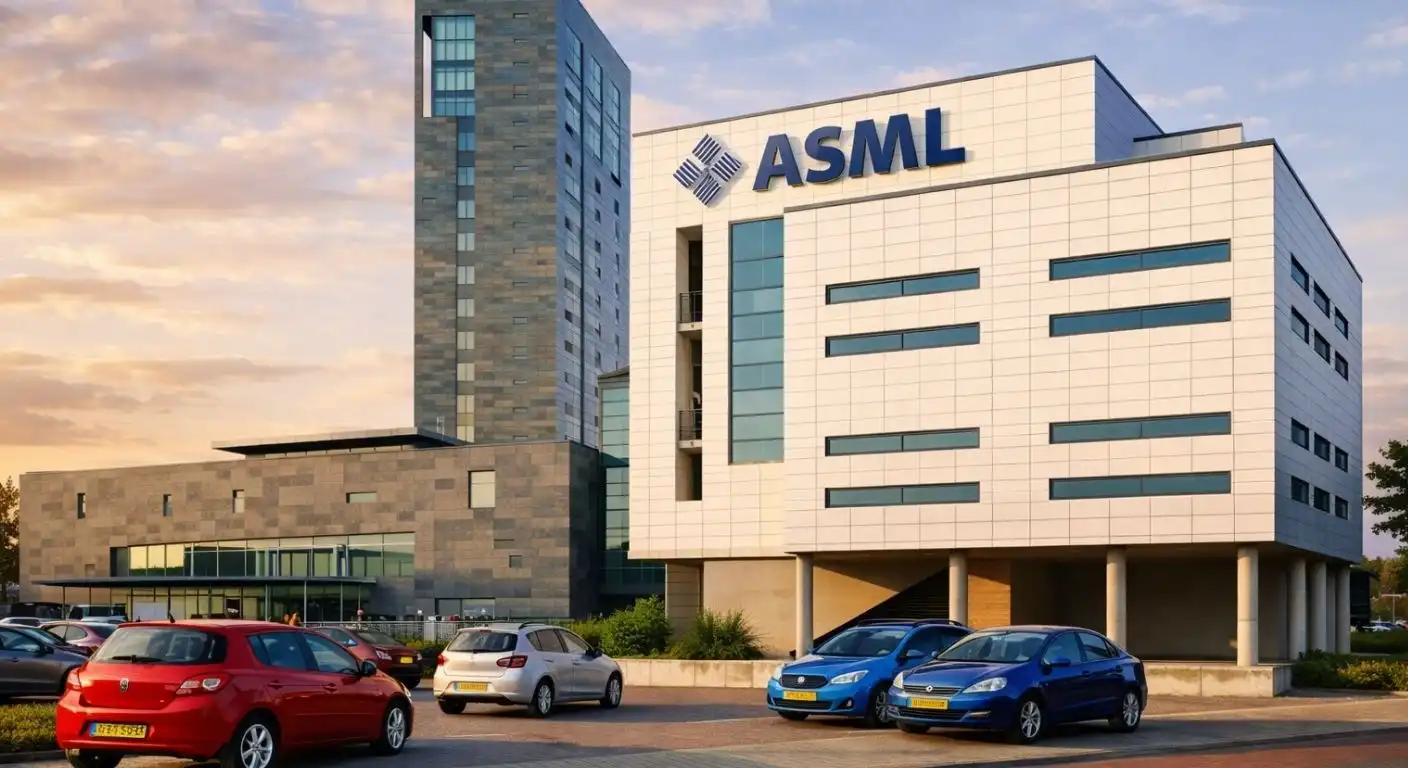
The global artificial intelligence boom is placing unprecedented demand on the supply chains that build advanced microchips. At the center of this technological gold rush sits ASML Holding NV, a Dutch company that holds a virtual monopoly on the manufacturing equipment required to produce the world’s most advanced semiconductors. Recognizing this unparalleled market position, Wall Street analysts have unleashed a fresh round of bullish forecasts. Most notably, Bank of America raised its price target on the technology giant, pointing to a rapidly filling order book that could be completely sold out through 2027 in the coming weeks.
This aggressive valuation upgrade comes at a time when chipmakers are scrambling to secure the machinery needed to construct high-performance AI processors. Extreme ultraviolet lithography systems, which only ASML can produce, have become the most sought-after tools in the semiconductor capital equipment sector. As global foundries invest billions of dollars to expand their production capacity, ASML’s long-term earnings potential is shifting into overdrive. By rolling forward financial models and anticipating a complete backlog sellout, major financial institutions are signaling that the company’s growth trajectory is set to accelerate well into the next decade.
The Price Target Upgrades and Market Context
The financial community expressed strong confidence in ASML’s market-leading position through a series of significant price target revisions in late June 2026. Bank of America analyst Didier Scemama raised the firm’s price target on the Nasdaq-listed shares of ASML to $2,345 from its previous target of $2,268, while reiterating a firm Buy rating. This new target implies an upside potential of approximately 22% from the stock’s recent trading levels, which have hovered near historic highs around $1,920.
BofA was not the only institution to adjust its outlook upward. Wells Fargo analyst Joe Quatrochi also lifted the bank’s price target on ASML to $2,200 from a previous projection of $1,750, maintaining an Overweight rating. This wave of upward revisions reflects a broader consensus on Wall Street that the chip equipment sector is entering a multi-year supercycle.
The financial performance of the company supports this optimism. During 2026 alone, ASML added nearly $331 billion to its total market capitalization, highlighting the intense investor appetite for businesses with solid fundamentals and exposure to the AI theme. Despite some temporary market volatility and geopolitical concerns regarding tool sales to China, the underlying demand for ASML’s advanced systems remains highly resilient.
Why the 2027 Order Book Matters Now
The timing of the analyst upgrades is directly linked to expectations for the company’s upcoming corporate reporting cycle. Investors are looking past near-term quarterly fluctuations and focusing on the sheer volume of future commitments in the company’s sales pipeline.
An Anticipated Q2 Backlog Sellout
The immediate catalyst for the target hikes is the expectation that ASML’s order book for fiscal year 2027 will be fully booked by the time the company releases its second-quarter earnings results on July 15, 2026. This potential development represents a massive shift from typical cyclical booking patterns.
Normally, semiconductor manufacturing equipment purchases are highly cyclical, with buyers waiting as long as possible before committing hundreds of millions of dollars to individual machines. However, the current supply squeeze has forced chipmakers to change their behavior. To ensure they can meet their own delivery promises to clients like Nvidia, AMD, and big tech hyperscalers, major foundries are locking in equipment deliveries years in advance. A completely filled 2027 backlog would provide the company with exceptional revenue visibility and prove that the demand for advanced hardware is far more durable than critics initially believed.
The Shifts in Investor Horizon
When a technology company completely fills its order book for the next eighteen to twenty-four months, it fundamentally changes how the stock market values its shares. If 2027 revenues are already locked in and guaranteed, investors stop analyzing near-term sales figures. Instead, their attention shifts directly to the 2028 and 2030 horizons.
This shift in investor focus allows the market to apply higher valuation multiples to the stock. Analysts can confidently project earnings figures farther into the future, reducing the perceived risk of a sudden market downturn. By rolling forward their valuation models to calendar year 2028 and 2030 estimates, financial institutions are acknowledging that the company’s long-term earning power is much higher than previous consensus estimates suggested.
The Mechanics of EUV Dominance
The core of ASML’s business strategy relies on its mastery of extreme ultraviolet (EUV) lithography. This technology is the only viable method for printing the microscopic circuits that make modern computer chips so powerful and energy-efficient.
Unlocking Lithography at Scale
To understand the company’s pricing power and market influence, one must understand the technical complexity of EUV systems. These machines are roughly the size of a city bus and cost between $150 million and $350 million each. They work by using high-powered lasers to vaporize tiny droplets of molten tin, generating a specific wavelength of light that is then bounced off highly precise mirrors to etch circuit designs onto silicon wafers.
ASML has successfully scaled this highly complex technology to an industrial level. Bank of America predicts that the company’s annual EUV manufacturing capacity could rise beyond 90 units by 2027. This expansion is possible because the company is actively reducing assembly lead times and finding structural efficiencies along its highly specialized production lines. As the output of these machines grows, the company can deliver more units per quarter, directly driving top-line revenue growth and expanding operating margins.
High-NA Lithography and Next-Generation Chips
While standard EUV machines handle current-generation production, the company is already rolling out its next major technological leap: High Numerical Aperture (High-NA) EUV lithography. These next-generation systems use a larger lens design to focus light even more sharply, allowing chipmakers to shrink transistor sizes down to the sub-2-nanometer level.
High-NA systems command even higher price tags, often exceeding $350 million per unit. Although the initial ramp-up and delivery of these machines involve high research and development costs, they will ultimately drive significant margin expansion. The introduction of these advanced systems ensures that the company will remain the undisputed technology leader for the rest of the decade, making it impossible for competitors to catch up.
Long-Term Revenue Projections and China’s Recovery
The combination of rising equipment prices and increased manufacturing capacity has led analysts to project long-term financial results that far exceed the company’s own conservative guidance.
Outperforming the 2030 Targets
In its official long-term guidance, ASML estimated that its 2030 sales would land between €44 billion and €60 billion, with gross profit margins ranging from 56% to 60%. However, Bank of America’s updated financial models suggest that these targets are too conservative.
Analysts at the bank believe that the global AI build-out could push the company’s 2030 revenues to as high as €73 billion. Because the company’s business model features high operating leverage, exceeding these revenue targets would significantly improve profitability. Fixed costs represent approximately 20% of the company’s total cost of goods sold. When revenues rise sharply, these fixed costs are spread over a much larger volume of sales, which helps to absorb manufacturing overhead.
Consequently, BofA projects that the company could achieve gross margins above 60%, operating margins of 50%, and earnings per share exceeding €90 on or around 2030. This represents a substantial leap from the company’s current gross margin of 52.6% over the last twelve months, offering a highly compelling growth narrative for long-term investors.
The Geopolitical Swing and Chinese Demand
A significant source of investor anxiety over the past year has been the potential impact of government-imposed export restrictions on shipments of advanced chipmaking tools to China. Because China has historically been a major market for the company’s older deep ultraviolet (DUV) immersion lithography systems, some analysts feared that new trade barriers would lead to a sharp decline in sales.
However, the latest channel checks suggest that these fears are overblown. Bank of America notes that the Chinese market is likely to recover strongly by 2027 as local memory cleanroom availability improves. This expansion will drive renewed demand for argon fluoride (ArFi) immersion tools, which are essential for manufacturing standard logic and memory chips. When combined with the massive demand for EUV tools in Western nations and Taiwan, the recovery of the Chinese market ensures that the company’s global order book remains balanced and insulated from localized regulatory shocks.
Broader Implications for the Semiconductor Industry
The robust health of ASML’s order book serves as a vital leading indicator for the entire global technology sector. Because lithography tools must be ordered years before a new microchip factory can begin operations, the company’s booking trends tell us what the global tech landscape will look like at the end of the decade.
The fact that the company’s order book is filling up so rapidly proves that the massive capital expenditure budgets of the major cloud hyperscalers are built to last. Companies like Microsoft, Alphabet, Meta, and Amazon are not just buying AI chips for today; they are actively building out the infrastructure to support artificial intelligence applications for the next ten years. To sustain this construction boom, foundry operators like Taiwan Semiconductor Manufacturing Company (TSMC), Intel, and Samsung must continually buy more lithography equipment.
This dynamic supports Bank of America’s broader industry forecast, which predicts that global semiconductor sales could approach a staggering $1 trillion by 2027, up significantly from previous estimates of $860 billion. This expansion is being driven primarily by the rapid growth of high-bandwidth memory (HBM) chips and data center components. As manufacturing complexity increases, the capital intensity of the chipmaking process is expected to rise to a range of 14% to 17%, well above the historical average of 13%. This shift means that a larger percentage of every dollar earned in the chip industry will be spent on manufacturing equipment, directly benefiting ASML and its peers, such as Lam Research and KLA Corporation.
A Solid Long-Term Investment Thesis
By raising its price target to $2,345 and pointing to a fully booked 2027 order pipeline, Bank of America has highlighted the exceptional strength of the company’s business model. While other technology stocks trade on speculative future earnings, ASML’s valuation is anchored by a massive backlog of contracted business from the world’s most stable and well-capitalized corporations.
The company is not just a participant in the artificial intelligence revolution; it is the gatekeeper. Without its highly specialized lithography systems, the advanced microchips that run deep learning models, self-driving cars, and supercomputers cannot exist. As the industry scales up to meet the demands of a highly automated world, the company’s pricing power, expanding margins, and massive backlog position it to remain a dominant force in the global technology sector for years to come.