

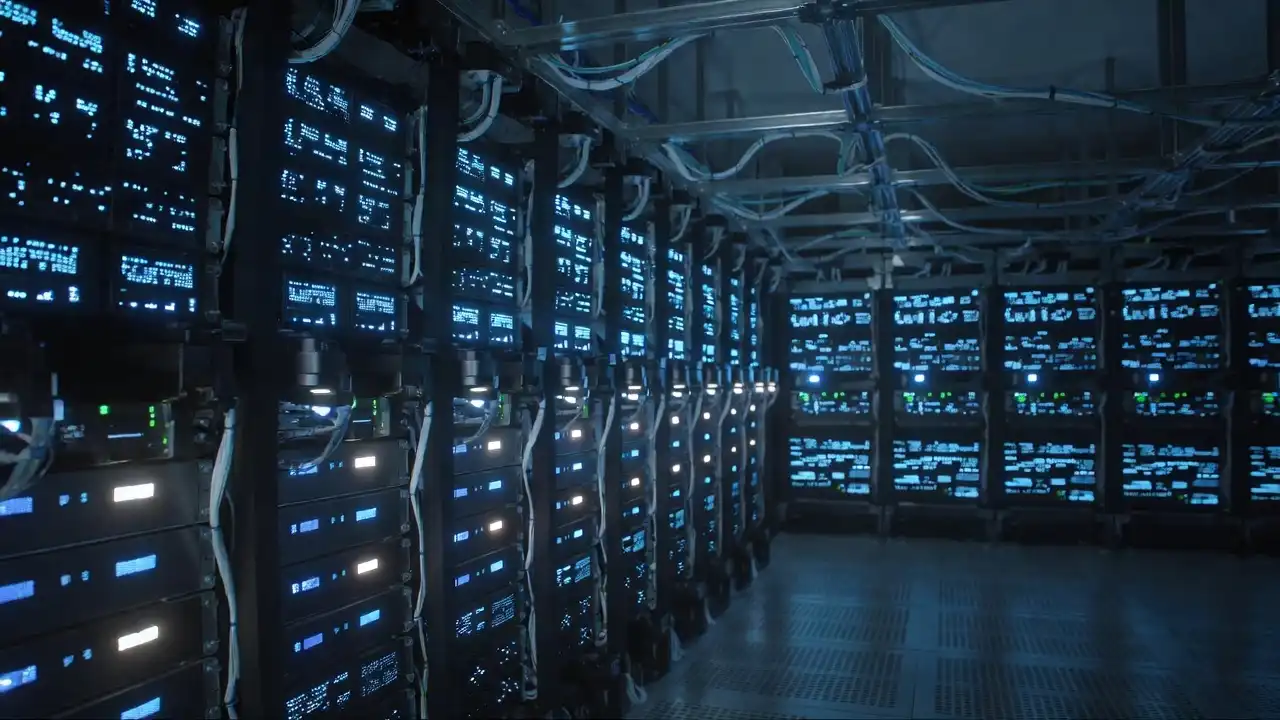
Australia’s rapid expansion into high-density artificial intelligence computing infrastructure threatens to overstimulate domestic demand and push the economy beyond its physical capacity, creating persistent inflationary pressures that could force the Reserve Bank of Australia to maintain higher interest rates for an extended period. A comprehensive economic assessment from Bloomberg Economics warns that an influx of multi-billion-dollar data center investments is colliding with an already constrained domestic supply side, driving up competition for skilled construction labor, electrical grid capacity, and raw building materials.
The economic warning arrives as global technology giants and private equity infrastructure managers deploy unprecedented capital into Australian digital infrastructure. Multinationals including Microsoft, Amazon Web Services, and Blackstone have committed tens of billions of dollars to expand cloud campuses across Sydney, Melbourne, and regional hubs, driving the national data center development pipeline past A$150 billion. Data centers have scaled so rapidly that the sector now accounts for nearly 20% of all non-residential commercial building construction nationwide.
However, Bloomberg Economics senior economist James McIntyre highlighted that this capital surge creates acute macroeconomic hazards. In an economy operating with a tight labor market where national unemployment hovers near 4.2% and underlying trimmed-mean inflation remains stubborn at 3.9%, adding tens of billions of dollars in specialized infrastructure spending risks overheating the domestic economy. As commercial computing projects pull electrical engineers and high-voltage gear away from residential home construction and public transport infrastructure, the artificial intelligence boom is complicating the central bank’s inflation battle, ensuring that borrowing costs will remain elevated across the country.
A Demand Shock Threatening Australia’s Supply-Side Capacity
The surge in artificial intelligence infrastructure represents a massive, concentrated demand shock to Australia’s industrial economy. While long-term macroeconomic models suggest that generative artificial intelligence and workflow automation will eventually boost national labor productivity, the near-term construction phase consumes vast volumes of physical resources without delivering immediate consumer goods or services to domestic markets.
Building a hyperscale computing campus requires heavy physical inputs, including thousands of tons of structural steel, specialized low-carbon concrete, high-capacity cooling chillers, and sophisticated electrical substations.
Because Australia’s domestic manufacturing base produces only a fraction of these specialized industrial components, developers must compete aggressively for domestic engineering contractors and import equipment through congested global supply chains.
The economic assessment published by Bloomberg Economics argues that this sudden demand surge is arriving at the worst possible moment in the business cycle. With the domestic economy operating near full productive capacity, adding massive corporate infrastructure projects drives up prices across the entire supply chain.
Unpacking the Bloomberg Economics Warning on Overheating Risks
The research published by Bloomberg Economics details how the artificial intelligence infrastructure race threatens to distort standard macroeconomic relationships. Rather than generating broad, balanced economic growth, the localized concentration of data center capital creates severe bottlenecks in specific industrial sectors.
Senior economist James McIntyre outlined the core mechanisms generating supply-side friction:
- Capital expenditure on digital infrastructure is expanding at a pace that outstrips the training and certification rate of domestic electrical trades and civil engineers.
- High-paying commercial technology developers are bidding up hourly contractor rates, driving construction wage inflation higher across major metropolitan centers.
- The concentration of multi-hundred-megawatt computing requests in New South Wales and Victoria is straining regional power grids, requiring billions of dollars in utility substation upgrades.
- The demand shock threatens to prevent headline inflation from sustainably returning to the central bank’s 2.5% target midpoint over the projected forecast horizon.
McIntyre explained that when an economy absorbs a multi-billion-dollar infrastructure boom while operating with minimal spare capacity, the added spending inevitably translates into higher price inflation rather than higher real output.
Why an A$150 Billion Capital Wave Strains Domestic Production Bounds
The sheer scale of the investment pipeline explains why economists are raising alarms over supply constraints. Research from major commercial banking institutions, including Commonwealth Bank of Australia, estimates that the total pipeline of planned and active data center developments could easily exceed A$150 billion over the next decade.
The capital allocation spans major global and domestic players:
- Microsoft committed A$25 billion toward expanding Australian hyperscale cloud and artificial intelligence infrastructure.
- Amazon Web Services launched a long-term A$20 billion capital investment roadmap to construct high-capacity computing clusters in regional technology corridors.
- Global asset manager Blackstone completed an extraordinary A$24 billion acquisition of Australian data center pioneer AirTrunk, committing billions more to fund site expansions.
- Domestic industrial powerhouses and telecommunications operators are constructing multi-megawatt colocation facilities to serve enterprise banking and government clients.
Deploying A$150 billion into an economy with a gross domestic product of roughly A$2.6 trillion represents an enormous structural capital injection, absorbing resources that would otherwise support residential homebuilding, regional hospitals, and clean energy transmission lines.
The Monetary Policy Dilemma for the Reserve Bank of Australia
The primary macroeconomic casualty of an overheating digital infrastructure boom is the Reserve Bank of Australia’s interest rate trajectory. While global central banks like the United States Federal Reserve, the European Central Bank, and the Bank of England have initiated monetary easing cycles, Australia is walking an independent, hawkish path.
Led by Governor Michele Bullock, the Reserve Bank’s Monetary Policy Board has maintained its benchmark cash rate at a 12-year high of 4.35%, explicitly warning that it stands ready to raise interest rates further if domestic inflation risks intensify.
The artificial intelligence data center boom complicates the central bank’s policy calculus.
If massive capital expenditure fuels construction wage growth, inflates commercial real estate valuations, and increases wholesale electricity tariffs, the central bank will have zero room to lower borrowing costs for everyday consumers.
The central bank finds itself caught in a policy bind: cutting rates to relieve mortgage stress on indebted households could ignite a broader inflationary surge fueled by corporate infrastructure spending.
Keeping the 4.35% Cash Rate Higher for Longer Amid 3.9% Inflation
The persistent elevation of domestic inflation metrics provides the primary justification for the Reserve Bank’s restrictive monetary stance. While headline inflation cooled from earlier peaks, underlying inflation measures that strip out volatile price spikes remain stubbornly above the central bank’s official 2.0% to 3.0% target band.
The latest economic data highlights persistent price pressures across the domestic economy:
- The trimmed-mean consumer price index, the central bank’s preferred core inflation gauge, stood at 3.9%, marking eleven consecutive quarters above the statutory target ceiling.
- Service sector inflation remained elevated near 4.5%, driven by rising commercial rents, public liability insurance, and non-tradable service expenses.
- Central bank macroeconomic modeling indicates that underlying inflation will not reach the 2.5% midpoint target until late 2026 at the earliest.
- Financial market swap pricing has priced out near-term interest rate cuts, with traders assigning a rising probability to potential rate hikes if upcoming quarterly inflation prints accelerate.
Governor Bullock reaffirmed that the central bank will show zero complacency in its inflation fight, signaling that interest rates will remain restrictive until domestic demand aligns with productive supply capacity.
Tight Labor Markets at 4.2% Unemployment Amplifying Wage Pressures
A central pillar supporting the central bank’s hawkish posture is the enduring strength of the Australian labor market. Despite eighteen months of restrictive interest rates, national unemployment has remained remarkably low, hovering between 4.1% and 4.2%.
The tight labor market amplifies the inflationary risks of the artificial intelligence boom:
- High-voltage electricians, precision cooling technicians, and structural civil engineers command substantial wage premiums on commercial data center construction sites.
- Annual nominal wage growth across the national economy expanded at a 4.1% rate, running far ahead of zero labor productivity growth.
- When wage growth expands without corresponding improvements in labor productivity, unit labor costs surge, forcing businesses to raise end-consumer retail prices to defend profit margins.
- Competition for specialized technical labor is siphoning skilled workers away from regional infrastructure projects, driving up public-sector construction costs.
The Reserve Bank warned that unless domestic labor productivity improves rapidly, current wage growth rates remain inconsistent with returning inflation to the 2.5% target, requiring borrowing costs to stay higher for longer.
Squeezing Household Borrowers with Higher Mortgage Repayments
While multinational technology conglomerates utilize deep corporate balance sheets and private credit lines to finance data center construction, the human cost of higher interest rates falls directly on Australian households. Australia’s residential mortgage market is uniquely sensitive to central bank policy, as roughly 70% of active home loans are structured on floating, variable interest rates.
Elevated borrowing costs have placed immense financial pressure on middle-income families:
- Monthly mortgage repayments for an average homeowner with an A$600,000 variable-rate home loan have climbed by more than A$1,400 per month since the tightening cycle began.
- The net household savings ratio collapsed to 0.9% of disposable income, down from pandemic-era highs exceeding 20% and well below historical norms.
- Real household disposable income contracted, forcing families to slash discretionary retail spending, dine out less, and trade down to private-label groceries.
- Small businesses operating in retail, hospitality, and construction face rising corporate insolvency rates as consumer spending slows.
The contrast between struggling residential mortgage holders and booming commercial data center investments highlights the two-speed nature of Australia’s modern economy.
Construction Bottlenecks and the Housing Affordability Conflict
The conflict between artificial intelligence infrastructure expansion and domestic economic welfare is most visible in the construction and civil engineering sectors. Australia is grappling with an acute national housing crisis, characterized by soaring residential rents, low rental vacancy rates below 1.5%, and severe shortages of affordable homes.
Under the National Housing Accord, federal and state governments established an ambitious target to construct 1.2 million new, well-located residential homes over a five-year period.
However, the residential construction industry is falling far behind schedule, constrained by acute shortages of skilled trade labor, expensive building materials, and complex planning approvals.
The massive expansion of data center construction directly competes with residential homebuilders for the exact same pool of skilled labor, heavy equipment, and building supplies, worsening the national housing shortage.
Data Centers Absorbing 20% of Non-Residential Commercial Buildings
The intensity of digital infrastructure development has reshaped commercial construction pipelines across the country. Commercial building data shows that data center projects now account for nearly 20% of all non-residential commercial building activity nationwide.
The concentration of construction resources inside server halls is substantial:
- Major commercial construction contractors are shifting engineering divisions away from office towers, retail shopping centers, and public schools to focus on high-margin tech campuses.
- Excavation equipment, concrete pouring fleets, and heavy crane rentals are booked months in advance by technology developers offering premium rates.
- Industrial land valuations near primary high-voltage substations in Western Sydney and suburban Melbourne have doubled over the past three years.
- The physical scale of single data center campuses—often spanning dozens of contiguous hectares—absorbs hundreds of thousands of cubic meters of ready-mix concrete.
This concentration of commercial building capital crowds out traditional community infrastructure, inflating construction overhead across the entire property development sector.
Siphoning Electricians and Specialized Trades Away from Residential Projects
The most damaging side effect of the data center construction boom is the diversion of skilled trade workers away from residential housing sites. Constructing a high-density data center requires an extraordinary concentration of specialized electrical and mechanical labor.
The migration of skilled trades creates severe bottlenecks for homebuilders:
- Commercial data center projects offer union-backed commercial wage rates, overtime bonuses, and per diem allowances that residential homebuilders cannot match.
- Certified high-voltage electricians, refrigeration mechanics, fire-protection technicians, and telecommunications cabling installers are leaving residential subdivisions to work on tech campuses.
- Residential homebuilders face multi-week delays waiting for electrical subcontractors to complete wiring on new residential apartment towers and suburban housing estates.
- Subcontractor shortages drive up residential construction costs, which developers pass directly to homebuyers through higher purchase prices.
Housing policy analysts warn that governments cannot achieve ambitious national housing targets while allowing a single commercial technology sector to absorb a dominant share of the domestic trade workforce.
Escalating Material Costs for High-Voltage Transformers and Concrete
The global surge in data center construction has created intense competition for heavy electrical and structural equipment. Sourcing the specialized hardware required to connect computing facilities to high-voltage power lines has become an expensive, time-consuming challenge.
Supply chain bottlenecks are driving construction costs higher across the economy:
- Procurement lead times for high-voltage large power transformers have stretched from 50 weeks to between 150 and 200 weeks, representing delivery delays of three to four years.
- Global prices for specialized electrical steel, copper busbars, and medium-voltage switchgear have climbed by double digits.
- Competition for local quarry aggregates and cement has driven up ready-mix concrete prices for regional infrastructure and road projects.
- Commercial developers are paying premium freight surcharges to air-freight emergency electrical components, driving up project delivery budgets.
These elevated material costs ripple through the broader construction industry, increasing the capital expenditures required for public transport, water treatment, and civic building projects.
The Energy Matrix: Power Grid Saturation and Decarbonization Pressures
Beyond labor and construction bottlenecks, the primary physical constraint capping artificial intelligence expansion in Australia is electrical power. High-performance computing clusters run continuously, drawing flat baseload electricity 24 hours a day, 365 days a year.
Official projections from the Australian Energy Market Operator reveal that computing facilities will consume approximately 34 terawatt-hours of electricity annually by the 2035-2036 fiscal year.
This marks a dramatic leap from the 5 terawatt-hours currently drawn by digital facilities, raising data centers’ share of the National Electricity Market from roughly 3% today to more than 13%.
The timing of this digital boom creates severe operational challenges for power grid planners, as it coincides directly with the largest power plant retirement cycle in Australian history.
Data Center Power Consumption Surging Toward 34 Terawatt-Hours
The projected jump from 5 terawatt-hours to 34 terawatt-hours represents an annual compound growth rate exceeding 21%. A 34-terawatt-hour load represents an extraordinary volume of electrical energy, equivalent to the combined annual electricity consumption of all residential households across New South Wales and Victoria.
The concentration of this power demand in urban centers creates acute transmission bottlenecks:
- In Sydney, data centers are projected to consume 11% of the entire metropolitan power supply by 2030, up from 4% today.
- In Melbourne, digital infrastructure demand will more than quadruple, claiming 8% of Victoria’s total electricity generation.
- A single 500-megawatt computing campus requires as much continuous electricity as a major commercial aluminum smelter.
- High-density server cabinets generate localized heat that requires continuous electrical power for liquid-cooling chillers and pumps.
Supplying this immense volume of continuous power requires generating and transmitting billions of kilowatt-hours of clean electricity around the clock, placing relentless pressure on regional transmission substations.
Clashing with the Retirement of 13 Gigawatts of Coal-Fired Generation
The data center power surge arrives at the exact moment when Australia is executing a mandatory phase-out of its aging coal-fired power stations. Over the next decade, energy companies plan to retire roughly 13 gigawatts of coal-fired generation capacity across Queensland, New South Wales, and Victoria, alongside nearly 2 gigawatts of older gas plants.
Balancing flat baseload data center demand while shutting down thermal baseload generators creates severe grid stability risks:
- During overnight hours when solar generation drops to zero, the grid must rely on stored hydropower, grid-scale batteries, and gas peaking plants to maintain high-voltage frequency stability.
- Surging data center power consumption threatens to exhaust regional battery storage reserves during low-wind evening hours, forcing utilities to burn expensive fossil fuels.
- The Climate Council warns that without massive additions of new renewable generation and long-duration storage, surging data center demand will push wholesale electricity prices more than 20% higher by 2035.
- Because wholesale power costs make up roughly 40% of standard residential electricity bills, unmanaged industrial compute demand could add hundreds of dollars to household utility expenses.
Energy economists emphasize that data centers must not be permitted to drain existing public power supplies at the expense of national decarbonization targets.
Strategic Implications for the Australian Economy and Policy Makers
The economic risks identified by Bloomberg Economics have transformed artificial intelligence infrastructure policy into a top-tier national political debate. Independent lawmakers, state premiers, and federal ministers are debating comprehensive regulatory guardrails ahead of National Cabinet meetings.
Policymakers are recognizing that the nation cannot afford a repeat of past resource booms, where foreign corporations extracted valuable resources while domestic households were left paying higher utility bills.
The emerging policy consensus focuses on establishing a strict user-pays framework that forces technology conglomerates to finance their own power, water, and grid infrastructure.
Enforcing Renewable Additionality and Mandatory Large-Load Tariffs
The cornerstone of the proposed regulatory response is the mandatory enforcement of renewable energy additionality and specialized large-load customer tariffs. Under these progressive market rules, data center developers will be legally prohibited from simply drawing power from the public grid or purchasing existing green energy certificates.
Draft policy frameworks under consideration include binding statutory mandates:
- 100% Renewable Additionality: Requiring data center operators to fund and construct brand-new utility-scale solar arrays, wind corridors, and battery storage projects equivalent to 100% to 120% of their peak power demand.
- Dedicated Industrial Large-Load Tariffs: Mandating that tech companies pay 100% of the upfront capital costs required to construct dedicated high-voltage substations, transmission lines, and transformers.
- Mandatory Demand-Response Integration: Requiring computing facilities to integrate automated load-shedding software capable of curtailing non-essential artificial intelligence training workloads by 20% to 30% during extreme heatwaves or winter grid emergencies.
- Strict Water Conservation Standards: Banning open evaporative water cooling in drought-stressed urban corridors, forcing operators to deploy closed-loop liquid cooling or air-cooled heat exchangers.
Enforcing these additionality and tariff rules ensures that data center investments accelerate the national clean energy transition rather than deplete public power reserves.
The Long-Term Horizon for Sovereign Compute and Economic Productivity
The ultimate objective for Australian policymakers is to capture the long-term productivity benefits of artificial intelligence while mitigating near-term demand shocks. If managed with disciplined planning and enforceable public guardrails, private technology capital can underwrite the modernization of Australia’s energy and digital systems.
Key structural priorities that will shape the next decade of Australia’s digital economy include:
- Guaranteed Local Compute Allocations: Requiring hyperscale operators to reserve a dedicated percentage of high-performance computing capacity at affordable rates for Australian research universities, medical institutes, and domestic artificial intelligence startups.
- Regional Infrastructure Decentralization: Offering tax incentives and streamlined permitting to encourage developers to construct data centers in remote regional renewable energy zones rather than crowded urban centers.
- Workforce Transition Funding: Utilizing revenues from specialized data center infrastructure levies to fund vocational apprenticeships, training thousands of new electricians, civil engineers, and technicians.
- Sovereign Digital Independence: Ensuring that sensitive government data, corporate intellectual property, and national healthcare records are processed and stored on sovereign, Australian-governed computing infrastructure.
By pairing rigorous regulatory oversight with strategic capital investment, Australia can build a resilient digital foundation that powers long-term economic prosperity without sacrificing household affordability.
The warning from Bloomberg Economics that Australia’s artificial intelligence boom risks driving demand beyond supply capacity and keeping interest rates elevated marks a critical moment of macroeconomic reckoning. By exposing how an A$150 billion digital infrastructure gold rush is straining tight labor markets, driving up construction costs, and saturating regional power grids, economists have shown that digital progress carries real physical consequences. As the Reserve Bank of Australia holds its cash rate at 4.35% to battle persistent 3.9% inflation and everyday families absorb higher mortgage repayments, the nation must establish binding public guardrails. By mandating 100% renewable energy additionality, enforcing large-load utility tariffs, and protecting skilled construction labor for residential housing, Australia can harness the transformative power of artificial intelligence while safeguarding the economic living standards of all citizens.






