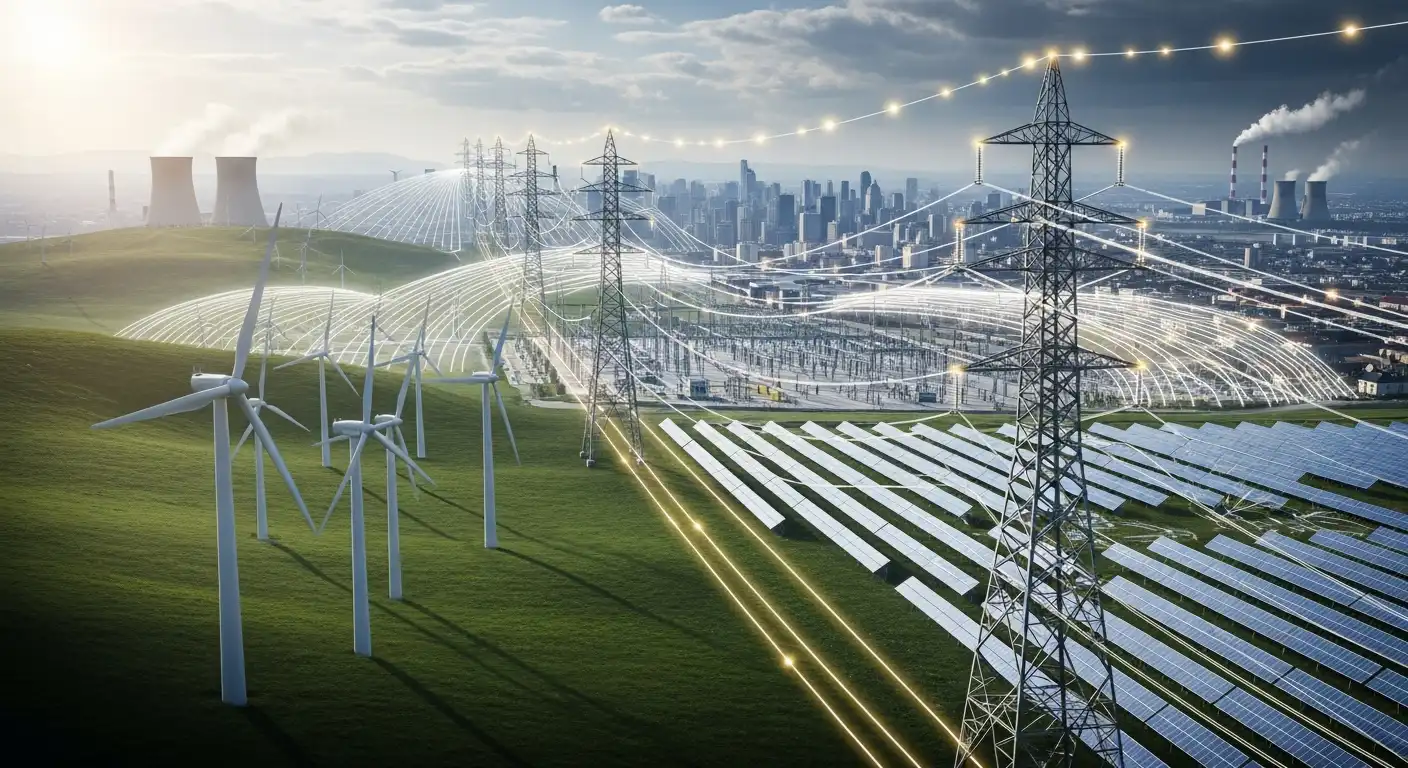
China has unveiled an expansive national strategy to modernize, digitize, and expand its electrical infrastructure, announcing plans to advance the high-quality development of its new-type power grids during the 15th Five-Year Plan period spanning 2026 to 2030. The National Energy Administration confirmed that the initiative will transform the world’s largest power system into a robust, intelligent, and digitalized network capable of ensuring safe and reliable energy delivery while integrating massive volumes of renewable power.
The strategic push arrives as the nation’s energy consumption enters an intensive growth phase driven by high-technology industries. National Energy Administration projections reveal that China’s total electricity demand will expand at an average annual rate of roughly 5.0% between 2026 and 2030. This demand surge is propelled by advanced manufacturing, semiconductor cleanrooms, electric vehicle charging corridors, and high-density artificial intelligence computing campuses that require uninterrupted, high-purity green electricity.
To satisfy these mounting industrial energy needs, state planning authorities are mobilizing trillions of yuan across both heavy physical transmission infrastructure and advanced software intelligence. The new-type power grid initiative links massive renewable energy generation bases in western deserts directly to eastern economic demand centers while overhauling localized municipal distribution systems. By integrating artificial intelligence into real-time dispatch, encouraging private capital investment, and connecting power delivery with national computing and telecommunications networks, China is engineering the foundational energy architecture required to sustain its long-term industrial modernization.
A Digital and Physical Revolution for China’s Energy Architecture
The transition toward a new type of power grid represents a fundamental evolution in electrical engineering. Traditional electrical grids were constructed around centralized, fossil-fuel-fired thermal power stations that generated predictable, continuous baseload electricity flowing in a single direction from power plants to passive end consumers.
The rapid rise of renewable energy has shattered that legacy operating model. China has installed more than 1,200 gigawatts of wind and solar capacity, with vast utility-scale clean energy bases operating in remote desert regions like Xinjiang, Inner Mongolia, and the Gobi Desert.
However, wind and solar power generate variable, weather-dependent electricity that fluctuates throughout the day.
The new-type power grid solves this intermittency challenge by combining heavy physical transmission backbones with digital intelligence. The National Energy Administration defines the system as a coordinated, multi-tiered network powered by advanced information technology, automated sensors, and flexible energy storage.
This integrated approach ensures that the power grid can absorb massive surges of variable clean energy, balance regional supply imbalances in milliseconds, and maintain absolute voltage stability for high-precision industrial manufacturing.
Unpacking the 15th Five-Year Plan Grid Modernization Strategy
The 15th Five-Year Plan covering 2026 through 2030 marks a defining operational window for China’s national carbon peaking and neutrality targets. During this five-year period, the power sector must accommodate the largest influx of renewable energy generation in human history while maintaining total grid reliability.
The National Energy Administration’s strategic roadmap establishes clear engineering priorities:
- Constructing high-capacity backbone transmission rings to connect regional power pools and eliminate inter-provincial electricity bottlenecks.
- Coordinating the development of power grids across all voltage tiers, ensuring seamless power transfers between ultra-high-voltage corridors and localized low-voltage neighborhood lines.
- Upgrading existing distribution networks to operate as flexible, open public platforms that accommodate bi-directional power flows from rooftop solar and electric vehicles.
- Deploying advanced digital sensing and edge computing across millions of utility substations and transmission towers nationwide.
By executing these coordinated upgrades, China aims to construct an energy network that combines physical strength with digital agility, ensuring uninterrupted power for a rapidly modernizing economy.
Projecting 5% Annual Power Demand Growth Driven by High-Tech Sectors
A primary factor driving the urgency of the grid overhaul is the accelerating growth rate of national electricity consumption. In mature Western economies, electricity demand has historically tracked low annual growth rates between 1.0% and 2.0%.
In contrast, China’s electricity consumption is projected to expand at a robust 5.0% annual pace throughout the late 2020s.
The structural composition of this demand growth has shifted decisively toward advanced high-technology sectors:
- High-density artificial intelligence computing campuses and cloud data centers consume tens of gigawatts of continuous electrical baseload power.
- Advanced semiconductor fabrication plants and cleanrooms require ultra-stable electrical currents where even a microsecond voltage sag can ruin millions of dollars in silicon wafers.
- The mass electrification of transportation, with new energy vehicles capturing over 50% of monthly domestic passenger car sales, requires high-capacity fast-charging networks across national highways.
- Industrial manufacturing sectors, including green hydrogen synthesis, electric arc furnace steelmaking, and precision battery gigafactories, are replacing direct fossil fuel combustion with clean electricity.
These high-end industries require high-quality green power that carries verifiable clean-energy provenance certificates, placing unprecedented technical demands on national transmission and distribution networks.
Integrating the Six Networks National Infrastructure Framework
The development of new-type power grids does not operate in isolation; it functions as a core pillar of China’s broader “six networks” national infrastructure initiative. Designed by central economic planners to stimulate domestic demand, boost industrial productivity, and support steady macroeconomic growth, the initiative coordinates six strategic physical and digital networks under a unified national blueprint.
The six interconnected infrastructure networks encompass:
- Water Networks: Managing national water diversion projects, agricultural irrigation reservoirs, and flood-control river basins.
- New-Type Power Grids: Modernizing high-voltage transmission backbones, smart distribution grids, and energy storage microgrids.
- Computing Power Networks: Constructing national computing clusters under the Eastern Data, Western Computing framework.
- Next-Generation Communication Networks: Expanding nationwide 5G-Advanced and 6G optical telecommunications backbones.
- Urban Underground Pipeline Networks: Upgrading municipal utility conduits, stormwater drainage, natural gas mains, and industrial heat channels.
- Logistics Networks: Expanding automated freight rail corridors, deep-water port terminals, and smart warehousing hubs.
Linking power grid modernization directly with computing and telecommunications networks allows state planners to synchronize energy delivery with data center compute loads, ensuring that artificial intelligence supercomputers operate adjacent to abundant, low-cost clean electricity generation.
Engineering the New-Type Power Grid: From UHV Backbones to Smart Microgrids
The physical realization of the new-type power grid requires building massive, interconnected engineering systems across continental distances. China’s primary energy resources are located thousands of kilometers away from its primary energy consumption centers.
The vast majority of China’s wind, solar, and coal reserves reside in the western and northern interior provinces, while roughly 70% of total national electricity consumption is concentrated in the heavily populated, industrial coastal provinces of the east and south.
Bridging this vast geographical divide requires constructing long-distance Ultra-High-Voltage (UHV) direct-current and alternating-current transmission corridors capable of transporting gigawatts of electrical energy across mountain ranges and river basins with minimal transmission losses.
Simultaneously, local municipal grids are being re-engineered into intelligent, decentralized microgrids that can operate independently during severe weather emergencies.
Expanding Ultra-High-Voltage Transmission Corridors Across Desert Mega-Bases
China is the undisputed global leader in Ultra-High-Voltage transmission technology, operating the world’s most advanced 800-kilovolt direct-current and 1,000-kilovolt alternating-current power lines. These massive transmission highways function as the electrical equivalent of transcontinental freight railways.
The 15th Five-Year Plan accelerates the construction of dedicated clean-energy export corridors:
- Building multi-gigawatt UHV transmission lines linking desert renewable energy mega-bases in the Gobi Desert directly to coastal industrial hubs in Guangdong, Jiangsu, and Zhejiang.
- Expanding transmission capacities to ensure that newly constructed desert solar and wind farms can export 100% of their generated electricity without facing localized curtailment.
- Deploying advanced converter transformers and high-power thyristor valves that convert alternating current into direct current with transmission line losses below 2.5% per 1,000 kilometers.
- Constructing regional ultra-high-voltage AC transmission rings to interconnect adjacent provincial power pools, enabling automated cross-provincial power sharing during seasonal demand peaks.
These long-distance power corridors allow coastal manufacturing megacities to run their assembly lines on clean wind and solar electricity generated thousands of kilometers away in the western interior.
Transforming Distribution Networks into Open Multi-Directional Public Platforms
While ultra-high-voltage lines manage long-distance power transport, local distribution networks are undergoing a radical structural transformation. Historically, distribution grids operated as passive, one-way systems that delivered power from local substations to residential homes and retail businesses.
National Energy Administration head Wang Hongzhi emphasized that distribution networks must now be fully leveraged as open, multi-directional public platforms:
- Accommodating millions of decentralized rooftop solar installations, allowing residential homeowners and commercial building operators to feed surplus electricity back into the grid.
- Managing high-power bi-directional vehicle-to-grid charging stations that allow parked electric vehicles to discharge stored battery power during evening peak hours.
- Installing smart solid-state transformers and automated switchgear that balance localized voltage fluctuations caused by rapid solar generation shifts.
- Providing standardized, open digital interfaces that allow commercial building operators, industrial parks, and independent battery storage facilities to participate in local energy trading markets.
Transforming distribution lines into dynamic public platforms democratizes energy generation, turning passive consumers into active participants in national grid balancing.
Deploying Smart Microgrids and Flexible Distributed Energy Storage
To enhance localized grid resilience and support rural economic development, the national strategy mandates the rapid deployment of smart microgrids and flexible distributed energy storage systems. A smart microgrid functions as a localized, self-contained energy ecosystem that combines local generation, battery storage, and smart load controls.
Smart microgrid architectures deliver critical operational benefits:
- Islanding Capabilities: Smart microgrids can seamlessly disconnect from the main utility grid during extreme weather events or transmission line faults, maintaining uninterrupted power for local hospitals, emergency services, and critical factories.
- Commercial Industrial Parks: Industrial zones integrate on-site rooftop solar arrays with multi-megawatt-hour battery energy storage systems, lowering commercial electricity bills and shielding factories from grid outages.
- Rural Electrification: Remote agricultural communities and island outposts deploy hybrid solar-plus-storage microgrids, securing reliable 24/7 power without requiring expensive grid extensions.
- Dynamic Peak Shaving: Microgrids absorb surplus clean energy during midday hours and discharge power during expensive evening peak tariff windows, flattening local utility demand curves.
Deploying flexible smart microgrids across thousands of industrial parks provides the power system with essential decentralized shock absorbers, protecting the broader economy from cascading grid failures.
Artificial Intelligence and Digitalization at the Core of Grid Management
The defining characteristic that separates the new-type power grid from legacy networks is the deep integration of digital information technology and artificial intelligence. Operating an electrical grid powered by millions of variable wind turbines, rooftop solar panels, battery storage facilities, and electric vehicle chargers is humanly impossible to manage through manual control dials.
The National Energy Administration has placed innovation-driven development at the center of its 2026-2030 roadmap, mandating the rapid research, development, and commercial deployment of artificial intelligence algorithms across all grid management layers.
By processing petabytes of real-world sensor telemetry in real time, artificial intelligence systems can predict weather patterns, forecast localized power demand, detect physical component failures, and execute automated dispatch decisions within milliseconds.
AI-Powered Predictive Dispatch and Real-Time Load Balancing
Operating a power network with high renewable penetration requires advanced predictive capabilities. Artificial intelligence algorithms deployed across provincial dispatch centers analyze satellite imagery, Doppler radar feeds, and numerical weather models to forecast renewable generation with exceptional precision.
Machine learning models execute complex operational tasks:
- Forecasting minute-by-minute solar irradiance and wind speed variations across thousands of generation sites up to 72 hours in advance.
- Predicting localized electricity demand spikes caused by sudden temperature changes, industrial shift schedules, and electric vehicle charging patterns.
- Executing automated millisecond-level power dispatch commands, dynamically ramping flexible hydropower turbines and battery storage arrays to balance generation deficits.
- Managing automated demand-response protocols that incentivize industrial factories to shift heavy energy consumption to hours of peak solar generation.
Automating the dispatch process allows the grid to maintain absolute 50-hertz frequency stability, even when sudden cloud cover cuts solar output by thousands of megawatts across an entire province.
Digital Twins and Automated Substation Diagnostics
The digital transformation extends to the physical maintenance and operational monitoring of grid assets. Grid operators are constructing comprehensive, photorealistic 3D digital twins of transmission corridors, transformer substations, and distribution lines.
Digital twin software combines spatial mapping with real-time Internet of Things telemetry:
- Ingesting live sensor data from millions of thermal imaging cameras, acoustic vibration monitors, and oil-gas analyzers mounted on high-voltage transformers.
- Running predictive machine learning algorithms that detect microscopic insulation degradation and mechanical wear weeks before equipment failure occurs.
- Deploying autonomous inspection drones equipped with high-resolution optical cameras and LiDAR to inspect remote transmission towers in mountainous terrain.
- Simulating the structural and electrical impact of severe typhoons, ice storms, and heatwaves within virtual environments, allowing emergency response teams to pre-position repair crews and reroute power flows before storms make landfall.
Utilizing artificial intelligence for predictive maintenance lowers operational overhead, prevents catastrophic transformer explosions, and ensures high availability across the national power network.
Private Investment Mobilization and Economic Multiplier Effects
The construction of new-type power grids functions as a massive, multi-trillion-yuan economic stimulus engine for the broader Chinese economy. As an expansive infrastructure undertaking that touches heavy metallurgy, electrical engineering, advanced software development, and civil construction, grid modernization generates powerful economic multiplier effects across domestic supply chains.
National Energy Administration head Wang Hongzhi highlighted that the new-type power grid links upstream renewable energy generators with downstream industrial enterprises, commercial businesses, and residential households, making it one of the most effective drivers of domestic capital investment.
To accelerate project delivery and foster healthy market competition, the central government is establishing transparent mechanisms to encourage private enterprises nationwide to invest in and benefit from grid modernization projects.
Unlocking Trillions of Yuan in Upstream and Downstream Capital Deployment
The capital expenditure deployed across the power grid sector during the 15th Five-Year Plan will reach historical records. State grid corporations, including State Grid Corporation of China and China Southern Power Grid, alongside private infrastructure consortiums, are budgeting hundreds of billions of dollars annually for grid construction.
This capital wave creates extensive commercial opportunities across the industrial value chain:
- Upstream Equipment Manufacturing: Driving massive purchase orders for high-voltage power transformers, gas-insulated switchgear, high-temperature superconducting cables, and power semiconductor thyristors.
- Energy Storage Integration: Financing the deployment of tens of gigawatts of utility-scale lithium-ion, sodium-ion, flow battery, and pumped-storage hydroelectric facilities.
- Downstream Smart Hardware: Stimulating consumer and commercial demand for smart electric meters, building energy management systems, and bi-directional vehicle-to-grid charging hardware.
- High-Tech Software Development: Generating commercial contracts for software developers specializing in industrial artificial intelligence, cyber defense, cloud computing, and big data analytics.
By mobilizing capital across these diverse industrial sectors, the new-type power grid initiative provides reliable, non-speculative economic stimulus that supports national gross domestic product growth.
Accelerating Approval Timelines for Major Transmission Corridors
A critical administrative priority emphasized by the National Energy Administration is the rapid streamlining of regulatory approval procedures for major power infrastructure projects. Historically, constructing cross-provincial ultra-high-voltage transmission corridors involved protracted administrative approvals, complex inter-provincial land-use negotiations, and lengthy environmental impact assessments.
To eliminate these project delivery bottlenecks, central and local energy authorities are implementing fast-track administrative mechanisms:
- Establishing centralized single-window approval portals for strategic national transmission corridors, cutting permitting timelines from years to months.
- Coordinating inter-provincial land-use quotas to guarantee immediate right-of-way access for high-voltage transmission lines crossing provincial borders.
- Expediting environmental and forestry clearances for critical clean-energy evacuation corridors connecting western renewable bases to eastern markets.
- Mandating that local municipal governments deliver required substation land allocations and civil infrastructure connections on schedule.
Accelerating regulatory approvals ensures that newly constructed wind and solar mega-bases can connect to national transmission lines immediately upon completion, preventing capital from sitting idle.
Encouraging Private Sector Participation Across Equipment and Grid Software
A defining feature of the updated policy framework is the deliberate expansion of private-sector participation. While long-distance ultra-high-voltage transmission backbones remain managed by state grid utilities, the central government is opening high-value segments of the grid ecosystem to private investment.
Private enterprises are capturing expanding commercial roles:
- Private equipment manufacturers dominate the production of high-efficiency dry-type transformers, smart distribution switchgear, and advanced power electronics.
- Independent software developers building proprietary artificial intelligence algorithms, digital twin platforms, and cybersecurity software for utility dispatch centers.
- Private renewable energy developers are constructing, owning, and operating independent commercial battery energy storage facilities that provide capacity services to the grid.
- Specialized energy service companies managing distributed smart microgrids, rooftop solar leasing programs, and virtual power plants across commercial industrial parks.
Encouraging private enterprise participation fosters healthy market competition, drives rapid technological innovation, and ensures that private capital actively contributes to the national clean energy transition.
Strategic Implications for National Decarbonization and Industrial Supremacy
The construction of the new-type power grid carries profound strategic consequences that reach far beyond domestic energy supply. In an increasingly competitive global economy, possessing an abundant, low-cost, and reliable clean energy system is the foundational prerequisite for industrial competitiveness, technological leadership, and national security.
By constructing an intelligent electrical grid capable of supporting a 5.0% annual demand growth rate while integrating hundreds of gigawatts of clean power, China is decoupling its economic expansion from foreign fossil fuel imports.
Furthermore, mastering the advanced engineering and software disciplines required to operate a digitalized power grid establishes domestic Chinese industrial champions as the premier global suppliers of next-generation energy infrastructure.
Powering High-Density AI Computing Campuses and Advanced Chip Foundries
The global artificial intelligence revolution has elevated physical electrical power into the ultimate strategic asset. Advanced semiconductor fabrication cleanrooms, high-density graphics processor server racks, and automated robotics assembly plants require immense amounts of continuous electrical energy.
The new-type power grid delivers vital competitive advantages for China’s high-tech manufacturing sector:
- Guaranteeing 24/7/365 uninterrupted electrical baseload power for domestic semiconductor foundries fabricating advanced logic and memory microchips.
- Powering massive computing clusters under the Eastern Data, Western Computing initiative with low-cost clean energy generated in western desert hubs.
- Providing domestic technology corporations with verified green electricity certificates, protecting Chinese manufactured exports from international carbon border adjustment taxes.
- Shielding high-tech industrial parks from localized power shortages during extreme summer heatwaves or winter freezes through automated cross-provincial power transfers.
Securing an abundant supply of clean, reliable electricity ensures that domestic technology champions can scale their computing infrastructure without encountering the severe power grid bottlenecks that are currently delaying data center construction across Western economies.
The Long-Term Horizon for Sovereign Green Power Networks
Looking toward 2030 and beyond, the technological innovations pioneered under the new-type power grid initiative will establish the global engineering standard for twenty-first-century energy infrastructure. As nations worldwide confront the dual challenges of climate change and surging electrical demand, the integration of ultra-high-voltage transmission, artificial intelligence dispatch, and flexible microgrids represents the indispensable blueprint for modern energy systems.
Key structural trends that will define the future of global power architecture include:
- Continental-Scale Clean Energy Transmission: Ultra-high-voltage direct-current transmission lines moving clean energy across international borders, connecting regional power grids into integrated continental clean energy networks.
- Autonomous Self-Healing Grids: Artificial intelligence agents run continuous micro-adjustments that automatically isolate downed power lines, reroute electricity flows, and restore power in milliseconds without human intervention.
- Universal Vehicle-to-Grid Integration: Tens of millions of bidirectional electric vehicles operate as a massive, distributed energy storage battery that stabilizes national power grids during peak demand hours.
- Direct Hydrogen-Electricity Synthesis: Co-locating utility-scale electrolyzers directly adjacent to renewable energy megabases to convert surplus clean electricity into green hydrogen and ammonia for heavy industrial transport.
By executing a synchronized, comprehensive modernization of its national power grid during the 15th Five-Year Plan, China is constructing an enduring technological foundation that will power economic growth, drive industrial decarbonization, and secure national energy sovereignty for generations to come.
The National Energy Administration’s comprehensive strategy to advance the high-quality development of new-type power grids during the 15th Five-Year Plan period marks a decisive turning point in the modernization of global energy infrastructure. By pairing ultra-high-voltage physical transmission corridors with cutting-edge artificial intelligence dispatch, flexible distribution platforms, and smart microgrids, China is engineering the robust, intelligent, and digitalized power network required to meet an annual 5.0% electricity demand growth rate. As part of the national “six networks” initiative, this multi-trillion-yuan infrastructure deployment links abundant western renewable generation with eastern industrial demand, providing the clean, uninterrupted electricity needed to power artificial intelligence supercomputers, advanced chip foundries, and modern electric mobility. In executing this sweeping transformation, China is not only securing its domestic energy future but also establishing the definitive technological standard for the clean, electrified global economy of the twenty-first century.