

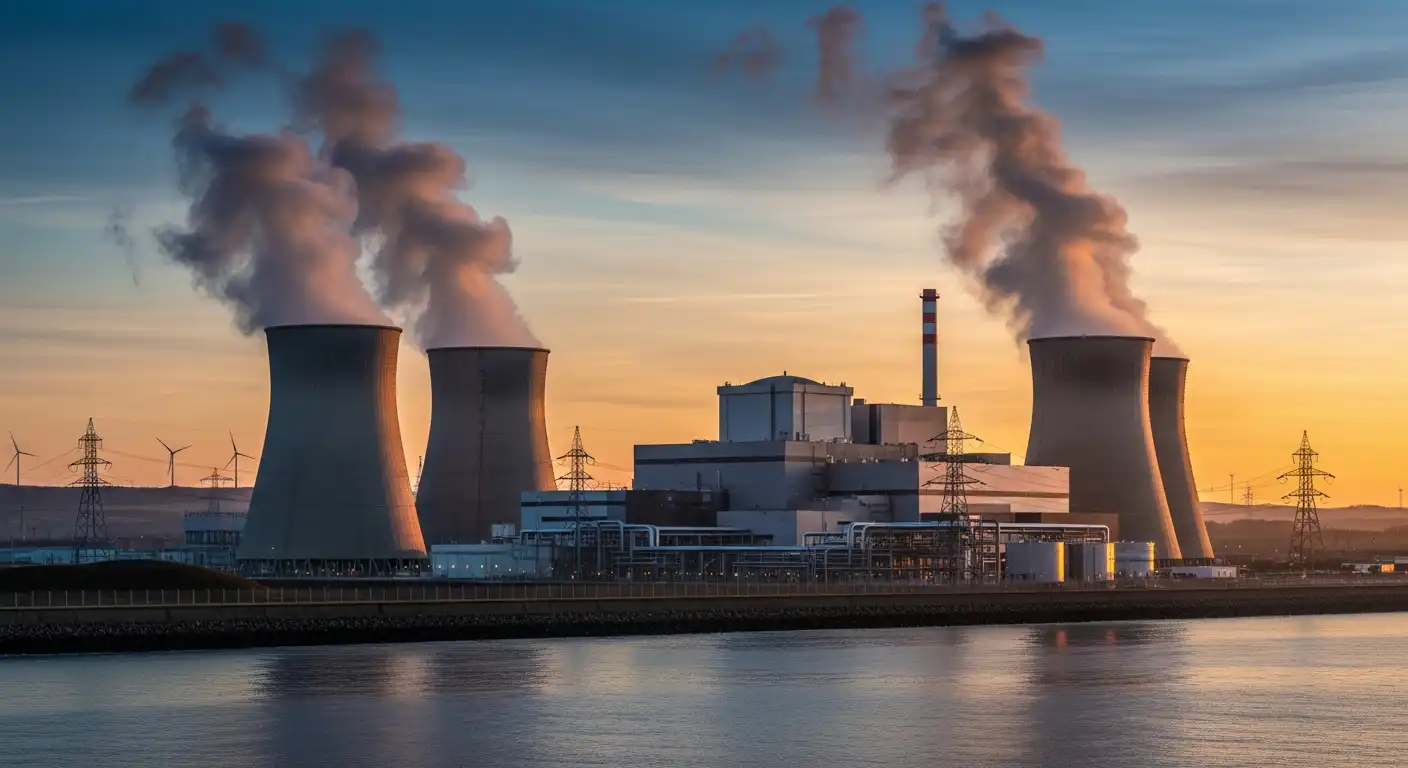
Europe’s ambitious nuclear energy revival is running directly into the physical realities of a warming planet. As European policymakers, led by France and a coalition of pro-nuclear member states, promote atomic power as the ultimate zero-carbon baseload solution to achieve net-zero emissions and break free from foreign fossil fuel dependencies, recurring summer heatwaves, severe river droughts, and rising water temperatures are exposing structural vulnerabilities across the continent’s nuclear fleet.
Nuclear reactors generate roughly 26% of the European Union’s total electricity and account for approximately half of its low-carbon generation, avoiding an estimated 700 million metric tons of carbon dioxide emissions every year. However, conventional nuclear power is an extraordinarily water-intensive technology. Inland nuclear power stations rely on continuous, multi-million-liter withdrawals of cool freshwater from major river systems—including the Rhône, the Garonne, the Loire, and the Danube—to cool their steam condensers and maintain thermal safety margins.
When extreme heatwaves strike and river water levels plunge during summer months, river water temperatures often exceed strict environmental thresholds designed to protect aquatic ecosystems from thermal pollution. Under statutory environmental regulations, power plant operators like France’s Électricité de France (EDF) are legally required to throttle back generation or shut down reactors entirely. This creates an ironic and dangerous energy paradox: at the exact moment when scorching heat drives electricity demand to peak levels for residential and commercial air conditioning, the nuclear fleet loses significant generation capacity, driving power prices higher and threatening grid reliability across the continent.
The Paradox of Climate-Driven Nuclear Vulnerability
The central thesis underpinning Europe’s nuclear renaissance is that atomic power provides dependable, weather-independent baseload electricity that solar and wind farms cannot guarantee. While renewable energy output fluctuates based on local cloud cover and wind speeds, a nuclear power plant is engineered to run flat at full capacity 24 hours a day, 365 days a year.
However, climate change is proving that nuclear energy is not completely weather-independent. The physical operation of a thermal power plant depends on the laws of thermodynamics, requiring a cold heat sink to convert high-temperature reactor steam back into water so the cycle can repeat.
Because Europe is warming at more than twice the global average rate, the availability and temperature of natural cooling water have become critical operational constraints.
When climate-induced droughts dry up river basins and push water temperatures above historical norms, inland nuclear reactors must reduce their output, transforming firm baseload capacity into an intermittent, climate-sensitive energy source.
Unpacking the Thermodynamics of River-Cooled Inland Reactors
To understand why nuclear reactors struggle during heatwaves, one must examine the basic thermodynamic principles governing thermal power generation. A nuclear power plant operates essentially as a massive thermal engine: nuclear fission splits uranium atoms to generate extreme heat, boiling water into high-pressure steam that spins heavy electrical turbines.
Once steam passes through the turbine blades, it must be cooled and condensed back into liquid water before returning to the steam generator:
- A standard 1,000-megawatt nuclear reactor requires roughly 30 to 50 cubic meters of cooling water every single second to maintain efficient thermal condensation.
- Open-circuit cooling systems withdraw cool water directly from a river, pump it through surface condensers, and return the warmed water back into the river.
- Closed-circuit cooling systems utilize massive concrete cooling towers, evaporating a portion of the water into the atmosphere while returning the remaining concentrated water to the river.
- As incoming river water temperatures rise, the thermodynamic efficiency of the condenser drops, requiring the plant to either withdraw higher water volumes or reduce turbine power output.
When river flows drop significantly during prolonged summer droughts, operating open-circuit reactors at full capacity risks draining local river channels, causing severe water shortages for downstream agricultural irrigation and municipal drinking supplies.
Regulatory Thermal Discharge Caps and Environmental Thresholds
The primary operational constraint forcing reactor curtailments during heatwaves is environmental compliance. Under European Union environmental directives and national water laws, nuclear operators are subject to strict legal limits governing the maximum temperature of water returned to public waterways.
Thermal discharge regulations are designed to protect river biodiversity:
- Discharging overheated cooling water into a river reduces dissolved oxygen levels, triggering catastrophic fish kills and destroying sensitive aquatic micro-ecosystems.
- Statutory limits typically prohibit power plants from heating downstream river water by more than 1.0 to 3.0 degrees Celsius above baseline ambient temperatures.
- Maximum downstream river water temperatures are capped at strict absolute ceilings, often set between 28 and 30 degrees Celsius depending on the specific river basin.
- When background ambient river temperatures approach these legal ceilings during heatwaves, power plant operators must curtail reactor output to prevent statutory violations.
While national regulators can grant temporary emergency waivers—known as environmental derogations—to keep reactors running during severe grid emergencies, doing so inflicts severe ecological damage on fragile river ecosystems.
Summer Heatwaves and River Droughts Across European Basins
The collision between rising temperatures and nuclear operations is no longer a rare, isolated occurrence; it has become an annual summer operational hazard across major European river basins. Over the past four years, recurring European heat domes have broken all-time temperature records, pushing river systems into severe hydrological distress.
From the alpine valleys of France and Switzerland to the low-lying plains of Romania and Hungary, nuclear operators have been forced to execute emergency power reductions.
Examining these regional river crises illustrates how deeply climate disruption is impacting the operational reliability of Europe’s core nuclear fleet.
French Reactor Curtailments Along the Rhône and Garonne
France operates the largest nuclear fleet in Europe, generating approximately 70% of its national electricity from 56 commercial reactors. However, a significant portion of these reactors sit inland along major river corridors, including the Rhône, the Garonne, the Seine, and the Loire.
During recent peak summer heatwaves, EDF was forced to throttle generation across multiple flagship nuclear stations:
- Nuclear reactors at the Bugey and Saint-Alban power plants along the Rhône River reduced generation output by 20% to 50% as water temperatures climbed near regulatory limits.
- The Golfech nuclear power station along the Garonne River in southwestern France faced repeated curtailments as river flows dropped to historic seasonal lows.
- In previous severe drought years, climate-driven cooling constraints and corrosion inspections forced EDF to cut nuclear output by more than 33 terawatt-hours, turning France from Europe’s largest electricity exporter into a net energy importer.
- French reactor adjustments during summer heatwaves forced the state utility to purchase expensive replacement electricity from neighboring European power grids to maintain domestic balance.
These recurring curtailments have cost the state-owned utility hundreds of millions of euros in lost electricity export revenues and emergency grid balancing fees.
Danube River Crises Halting Output in Romania and Hungary
The vulnerability of inland nuclear reactors extends far beyond France. In Eastern Europe, the Danube River—the second-longest river on the continent—serves as the critical cooling artery for nuclear power plants in Romania and Hungary.
Record-breaking heat and prolonged drought conditions have pushed the Danube into acute hydrological crisis:
- In Romania, state nuclear operator Nuclearelectrica was forced to shut down a 700-megawatt reactor unit at the Cernavodă nuclear power plant as Danube water levels dropped below mandatory safety intake thresholds.
- In Hungary, the Paks nuclear power station, which generates roughly half of the country’s domestic electricity, executed emergency underwater engineering operations to secure cooling water as the Danube hit near-record low water levels.
- Water temperatures in the Danube exceeded 25 degrees Celsius for consecutive weeks, forcing operators to execute partial output curtailments to comply with environmental discharge caps.
- Falling river water levels disrupted barge logistics, preventing the delivery of heavy equipment and specialized industrial maintenance supplies to riverside power complexes.
These Eastern European disruptions demonstrate that any country relying on shared international river systems for nuclear cooling faces compounding cross-border energy security risks during extreme climate events.
The Summer Demand Squeeze from Widespread Air Conditioning
Historically, European electricity demand followed a predictable seasonal pattern: power consumption peaked during freezing winter months due to space heating and lighting, while summer months experienced low demand that allowed utilities to take reactors offline for routine maintenance.
Climate change has completely upended this historical load profile:
- Intense summer heatwaves have driven an explosive expansion in residential and commercial air conditioning adoption across Southern, Central, and Western Europe.
- Summer peak electricity demand has grown by 15% to 25% across Mediterranean nations, creating steep afternoon load spikes that rival winter peaks.
- While high electricity demand occurs, solar photovoltaic generation peaks during the day, but solar output fades in the late afternoon and evening, just as cooling demand remains high.
- If nuclear reactors are curtailed at the exact same time that hydroelectric reservoirs are depleted by drought, power grids lose their primary sources of dispatchable zero-carbon generation.
This simultaneous squeeze of surging consumer demand and curtailed nuclear supply creates severe price spikes on wholesale electricity markets, forcing utilities to fire up expensive natural gas peaking plants.
Coastal Adaptation Realities, Sea-Level Rises, and Marine Hazards
Confronted with the chronic cooling constraints of inland rivers, pro-nuclear advocates frequently argue that future nuclear construction should shift entirely to coastal locations. Coastal nuclear plants draw cooling water from the open ocean, which provides a virtually limitless heat sink that avoids river temperature and flow restrictions.
However, locating nuclear power stations along ocean coastlines introduces a completely different set of severe climate-driven hazards.
From accelerating sea-level rise and extreme maritime storm surges to biological disruptions caused by marine life, coastal nuclear plants require expensive, complex engineering adaptations to survive on a changing coastline.
Coastal Siting Trade-Offs and Extreme Storm Surges
Building nuclear reactors on ocean shores exposes multi-billion-dollar industrial assets directly to marine climate impacts. As global warming accelerates polar ice melt, sea levels along the European Atlantic and North Sea coastlines are projected to rise significantly over the 60-to-80-year operating lifespan of a modern reactor.
Coastal nuclear facilities face escalating physical threats:
- Extreme maritime storm surges, supercharged by warming Atlantic waters, can overwhelm traditional coastal sea walls and flood low-lying reactor turbine halls.
- Coastal erosion and shifting shoreline sediment can block or damage underwater cooling water intake tunnels.
- Seawater is highly corrosive, requiring specialized titanium condenser tubes and expensive anti-corrosion concrete coatings that increase capital construction costs.
- Nuclear operators must spend hundreds of millions of euros to build higher, reinforced sea defense berms to protect coastal facilities from 100-year flood events.
These coastal engineering requirements significantly inflate upfront construction budgets and complicate site selection across densely populated European coastlines.
Swarming Jellyfish and Marine Bio-Fouling Disruptions at Gravelines
An unexpected and increasingly frequent hazard plaguing coastal nuclear power stations is marine biofouling, particularly swarms of jellyfish. As ocean temperatures rise and marine ecosystems experience seasonal disruptions, jellyfish populations in the North Sea, the English Channel, and the Mediterranean have exploded.
These soft-bodied marine creatures create massive physical blockages in cooling systems:
- Massive swarms of jellyfish are sucked into cooling water intake pipes, completely clogging fine-mesh drum filters and cutting off the flow of cooling water within minutes.
- At the Gravelines nuclear power plant in northern France, the largest nuclear station in Western Europe, operators have experienced repeated emergency shutdowns as jellyfish swarms overwhelmed water intake screens.
- Similar jellyfish-induced reactor shutdowns have struck coastal nuclear facilities in Sweden, the United Kingdom, and Scotland during peak summer months.
- Clearing millions of clogged organisms from industrial filtration drums requires manual maintenance interventions and days of reactor downtime.
These biological disruptions highlight the unpredictable ecological side effects that warming oceans inflict on sensitive industrial cooling infrastructure.
The Multibillion-Dollar Economics of European Atomic Expansion
The operational challenges posed by climate change arrive as European nations debate massive capital investments in next-generation nuclear infrastructure. Led by French President Emmanuel Macron, a 14-nation European Nuclear Alliance is pushing to construct dozens of new reactors to achieve energy sovereignty and decarbonize heavy industry.
However, the capital intensity of modern nuclear construction is immense. Building a new generation of reactors requires hundreds of billions of euros in public subsidies, loan guarantees, and long-term power purchase agreements.
As climate adaptation costs multiply—requiring deeper water intakes, massive hybrid cooling towers, and enhanced flood defenses—the economic competitiveness of nuclear power compared to rapidly scaling renewables is coming under intense scrutiny.
France’s €80 Billion EPR2 Reactor Buildout Under Fiscal Scrutiny
The centerpiece of Europe’s nuclear ambitions is France’s plan to construct six to fourteen next-generation EPR2 evolutionary pressurized water reactors. When initially proposed, state planners estimated that the initial batch of six EPR2 reactors would cost roughly €51.7 billion.
However, technical delays, supply chain inflation, and climate adaptation requirements have driven projected costs higher:
- Updated independent cost assessments project that the total overnight construction cost for the initial six EPR2 reactors has ballooned to over €80 billion, with completion dates stretching into the late 2030s and 2040s.
- European private capital markets hesitate to finance nuclear megaprojects without state-backed Contracts for Difference that guarantee minimum electricity prices above €70 to €90 per megawatt-hour.
- By comparison, utility-scale solar and onshore wind auctions across Southern and Central Europe consistently clear at prices below €30 to €50 per megawatt-hour.
- France’s national audit office has raised concerns over state utility EDF’s heavy corporate debt burden, which exceeds €54 billion, questioning the state’s capacity to finance massive reactor builds while funding climate adaptation upgrades.
These soaring capital costs are prompting fiscal conservatives and parliamentary oversight committees to question whether committing billions to slow-moving nuclear builds represents the most efficient use of public clean-energy funds.
Small Modular Reactors and Closed-Loop Cooling Technologies
To mitigate the massive capital costs and water vulnerabilities of traditional gigawatt-scale reactors, the nuclear industry is championing Small Modular Reactors (SMRs). Producing between 50 and 300 megawatts of electricity per unit, SMRs utilize factory-fabricated modular components designed to lower construction timelines and capital risks.
Small Modular Reactors incorporate advanced cooling innovations designed to survive in water-stressed environments:
- Advanced passive safety systems utilize natural air convection and internal gravity-driven water loops, eliminating the need for continuous external water pumping during emergency shutdowns.
- Dry-cooling and hybrid-cooling systems utilize air-cooled heat exchangers, cutting water consumption by up to 90% compared to traditional open-circuit reactors.
- Modular designs allow units to co-locate directly adjacent to inland industrial manufacturing hubs or artificial intelligence data centers without requiring massive nearby river channels.
- High-temperature gas-cooled SMR architectures operate at significantly higher thermal efficiencies, reducing the total volume of waste heat that must be dissipated into the environment.
While SMRs offer promising climate-resilient solutions, the technology remains in the early regulatory licensing and prototype demonstration phase, with commercial fleet deployment unlikely before the mid-to-late 2030s.
Strategic Implications for the European Green Deal and Energy Security
The collision between climate change and nuclear power carries profound strategic consequences for the European Union’s broader energy policy. Following the geopolitical disruptions of recent years, European energy policy has attempted to balance three competing objectives: decarbonization, energy affordability, and security of supply.
The vulnerabilities exposed by summer heatwaves prove that relying too heavily on any single generation technology creates dangerous systemic risks.
Building a resilient, climate-proof energy system requires a balanced, diversified generation portfolio that pairs adapted nuclear baseload with massive renewable additions, long-duration energy storage, and cross-border grid interconnections.
Re-Evaluating the 24/7 Baseload Reliability Thesis
The recurring curtailment of nuclear power during extreme summer weather is forcing grid operators and energy modelers to rethink traditional assumptions regarding baseload reliability. In traditional power system planning, nuclear was treated as an unshakeable, 100% available asset that required minimal backup reserves.
Modern grid management requires a more dynamic, probabilistic approach:
- Transmission system operators like France’s RTE and Germany’s Amprion must maintain larger strategic capacity reserves during summer months to compensate for potential nuclear curtailments.
- Energy planners must integrate climate projection models directly into power grid simulations, accounting for simultaneous river droughts and heatwaves.
- The concept of “firm baseload” is transitioning toward “firm flexible capacity,” prioritizing power plants and storage systems that can ramp output up and down rapidly to balance variable demand.
- Industrial consumers are deploying automated demand-response software, agreeing to curtail factory power consumption during peak summer grid stress in exchange for discounted electricity tariffs.
Acknowledging that nuclear power has seasonal climate vulnerabilities allows grid operators to design smarter, more resilient energy networks that prevent localized power outages.
The Long-Term Horizon for a Resilient European Power Mix
The ultimate resolution of Europe’s energy challenge lies in creating a symbiotic, complementary relationship between nuclear power, renewable energy, and digital grid management. Nuclear and renewables are not mutually exclusive rivals; they are essential teammates in the race to eliminate fossil fuels.
Key structural pillars that will define Europe’s climate-resilient energy future include:
- Climate-Proofing Existing Reactors: Investing billions of euros to retrofit operational inland reactors with advanced cooling towers, deeper water intake channels, and upgraded heat exchangers under long-term life-extension programs.
- Massive Renewable Acceleration: Deploying hundreds of gigawatts of offshore wind in the North Sea and utility-scale solar across Southern Europe, taking advantage of the fact that solar generation peaks during sunny heatwaves when river cooling is constrained.
- Expanding Grid-Scale Battery Storage: Installing tens of gigawatts of multi-hour lithium-ion and flow battery energy storage systems to capture daytime renewable surpluses and discharge clean power during evening cooling demand peaks.
- Cross-Border European Interconnectors: Expanding high-voltage direct-current transmission corridors linking Scandinavia’s vast hydroelectric reservoirs with Central and Western European demand centers.
By uniting modernized nuclear power with aggressive renewable deployment and cross-border grid integration, Europe can construct an unbreakable, zero-carbon energy system capable of thriving on a warming planet.
The growing threat that climate change poses to Europe’s nuclear renaissance marks an essential moment of technological and environmental reckoning. By exposing how summer heatwaves, depleted river basins, and rising water temperatures can force the curtailment of vital baseload reactors, nature has shown that no energy technology operates completely outside the planetary ecosystem. As France, Romania, Hungary, and their European allies commit hundreds of billions of euros to build next-generation reactors, the industry must engineer climate resilience directly into every blueprint. By adopting advanced closed-loop cooling, investing in small modular reactors, and integrating atomic power with massive solar and battery storage networks, Europe can overcome these environmental bottlenecks. True energy sovereignty requires building a clean, adaptable, and robust power grid that can withstand the extreme climate realities of the twenty-first century.






