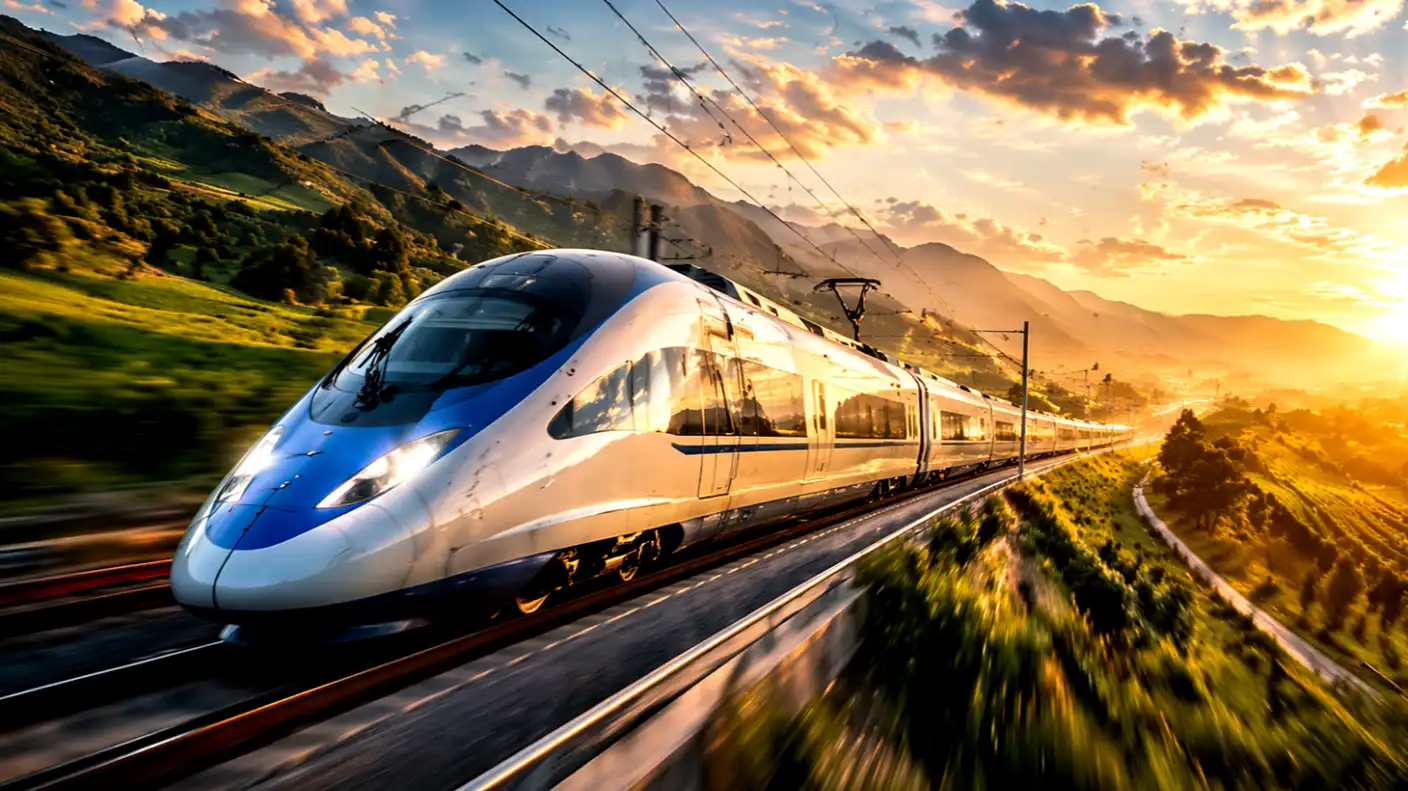
European international rail travel is preparing for its most significant competitive shake-up in more than three decades. In August 2026, Italian state railway operator FS Italiane Group announced that it has placed a massive order for 19 state-of-the-art high-speed trains from Japan’s Hitachi Rail. The blockbuster contract, valued at €2 billion (approximately $2.18 billion), represents the most concrete, capital-backed step yet toward introducing direct high-speed rail competition through the Channel Tunnel, officially setting the stage for a dramatic challenge to Eurostar’s long-standing monopoly by 2029.
The historic train order assigns the new fleet to Trenitalia France, the Paris-based international subsidiary of the Italian railway group. While the trains will first enter service on highly competitive domestic and cross-border French routes, their ultimate destination is the lucrative London-to-Paris corridor. By committing billions of euros to purchase trains specifically engineered to meet the strict technical standards of the Channel Tunnel, FS Italiane is transforming what was once a quiet corporate ambition into an active, highly capitalized operational reality.
This massive capital commitment arrives at a time of growing public and political demand for sustainable, low-carbon transport alternatives across Europe. Moving passengers from carbon-heavy regional flights to high-speed electric trains is a central pillar of the European Union’s environmental strategy. The introduction of a major, well-funded competitor on the cross-Channel route is expected to drive down ticket prices, increase service frequencies, and significantly expand the market for international rail travel, representing a significant victory for consumers and climate advocates alike.
The Mechanics of the Two Billion Euro Hitachi Deal
The contract signed between FS Italiane and Hitachi Rail is a comprehensive, multi-year agreement designed to ensure that the new high-speed fleet operates with maximum efficiency and reliability from day one.
Inside the Massive Fleet Acquisition
The €2 billion investment is a highly structured package that extends far beyond the physical construction of the trains. The contract covers the manufacturing of 19 high-speed trainsets, which will be based on the highly successful Frecciarossa 1000 platform, also known as the ETR 1000. These trains represent the absolute peak of modern European rail technology, capable of achieving commercial operating speeds of up to 360 kilometers per hour.
Crucially, the €2 billion figure also includes a comprehensive, multi-decade agreement for long-term maintenance, spare parts supply, and continuous technical support from Hitachi Rail’s engineering teams.
Additionally, the deal includes the construction of a brand-new, state-of-the-art international maintenance facility at Maisons-Alfort Pompadour, located in the southeastern suburbs of Paris.
This dedicated maintenance hub will provide the specialized engineering capacity needed to service, clean, and stabilize the expanding fleet, ensuring that the international trains can operate with the highest standards of punctuality and safety.
Expanding Frequencies Across the French High-Speed Network
Before they ever descend into the undersea environment of the Channel Tunnel, the 19 new Hitachi trainsets will play a vital role in expanding Trenitalia France’s presence on the European mainland. The operator plans to deploy the incoming trains to increase frequencies and improve service quality on its highly popular existing routes: Paris–Lyon, Paris–Milan, and Paris–Marseille.
On these highly competitive lines, Trenitalia’s modern Frecciarossa trains have already won over millions of passengers from the French state-owned operator SNCF, thanks to their premium amenities, redesigned interiors, and advanced, high-speed Wi-Fi systems capable of delivering up to 10 Gbps of bandwidth.
By adding 19 more trains to its French operations over the next three years, the company will build up the operational scale and brand awareness required to support its eventual expansion into the UK market, ensuring that its crew, logistics, and maintenance networks are fully optimized long before the first London-bound service departs.
Partnering with Certares to Fund the European High-Speed Platform
The massive €2 billion rolling stock order was made possible by a highly strategic private equity partnership designed to fuel FS Italiane’s international growth. In December 2025, the Italian state railway group formed a landmark joint venture with prominent US-based private equity firm Certares, which was co-founded by senior travel industry executive Greg O’Hara.
Under the terms of that strategic partnership, Certares committed to investing €1 billion in private capital directly into the expansion of Trenitalia France.
This capital injection has successfully transformed the financial capacity of the Italian rail operator. By combining FS Group’s operational engineering excellence with Certares’ extensive global travel distribution assets and deep investor networks, the joint venture has created a formidable international high-speed rail platform.
The private equity backing allowed FS Italiane to double its initial $1 billion rolling stock budget, giving the company the financial muscle required to sign the €2 billion contract with Hitachi Rail and confidently commit to the expensive, highly regulated Channel Tunnel market.
Dismantling Eurostar’s Thirty-Year Channel Tunnel Monopoly
The planned entry of Trenitalia France into the London-to-Paris market represents the first genuine challenge to one of the most durable monopolies in modern transport history.
The History of the Cross-Channel Monopoly
Since the historic Channel Tunnel first opened for commercial passenger traffic in 1994, Britain’s Eurostar has operated as the sole high-speed rail passenger service connecting London with mainland Europe. For over 30 years, Eurostar operated with virtually zero direct competition, allowing it to maintain absolute control over ticket pricing, service schedules, and passenger amenities on the vital route.
While Eurostar has built a highly successful brand, the lack of competition has also drawn criticism from transport consumer groups and business organizations. With no rival operators to drive down prices, cross-Channel rail travel has remained an expensive luxury for many passengers, often costing significantly more than budget airline flights.
Furthermore, despite the tunnel possessing a massive, high-speed design capacity, the undersea rail link is currently utilized at only about 50% of its total capacity, representing a massive, underutilized asset that is ripe for competitive disruption.
The Surge of Competitors: Branson’s Virgin Trains and Evolyn
The massive potential of the cross-Channel market has attracted several other prominent challengers, turning the high-speed rail corridor into a highly active corporate battleground. The most high-profile challenger is Sir Richard Branson’s Virgin Group.
In late October 2025, the UK’s rail regulator, the Office of Rail and Road, officially approved Virgin Trains’ application to share Eurostar’s Temple Mills International depot in East London, clearing a critical operational hurdle and putting the billionaire entrepreneur on track to launch a competing cross-Channel service by 2030.
At the same time, Spanish-backed consortium Evolyn and other prospective operators like Gemini Trains have announced plans to launch their own competitive services through the tunnel.
This sudden surge of interest proves that the era of the single-operator monopoly is drawing to a close. By committing substantial capital to purchase a dedicated fleet of 19 high-speed trains from Hitachi Rail, FS Italiane has established itself as the most advanced and best-funded challenger, positioned to beat its private rivals to the market and claim the first major slice of Eurostar’s historical market share.
Navigating the Technical and Regulatory Hurdles of the Channel Tunnel
While the €2 billion train order represents a massive milestone on paper, transforming this ambition into a daily passenger service requires navigating some of the most stringent technical and safety regulations in the global transport sector.
Meeting the Stringent Safety Standards of the Intergovernmental Commission
The Channel Tunnel is a highly unique, high-risk environment. Spanning 50 kilometers end-to-end, with 37.5 kilometers of the route running deep beneath the seabed of the English Channel, the tunnel requires specialized safety designs to protect passengers in the event of an emergency.
The Channel Tunnel Intergovernmental Commission enforces strict safety rules that passenger trains must meet to secure certification:
- Under the Technical Specification for Interoperability (TSI) guidelines, trains operating through the tunnel must possess a continuous running capability of at least 30 minutes in the event of a fire, allowing the train to escape the undersea section even if a blaze breaks out.
- The trains must be equipped with specialized fire-resistant doors and highly advanced automated fire suppression systems.
- The rolling stock must be compatible with the unique signaling and power systems used by High Speed 1 (HS1) in the United Kingdom, the Eurotunnel network, and the French high-speed rail network.
Hitachi Rail faces a significant engineering task to ensure that the 19 new Frecciarossa 1000 trainsets comply fully with these national safety rules. The manufacturer must design and install custom safety systems specifically for the UK and Channel Tunnel markets, securing formal approvals from both French and British railway regulators before the first test trains can begin running on the cross-Channel route.
The Battle for London’s St Pancras and Terminal Constraints
While the track capacity of the Channel Tunnel and the HS1 rail link is highly underutilized, the primary operational bottleneck of the Paris-to-London route sits at the terminal stations, particularly at London’s historic St Pancras International.
Since the United Kingdom officially exited the European Union, the implementation of physical passport controls and manual border-processing checks has created massive passenger bottlenecks at St Pancras. The station’s departure lounges, security checkpoints, and passport control zones were designed during the pre-Brexit era, and they lack the physical space needed to process large volumes of international passengers efficiently.
If a second or third high-speed rail operator enters the market, St Pancras will struggle to absorb the sudden increase in passenger traffic. To prevent complete operational paralysis, the UK government, HS1, and Eurotunnel must invest millions of pounds in physical construction projects to expand and automate the border-processing and security facilities at St Pancras International, representing a critical path that must be completed before Trenitalia France can successfully launch its first competitive services in 2029.
Economic and Job Impacts Across Three European Nations
The massive scale of FS Italiane’s €2 billion investment is expected to deliver a significant economic boost to several European economies, generating thousands of high-skilled jobs and strengthening the continent’s industrial base.
Creating Two Thousand Industrial Jobs
According to official estimates released by the Italian rail operator, the construction, maintenance, and technical support agreements linked to the 19-train Hitachi contract will create approximately 2,000 high-skilled jobs.
These employment benefits will be distributed across France, Italy, and the United Kingdom, spanning specialized manufacturing roles at Hitachi Rail’s production facilities, construction jobs at the new Maisons-Alfort Pompadour maintenance hub in Paris, and high-tech software and engineering roles throughout the extensive European railway supply chain.
For local economies struggling with industrial decline, these high-paying, long-term engineering jobs represent a vital source of economic stability. The project proves that investing in sustainable infrastructure is not only a climate necessity, but also a powerful driver of modern economic growth and industrial employment.
Building the “Metro of Europe”
The acquisition of the 19 new high-speed trains is a central pillar of FS Italiane’s ambitious 2025–2029 Strategic Plan. Gianpiero Strisciuglio, the chief executive and general manager of FS Italiane Group, has frequently described the company’s international expansion as a strategic milestone designed to build a highly integrated, sustainable high-speed rail platform across the continent, which the company calls the “metro of Europe.”
The vision of the “metro of Europe” is to connect the continent’s major capitals—including Rome, Milan, Paris, Brussels, Amsterdam, and London—with a seamless, high-frequency network of modern high-speed trains. By offering a comfortable, low-carbon alternative to regional airlines, the FS Group wants to drive a major shift in passenger behavior, proving that high-speed rail can successfully serve as the primary transport backbone for a modern, connected, and sustainable Europe.
Turning the Corner on Cross-Channel Travel
The €2 billion rolling stock agreement signed between FS Italiane Group and Hitachi Rail represents a historic turning point for international rail travel in Europe. By committing substantial state and private capital to purchase 19 high-speed trains specifically engineered for the Channel Tunnel, the Italian rail giant has proven that the era of Eurostar’s 30-year monopoly is finally drawing to a close.
While significant technical, regulatory, and terminal capacity challenges remain to be resolved before the first passenger services depart, the partnership between FS Group, Certares, and Hitachi Rail has established a highly resilient, well-funded platform capable of navigating these hurdles successfully.
As the construction of the new Maisons-Alfort Pompadour maintenance hub begins and engineering teams work to secure the required safety certifications, Europe’s travelers can look forward to a more competitive, affordable, and sustainable future, where the high-speed trains of the “metro of Europe” seamlessly connect the continent’s major capitals with speed, comfort, and style.