

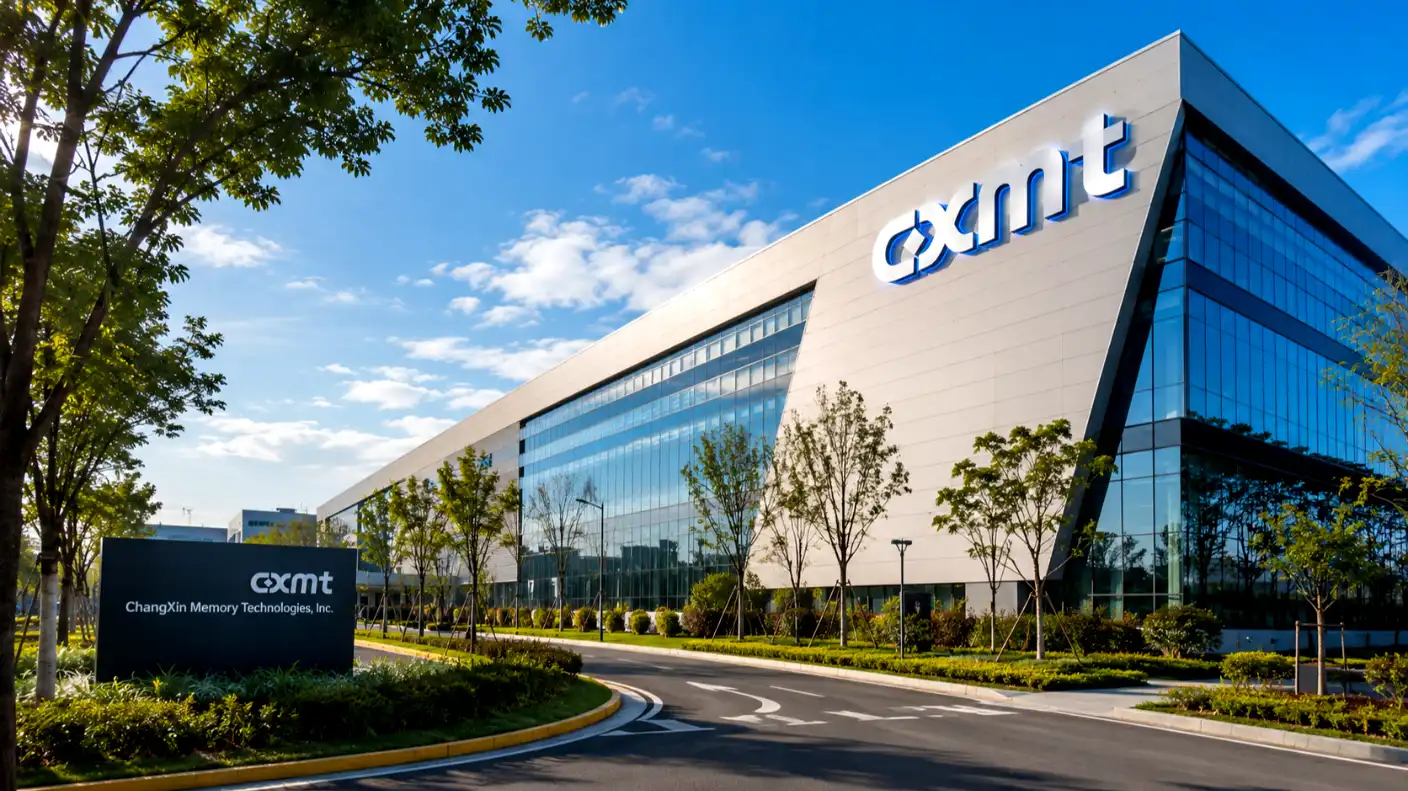
The global technology and semiconductor markets are experiencing a profound, highly volatile period of capital reallocation. While the artificial intelligence boom has generated spectacular, multi-billion-dollar opportunities for hardware manufacturers, it has also introduced a significant wave of investor caution. In a major milestone that has exposed this delicate balance, Chinese memory chip giant ChangXin Memory Technologies, widely known as CXMT, finalized its initial public offering pricing on Shanghai’s tech-focused STAR Market.
The public offering represents a historic moment for the Asian financial markets. Priced at 8.66 yuan, or approximately $1.28, per share, CXMT is on track to raise a massive 57.9 billion yuan, or roughly $8.55 billion, before any overallotment options are exercised. If lead underwriter China International Capital Corporation exercises the full 15 percent greenshoe overallotment option, the total capital raised will climb to an extraordinary 66.6 billion yuan, or approximately $9.8 billion, valuing the company at a staggering $85.5 billion. This makes the flotation Asia’s largest initial public offering so far this year and the largest Chinese semiconductor listing since foundry giant SMIC made its market debut in 2020.
However, the filing details released on Sunday, July 19, 2026, reveal a stark, highly instructive divergence in market demand. While retail investors went completely wild—oversubscribing the online retail tranche by more than 212 to 243 times—institutional demand was noticeably dented. Valid bids from 285 mutual funds, pension funds, and insurance companies covered roughly 463 to 570 times the institutional shares on offer. While this represents robust demand in absolute terms, it is a significant drop from the 5,000-fold oversubscriptions commonly seen in other recent high-profile Chinese technology listings, proving that professional money managers are adopting a highly cautious approach amid a brutal global correction in semiconductor stocks.
The Global Tech Correction: Why the Institutional Appetite Soured
The primary driver behind the cooler institutional response is a massive, highly synchronized pullback in the global technology sector. Over the past month, investors from Seoul to Silicon Valley have begun to take profits and reduce their exposure to high-flying chipmaker stocks, raising concerns that the artificial intelligence infrastructure boom may have become over-leveraged and detached from near-term software profitability.
This global correction has hit the Chinese market particularly hard. The tech-focused STAR Market, which serves as the premier listing venue for the country’s leading semiconductor, advanced materials, and clean energy firms, has plummeted by roughly 25 percent from its July 1 peak. This rapid contraction has wiped out over 4 trillion yuan, equivalent to approximately $590 billion, of public market value in less than three weeks, leaving institutional fund managers highly reluctant to deploy massive, non-hedged capital into a newly public chip company at a premium multiple.
The Looming Threat of Tightening U.S. Export Restrictions
Beyond the immediate market volatility, institutional investors are pricing in severe, long-term geopolitical risks. As the technological cold war between Washington and Beijing continues to intensify, the United States government has systematically tightened its export controls to restrict Chinese semiconductor firms from accessing advanced Western manufacturing technologies.
CXMT sits squarely in the crosshairs of this geopolitical decoupling policy. As China’s leading developer of Dynamic Random-Access Memory, the company relies heavily on advanced lithography and etching tools imported from European, Japanese, and American suppliers to upgrade its manufacturing lines.
If Washington implements further unilateral trade sanctions or pressures its international allies to expand their export blacklists, CXMT could find itself unable to secure the critical equipment and spare parts needed to run its factories, creating an existential risk to its long-term technological roadmap. This regulatory uncertainty has forced professional money managers to demand a significant valuation discount, limiting their bidding enthusiasm during the book-building process.
The Cash Drainage Fear on the STAR Market
A secondary concern among institutional investors is the sheer scale of the CXMT listing. An $8.55 billion initial public offering is an extraordinary capital drain for any domestic stock market, particularly one that has been struggling to regain its footing amid persistent economic headwinds.
Wall Street analysts warn that the massive capital requirements of the CXMT listing could temporarily drain liquidity away from other, mid-cap technology stocks on the STAR Market.
When a single, high-profile semiconductor giant sucks billions of dollars out of the local system, mutual funds and index trackers must sell off their holdings in other tech firms to reallocate capital to the new benchmark constituent.
This forced selling pressure can create a localized down-cycle, keeping institutional managers cautious about buying into a mega-IPO that could trigger a broader, near-term correction across their existing portfolios.
Inside the Numbers: CXMT’s Explosive Financial Turnaround
The institutional caution surrounding the IPO is particularly interesting because it stands in stark contrast to the company’s spectacular, highly profitable financial performance. Driven by a global upcycle in memory prices and rising domestic demand for artificial intelligence servers, CXMT has delivered a historic financial turnaround.
According to its updated prospectus filings, the Hefei-based manufacturer recorded a spectacular first-quarter revenue of 50.8 billion yuan, representing a staggering 719 percent year-on-year increase. More importantly, the company swung from a net loss of 1.6 billion yuan in the first quarter of the prior year to a massive net profit of 33 billion to 35.4 billion yuan, proving that its low-price market expansion strategy has successfully transitioned into high-margin operational profitability.
This momentum has continued to accelerate throughout the first half of the year. CXMT has provided a robust revenue guidance between 110 billion yuan and 120 billion yuan, equivalent to approximately $17.62 billion, for the first six months.
To put this figure in perspective, the projected first-half revenue is nearly double the 61.8 billion yuan the company generated during the entirety of the previous year, demonstrating that the firm is successfully capturing the massive economic windfalls of the global memory chip recovery.
Rebuilding the Domestic Ecosystem: The Strategic Allies of Beijing
While institutional demand was slightly dampened, the public listing has secured powerful backing from a massive consortium of strategic, state-owned, and private-sector corporate investors, demonstrating Beijing’s absolute determination to achieve semiconductor self-reliance.
The list of strategic investors participating in the IPO reads like a who’s who of the Chinese technology and manufacturing landscapes. Major corporate players—including Alibaba Cloud, Xiaomi, Tencent, ZTE, and Chery Automobile—have taken substantial, direct equity stakes in the company, ensuring they secure a reliable, domestic source of memory chips for their future cloud services, smartphones, telecommunications gear, and electric vehicles, while building a protective wall around the country’s technology supply chain.
High-Flyer Quant’s Massive Twelve-Billion-Share Bid
The primary private-sector driver of the institutional bidding was High-Flyer Quant, one of the most successful and technologically advanced quantitative hedge funds in China. The firm, which co-founded the globally famous artificial intelligence startup DeepSeek, has built a massive reputation for utilizing advanced machine learning algorithms to run algorithmic trading strategies.
During the book-building process, High-Flyer Quant bid heavily, submitting bids through 153 private fund products for a combined 12.55 billion shares at a premium price of 8.78 yuan per share.
This massive, multi-billion-yuan commitment from the nation’s leading quantitative fund represents a powerful vote of confidence in CXMT’s underlying technology, signaling to the wider market that the country’s most sophisticated algorithmic traders believe the chipmaker’s stock represents a highly valuable, long-term asset.
The National “Big Fund” and State Ownership
The financial backbone of the company’s capital structure remains firmly anchored in state ownership. Before the initial public offering, state-owned investment entities held a controlling 36.29% stake in the company.
The primary state backers include the Anhui Investment Group and the highly powerful National Integrated Circuit Industry Investment Fund II, commonly known as the “Big Fund.”
This extensive state ownership guarantees that CXMT will always have access to the strategic support, cheap capital, and favorable government procurement contracts needed to survive and expand.
For Beijing, supporting CXMT is not a simple commercial investment; it is a vital national security priority to ensure that China’s domestic computing infrastructure, mobile networks, and military hardware can operate independently of foreign semiconductor suppliers, making the company virtually immune to the threat of corporate bankruptcy.
The Global DRAM Oligopoly and the Battle for Fifteen Percent Market Share
To understand the long-term strategic goals of CXMT, one must analyze its competitive positioning in the global Dynamic Random-Access Memory market. For decades, the DRAM industry has operated as an incredibly tight, highly profitable oligopoly, dominated by a tiny group of three giant manufacturers: Samsung Electronics, SK Hynix, and Micron Technology.
These three players have historically controlled over 90 percent of the global market, using their massive capital scale and deep intellectual property portfolios to lock out potential competitors.
While smaller memory makers in Taiwan and Europe attempted to compete in previous decades, they ultimately collapsed or retreated into niche markets because they lacked the massive cash flows required to constantly upgrade their manufacturing facilities and keep pace with the rapid, multi-billion-dollar development of new node architectures.
The Fifteen Percent Market Share Threshold for Survival
To break this oligopoly and establish itself as a permanent, self-sustaining player in the global market, industry analysts believe that CXMT must achieve a critical threshold: capturing at least 15% of global DRAM bit shipments.
Historically, when a memory manufacturer’s market share falls below this 15% line, its revenues are insufficient to cover the extreme research and development and capital expenditure costs required to develop next-generation technologies, forcing them to fall behind the technology curve.
The company is making rapid, highly encouraging progress toward this target. Driven by its aggressive pricing and strong domestic customer base, CXMT’s global DRAM market share climbed from 4% in the second quarter of last year to 8% in the first quarter, with market research firms projecting the company will reach 11% by 2028.
The proceeds from the massive $8.55 billion IPO will go directly toward funding the capital-intensive construction of new, advanced fabrication facilities, allowing the company to rapidly scale its output, close the technology gap with Samsung and SK Hynix, and secure its long-term survival in the global market.
The successful pricing of ChangXin Memory Technologies’ $8.55 billion initial public offering is a defining, historic milestone for the global semiconductor industry. By completing the largest technology listing of the year on Shanghai’s STAR Market, the company has successfully secured the massive war chest needed to fund its next-generation DRAM and advanced packaging development programs.
While the sudden, global correction in tech stocks and tightening U.S. trade embargoes have introduced a healthy wave of near-term caution among institutional investors, the long-term strategic trajectory of the company remains highly secure.
Backed by the absolute financial power of the Chinese state, aligned with a massive consortium of domestic technology giants, and executing a highly disciplined, rapid capacity expansion, CXMT is proving that the global memory market is no longer a closed, Western-led oligopoly. It is a highly competitive, multi-polar arena where domestic resilience, sovereign security, and advanced engineering will determine the ultimate winners of the digital age.






