

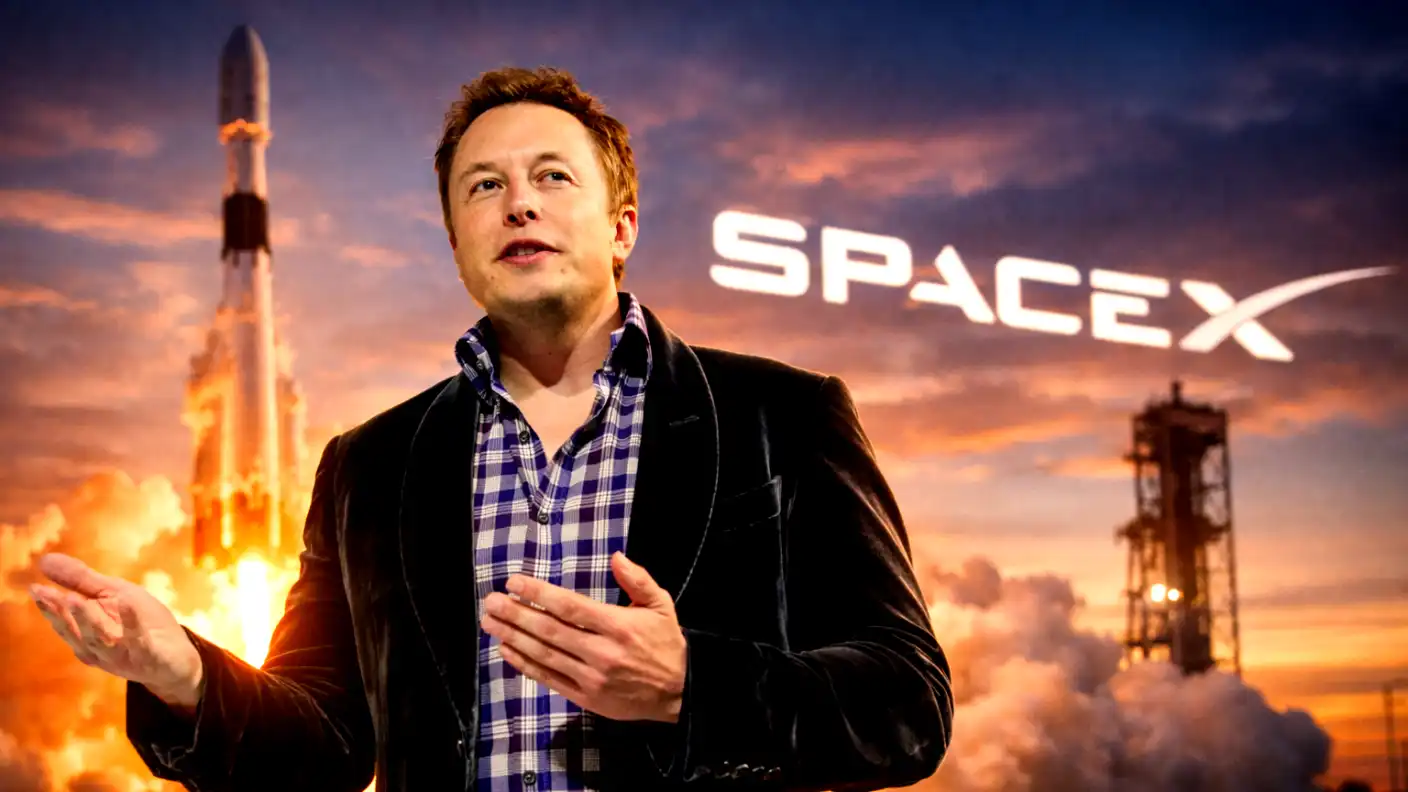
SpaceX founder and chief executive Elon Musk has unveiled an extraordinary long-term financial target for the aerospace and satellite communications giant, projecting that the company could generate approximately $3.5 trillion in annual revenue around 2033. The projection outlines a seven-year roadmap that would elevate SpaceX from a multi-billion-dollar rocket launch provider into the most lucrative commercial enterprise in modern economic history.
The projection reflects a strategic transformation of SpaceX’s business model. While heavy rocket launches and government exploration contracts provided the foundational revenue to scale operations, future growth will be driven by high-margin commercial telecommunications, direct-to-cell mobile networks, massive orbital artificial intelligence data centers, and heavy-payload Starship freight. By deploying space-based computing clusters that operate outside terrestrial electrical power grids, SpaceX aims to capture hundreds of billions of dollars from the global computing boom.
Reaching $3.5 trillion in annual revenue requires sustained, compounding growth across multiple operational frontiers. For context, the entire gross domestic product of economic powerhouses like the United Kingdom or France sits near $3.5 trillion, and no single commercial corporation has ever generated more than $700 billion in annual sales. However, as SpaceX accelerates Starship flight tests, expands its Starlink satellite constellation past 30 million subscribers, and partners with Tesla on semiconductor manufacturing, Musk is wagering that orbital infrastructure will become the central engine of the global digital economy.
An Audacious Revenue Roadmap for the Global Space Economy
The financial trajectory of SpaceX has consistently outpaced traditional aerospace forecasts. When Musk founded the company, industry veterans dismissed the concept of reusable orbital rockets as an engineering fantasy. Today, SpaceX dominates the global commercial launch market, launching more mass into orbit every quarter than all other nations and private companies combined.
The $3.5 trillion revenue estimate represents a continuation of this exponential scaling philosophy. Musk’s long-term projection assumes that orbital services will transcend traditional aerospace boundaries, merging with global telecommunications, enterprise cloud computing, consumer wireless networking, and deep-space mining logistics.
Financial analysts note that achieving multi-trillion-dollar revenue within seven years requires SpaceX to maintain an annual compound growth rate exceeding 60%. By vertically integrating rocket manufacturing, satellite design, custom semiconductor fabrication, and consumer ground terminals, SpaceX captures full operating profit margins across every layer of its technology stack.
Unpacking the 2033 Projection and the Exponential Growth Trajectory
The timeline established by Musk targets 2033 as the operational milestone where multiple capital-intensive projects reach full commercial maturity. The roadmap outlines three distinct phases of revenue acceleration:
- Phase One: Scaling Starlink broadband to tens of millions of enterprise and residential users while expanding direct-to-cell connectivity across major mobile carriers.
- Phase Two: Deploying high-capacity Starship fleets to launch space-based artificial intelligence data centers, generating recurring computing revenues from global enterprise clients.
- Phase Three: Commercializing point-to-point suborbital passenger transit, planetary logistics routes, and sovereign orbital defense platforms.
Financial models suggest that while satellite broadband will generate between $90 billion and $100 billion in annual revenue by 2031, space-based computing infrastructure and heavy orbital logistics will provide the massive volume required to push annual revenues toward the multi-trillion-dollar mark.
Comparing SpaceX’s Projected Top Line Against Global Technology Conglomerates
To understand the magnitude of generating $3.5 trillion in annual sales, one must compare the figure to existing global corporate giants. Leading Fortune 500 enterprises like Walmart, Amazon, and Apple currently generate annual revenues between $400 billion and $650 billion.
Generating $3.5 trillion in top-line revenue would mean:
- SpaceX’s annual sales would exceed the combined total revenues of Alphabet, Microsoft, Meta, Apple, Amazon, and Nvidia.
- The company would capture an estimated 2.5% to 3.0% of total global economic output.
- Daily corporate revenue collections would exceed $9.5 billion every single day of the year.
- Operating cash flows generated by the business would fund continuous planetary exploration and Mars colonization without requiring external debt or public equity financing.
While traditional Wall Street analysts view these projections as aggressive, Musk’s track record with Tesla—which grew from an experimental electric car startup into a trillion-dollar automotive leader—proves that exponential scaling can disrupt established global industries.
Starlink Direct-to-Cell and Global Telecommunications Dominance
The immediate commercial engine powering SpaceX’s financial expansion is the Starlink satellite internet network. Operating thousands of low-Earth-orbit satellites, Starlink has established itself as the world’s premier satellite communications provider, delivering high-speed, low-latency broadband to consumers, commercial airlines, maritime shipping fleets, and emergency rescue operations.
However, standard fixed broadband represents only the first phase of Starlink’s commercial monetization. The next major growth frontier is Direct-to-Cell technology, which connects standard, unmodified smartphones directly to orbiting satellites without requiring specialized external hardware or satellite dishes.
Direct-to-Cell technology transforms Starlink from a niche rural internet provider into a global mobile telecommunications operator capable of serving billions of cellular subscribers worldwide.
Scaling Starlink Subscribers Beyond 30 Million Worldwide
The growth of Starlink’s subscriber base continues to accelerate across North America, Europe, Latin America, and emerging markets. Industry forecasts project that active Starlink customer accounts will expand from several million users today to more than 30 million active subscriptions before 2028.
Key drivers accelerating subscriber expansion include:
- Expanding commercial aviation contracts, providing continuous in-flight Wi-Fi for major international airline carriers.
- Equipping global maritime shipping fleets, oil platforms, and commercial cruise liners with high-bandwidth mobile terminals.
- Supplying sovereign military and government defense agencies with encrypted Starshield communication constellations.
- Lowering hardware terminal manufacturing costs, allowing SpaceX to distribute consumer satellite dishes at affordable retail prices across developing nations.
With monthly subscription fees ranging from $80 to $250 for residential users and thousands of dollars per month for commercial enterprise accounts, scaling to 30 million users establishes a dependable, high-margin revenue foundation of tens of billions of dollars per year.
Direct-to-Cell Wireless Partnerships with T-Mobile and Global Telcos
Starlink’s Direct-to-Cell initiative is expanding rapidly through commercial partnerships with leading national telecommunications carriers. In the United States, SpaceX partnered with T-Mobile to eliminate cellular dead zones, allowing mobile subscribers to send text messages, make voice calls, and access mobile data in remote wilderness areas, national parks, and offshore coastal waters.
Major international investment banks, including Bank of America, noted that SpaceX’s wireless expansion provides significant commercial benefits to partner mobile operators:
- Partner carriers can market 100% geographic network coverage to consumer and enterprise subscribers without constructing expensive terrestrial cell towers in remote regions.
- SpaceX captures wholesale network access fees from dozens of international mobile carriers across Japan, Australia, New Zealand, Canada, and Western Europe.
- Connected Internet of Things sensors deployed across agriculture, mining, and freight transport can transmit data continuously from any point on Earth.
- Emergency disaster management agencies can maintain communications during earthquakes, hurricanes, and wildfires that disable terrestrial cell networks.
Direct-to-cell wireless networking positions SpaceX to capture a significant share of the $1.5 trillion global telecommunications market, providing high-volume recurring revenues that scale with global smartphone adoption.
Space-Based AI Compute and the Starmind Orbital Constellations
The most revolutionary component of SpaceX’s multi-trillion-dollar revenue strategy is the deployment of space-based artificial intelligence data centers. As artificial intelligence models expand in size and complexity, terrestrial data centers are running into severe physical constraints, including electrical power grid shortages, water cooling restrictions, and multi-year interconnection delays.
Elon Musk has stated that space-based computing revenue could eventually surpass revenue from all other SpaceX businesses combined, projecting that artificial intelligence infrastructure will become the dominant revenue driver for the company.
By launching massive computing constellations, known as Starmind clusters, SpaceX intends to operate gigawatts of high-performance artificial intelligence computing directly in low Earth orbit, bypassing terrestrial power and regulatory bottlenecks entirely.
Bypassing Terrestrial Power Grid Bottlenecks with Orbital Data Centers
Terrestrial data center developers face severe operational hurdles on Earth. In major computing corridors across the United States and Europe, connecting a 500-megawatt computing campus to the public electrical grid now takes between four and seven years due to transformer shortages and transmission congestion.
Operating artificial intelligence data centers in low Earth orbit eliminates these terrestrial limitations:
- Continuous Solar Power: Orbiting satellite data centers in specialized sun-synchronous orbits capture uninterrupted, high-intensity solar radiation 24 hours a day without atmospheric filtering or cloud interference.
- Radiative Vacuum Cooling: In the vacuum of space, computing hardware can dissipate thermal energy directly into deep space via radiative cooling panels, eliminating the need for millions of gallons of municipal cooling water.
- Zero Land and Permitting Delays: Spacecraft operate outside municipal zoning battles, regional environmental lawsuits, and local utility rate disputes.
- Ultra-Low-Latency Optical Mesh: Satellites communicate via high-speed laser cross-links, routing data packets around the globe at the speed of light in a vacuum, which is 40% faster than light traveling through terrestrial glass fiber-optic cables.
Financial analysts at Evercore ISI emphasized that orbital computing provides technology companies with a viable alternative to circumvent the growing political and environmental opposition facing terrestrial data centers.
Targeting 10 Gigawatts of Space-Based Compute Capacity
SpaceX has established an ambitious technical objective to deploy roughly 10 gigawatts of space-based artificial intelligence computing capacity before the end of 2027. A single gigawatt represents 1 billion watts of continuous computing power.
Operating 10 gigawatts of compute capacity in orbit represents an extraordinary technological leap:
- The orbital capacity would equal the combined power consumption of several hundred terrestrial hyperscale data centers.
- Starship launch vehicles will deploy customized satellite buses packed with radiation-hardened graphics processing units, high-bandwidth memory stacks, and lightweight photovoltaic solar arrays.
- High-throughput optical downlinks will beam processed inference tokens and foundation model outputs directly to ground stations and enterprise clients worldwide.
- Musk estimated that 10 gigawatts of operational space compute could generate between $300 billion and $500 billion in annual revenue from global tech giants leasing compute time.
As artificial intelligence reasoning models become the primary computing workload of the global economy, providing clean, space-powered compute capacity will establish SpaceX as the world’s premier cloud computing utility.
Synergies with the $119 Billion Terafab Semiconductor Megafactory
Deploying gigawatts of computing hardware into space requires a dependable supply of specialized silicon. To support this infrastructure buildout, SpaceX and Tesla are jointly developing Terafab, a $119 billion semiconductor manufacturing megaplant located in Grimes County, Texas.
Covering more than 100 million square feet under a single roof, Terafab is engineered to produce over 1 terawatt of annual computing capacity, with SpaceX claiming roughly 75% of total silicon output:
- Manufacturing radiation-hardened processors built from specialized substrates that withstand cosmic ray strikes and solar flare ionization.
- Integrating high-bandwidth memory dies directly onto compute logic using advanced 3D packaging to minimize power consumption in orbit.
- Eliminating reliance on overseas semiconductor foundries, protecting SpaceX’s hardware roadmap from international geopolitical supply disruptions.
- Accelerating hardware development cycles by testing and packaging custom silicon in Texas before loading it directly onto Starship launch vehicles.
Total vertical integration—controlling the raw silicon fabrication, satellite assembly, launch vehicle manufacturing, and orbital operations—gives SpaceX an insurmountable cost advantage over terrestrial cloud competitors.
Starship Mass Production and Heavy Launch Monopolies
The physical foundation that makes space-based computing and global satellite networks economically viable is Starship. As the largest and most powerful flying machine ever constructed, Starship represents a complete revolution in aerospace engineering.
Standing nearly 400 feet tall and powered by 33 Raptor methane-fueled engines, the fully reusable launch system is designed to carry more than 100 to 150 metric tons of payload to low Earth orbit in standard configurations.
By achieving rapid reusability for both the Super Heavy booster and the Starship upper stage, SpaceX is lowering the cost of reaching orbit by multiple orders of magnitude.
Slashing Launch Costs to Under $10 Per Kilogram to Low Earth Orbit
Throughout the history of spaceflight, the prohibitive cost of launching mass into orbit prevented large-scale commercial industrialization. Traditional expendable rockets cost between $2,000 and $10,000 per kilogram of payload delivered to orbit.
Starship alters space economics by driving launch costs to historic lows:
- Reusing the stainless-steel booster and ship eliminates the expense of manufacturing new rockets for every mission.
- Utilizing low-cost liquid methane and liquid oxygen propellants keeps direct fuel costs below $1.0 million per launch.
- High launch cadences, targeting multiple launches per day from facilities in Boca Chica, Texas, and Cape Canaveral, Florida, amortize fixed ground infrastructure costs across thousands of flights.
- Internal engineering projections estimate that marginal launch costs will drop below $10 per kilogram of payload delivered to low Earth orbit.
Slashing launch costs to $10 per kilogram makes it economically feasible to deploy thousands of heavy computing satellites, orbital propellant depots, and space manufacturing facilities, unlocking a commercial space market worth trillions of dollars.
Capturing Multibillion-Dollar Defense and NASA Artemis Contracts
While commercial markets represent the largest long-term revenue opportunity, government space contracts provide steady, high-margin cash flows. The United States government, NASA, and allied defense agencies rely heavily on SpaceX to maintain space dominance.
SpaceX holds multi-billion-dollar government contract commitments:
- NASA Artemis Human Landing System: NASA awarded SpaceX multi-billion-dollar contracts to develop Starship variants to land American astronauts on the lunar surface.
- Commercial Crew and Resupply: SpaceX provides continuous crew transport and cargo resupply flights to the International Space Station aboard Falcon 9 and Dragon spacecraft.
- National Security Space Launch: The United States Space Force awarded SpaceX multi-billion-dollar contracts to launch heavy classified national security satellites.
- Point-to-Point Military Freight: The Department of Defense is evaluating Starship to transport 100 tons of military cargo and humanitarian aid to any location on Earth within 90 minutes.
These multi-year government partnerships validate the reliability of SpaceX’s engineering, providing non-dilutive capital to fund advanced rocket development programs.
Strategic Implications for Global Capital Markets and Public Investors
Elon Musk’s multi-trillion-dollar revenue target is reshaping how Wall Street and institutional asset allocators value aerospace and technology infrastructure. Equity analysts who previously evaluated SpaceX as an industrial aerospace manufacturer are now valuing the company as a high-growth platform that combines telecommunications, cloud infrastructure, and logistics.
As SpaceX scales its operational revenues toward 2033, private market valuations and anticipated public market debuts will establish historical milestones for corporate capital formation.
Understanding the financial and technical metrics driving this valuation super-cycle is essential for institutional investors navigating the modern technology economy.
Evaluating Valuation Multiples and Capital Requirements Toward 2033
In private funding rounds and secondary employee share transactions, SpaceX’s valuation has climbed steadily, establishing it as the most valuable private technology enterprise in the world. Financial analysts project that as Starlink revenues compound and space-based computing comes online, the company’s enterprise valuation could reach $5 trillion to $7 trillion by the early 2030s.
Financial strategists are tracking key valuation drivers:
- Telecommunications multiples: Valuing Starlink’s recurring subscription cash flows at enterprise multiples between 15 and 20 times EBITDA.
- Cloud infrastructure multiples: Applying premium 25-to-30-times multiples to space-based artificial intelligence compute revenues.
- Capital expenditure management: Reinvesting billions of dollars in free cash flow into automated Starship gigafactories and orbital launch pads.
- Margin expansion: Expanding company-wide gross profit margins past 70% as software and network subscription revenues outpace launch manufacturing costs.
These structural financial characteristics provide SpaceX with unprecedented capital strength, allowing the company to fund ambitious engineering projects that traditional public corporations cannot justify to short-term shareholders.
The Long-Term Vision for Multi-Planetary Transport and Orbital Freight
While multi-trillion-dollar revenues represent a landmark commercial milestone, Elon Musk has repeatedly emphasized that financial profitability is a means to an end rather than the ultimate corporate objective. The foundational purpose of SpaceX remains making humanity a multi-planetary species by building a self-sustaining city on Mars.
Establishing commercial profitability on Earth enables this long-term interplanetary mission:
- High-margin terrestrial revenues fund the construction of thousands of Starship vehicles, orbital propellant tanker fleets, and planetary surface habitats.
- Regularly scheduled Earth-to-Mars launch windows, occurring every 26 months, will transport millions of tons of construction equipment, mining machinery, and life-support modules.
- Establishing orbital propellant depots in low Earth orbit will enable heavy spacecraft to refuel before traveling to the Moon, Mars, and the outer solar system.
- Orbital manufacturing facilities will produce advanced optical glass, ultra-pure semiconductor alloys, and pharmaceuticals in microgravity conditions for export back to Earth.
By building an integrated economic engine that unites satellite telecommunications, orbital artificial intelligence computing, and reusable heavy launch logistics, SpaceX is constructing the foundational infrastructure for the next century of human economic activity.
Elon Musk’s projection that SpaceX could achieve approximately $3.5 trillion in annual revenue by 2033 marks a bold declaration of the commercial potential of the space economy. By expanding Starlink’s direct-to-cell network across global telecommunications markets, deploying gigawatts of space-based artificial intelligence compute to bypass terrestrial grid constraints, and mastering fully reusable heavy launch with Starship, SpaceX is redefining the boundaries of global industry. While multi-trillion-dollar targets challenge conventional financial models, SpaceX’s vertical integration, technological lead, and execution track record make its orbital ambitions an unstoppable economic force. As the space age merges with the artificial intelligence revolution, SpaceX stands as the architect of a new industrial paradigm, transforming the cosmos into the most valuable economic frontier in human history.






