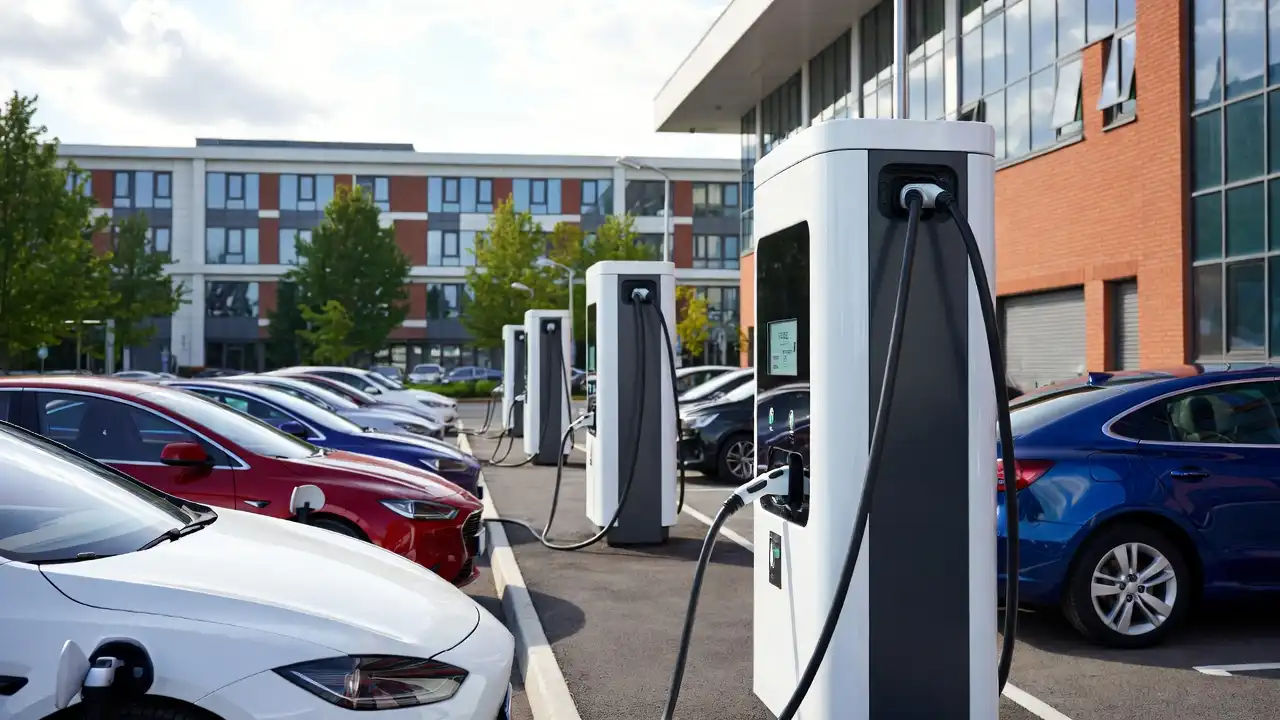
The global transition to sustainable mobility has reached a fascinating, highly unexpected turning point in Europe. For years, the primary argument against purchasing an electric vehicle was the notorious “chicken-and-egg” dilemma of public infrastructure. Consumers refused to buy electric cars because there were not enough charging stations, while private companies refused to invest in building charging stations because there were not enough electric cars on the road to make them profitable. Today, fresh regulatory data reveals that Europe has successfully shattered this deadlock.
According to a comprehensive industry report published by Reuters, the European Union’s public electric vehicle charging network is expanding at an extraordinary pace, successfully outstripping the rate of new electric vehicle sales. The bloc has met its ambitious, legally binding infrastructure targets years ahead of schedule. By the middle of the year, the total number of active public charging points across the twenty-seven member states exceeded 950,000, representing a massive 38 percent increase compared to the previous year.
This rapid infrastructure expansion has occurred exactly as the European consumer electric vehicle market experienced a temporary, policy-driven slowdown. Following Germany’s abrupt termination of consumer electric vehicle subsidies and rising cost-of-living pressures across the continent, new electric vehicle sales in Europe fell by roughly 12 percent in the first half of the year. This combination of surging infrastructure and cooling sales has created a highly unique gap where the charging network has pulled far ahead of vehicle registration numbers, effectively dismantling “range anxiety”—the primary psychological barrier to electric vehicle adoption—and ensuring that Europe is physically prepared for the next massive wave of clean transport.
The Infrastructure Paradox: Why Charging Stations Are Outrunning EV Registrations
The current state of the European energy and transport markets represents a complete inversion of historical trends. In the early years of the electric vehicle transition, public charging networks were severely underdeveloped, with drivers frequently reporting broken chargers, long waiting lines, and vast “data deserts” where no fast-charging options existed for hundreds of kilometers. This infrastructure deficit kept electric vehicles restricted to wealthy urban areas, preventing mass adoption in rural and regional communities.
The rapid, state-supported infrastructure buildout of the past two years has completely resolved this bottleneck. The European Union’s public charging network is growing so quickly that it has created a significant capacity cushion. While the physical number of electric vehicles on European roads continues to rise gradually, the number of public charging points is compounding at a much faster rate, ensuring that drivers have immediate, convenient access to high-power charging whenever and wherever they need it.
For the automotive industry, this infrastructure cushion is a major strategic asset. Car manufacturers can now market their upcoming electric models with absolute confidence, showing consumers that they can easily take long-distance road trips across international borders without worrying about running out of power. By building the charging network ahead of demand, the European Union is establishing a highly resilient, long-term foundation that will support the mass adoption of zero-emission vehicles as battery costs continue to fall and affordable new models enter the market.
Demystifying the AFIR Mandates: How Europe Met Its Targets Early
The primary force driving this rapid infrastructure expansion is the European Union’s Alternative Fuels Infrastructure Regulation, commonly known as the AFIR. Passed as a key pillar of the bloc’s ambitious “Fit for 55” climate package, the AFIR is a highly progressive, legally binding piece of legislation that mandates exact, numbers-driven infrastructure targets for every member state, eliminating the voluntary, hands-off approach of the previous decade.
The AFIR is unique because it directly links the growth of the charging network to the number of electric vehicles actually registered on the road, ensuring that the infrastructure always scales in proportion to demand.
By forcing member states to meet strict, legally enforceable power-capacity targets, the regulation has mobilized billions of euros in private and public investment, completely transforming the highways of Europe into highly connected green transport corridors.
The Kilowatt-Per-Vehicle Sourcing Formula
The operational core of the AFIR is a highly precise, legally binding formula that requires member states to provide a specific amount of public charging power for every electric vehicle registered within their borders.
Specifically, the law mandates that for every single battery-electric vehicle registered, the public charging network must provide at least 1.3 kilowatts of power, while plug-in hybrids require at least 0.8 kilowatts of dedicated public capacity.
The latest regulatory filings confirm that European nations have not only met this requirement, but have actually exceeded the baseline power targets by a wide margin.
Through aggressive state-level funding programs, streamlined permitting processes, and partnerships with private charging operators like Ionity, Allego, and Fastned, member states have built a massive power-capacity buffer. This excess capacity ensures that the public grid can easily handle the electrical demands of millions of additional electric vehicles without experiencing localized overloads or voltage fluctuations.
The Sixty-Kilometer Fast-Charging Highway Network
The second, equally critical pillar of the AFIR is a strict mandate governing the density of fast-charging stations along Europe’s primary transportation arteries, known as the Trans-European Transport Network (TEN-T) core network.
The regulation requires that by the end of the year, member states must install high-power charging pools featuring an output of at least 150 kilowatts every 60 kilometers along these primary highways.
The latest audits show that the European Union has successfully achieved this landmark milestone ahead of schedule, completely transforming the reality of long-distance European travel.
A driver can now travel from Lisbon, Spain, to Stockholm, Sweden, with absolute confidence, knowing they are never more than 60 kilometers away from a high-speed charging station.
Furthermore, the regulation includes even more demanding mandates for heavy-duty commercial trucks, requiring the installation of massive 350-kilowatt charging pools every 100 kilometers to support the rapid decarbonization of Europe’s critical logistics and freight networks.
The Great Divide: Europe’s Highly Unequal Charging Map
While the aggregate numbers paint a picture of historic success, a granular examination of the European Union’s charging network reveals a severe, highly concerning geographical divide. The rapid expansion of the infrastructure is heavily concentrated in a few wealthy, highly progressive Western European nations, leaving Southern and Eastern European members dangerously behind.
This geographical inequality represents a major threat to the integrity of the single market. If a citizen living in Poland or Greece cannot access the same high-quality, convenient charging infrastructure as a citizen living in Germany or the Netherlands, it creates a two-tier Europe, restricting the freedom of movement and slowing down the transition to clean mobility in the countries that need it most.
The Western Monopoly: Germany, France, and the Netherlands
The latest registry data from the European Alternative Fuels Observatory reveals that the European Union’s charging network is overwhelmingly dominated by just three countries: Germany, France, and the Netherlands.
Together, these three nations host over 58 percent of all public charging stations in the entire 27-member bloc, creating a high-density “electric golden triangle” in Western Europe.
The Netherlands stands as the undisputed champion of this movement, boasting the highest charging-point density in the world, with over 140,000 public chargers installed across its compact territory.
Germany and France have pursued similar, highly aggressive strategies, investing billions of euros to subsidize municipal charging stations, streamline connection permits for private businesses, and mandate the installation of fast chargers at traditional gasoline stations, ensuring their citizens are never more than a few minutes away from a secure charge.
The Inadequate Networks of Southern and Eastern Europe
In sharp contrast to the high-density networks of the West, the charging infrastructure in Southern and Eastern Europe remains severely underdeveloped. Countries like Poland, Greece, Romania, and Bulgaria collectively account for less than 10 percent of the EU’s total public charging points, despite making up a massive percentage of the bloc’s landmass and population.
In Poland, for example, a driver must often travel hundreds of kilometers between fast-charging stations, and the few available chargers are frequently slow, outdated systems that require hours to replenish a battery pack.
This infrastructure deficit is driven by a combination of factors: lower average consumer incomes, a lack of state-level subsidies, and legacy electrical grids that require massive, multi-billion-euro upgrades before they can support high-power, fast-charging installations.
By failing to build out their networks, these countries are trapping themselves in a cycle of low electric-vehicle adoption, as local consumers refuse to buy clean cars until they see a reliable charging network on their roads.
Funding the Grid: The Multi-Billion Euro Clean Energy Push
Building a continental-scale charging network requires an extraordinary amount of capital. To overcome the high upfront costs of cleanroom civil engineering, grid upgrades, and equipment procurement, the European Union has launched several massive, multi-billion-euro funding programs to subsidize the transition.
These public subsidies are designed to de-risk projects for private charging operators, making it financially viable for them to build high-power stations in remote or low-density regions where low traffic volumes would normally prevent profitability.
By partnering with private capital, the EU is using public money as a powerful economic multiplier, drawing in billions of euros in private investment to accelerate the construction of the clean energy network.
The Connecting Europe Facility and the $1.6 Billion Subsidy Engine
The primary financial engine driving the European infrastructure buildout is the Connecting Europe Facility, a dedicated European Union funding program designed to promote high-performance, sustainable infrastructure projects across the transport, energy, and digital sectors.
Under its Alternative Fuels Infrastructure Facility, the CEF has deployed over €1.5 billion, or approximately $1.63 billion, in direct grants to fund fast-charging and hydrogen-refueling stations.
These federal grants have funded the installation of thousands of ultra-fast charging points along the TEN-T highway network, ensuring that major travel corridors are fully equipped to support high-density commercial and passenger traffic.
By targeting its subsidies directly at the high-power, 150-kilowatt and 350-kilowatt segments, the CEF is successfully building the high-speed transit network required to support the next phase of the global digital and clean energy transitions.
Overcoming the High-Voltage Grid Connection Challenge
While securing capital and purchasing charging equipment are critical steps, the final, most difficult bottleneck in the infrastructure buildout is the physical grid connection. Connecting a massive, multi-charger fast-station to the local electrical network is an incredibly complex engineering feat that requires significant, localized grid upgrades.
A single ultra-fast charging pool containing four 350-kilowatt chargers can draw up to 1.4 megawatts of electricity simultaneously when fully utilized—an amount of power equal to the energy consumption of a small village.
To deliver this volume of electricity safely, utility companies must install specialized high-voltage transformers, reinforce regional transmission lines, and deploy advanced power management systems to prevent localized voltage drops.
Currently, the industry faces a severe global shortage of high-voltage transformers and switchgear, with wait times for critical equipment stretching to over two years, representing the new primary bottleneck that charging operators must overcome to bring their completed stations online.
Strategic Outlook: Preparing for the Next Phase of the EV Market
The successful de-risking of the European charging network has laid the physical foundation for the next major phase of the global automotive transition. By meeting its infrastructure targets early and outpacing the rate of vehicle sales, the European Union has successfully eliminated the single largest argument against electric mobility.
As battery technology continues to improve, and as Chinese and Western automakers launch a new wave of highly competitive, budget-friendly electric vehicles priced under $25,000, the presence of a mature, high-density public charging network will become a massive, unstoppable market driver.
Consumers who previously remained on the sidelines due to range anxiety will find themselves with no remaining excuses, triggering a massive, long-term resurgence in electric vehicle registrations that will easily absorb the excess capacity currently being built across the continent.
The European Union has proved that through strict, legally binding policy mandates, proactive public-private funding, and a relentless focus on infrastructure-first planning, a society can successfully build the clean energy foundations of the future, ensuring a more resilient, sustainable, and prosperous world for generations to come.