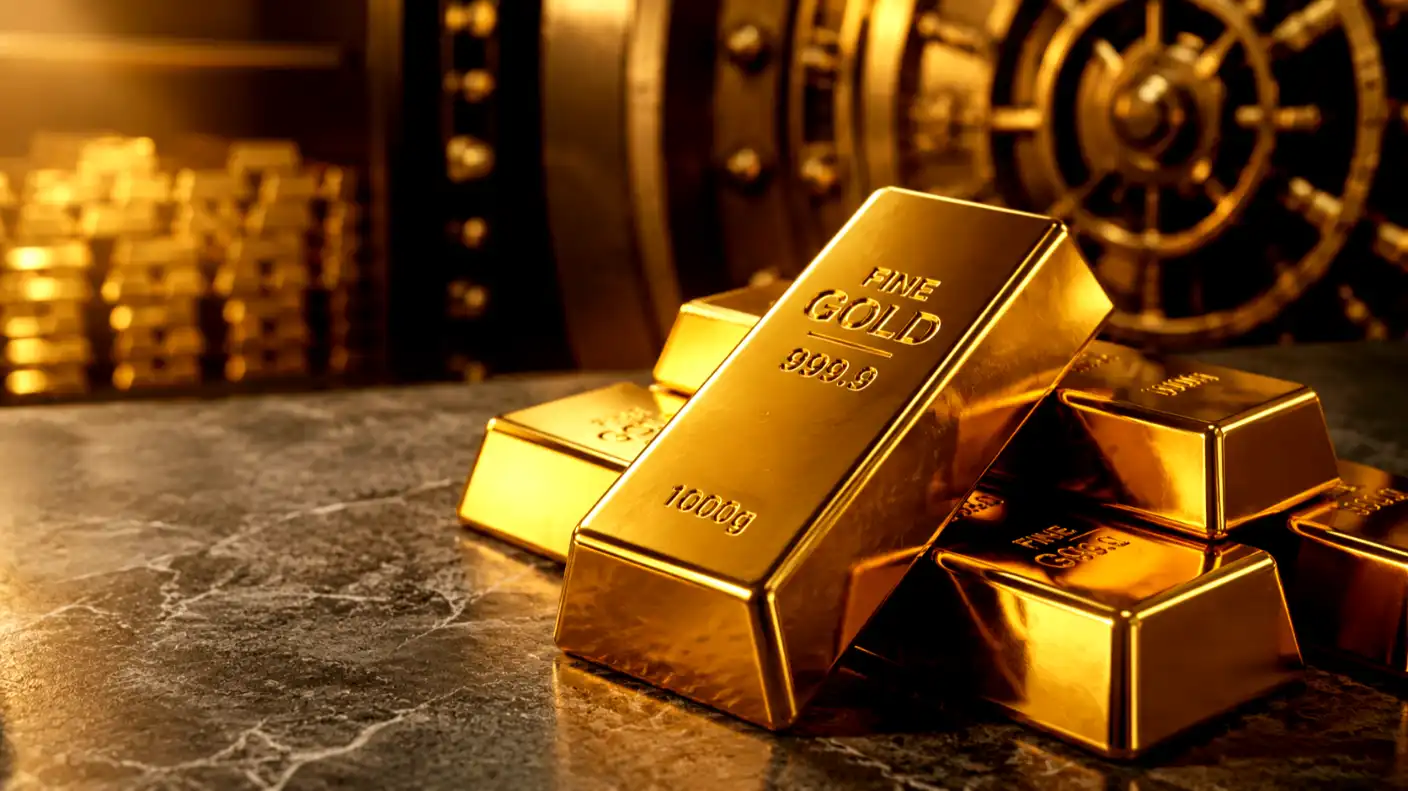
The global commodity markets are experiencing a severe realignment as geopolitical conflict and hawkish monetary policy expectations converge. Gold prices locked in significant weekly losses on Friday, July 10, 2026, as a dramatic escalation in military hostilities between the United States and Iran shattered hopes of a sustained diplomatic truce. The sudden flare-up in the Middle East has sent shockwaves through the energy markets, triggering a spike in crude oil prices that threatens to unleash a new wave of global inflation.
This inflationary threat has fundamentally altered the outlook for interest rates, forcing financial markets to prepare for a much more hawkish stance from the Federal Reserve. Spot gold fell about 0.6% on Friday to trade at $4,100.34 per ounce, while gold futures for August delivery slipped 0.8% to end at $4,108.90 per ounce. This downward movement capped a painful week for precious metal investors, with spot gold registering a weekly decline of approximately 2%.
For gold bulls, the correction is a sobering reminder of the metal’s high sensitivity to interest rate expectations. Earlier this year, gold served as the ultimate safe-haven asset, soaring to a record high of $5,594.82 per ounce on January 29. However, the subsequent rise in global interest rates and the resurgence of the US dollar have initiated a deep correction. With the metal now trading down more than 20% from its January peak, gold has officially crossed into technical bear market territory. The ongoing military clashes and the resulting rate jitters suggest that the near-term path for precious metals remains highly challenging.
Geopolitical Turmoil Meets Monetary Reality: Gold’s Complex Correction
The current decline in gold prices highlights a significant shift in how financial markets process geopolitical crises. Historically, sudden military escalations served as a direct catalyst for gold buying, as investors sought refuge from volatile equity markets in the safety of tangible assets. However, the unique dynamics of the current U.S.-Iran conflict have inverted this traditional relationship.
Instead of acting as a pure safe haven, gold is behaving increasingly like a rate-sensitive financial instrument. When military strikes disrupt vital shipping lanes in the Persian Gulf, the immediate economic consequence is a sharp increase in the price of crude oil. This energy shock raises manufacturing and transportation costs globally, feeding directly into core consumer inflation indices.
Because modern central banks are committed to bringing inflation back to target, any sign of persistent, energy-driven price increases forces policymakers to keep interest rates higher for longer. For gold, which pays no yield or dividend, a high-interest-rate environment represents a significant structural headwind. Investors are increasingly choosing to allocate capital to yield-bearing government debt or cash-equivalent instruments, raising the opportunity cost of holding physical precious metals and triggering widespread liquidations.
The US-Iran War and the Inflationary Feedback Loop
The fragile geopolitical balance in the Middle East collapsed entirely after a series of military actions disrupted regional shipping corridors. The primary driver of the week’s market volatility was a major announcement from Washington regarding the status of the regional ceasefire. The news instantly revived concerns that the localized conflict could expand into a wider regional war, with direct implications for global energy supplies.
As the conflict escalated, international mediators scrambled to salvage a recently signed memorandum of understanding between the two nations. However, the prospect of a lasting diplomatic breakthrough appears highly remote. The constant threat of retaliatory strikes on vital oil infrastructure and shipping channels has injected a massive risk premium into the energy markets, keeping global commodities on high alert.
The Termination of the Ceasefire and Soaring Oil Prices
The latest round of selling in the gold market was triggered when U.S. President Donald Trump declared on social media that the active ceasefire with Iran was officially over. Following a series of projectile attacks on commercial shipping vessels and oil tankers transiting the strategic Strait of Hormuz, the U.S. military launched a coordinated wave of airstrikes against Iranian military infrastructure.
The immediate consequence of these military strikes was a sharp spike in international crude oil prices, which jumped nearly 3% in early trading. The Strait of Hormuz is the world’s most critical oil transit chokepoint, facilitating the daily movement of roughly 20% of global petroleum supplies. Any threat of a prolonged military blockade or active fighting in these waters directly reduces the available supply of physical oil, forcing refiners to pay a premium for alternative shipments from West Africa and the Americas. This rapid increase in energy costs serves as a primary driver of global inflation, affecting everything from manufacturing overheads to household utility bills.
How Energy-Driven Inflation Fuels Hawkish Federal Reserve Expectations
The spike in oil prices has direct consequences for U.S. monetary policy. The Federal Reserve has spent more than a year attempting to cool the American economy and bring inflation back down to its long-term target. A sudden, geopolitical energy shock threatens to undo this progress, raising concerns that inflation could remain sticky and persistent well into next year.
This inflationary threat has forced investors to dramatically reprice their expectations for interest rates. According to the CME FedWatch tool, markets steadily raised their bets on a Federal Reserve interest rate hike in 2026. The probability of a rate hike at the upcoming meetings has shifted significantly, with a growing majority of traders now betting that the central bank will keep monetary policy tight or even raise rates further to combat energy-driven price pressures.
Because higher interest rates increase the yield on government bonds, they diminish the relative appeal of non-yielding assets like gold, forcing portfolio managers to reduce their precious metal exposure in favor of debt instruments.
The Financial Metrics: Currency Strength and Precious Metals Retreat
The downward pressure on gold is being amplified by a significant strengthening of the U.S. financial system. As interest rate expectations move higher, capital is flowing rapidly into U.S. dollar-denominated assets, driving the greenback to its strongest levels in over a year and creating a difficult environment for commodity markets.
A Resurgent Greenback and Rising Treasury Yields
The primary financial indicator weighing on the gold market is the resurgent U.S. Dollar Index, which is currently trading near a 13-month high. Because gold is priced internationally in U.S. dollars, a stronger greenback makes the precious metal significantly more expensive for foreign buyers holding other currencies. This currency effect reduces retail and institutional demand in major consuming nations like India and China, compounding the selling pressure on the spot market.
At the same time, U.S. Treasury yields are advancing across the board. The yield on the benchmark 10-year U.S. Treasury note rose to 4.55%, while the yield on the policy-sensitive 2-year note advanced to 4.19%.
These rising yields offer investors a risk-free, highly liquid alternative to precious metals. When government debt pays a reliable, high return, the financial incentive to hold a physical commodity that requires storage and insurance costs drops significantly, leading to steady outflows from gold-backed exchange-traded funds.
The Broader Precious Metals Correction: Silver and Platinum Plunge
The bearish sentiment in the gold market has quickly spread to the broader precious and industrial metals sector. Silver and platinum prices also registered significant weekly declines, as rising energy costs and the prospect of tighter credit conditions dampened industrial demand projections.
Spot silver did manage a modest 0.5% gain on Friday to end at $60.2550 per ounce, but the minor rebound did little to erase a painful weekly loss of 4.1%. Silver is highly sensitive to industrial manufacturing cycles, and concerns over higher interest rates have prompted manufacturers to scale back production forecasts, reducing industrial demand for the metal.
Meanwhile, spot platinum rose 1.2% on Friday to end at $1,636.14 per ounce, locking in a modest 0.4% weekly drop. The synchronized retreat of these metals shows that the current correction is a systemic, macro-driven event, rather than an isolated adjustment in the gold market.
Wall Street Debates the Floor: Re-Evaluating Gold Price Forecasts
The rapid decline in gold prices has forced major Wall Street investment banks and commodity analysts to completely re-evaluate their long-term forecasts. While some analysts believe that the current cyclical pressures will keep gold under pressure for longer, others argue that structural fiscal deficits and geopolitical risks will eventually spark a massive rebound.
Banking Giants Downgrade Forecasts Amid Dollar Pressure
As the cyclical headwinds of a stronger dollar and higher interest rates persist, several leading financial institutions have adjusted their short-term expectations downward. HSBC chief precious metals analyst James Steel announced that the bank has cut its average gold price forecast for 2026 to $4,560 per ounce, down from its previous projection of $4,864.
The bank also lowered its 2027 average forecast to $4,925 per ounce, down from $5,000. Despite these near-term downgrades, Steel maintains a positive underlying posture on the metal, arguing that the long-term structural supports remain fully intact.
Similarly, other research institutions have cut their short-term targets. ING Research revised its gold price expectations downward, stating that higher yields and a stronger dollar will weigh on the market for longer than previously anticipated.
The bank now expects gold to average $4,300 per ounce in the third quarter of 2026 and $4,600 per ounce in the fourth quarter, down from its previous targets of $4,850 and $5,000, respectively. These revised forecasts reflect a growing consensus that the high-interest-rate environment is a persistent reality that precious metals must navigate.
Goldman Sachs Retains Bullish Stance on Central Bank Accumulation
In contrast to the near-term caution exhibited by some banks, Goldman Sachs has retained a highly constructive, long-term outlook for the yellow metal. Despite options markets flashing unusually bearish signals—with gold’s put/call skew turning positive for the first time since 2016, indicating that traders are paying a premium for downside protection—Goldman Sachs commodity co-head Samantha Dart argues that the gold rally is far from over.
Goldman Sachs has maintained its end-of-year gold price target of $4,900 per ounce, representing a potential rebound of nearly 20% from current trading levels. The bank’s bullish thesis relies heavily on structural, non-cyclical demand drivers, most notably the continued diversification of foreign reserves by emerging market central banks.
Following the freezing of Russia’s foreign reserves by Western governments in 2022, central banks across the global south have steadily increased their gold purchases to reduce their vulnerability to Western financial sanctions. This institutional buying provides a powerful, long-term floor for the gold market, ensuring that downside risks remain capped even as interest rates rise.
Looking Ahead: The Critical July CPI and FOMC Tests
As gold prices attempt to find a stable bottom around the key psychological level of $4,100 per ounce, the immediate focus of the market is shifting to a series of critical economic and monetary policy milestones. The direction of the precious metals market over the next thirty days will be heavily dictated by the outcome of these upcoming events.
The first major test will occur on Tuesday, July 14, 2026, when the U.S. government releases the June Consumer Price Index inflation report. This data will provide the first concrete measure of whether the recent Middle East energy shock has started to infect the broader consumer basket. A higher-than-expected inflation reading would solidify expectations for a Federal Reserve rate hike, likely putting fresh downward pressure on gold. Conversely, a soft inflation print would offer much-needed relief to the market, supporting a rebound toward the $4,200 level.
The ultimate arbiter of gold’s trajectory will be the Federal Open Market Committee meeting scheduled for July 28–29, 2026. This session will be closely watched as investors parse the monetary policy statement and the subsequent press conference under Fed Chair Kevin Warsh for fresh clues on the interest rate path.
If the central bank signals that it is prepared to tolerate slightly higher energy inflation to avoid overtightening the economy, gold could stage a sustained recovery. However, if the Fed adopts an aggressive, hawkish tone and signals a readiness to raise rates further, gold is likely to experience further liquidations, setting up a challenging second half of the year for the precious metals sector.