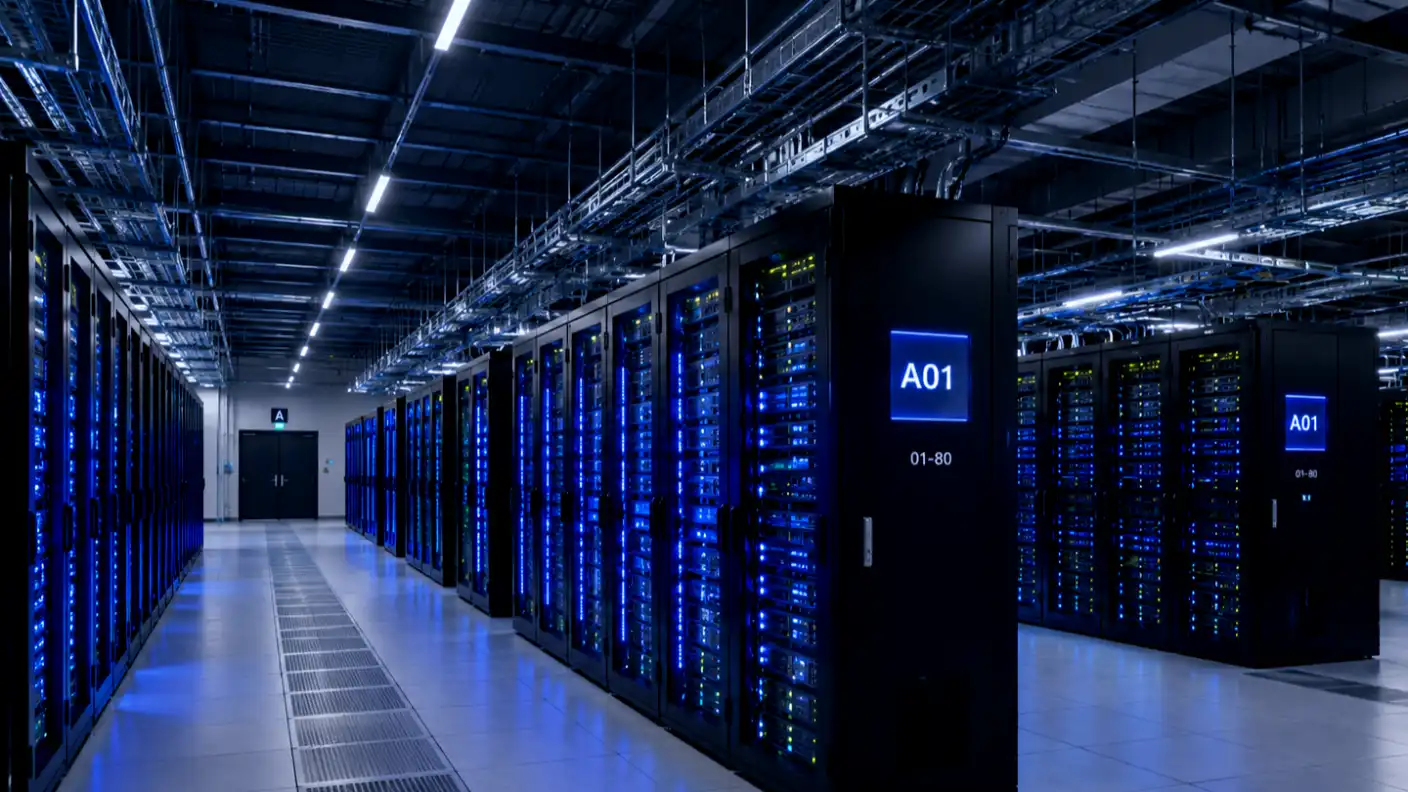
More than 50% of all proposed data center projects in the United States are facing severe construction and operational delays, as power grid interconnection backlogs, electrical equipment shortages, and local regulatory pushback collide with the artificial intelligence infrastructure boom. Comprehensive research from leading energy market analysts reveals that the multi-billion-dollar race to build hyperscale computing facilities is running directly into the physical limits of the American electrical grid.
The nationwide bottleneck threatens the deployment roadmaps of the world’s largest technology conglomerates. Cloud computing providers and artificial intelligence developers, including Microsoft, Amazon Web Services, Alphabet, Meta, and Oracle, have committed hundreds of billions of dollars to construct massive computing campuses across the country. Yet, industry data shows that securing a high-voltage grid connection now takes between four and seven years in primary technology hubs, forcing developers to postpone planned energization dates and freeze billions of dollars in allocated capital.
The primary obstacle is not a shortage of software capital or silicon chips, but a structural deficit of electrical hardware and transmission capacity. Lead times for specialized large power transformers have stretched from 150 to 200 weeks, while regional transmission organizations struggle to process tens of gigawatts of new commercial connection requests. As data centers expand from consuming roughly 3.5% of total United States electricity toward a projected 9% to 12% by 2030, tech giants are abandoning traditional utility models and pursuing direct behind-the-meter nuclear deals, on-site natural gas microgrids, and rural site relocations to keep their artificial intelligence ambitions on track.
A Deepening Interconnection Crisis Across American Regional Grids
The United States electrical grid was originally engineered around predictable, slow-growing demand patterns. For more than two decades, national electricity consumption grew at a modest baseline rate of less than 1.0% annually, driven by steady population growth and offset by consumer energy efficiency gains.
The sudden arrival of high-density artificial intelligence computing clusters has completely broken these historical utility planning models.
A modern hyperscale data center campus does not operate like a traditional commercial office building or standard light-industrial warehouse. A single artificial intelligence computing facility can consume between 100 megawatts and 1,000 megawatts of continuous electrical power, an amount equivalent to the energy required to power 100,000 to 800,000 residential homes.
When developers submit simultaneous interconnection requests for dozens of these mega-facilities across concentrated regional corridors, local transmission grids face immediate thermal overloads.
Regional grid operators must conduct exhaustive, multi-year engineering and stability studies before granting permission to connect. These administrative queues have expanded to unprecedented lengths, creating a massive backlog where viable projects sit in regulatory limbo for years before groundbreaking can begin.
Unpacking the 50% Project Delay Rate and Multi-Year Queues
Energy infrastructure surveys show that over 50% of all planned data center capacity in the United States now carries an official delayed status. Projects that developers initially scheduled to open within a standard 18-to-24-month construction window are seeing operational dates pushed back into the late 2020s and early 2030s.
The data reveals the scale of the interconnection backlog:
- More than 35 gigawatts of proposed data center capacity across the United States is currently stalled in regional interconnection queues.
- The average waiting time to secure formal transmission interconnection approval expanded from 2.5 years in 2019 to more than 5.5 years today.
- In high-demand regional utility territories, interconnection wait times for requests exceeding 100 megawatts routinely reach seven years.
- Over 40% of speculative interconnection applications in the queue are ultimately withdrawn after utilities demand multi-million-dollar developer contributions for transmission line rebuilds.
This multi-year waiting period has created severe friction for technology companies racing to satisfy commercial demand for generative artificial intelligence services, driving corporate leadership to bypass traditional utility channels.
Regional Transmission Hotspots: PJM, ERCOT, and Northern Virginia Saturation
The grid congestion crisis is most severe across established computing corridors. Northern Virginia’s Data Center Alley in Loudoun and Fairfax counties represents the largest concentration of computing infrastructure in the world, processing more than 70% of global internet traffic.
However, the local transmission grid operated by Dominion Energy and regional grid manager PJM Interconnection has reached near-total saturation:
- Dominion Energy received data center connection requests representing more than 40 gigawatts of potential demand, far exceeding the utility’s total existing generation capacity.
- PJM Interconnection’s multi-state regional transmission territory, which covers thirteen states from New Jersey to Illinois, instituted temporary queue freezes to overhaul its connection study procedures.
- In Texas, grid operator ERCOT reported over 50 gigawatts of large flexible load and computing requests seeking connection to the state’s independent power network.
- Silicon Valley and Pacific Northwest transmission operators in California and Washington have warned developers that new multi-hundred-megawatt allocations will remain unavailable until major 500-kilovolt transmission upgrades are energized in the 2030s.
Because these premier markets can no longer deliver immediate electrical power, developers are forced to look at secondary markets or construct private, on-site generation infrastructure.
Severe Equipment Shortages and 150-Week Transformer Lead Times
Even when a developer secures regulatory approval and a formal grid connection agreement from a local utility, securing the physical electrical hardware required to link a computing facility to the grid presents another massive barrier.
The global supply chain for heavy electrical equipment is experiencing unprecedented strain, driven by the simultaneous expansion of data centers, renewable energy projects, electric vehicle manufacturing plants, and aging utility grid modernization programs.
Manufacturing large power transformers, high-voltage switchgear, and backup generators requires specialized industrial tooling, high-purity electrical steel, and highly skilled precision labor that cannot scale overnight.
The resulting hardware deficits have created historic delivery backlogs, making physical equipment availability the single most significant pacing factor for new data center construction.
The Global Scarcity of High-Voltage Large Power Transformers
Large power transformers represent the critical physical link between high-voltage utility transmission lines and localized distribution substations. These massive electrical components, which can weigh over 400 tons and cost upwards of $4 million to $10 million per unit, step down electricity from 345-kilovolt transmission voltages to levels that data center transformers can safely distribute.
The supply shortage for large power transformers has reached crisis levels:
- Procurement lead times for high-voltage transformers have stretched from an average of 50 weeks in 2021 to between 150 and 200 weeks today, representing a delivery delay of nearly four years.
- Global manufacturing capacity for grain-oriented electrical steel, the specialized magnetic alloy required to build transformer cores, remains constrained across Asian, European, and American mills.
- Domestic United States transformer manufacturing capacity can only satisfy roughly 20% of total national utility demand, leaving the country heavily dependent on international suppliers in South Korea, Japan, and Europe.
- Heavy industrial transport bottlenecks, including a shortage of specialized Schnabel railcars and heavy-haul trucking trailers, delay the physical delivery of completed transformers to remote construction sites.
Because a hyperscale computing campus cannot operate without stepping down incoming transmission voltage, a delay in delivering a single transformer halts commercial operations for the entire facility.
Electrical Switchgear, Backup Turbines, and Specialized Substation Delays
Beyond primary transformers, data center developers face severe procurement shortages across secondary electrical and mechanical sub-assemblies:
- Medium-voltage switchgear and electrical circuit breakers carry delivery backlogs ranging from 80 to 130 weeks.
- Heavy-duty diesel and natural gas backup generator units, essential for maintaining uninterrupted facility uptime during grid outages, face procurement lead times of up to two years.
- Specialized liquid cooling distribution units, coolant manifolds, and precision chillers face delivery backlogs as manufacturers struggle to secure high-grade copper and aluminum components.
- Shortages of licensed high-voltage electrical engineers, substation line technicians, and master electricians are driving construction labor costs up by 15% to 25% annually.
Technology corporations with multi-billion-dollar balance sheets are attempting to leapfrog supply queues by placing bulk advance orders directly with industrial manufacturers, booking factory production lines years in advance and squeezing smaller regional developers out of the supply market entirely.
Behind-the-Meter Power Solutions and Nuclear Co-Location Deals
Confronted with five-to-seven-year utility connection queues and equipment delays, tech giants are rewriting their infrastructure playbooks. Instead of waiting for public utilities to build new power lines, developers are deploying behind-the-meter power strategies.
Under a behind-the-meter architecture, a data center co-locates directly adjacent to an existing power generation plant, drawing electricity straight from the generator before the power ever enters the public transmission grid.
This approach allows technology companies to bypass regional utility queues, avoid transmission line congestion fees, and achieve rapid operational timelines for high-density computing clusters.
Tapping Direct Nuclear Power and Small Modular Reactor Partnerships
Nuclear energy has emerged as the premier power source for artificial intelligence infrastructure. Modern nuclear power plants deliver steady, carbon-free baseload electricity 24 hours a day, 365 days a year, matching the continuous, flat demand profile of high-density graphics processor racks.
Tech giants are executing landmark nuclear power transactions:
- Amazon Web Services finalized a landmark agreement to acquire a 960-megawatt data center campus co-located directly at the 2.5-gigawatt Susquehanna nuclear power station in Pennsylvania, securing direct, carbon-free electricity behind the meter.
- Constellation Energy and Microsoft executed multi-decade power purchase agreements to support the commercial restart of shuttered nuclear generation units to power regional cloud infrastructure.
- Major technology firms are investing hundreds of millions of dollars into advanced small modular reactor developers, planning to deploy private nuclear reactors ranging from 50 to 300 megawatts directly on future data center campuses.
- Technology companies are lobbying federal nuclear regulators to streamline permitting for next-generation advanced micro-reactors that utilize safe, gas-cooled TRISO fuel pellets.
Nuclear co-location allows tech companies to secure hundreds of megawatts of dependable, clean power within months rather than waiting nearly a decade for utility transmission upgrades.
Deploying On-Site Natural Gas Turbines, Microgrids, and Fuel Cells
While nuclear projects provide a long-term solution, technology developers are deploying on-site natural gas generation and solid-oxide fuel cells to solve immediate power shortages.
Developers are constructing private on-site microgrids capable of powering server halls independently of the public grid:
- Installing aeroderivative natural gas turbines, which can be permitted and installed in 12 to 18 months, provides 50 to 200 megawatts of dedicated on-site power.
- Deploying stationary solid-oxide fuel cell arrays that convert natural gas or hydrogen into electricity through electrochemical reactions without combustion, lowering local emissions.
- Integrating industrial battery energy storage systems to provide frequency regulation, absorb peak compute spikes, and smooth microgrid transitions.
- Designing hybrid power plants that run on pipeline natural gas in the near term while maintaining technical compatibility with green hydrogen and renewable natural gas for the future.
While relying on natural gas introduces carbon emissions that challenge corporate sustainability goals, tech executives argue that utilizing transitional natural gas power is necessary to prevent American artificial intelligence development from falling behind global competitors.
Utility Tariff Battles and Consumer Bill Protection Mandates
The rise of massive, dedicated computing loads has ignited fierce regulatory battles across state public utility commissions. Consumer advocacy groups, residential ratepayers, and state attorneys general are pushing back against data center expansion, arguing that tech companies will drive up electricity bills for everyday households.
When a utility invests billions of dollars in new natural gas power plants, substation expansions, and transmission corridors to serve a massive computing customer, those capital costs are traditionally rolled into the utility’s general rate base, increasing monthly electricity bills for all consumers.
State regulators are responding by establishing strict protective frameworks:
- Mandating large-load customer tariffs that require data center operators to pay 100% of the capital costs associated with dedicated grid infrastructure upgrades.
- Requiring tech companies to sign minimum 10-to-15-year take-or-pay power contracts, ensuring that utilities recover infrastructure investments even if the tech company reduces computing operations.
- Enforcing demand-response rules that require computing facilities to curtail non-essential power consumption by 20% to 30% during extreme winter freezes or summer heatwaves.
- Implementing steep exit fees to prevent tech companies from abandoning local utility contracts if they transition to private behind-the-meter generation.
These regulatory requirements ensure that multinational technology corporations pay their fair share for public grid utilization, protecting local residential communities from bearing the financial burden of the artificial intelligence boom.
Geographic Relocation and the Race for Secondary Power Markets
The power grid saturation in premier markets is forcing developers to rethink where they build computing infrastructure. For two decades, data centers clustered near major metropolitan centers like Northern Virginia, Silicon Valley, and Dallas-Fort Worth to minimize network latency for financial trading and consumer mobile apps.
However, artificial intelligence model training does not require ultra-low millisecond latency. Training a massive neural network involves running complex mathematical computations over months, making access to abundant, low-cost electrical power far more important than proximity to metropolitan business districts.
This technical reality is driving a massive geographic redistribution of computing capital across the United States.
Migrating Compute Loads from Silicon Valley and Ashburn to the Midwest
Developers are redirecting billions of dollars in capital expenditure toward secondary and tertiary markets across the American Midwest, the Rust Belt, and the Great Plains:
- States like Ohio, Indiana, Wisconsin, and Iowa have emerged as premier destinations for multi-billion-dollar computing campuses, offering robust legacy transmission capacity and affordable industrial land.
- Columbus, Ohio, has developed into a major secondary cloud hub, attracting tens of billions of dollars in data center investments from Amazon, Google, and Microsoft.
- Regions with abundant freshwater resources and cooler annual climates allow operators to utilize high-efficiency air cooling, reducing water consumption and energy expenses.
- Former industrial manufacturing corridors with heavy electrical substations are being repurposed to house high-density server racks.
By distributing compute clusters across the Midwest, technology companies can tap into underutilized transmission capacity while revitalizing regional industrial economies.
Siting Next-Generation Facilities Near Rural Clean Energy Corridors
Another emerging development trend is co-locating computing infrastructure directly adjacent to large-scale rural wind and solar installations across West Texas, Wyoming, the Dakotas, and the Southwest.
These rural energy corridors offer significant operational advantages:
- Direct access to low-cost, zero-carbon electricity generated by utility-scale solar farms and high-capacity wind corridors.
- Reduced land acquisition costs, allowing developers to acquire thousands of contiguous acres for massive gigawatt-scale computing campuses.
- Proximity to vast geothermal energy reserves in the Western United States, which developers are tapping for continuous, clean baseload power.
- Streamlined local zoning and permitting processes for rural municipalities eager to expand local property tax bases.
Siting data centers near rural clean energy generation avoids the need to build expensive, long-distance transmission lines to move power into crowded coastal cities, allowing developers to bring new compute capacity online significantly faster.
Strategic Implications for the Artificial Intelligence Super-Cycle
The reality that over half of proposed data centers face multi-year delays carries profound strategic implications for the broader artificial intelligence super-cycle. In public equity markets, tech valuations are priced on the assumption that computing capacity will scale exponentially quarter after quarter.
However, computing power is fundamentally governed by the laws of physics, electrical engineering, and heavy manufacturing lead times.
The physical inability to energize server racks at the pace demanded by software algorithms introduces a structural pacing factor that will influence semiconductor demand, cloud pricing tiers, and national competitiveness.
Hyperscaler Capital Allocations and Compute Deployment Bottlenecks
The grid bottleneck is altering how hyperscale cloud providers allocate their capital expenditures. While tech companies have budgeted over $300 billion annually for infrastructure, a growing portion of that capital must be redirected away from pure silicon purchases toward electrical infrastructure, power generation assets, and transmission development.
Key financial adjustments include:
- Direct equity investments in utility transmission upgrades, private substation construction, and specialized transformer manufacturing plants.
- Rising cloud compute pricing, as constrained data center capacity allows cloud providers to maintain high pricing tiers for specialized graphics processor clusters.
- Increased corporate mergers and acquisitions targeting independent power producers, microgrid developers, and clean energy startups.
- Prioritizing algorithmic model efficiency, model distillation, and low-bit quantization to extract maximum performance from existing, energized hardware.
Tech companies that master energy procurement and build private power generation will capture an immense competitive moat over rivals that remain stalled in utility interconnection queues.
Re-Engineering Federal Transmission Permitting and Grid Infrastructure
The data center power crisis has elevated national transmission policy to a top-tier economic and national security issue in Washington. Lawmakers across both political parties recognize that America’s ability to maintain its lead in artificial intelligence depends directly on its ability to build and modernize physical energy infrastructure.
Federal agencies and congressional committees are advancing major regulatory reforms:
- Passing bipartisan permitting reform legislation to streamline federal environmental reviews for high-voltage interstate transmission lines.
- Granting the Federal Energy Regulatory Commission expanded backstop authority to approve interstate transmission corridors that cross state boundaries.
- Invoking the Defense Production Act to provide federal loans and purchase guarantees to domestic manufacturers of large power transformers and electrical steel.
- Coordinating federal research grants to commercialize high-temperature superconducting transmission cables capable of carrying five times as much electricity through existing underground rights-of-way.
Rebuilding America’s electrical transmission infrastructure will require hundreds of billions of dollars and sustained policy execution, but it is the essential foundation for powering the digital economy of the twenty-first century.
The finding that more than half of all proposed United States data centers face substantial delays marks a critical reality check for the global technology industry. While software innovation and venture capital move at the speed of light, the physical machinery of the electrical grid operates on the multi-year timelines of heavy industrial manufacturing and civil infrastructure. Overcoming the dual challenges of 150-week transformer backlogs and five-year interconnection queues requires a comprehensive transformation of how tech giants procure energy. By pioneering behind-the-meter nuclear co-location, deploying on-site microgrids, and expanding into secondary geographic markets, the technology sector is building a resilient energy foundation. The companies and nations that successfully bridge the divide between digital software algorithms and physical power grids will lead the next century of artificial intelligence innovation.