

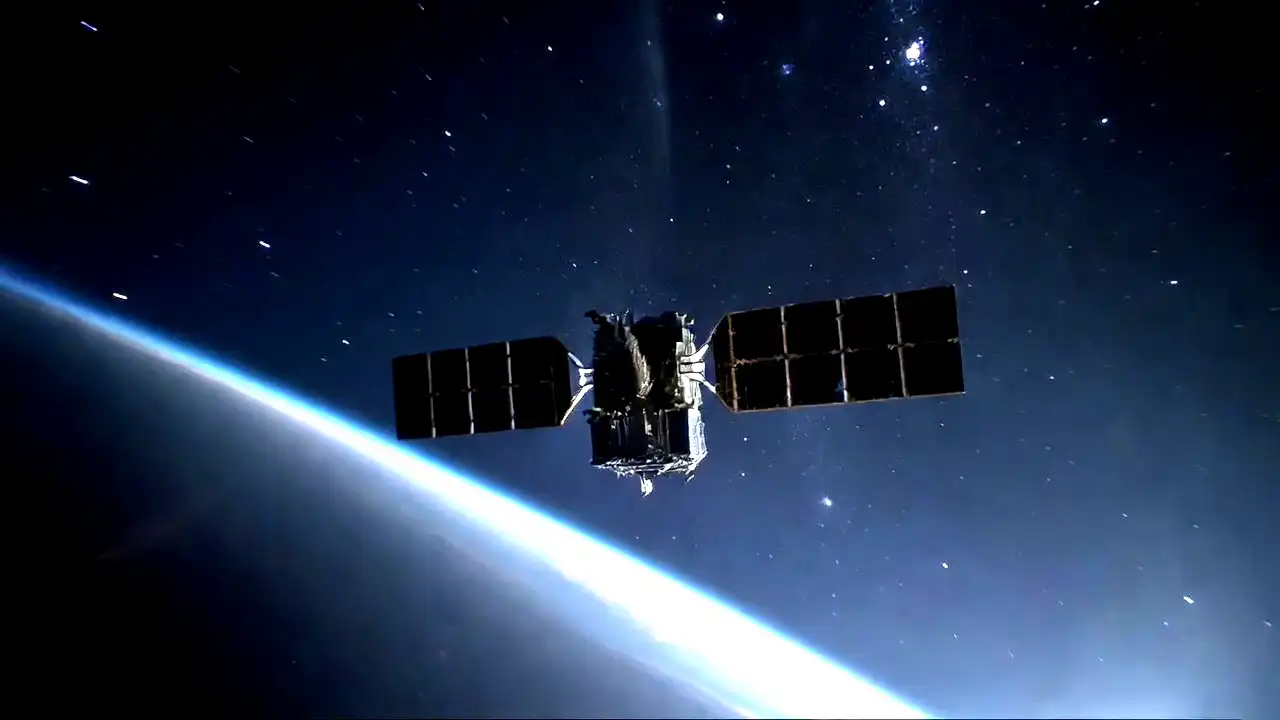
Commercial satellite manufacturer K2 Space has secured a $6.8 billion corporate valuation following the completion of a major venture capital funding round. Led by prominent technology investment firms including Altimeter Capital, Lightspeed Venture Partners, First Round Capital, and Founders Fund, the new capital injection provides the space startup with the financial capacity to scale up mass production of its heavy-payload satellite platforms. The landmark valuation reflects a profound structural shift across the commercial aerospace industry, as venture capital firms bet heavily on large, mass-manufactured satellite buses designed specifically to capitalize on the falling costs of heavy-lift rocket launches.
Founded by former SpaceX engineers Karan Kunjur and Neel Kunjur, K2 Space is pioneering an unconventional engineering strategy that directly challenges two decades of satellite miniaturization trends. While the commercial space sector spent years miniaturizing satellite payloads into tiny, low-power CubeSats, K2 Space builds massive, heavy-payload satellite platforms—designated as Mega-Class buses—weighing between 3 and 15 metric tonnes. By embracing larger physical dimensions and heavier weights, K2 Space delivers satellites capable of generating 15 to 100 kilowatts of continuous electrical power, offering capabilities previously restricted to multi-hundred-million-dollar exquisite military satellites.
The commercial timing of K2 Space’s expansion is deeply tied to the rapid evolution of the launch industry. The operational availability of heavy-lift rockets, such as SpaceX’s Falcon Heavy and the impending mass deployment of the fully reusable Starship vehicle, has dramatically lowered the financial cost of transporting heavy mass into low Earth orbit. K2 Space’s standardized Mega-Class satellite bus delivers extreme power and payload capacity for an estimated purchase price of $15 million per unit, providing defense agencies, cloud hyperscalers, and telecommunications operators with an affordable, high-power orbital platform.
TechGolly provides an in-depth analysis of K2 Space’s $6.8 billion valuation milestone, evaluating heavy-payload satellite mechanics, orbital power generation, space-based artificial intelligence data centers, United States Space Force defense contracts, mass-production manufacturing facilities, and the long-term outlook for the global space economy.
Unpacking the 6.8 Billion Dollar Valuation and Venture Capital Backing
The rapid surge in K2 Space’s corporate valuation to $6.8 billion represents one of the fastest capital appreciation trajectories in commercial aerospace history. Just two years after emerging from stealth development, the company has attracted top-tier institutional venture capital firms eager to secure equity in the physical infrastructure layer supporting next-generation space applications.
The lead investment firms backing the funding round—Altimeter Capital, Lightspeed Venture Partners, First Round Capital, and Founders Fund—are deploying capital into physical space infrastructure because the economics of the launch market have reached a critical tipping point. For decades, launching objects into space was the primary cost bottleneck for space missions. When launch costs hovered near $10,000 to $20,000 per kilogram, satellite developers spent millions of dollars engineering ultra-lightweight, miniature components to fit small payloads onto expensive rockets.
Co-founders Karan Kunjur and Neel Kunjur recognized that as reusable rockets drive launch costs down toward $1,500 per kilogram—and potentially below $500 per kilogram with heavy-lift reusable boosters—minimizing satellite weight is no longer the optimal engineering constraint. Instead, the primary bottleneck for advanced orbital applications has shifted to electrical power generation, thermal heat dissipation, and structural payload volume.
By designing a standardized, heavy-payload satellite bus that intentionally prioritizes mass and physical volume, K2 Space eliminates expensive, boutique aerospace engineering. The company constructs satellite frames using thicker, lower-cost structural aluminum, uses off-the-shelf industrial electronics rather than custom miniaturized components, and equips each satellite with massive solar arrays capable of generating unprecedented electrical power in orbit.
The Heavy-Payload Physics Shift: Reversing the CubeSat Miniaturization Trend
To appreciate the disruptive nature of K2 Space’s technology, aerospace analysts and satellite communication architects must examine the physical limitations of smallsats and CubeSats.
Over the past decade, the smallsat revolution allowed research universities, commercial startups, and government agencies to deploy hundreds of low-cost sensors and camera payloads into low Earth orbit. However, smallsats weighing between 10 and 500 kilograms operate under severe physical constraints. Small physical surface areas limit the size of onboard solar panels, capping electrical power generation at a modest 100 to 500 watts per satellite.
A satellite operating on 300 watts of power faces severe operational boundaries:
- First, limited communication throughput. Low-power transmitters cannot beam high-bandwidth data streams back to Earth quickly, creating data bottlenecks for Earth observation and radar satellites.
- Second, constrained sensor performance. High-resolution radar arrays, deep-space optical telescopes, and military surveillance systems require kilowatts of continuous electricity to operate effectively.
- Third, zero onboard computing capacity. Small satellites lack the power and thermal cooling systems needed to run high-performance graphics processing units or neural processing units, forcing satellites to transmit raw, uncompressed sensor data back to ground stations for processing.
K2 Space’s Mega-Class satellite platform completely alters these physical parameters. Weighing 3 metric tonnes and designed to fit inside the standard 5-meter payload fairing of a Falcon 9 or Falcon Heavy rocket, the Mega-Class bus generates over 15 kilowatts of continuous electrical power.
The company’s larger Gigawatt-Class platform, engineered specifically for heavy-lift vehicles like SpaceX Starship, can carry up to 15 metric tonnes of payload and generate over 100 kilowatts of onboard power. Delivering 100 kilowatts of power in orbit provides satellite operators with the energy capacity of a terrestrial industrial facility, enabling high-powered radar imaging, continuous laser communications, and high-density orbital computing.
Power and Payload: Delivering 15 to 100 Kilowatts in Low Earth Orbit
The availability of 15 to 100 kilowatts of continuous electrical power onboard a standardized $15 million satellite bus opens up revolutionary commercial and military applications that were previously impossible or cost-prohibitive.
A primary application enabled by high-power satellite buses is space-based artificial intelligence data centers. In traditional Earth observation and synthetic aperture radar (SAR) operations, satellites capture gigabytes of high-resolution image data as they orbit the globe. However, because ground-station downlink bandwidth is limited, satellites can take hours or days to transmit raw image files back to terrestrial processing centers for analysis.
Hosting high-density AI processing hardware directly onboard a K2 Space satellite bus allows the spacecraft to run machine learning inference in real-time within low Earth orbit. An orbital AI data center can process high-resolution radar imagery, run object-detection algorithms, identify suspicious maritime activity or environmental changes instantly, and transmit lightweight, actionable intelligence summaries down to ground operators within seconds.
High onboard power also revolutionizes Synthetic Aperture Radar (SAR) imaging. Unlike optical cameras that require sunlight and cannot see through clouds or storm systems, SAR satellites emit high-power microwave pulses that penetrate clouds, rain, and nighttime darkness to generate precise 3D terrain maps.
Operating a high-power SAR payload on a 15-kilowatt K2 Space bus allows the radar to emit significantly stronger microwave pulses, generating sub-meter resolution imagery across massive ground swathes continuously without overheating or depleting battery reserves.
Defense and National Security Contracts: U.S. Space Force Integration
The extraordinary power and heavy payload capabilities of K2 Space’s satellite buses have attracted intense interest from the United States Department of Defense, the U.S. Space Force, and national intelligence agencies.
Military space strategists are executing a rapid modernization of national security space architecture, transitioning away from small numbers of high-cost, vulnerable geostationary satellites toward large, resilient constellations deployed in low Earth orbit. The U.S. Space Force requires heavy-payload LEO platforms capable of carrying advanced missile-tracking infrared sensors, secure tactical communications payloads, and space domain awareness radars.
K2 Space has secured multiple defense prototype and research contracts with military agencies, demonstrating how its Mega-Class bus can host heavy defense payloads at a fraction of traditional aerospace procurement costs.
By mass-producing standardized 3-tonne and 15-tonne satellite chassis, K2 Space allows national defense agencies to procure and deploy heavy military payloads within 12 to 18 months, compared to the traditional 5-to-7-year procurement timelines required by legacy defense prime contractors.
Manufacturing Scale: Mass Production Cleanrooms and Industrial Supply Chains
Achieving a $15 million price tag for a heavy-payload satellite bus requires executing a fundamental transformation in aerospace manufacturing, replacing boutique, hand-crafted assembly with high-volume industrial mass production.
K2 Space is constructing a massive 150,000-square-foot advanced manufacturing facility in Torrance, California, designed to function as an automotive-style satellite assembly factory. The facility houses a mega-cleanroom environment equipped with automated structural welding stations, robotic wire-harness assembly arms, and environmental testing chambers.
The manufacturing strategy centers on three industrial principles:
- First, standardization. K2 Space manufactures a single, standardized satellite bus architecture in high volume. Whether a customer is building a commercial communications constellation, a military radar network, or a space science mission, the underlying structural chassis, power management system, attitude control reaction wheels, and thermal radiators remain identical.
- Second, commercial off-the-shelf (COTS) component integration. Rather than purchasing custom, radiation-hardened aerospace electronics that cost 50 times more than industrial equivalents, K2 Space uses high-reliability commercial automotive and industrial electronic components.
- Third, active hardware redundancy. To ensure high mission reliability while using commercial electronics, K2 Space incorporates dual and triple-redundant processing channels. If cosmic radiation causes a single commercial circuit component to fail, onboard automated voting systems instantly isolate the faulted module and transfer control to an active backup circuit without interrupting spacecraft operations.
The Competitive Landscape: K2 Space versus Legacy Aerospace Giants
The emergence of K2 Space at a $6.8 billion valuation poses a direct commercial threat to traditional defense primes and legacy satellite manufacturers, including Lockheed Martin, Northrop Grumman, Boeing, Maxar Technologies, and Airbus Defence and Space.
For decades, legacy aerospace contractors dominated the satellite market by building custom, highly complex satellites tailored to individual customer specifications. These exquisite satellites cost between $100 million and $500 million per unit and required years of specialized cleanroom assembly by hundreds of aerospace technicians.
K2 Space’s mass-produced Mega-Class bus completely upends this legacy business model. By offering a standardized 3-tonne bus with 15 kilowatts of power for $15 million, K2 Space allows payload developers to bypass legacy prime contractors entirely. A customer can purchase a standardized K2 Space bus, mount their proprietary camera, radar, or communication payload onto the chassis, and launch the spacecraft on a commercial rocket for less than a quarter of the cost of a traditional legacy satellite build.
This cost disruption is forcing legacy defense primes to re-evaluate their space manufacturing strategies, prompting corporate acquisitions and joint-venture investments as traditional contractors scramble to adopt low-cost, mass-production assembly models.
Strategic Outlook for Commercial Space Infrastructure and Orbital Compute
The $6.8 billion valuation secured by K2 Space marks the beginning of a mature, high-volume era for the commercial space economy, driven by the convergence of low-cost heavy-lift launch vehicles and mass-produced orbital infrastructure.
Looking forward through the late 2020s and into the 2030s, the low Earth orbit environment will transition from a sparse scientific research domain into an active, high-density industrial corridor.
As SpaceX Starship and competing heavy-lift rockets achieve high operational flight frequencies, the cost of transporting heavy mass into orbit will decline toward sub-$500 per kilogram levels. Low launch costs will unlock entirely new commercial space sectors:
- First, commercial space stations and orbital manufacturing platforms that manufacture high-purity pharmaceuticals, advanced semiconductor crystals, and fiber-optic cables in microgravity environments.
- Second, orbital high-performance computing networks that process, index, and analyze global satellite data in real time, distributing actionable intelligence to ground stations worldwide.
- Third, deep-space logistics and cislunar transport networks that move payloads between low Earth orbit, the Moon, and deep-space science destinations.
By establishing high-volume mass production of heavy-payload satellite buses today, K2 Space is positioning itself as the foundational hardware supplier for the future orbital economy, building the physical chassis upon which the next century of space technology will be constructed.
Key Takeaways for Aerospace Executives, Investors, and Defense Leaders
The rapid growth and $6.8 billion valuation of K2 Space deliver vital strategic insights for commercial space executives, venture capital partners, defense procurement officers, and technology investors.
First, low launch costs require a fundamental shift in satellite design philosophy. As heavy-lift rockets drastically reduce transport costs per kilogram, aerospace engineers must abandon expensive miniaturization and prioritize mass-produced, heavy-payload platforms that deliver maximum electrical power and volume.
Second, power is the ultimate enabling capability in orbit. High onboard electrical power—ranging from 15 to 100 kilowatts—unlocks revolutionary capabilities, enabling space-based AI computing, high-power radar surveillance, and ultra-high-throughput laser communications.
Third, commercial off-the-shelf component integration and active redundancy enable low-cost, high-reliability manufacturing. Utilizing automotive-grade electronics and standardized factory assembly lines allows satellite makers to slash manufacturing costs by over 80% while maintaining mission reliability.
Finally, the commercial space economy is shifting from experimental software concepts to physical heavy infrastructure. Organizations and investors that build, deploy, and operate high-capacity physical hardware in low Earth orbit will capture sustained commercial leadership in the expanding global space economy.






