Key Points:
- Automakers need a cheaper, smaller way to install lidar systems in autonomous vehicles.
- Standard silicon-photonics lidar chips either create false beam copies or have extremely narrow fields of view.
- MIT researchers designed 3 unique antennas that sit close together without their signals mixing.
- The new design cuts signal interference down to 1% and removes fake beam copies entirely.
Automakers rely heavily on lidar to help self-driving cars see the road. Lidar systems emit rapid pulses of infrared light to map 3D space and detect obstacles instantly. Unfortunately, traditional lidar sensors are expensive and take up too much space. They also use heavy spinning parts that easily break down over time. These physical limits prevent companies from installing sensors in everyday places.
A team of researchers from MIT found a way to build a much better sensor. They created a new silicon photonics chip that processes light rather than electricity. Their design makes lidar sensors tiny, durable, and entirely free of moving parts. More importantly, it gives the sensor a wide field of view without making errors.
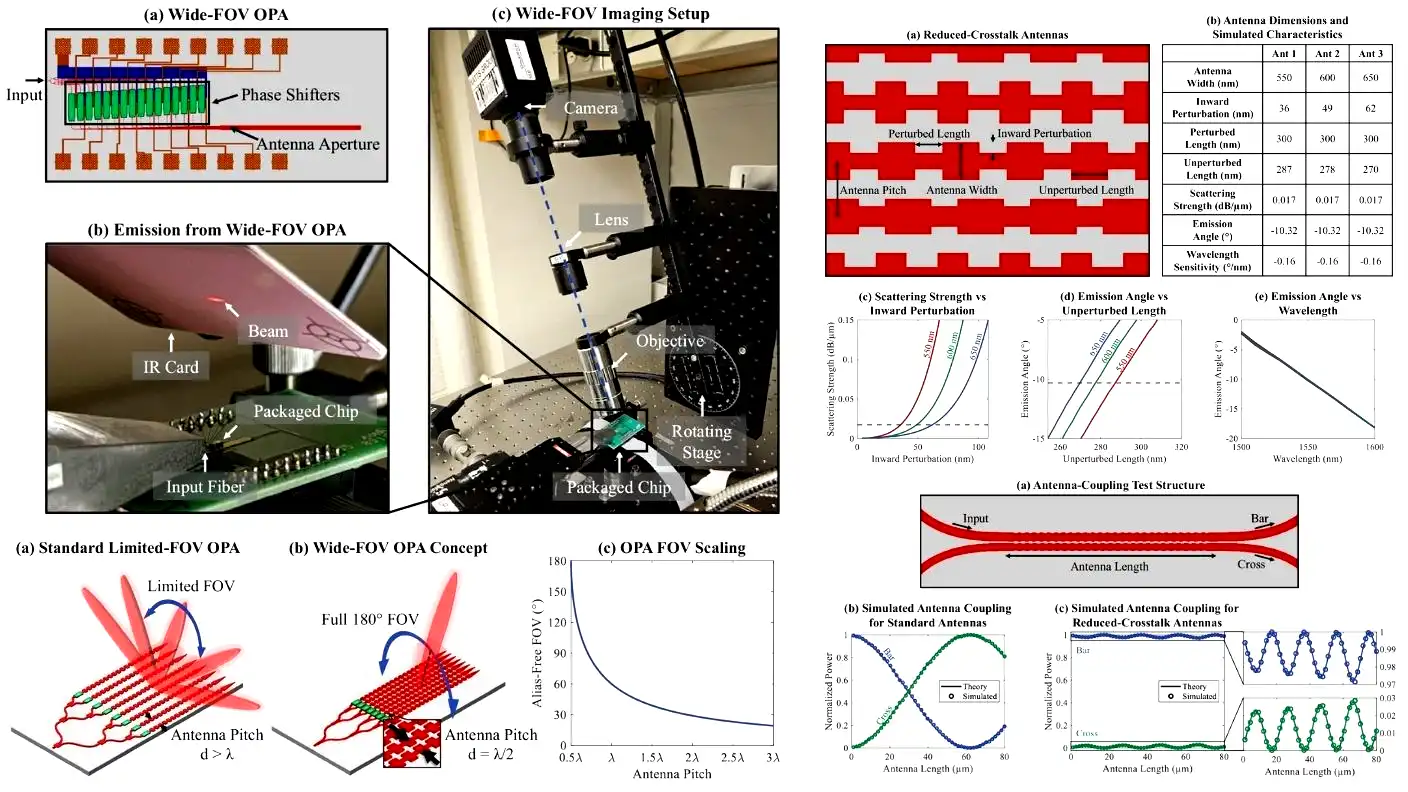
Older systems map a scene by spinning a bulky box that shoots light in all directions. The light hits objects and bounces back to the sensor. The MIT team completely avoided this method. They steer the light beam electronically using an integrated optical phased array. This array relies on a row of tiny antennas. The researchers carve small ridges along the antennas. These ridges scatter the light up and out of the chip. By adjusting how light reaches each antenna, the team can steer the beam in different directions without moving the device itself.
However, building a solid-state array creates tough challenges. If engineers pack the antennas too closely together, the antennas interact with each other. They mix their light and jumble the signal. To stop this interference, designers normally space the antennas farther apart.
Spacing the antennas out causes another severe problem. The wide gaps force the array to emit multiple identical copies of the light beam at different angles. When the researchers steer the main beam too far to the left or right, it becomes completely indistinguishable from its fake copies. Andres Garcia Coleto, an MIT graduate student, explains that this problem severely limits the sensor’s view. An autonomous vehicle only sees what is directly in front of it. These extra beams also waste battery power and confuse the car’s computer with false positive signals.
The MIT engineers solved this issue completely. They designed a set of antennas that sit right next to each other but never interact. In a standard array, engineers use identical antennas. Because they look the same, they couple together strongly when designers place them side by side.
To fix this, the MIT team broke the rules of normal antenna design. They crafted 3 distinct antennas. They varied the width of each antenna and changed the size and spacing of the ridges. Because the antennas feature different shapes, light travels through them differently. Garcia Coleto notes that the antennas basically ignore each other. Engineers can pack them tightly without ruining each other’s signals.
Giving the antennas different shapes solved the interference problem but created a brand-new hurdle. The team still needed all 3 antennas to fire light in the same way. Henry Crawford-Eng, the lead author of the study, says this goal requires a tough balancing act. The antennas must emit the same amount of light at the same angle. The beam must also move smoothly across the environment when the engineers steer it.
The researchers studied electromagnetic theory to figure out the math behind the light. They ran simulations and finally built a real chip. They placed the new antennas much closer together than anyone would in a regular array.
Their prototype achieved incredible results. A standard, closely packed array usually suffers a signal interference rate of 100%. The MIT chip dropped this coupling rate to just 1%. The team successfully steered a sharp, single beam over a wide area without generating any fake copies.
Jelena Notaros, an MIT professor and senior author of the paper, says this new chip solves a major problem for optical technology. The breakthrough allows future lidar sensors to hit much higher performance levels than older models could ever reach. Joyce Poon, a professor at the University of Toronto, also praised the work. She called the design elegant and an important step forward for solid-state technology.
The MIT team plans to expand the viewing angle in future designs further. Their tiny silicon chip could soon guide autonomous cars, map land from drones, and monitor busy construction sites with perfect accuracy.
Source: Nature Communications (2026).