Key Points:
- Shenzhen-based startup Even Realities raised $150 million in a pre-Series B funding round, officially achieving unicorn status at a $1 billion valuation.
- Founded by former Apple engineer Will Wang, the company focuses on camera-free smart glasses to completely bypass user privacy concerns.
- Tech conglomerates Tencent and Meituan led the round as global tech giants race to fund alternatives to Meta’s dominant Ray-Ban line.
- The flagship Even G2 glasses, which retail for $599, display notifications and translations via micro-LED lenses and use a smart ring controller.
The fast-growing smart glasses market has welcomed its newest heavyweight competitor, as a startup founded by an Apple veteran secured a massive war chest to challenge the dominance of Silicon Valley’s tech giants. Shenzhen-based wearable technology developer Even Realities recently raised $150 million in a pre-Series B funding round, officially reaching a $1 billion valuation to attain unicorn status. Chinese tech conglomerates Tencent and Meituan co-led the investment round, signaling robust institutional confidence in the company’s unique hardware philosophy. The funding arrives at a highly competitive moment, as the world’s largest consumer hardware brands scramble to establish their footprints in augmented reality and artificial intelligence-powered eyewear.
Even Realities owes much of its design and engineering discipline to its founder and chief executive officer, Will Wang. A highly respected mechanical engineer, Wang worked at major technology firms before starting the new enterprise. He brings years of specialized hardware experience to the role. By combining ultra-precision machining expertise with advanced electronic engineering, the company offers complete, system-level solutions to original equipment manufacturers. This integrated approach allows the firm to capture the computational demand of the AR era through advanced visual platforms.
While competitors like Meta and Snap are racing to put high-definition cameras on users’ faces, Even Realities is taking an opposite approach by deliberately omitting any recording hardware from its glasses. The company’s flagship product, the Even G2, features no outward-facing camera, no recording indicator light, and no video capture capabilities. Placing a camera on daily-wear glasses is irresponsible in the current security climate, as the technology and social infrastructure are not yet ready to protect bystander privacy. By eliminating the camera from the hardware entirely, the startup has bypassed the complex privacy concerns that continue to plague its competitors.
This strict focus on privacy gives the startup a powerful marketing advantage as major American platforms face severe backlash over data security. Meta’s Ray-Ban smart glasses recently fell under intense scrutiny following incidents where third-party contractors reviewed high-resolution video recorded inside users’ private spaces, including bathrooms. This privacy mess has triggered federal lawsuits and cooled consumer trust. By offering a camera-free alternative, the Chinese startup presents a highly attractive option for privacy-conscious users who want the benefits of digital assistance without the risk of continuous surveillance.
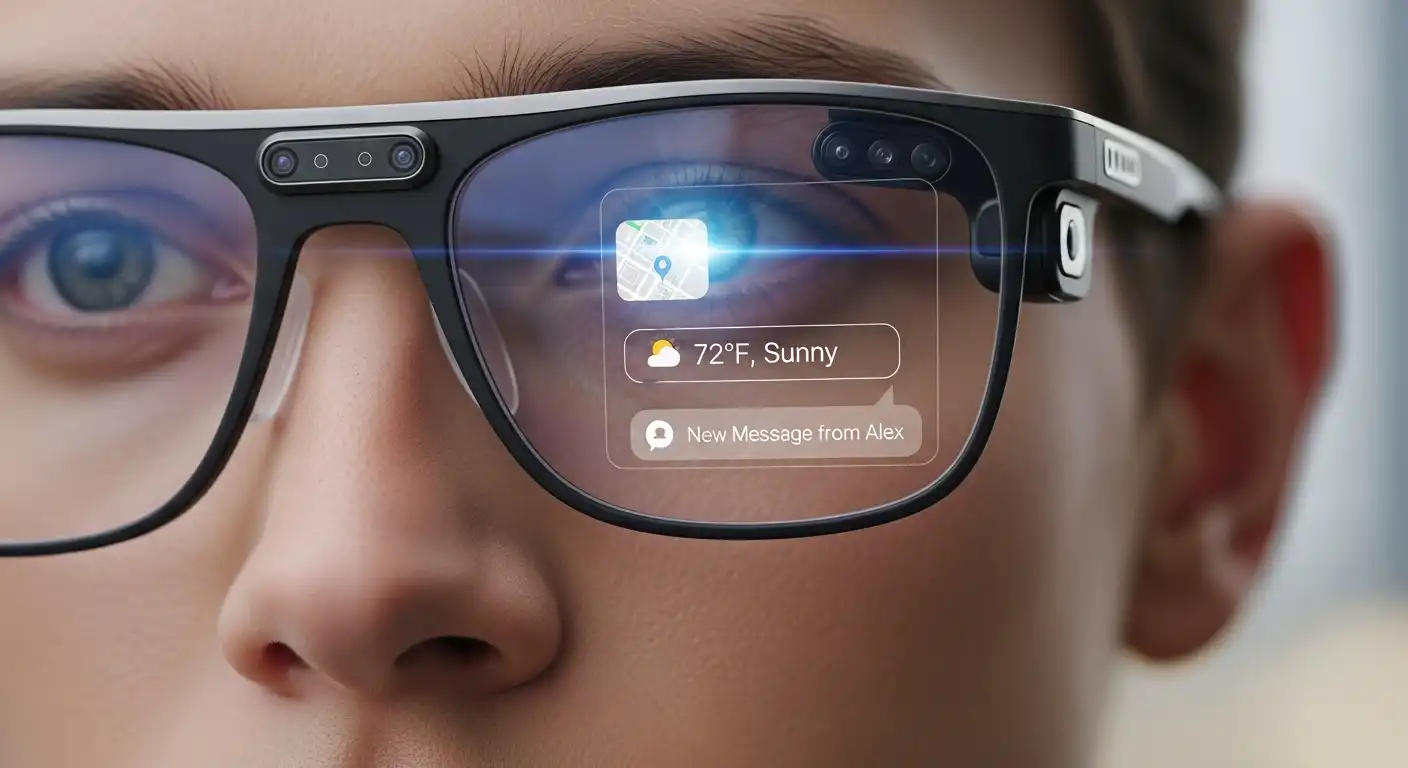
Instead of capturing video, the Even G2 glasses act as a pure, display-first information layer. The premium frames incorporate binocular, monochrome green micro-LED displays integrated directly into the lenses. This heads-up display projects real-time information—including text messages, turn-by-turn navigation prompts, and live translations—directly into the wearer’s line of sight, completely invisible to anyone else. To interact with this digital overlay, users wear a companion smart ring called the Even R1. The ring serves as a high-precision touchpad, allowing users to navigate menus, accept notifications, and trigger voice translation tasks using simple tap and swipe gestures.
This premium hardware combination carries a mid-range price tag that positions the startup as a competitive luxury brand. The base Even G2 glasses retail for $599 before tax, which is higher than Meta’s $299 starting price but significantly cheaper than full mixed-reality headsets. However, when users add custom prescription lenses and purchase the R1 smart ring, the average transaction price rises to approximately $1,000. Despite this premium pricing, the company has seen strong commercial traction, with over half of its active user base and roughly 80% of its developer community located within the United States.
The startup’s minimalist, comfort-first design has translated into impressive user engagement metrics that far outperform traditional wearable benchmarks. Active owners wear their G2 glasses for an average of 8 to 10 hours per day, treating them as their primary pair of prescription eyewear. Traditional, bulky augmented reality headsets rarely exceed two hours of daily wear due to eye strain and physical discomfort. By prioritizing visual protection—developed in collaboration with leading ophthalmologists—and keeping the weight under 40 grams, the company has successfully integrated technology into a product that users want to wear all day.
This massive capital injection coincides with an unprecedented explosion in global smart glasses demand. Global shipments of smart glasses reached 2.25 million units in the first quarter of the year, representing a staggering 167% jump compared to the same period in the prior year. While Meta continues to lead the market with a dominant 70% share of shipments, the rapid market expansion is drawing in new competitive forces. Google and Samsung recently teased their own upcoming Android XR-powered smart glasses, while Apple continues to refine its own unannounced eyewear project, setting the stage for a massive platform war.
The successful completion of this $150 million pre-Series B round brings the company’s total funding to $159 million, providing it with the necessary runway to accelerate its hardware roadmap. The company plans to use the new funds to build its next-generation smart glasses platform, deepen its artificial intelligence capabilities, and expand its sales operations across Europe and North America. By proving that a camera-free, privacy-first wearable can secure massive capital and achieve unicorn status, the startup has rewritten the playbook for personal computing. The coming years will reveal whether this minimalist philosophy can successfully displace Meta’s camera-heavy dominance on a global scale.