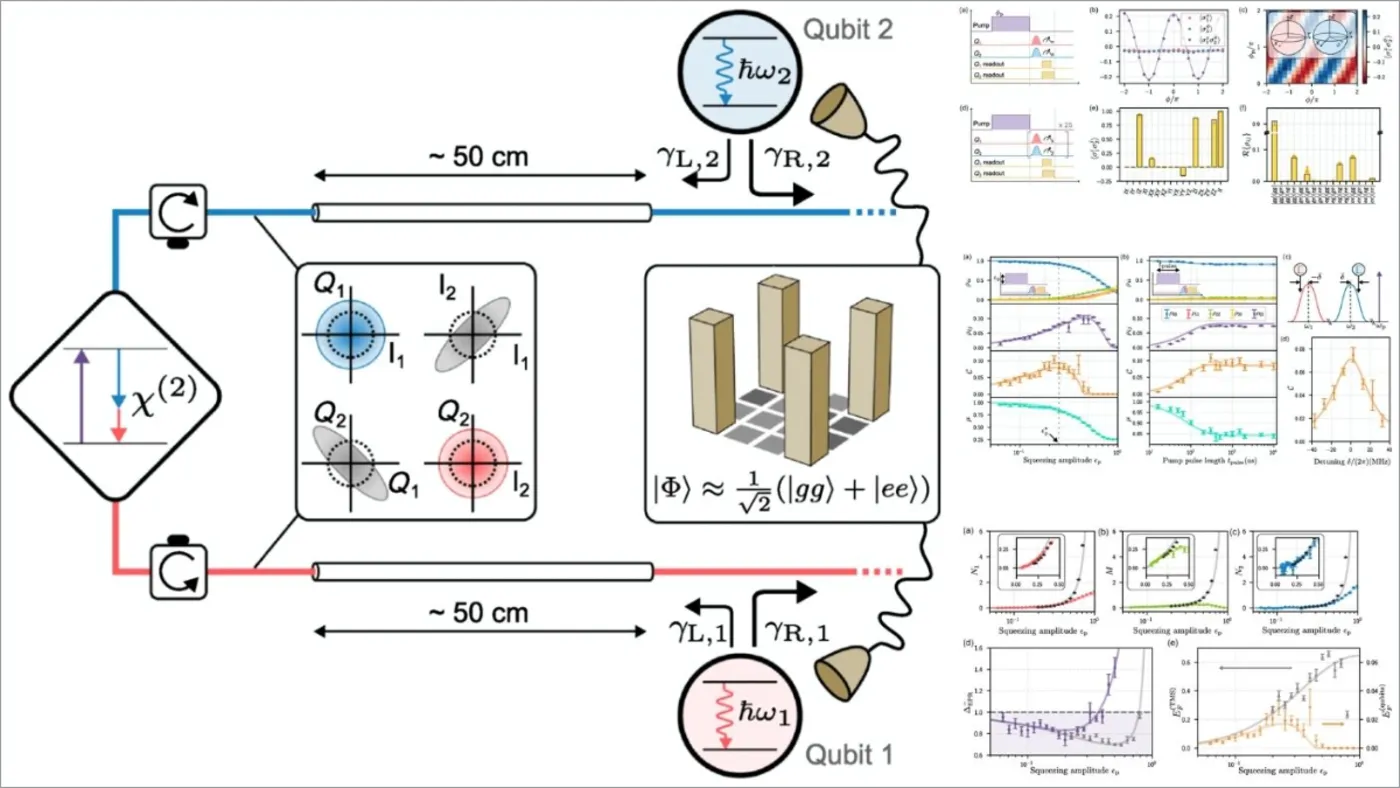
Key Points:
- Physicists at the Institute of Science and Technology Austria realized a fully autonomous method to entangle distant qubits.
- The new protocol utilizes an engineered “quantum bath” of correlated microwave photons to autonomously synchronize separated qubits.
- This continuous photon stream stabilizes the entangled state even beyond the individual qubits’ natural operational lifetimes.
- The experimental breakthrough confirms a 20-year-old theoretical prediction, paving the way for scalable quantum networks.
A historic experimental breakthrough in quantum physics has confirmed a 20-year-old theoretical prediction, paving the way for highly scalable quantum computing networks. Researchers at the Institute of Science and Technology Austria have successfully engineered a fully autonomous method to link physically separated quantum bits (qubits). The novel protocol utilizes an engineered “quantum bath” of correlated microwave light particles to synchronize and entangle distant qubits without requiring active human control or repeated external measurements.
Securing stable connections between distant modular processors stands out as one of the most critical challenges in modern quantum information science. This phenomenon, known as distributed entanglement, is essential for constructing modular quantum computers and secure, long-distance quantum communication networks. Entanglement links the state of physically separated particles, ensuring that any measurement performed on one qubit instantly dictates the state of its distant partner. However, maintaining this connection across physical distance has historically required highly complex and fragile operations.
Earlier attempts to distribute quantum entanglement have relied on two primary, highly demanding protocols. One approach involves sending a single, actively controlled light particle (photon) from one qubit directly to the other. The second approach requires each qubit to emit a photon simultaneously, matching the two particles in a central station to produce entanglement. While this second method earned the 2022 Nobel Prize in Physics, both protocols suffer from severe limitations, requiring thousands of repeated measurements, precise synchronization, and heavy post-selection filtering while still failing to guarantee stable, predictable entanglement.
The newly developed method bypasses these active controls by letting the environment do the work. Instead of manually pushing photons back and forth, the research team engineered a customized quantum bath—meaning the qubits’ immediate surrounding environment—that acts as the source of entanglement. By bathing the two separated qubits in a continuous stream of correlated microwave photons generated from a single, common source, the system autonomously synchronizes the two quantum components.
This continuous stream of correlated light particles establishes a brand-new, highly stable quantum ground state. The quantum bath essentially locks the two qubits into a synchronized, entangled dance that remains protected from external environmental noise. Crucially, this autonomous synchronization stabilizes the entangled state even beyond the individual qubits’ own natural coherence lifetimes. This permanent stability guarantees that the entangled resource remains continuously available for subsequent quantum computations and data routing.
Measuring and verifying these fragile quantum states required incredibly precise experimental tools. Standard quantum measurements typically trigger a collapse of the delicate superposition states, leaving behind a simple, binary state of 0 or 1. To observe the continuous entanglement process without destroying it, the research team utilized highly advanced quantum state tomography. This diagnostic methodology allowed the physicists to perform non-invasive state measurements at ultra-fast timescales ranging from 20 to 80 nanoseconds, capturing the exact progression of the synchronized qubit states.
The successful experiment marks the first physical verification of a theory originally proposed over 20 years ago. The researchers noted that while the initial theory was mathematically elegant, it was formulated under highly idealized, hypothetical conditions that do not exist in real-world laboratories. Transitioning the theory into a functional physical prototype revealed several unpredicted, non-ideal factors, such as parasitic electromagnetic couplings and thermal fluctuations. The team had to spend months designing specialized filters and adjusting waveguide geometries to counteract these real-world disruptions successfully.
The successful demonstration of this autonomous quantum bath opens up immediate, practical avenues for applied quantum technologies. By eliminating the need for complex, active-control hardware and repeated laser-pulse sequences, the new device prototype offers a significantly simpler architecture for linking modular quantum processors. This reduced hardware overhead is a critical requirement for scaling up quantum processors toward fault-tolerant, error-corrected computing systems.
The landmark research, published in the scientific journal Physical Review X, represents a highly coordinated international collaboration. Led by first author Alejandro Andrés-Juanes, a doctoral student, and principal investigator Professor Johannes Fink, the project brought together quantum theorists and experimentalists from multiple European academic institutions. This collaborative effort allowed the team to refine the physical chip designs, develop the high-speed microwave electronics, and construct the specialized dilution refrigerators needed to cool the qubits down to a few thousandths of a degree above absolute zero.
Ultimately, the successful confirmation of this decades-old quantum theory represents a major milestone for the future of distributed computing. By transforming the environment from a source of destructive noise into a powerful engine of autonomous entanglement, the research has bypassed some of the most formidable hardware limitations in physics. As researchers work to integrate these autonomous quantum baths into larger, multi-qubit systems, the technology brings the dream of secure, global quantum networks and massive, fault-tolerant supercomputers one step closer to reality.