

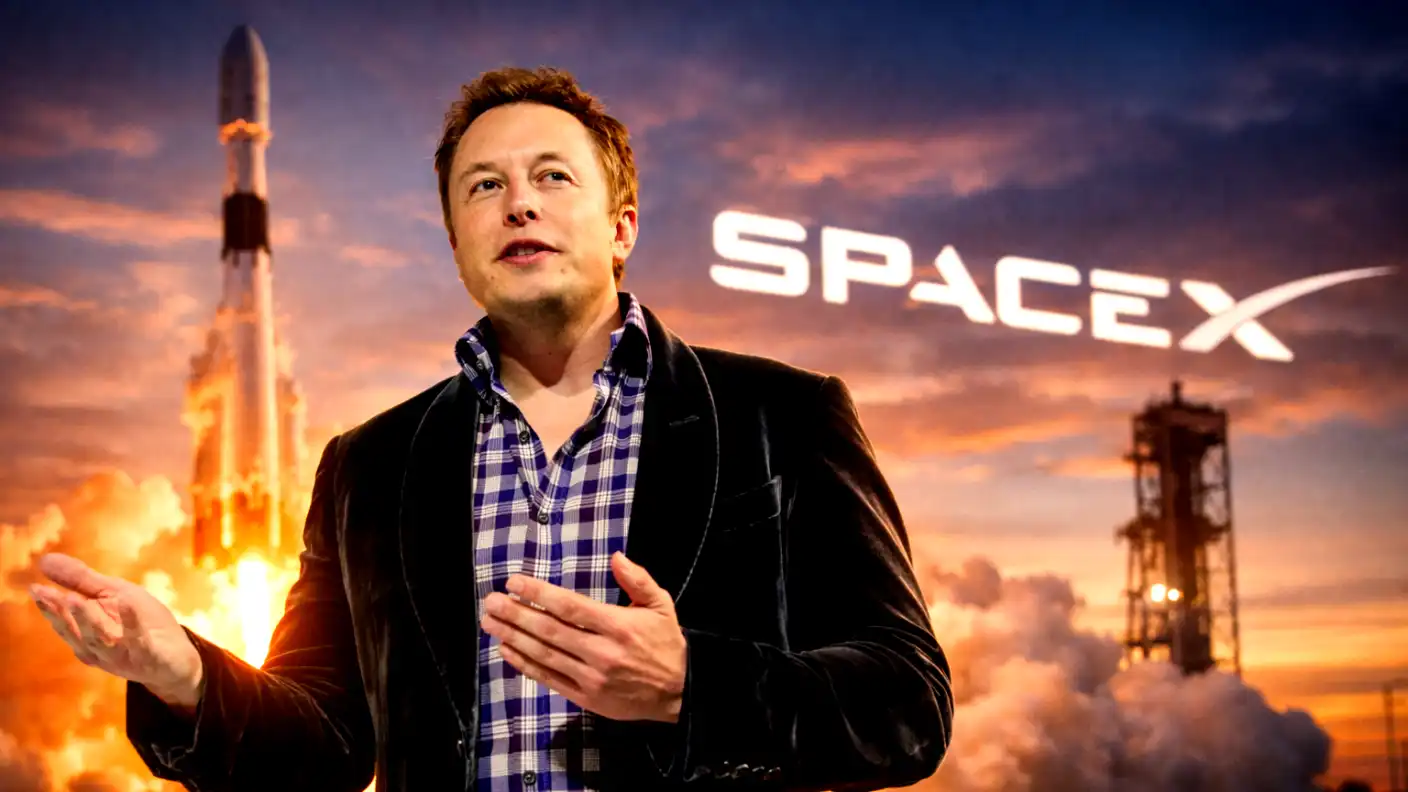
Space Exploration Technologies Corp. sits at the center of the global aerospace economy, commanding a market valuation that rivals the world’s largest industrial conglomerates. Wall Street analysts have issued bullish price targets reaching between $220 and $280 per share, which would push the commercial space giant’s valuation past $2 trillion toward $3 trillion. The company’s operating momentum remains strong, with quarterly revenues jumping 91.9% year on year to $7.81 billion as satellite deployments and launch cadences break historical records.
However, justifying a multi-trillion-dollar valuation requires flawless operational execution across multiple complex technological fronts. For SpaceX Chief Executive Officer Elon Musk, sending the stock into the stratosphere requires more than maintaining the company’s current launch monopoly with the workhorse Falcon 9. The aerospace pioneer must achieve complete, rapid reusability with its next-generation Starship vehicle, transform the Starlink satellite constellation into a high-margin global telecommunications powerhouse, deploy orbital computing infrastructure, and manage massive capital market liquidity shifts.
Mastering Rapid Starship Reusability to Crush Launch Costs
The core pillar of SpaceX’s long-term valuation model is the Starship launch system. Standing nearly 400 feet tall on its orbital launch mount in Starbase, Texas, the stainless steel rocket represents the largest and most powerful flying machine ever built.
Perfecting Tower Catches and Rapid Turnaround Cadence
While the Falcon 9 demonstrated the viability of propulsive rocket landings on ocean drone ships and concrete landing pads, the booster still requires days of inspection, transport, and refurbishment before flying again. The upper stage of the Falcon 9 is entirely expendable, burning up in the Earth’s atmosphere on every mission.
Starship changes this economic equation entirely by targeting 100% full and rapid reusability for both stages. SpaceX engineered the massive Mechazilla launch tower, equipped with mechanical chopstick arms, to catch the returning Super Heavy booster and the Starship upper stage directly out of the air. Successfully catching and restacking boosters within hours will lower the marginal launch cost to between $2 million and $10 million per flight. If SpaceX achieves this turnaround speed, it will achieve launch economics that no competitor on Earth can match, cementing an absolute monopoly over commercial, scientific, and military orbital access.
Unlocking Astronomical Mass-to-Orbit Capabilities
Full reusability unlocks unprecedented mass-to-orbit capacity. A fully operational Starship will deliver between 100 and 150 metric tons of payload to low Earth orbit in a reusable configuration, or over 250 metric tons in an expendable setup.
This lifting capacity allows SpaceX to deploy heavier, more capable hardware at a fraction of the price per kilogram. Squeezing launch costs down from $1,500 per kilogram on traditional commercial rockets to under $100 per kilogram enables business models that were previously financially impossible, including commercial orbital manufacturing, asteroid mining missions, large-scale orbital fuel depots, and deep-space crewed expeditions. Wall Street equity analysts calculate that successfully turning Starship into a routine freight transport service accounts for more than 40% of the company’s projected enterprise value.
Expanding Starlink from Consumer Broadband to Global Telecom Monopoly
While rocket launches generate steady top-line revenue, the Starlink satellite internet network represents the company’s biggest high-margin cash engine. Starlink has grown from an experimental broadband concept into a critical global utility operating thousands of active satellites in low Earth orbit.
Scaling Direct-to-Cell Connectivity and Enterprise Services
Starlink is moving beyond fixed residential satellite dishes mounted on rural rooftops. The network is rapidly expanding into direct-to-cell mobile communications, partnering with major global wireless carriers to connect standard, unmodified smartphones directly to orbital satellites.
This capability eliminates cellular dead zones across deserts, oceans, and mountainous regions worldwide. In addition to consumer mobile coverage, SpaceX is securing lucrative enterprise transport contracts. Major international airlines, maritime container shipping lines, cruise operators, and national railway networks are signing multi-year deals to install high-speed Starlink terminals across their fleets. Generating predictable recurring subscription revenue with software-like gross margins exceeding 60% gives SpaceX the internal cash flow required to fund capital-intensive rocket development without returning to private venture markets for dilutive cash infusions.
Fending Off Emerging Megaconstellation Competitors
To maintain its dominant market position, SpaceX must defend against well-capitalized technology and telecommunications rivals. Competitors such as Amazon’s Project Kuiper, backed by multi-billion-dollar investments, are partnering with legacy telecom giants like AT&T to deliver enterprise satellite broadband.
SpaceX counters this competitive pressure through vertical integration. Because SpaceX owns its own launch vehicles, it can deploy dozens of next-generation V3 Starlink satellites every week at internal cost, while rival satellite operators must purchase expensive launch slots from third-party rocket providers. Furthermore, Starlink’s upgraded laser cross-links create an autonomous optical mesh network in space, allowing satellites to route data packets around the globe at the speed of light in a vacuum without relying on terrestrial ground relay stations. This optical routing architecture lowers international latency, giving Starlink a structural technical advantage over competing constellations.
Merging Space Hardware with Artificial Intelligence and Orbital Data Centers
The convergence of space exploration and advanced computing offers a new frontier for long-term equity growth. Elon Musk is leveraging synergies between SpaceX and his artificial intelligence venture, xAI, to explore radical computing concepts.
Deploying Spaceborne Compute Powered by Continuous Solar
Terrestrial artificial intelligence data centers face severe bottlenecks on Earth, including constrained municipal power grids, massive cooling water consumption, and complex zoning battles. Moving high-density computing clusters into orbit solves several of these physical constraints.
In low Earth orbit, spaceborne data centers can harvest continuous, unattenuated solar radiation using massive photovoltaic arrays, bypassing terrestrial weather interruptions and night cycles. Furthermore, the vacuum of deep space provides a massive natural thermal heat sink, allowing computing clusters to radiate thermal energy away into the void without consuming billions of gallons of fresh water. While orbital radiation hardening and high-speed data downlinks present engineering challenges, deploying modular computing payloads on reusable Starship flights could create a new market for space-based artificial intelligence processing.
Integrating xAI Models into Starshield and Satellite Networks
Onboard computing intelligence is transforming how satellites operate. SpaceX is integrating real-time computer vision and reasoning models directly into its satellite hardware.
Instead of beaming raw sensor files back to ground stations for manual analysis, intelligent satellites can process high-resolution Earth observation imagery, detect maritime shipping movements, monitor wildfire progression, and track atmospheric anomalies locally in orbit. Downlinking only actionable insights and processed analytics reduces bandwidth overhead and delivers instant intelligence to commercial enterprises, scientific research institutions, and defense agencies. This software-defined satellite architecture elevates SpaceX from a pure infrastructure provider into a high-value data analytics platform.
Capital Markets, Passive Inflows, and Liquidity Pressures
As SpaceX navigates public and private capital markets, executive leadership must balance institutional investor demand against near-term equity supply dynamics.
Absorbing Lock-Up Expirations and Insider Selling
Rapidly appreciating tech stocks often encounter volatility during equity liquidity events. Market observers closely track lock-up expirations that make hundreds of millions of early employee and venture capital shares eligible for public market trading.
When long-term venture funds and early engineers seek to realize capital gains, the sudden release of tens of billions of dollars in equity can create temporary downward pressure on share prices. To absorb this potential supply overhang, SpaceX leadership relies on strong institutional demand, steady corporate stock buyback tenders, and consistent earnings beats. Maintaining clear communication regarding long-term revenue milestones reassures large asset managers, encouraging institutional funds to accumulate shares during trading dips rather than selling off positions.
The 15.5 Billion Dollar Passive Buying Catalyst from Index Rebalancing
A major technical catalyst supporting the stock is its inclusion in premier benchmark equity indices, most notably the Nasdaq-100 and the S&P 500. As index providers adjust weighting methodologies during routine quarterly rebalancing cycles, passive exchange-traded funds and mutual funds must purchase shares automatically to match benchmark allocations.
Financial analysts estimate that benchmark index inclusions and weighting increases could generate up to $15.5 billion in mandatory passive buying demand from index-tracking institutional funds. This massive, price-inelastic buying wave acts as a strong financial floor for the stock, offsetting potential insider selling and broadening the company’s permanent shareholder base across global pension funds, sovereign wealth portfolios, and long-term mutual funds.
NASA Deep Space Mandates and Sovereign Defense Backlogs
Government contracts provide a rock-solid financial foundation for SpaceX, generating billions of dollars in guaranteed baseline revenue while validating the company’s technology for commercial clients.
Delivering the Artemis Human Landing System for Lunar Exploration
NASA selected SpaceX’s Starship as the primary Human Landing System for the Artemis program, aiming to return American astronauts to the lunar surface. The multi-billion-dollar government contract requires SpaceX to master complex orbital cryogenic propellant transfer, docking maneuvers, and uncrewed lunar landing demonstrations.
Successfully landing an uncrewed Starship on the Moon and proving that automated tankers can refuel the spacecraft in low Earth orbit will eliminate remaining skepticism surrounding deep-space architecture. Meeting NASA’s mission milestones on schedule will protect crucial government funding lines and position SpaceX as the primary contractor for future human settlements on the Moon and long-term exploration missions to Mars.
Expanding Classified Starshield Military Satellite Fleets
In parallel with civilian space exploration, SpaceX has built a lucrative defense business through its Starshield division. Starshield adapts commercial Starlink communication protocols and bus designs into secure, encrypted satellite networks designed exclusively for the United States Department of Defense and allied intelligence agencies.
The Pentagon has awarded SpaceX billions of dollars in classified contracts to build tracking constellations capable of detecting hypersonic glide vehicles, coordinating drone networks, and providing jamming-resistant battlefield communications. Sovereign defense agencies value Starshield’s rapid deployment cadence and orbital redundancy, which make the network resilient against anti-satellite missile strikes. This high-margin defense backlog guarantees steady, recurring cash flows that remain insulated from broader commercial economic cycles.
Long-Term Outlook for the SpaceX Valuation Trajectory
SpaceX stands at a critical juncture in modern industrial history. The company has moved beyond its early days as a disruptive space startup, establishing itself as an indispensable utility for global communications, scientific exploration, and national defense.
To launch the stock into the stratosphere and achieve a sustained multi-trillion-dollar valuation, Elon Musk and his engineering teams must maintain an aggressive pace of innovation. Perfecting Starship’s automated tower catches, scaling orbital refueling, expanding Starlink’s high-margin enterprise telecom reach, and unlocking space-based artificial intelligence compute will dictate the company’s financial future.
If SpaceX executes on these ambitious engineering and commercial milestones, it will not only secure immense shareholder value on Wall Street but also redefine humanity’s economic relationship with outer space for generations to come.






