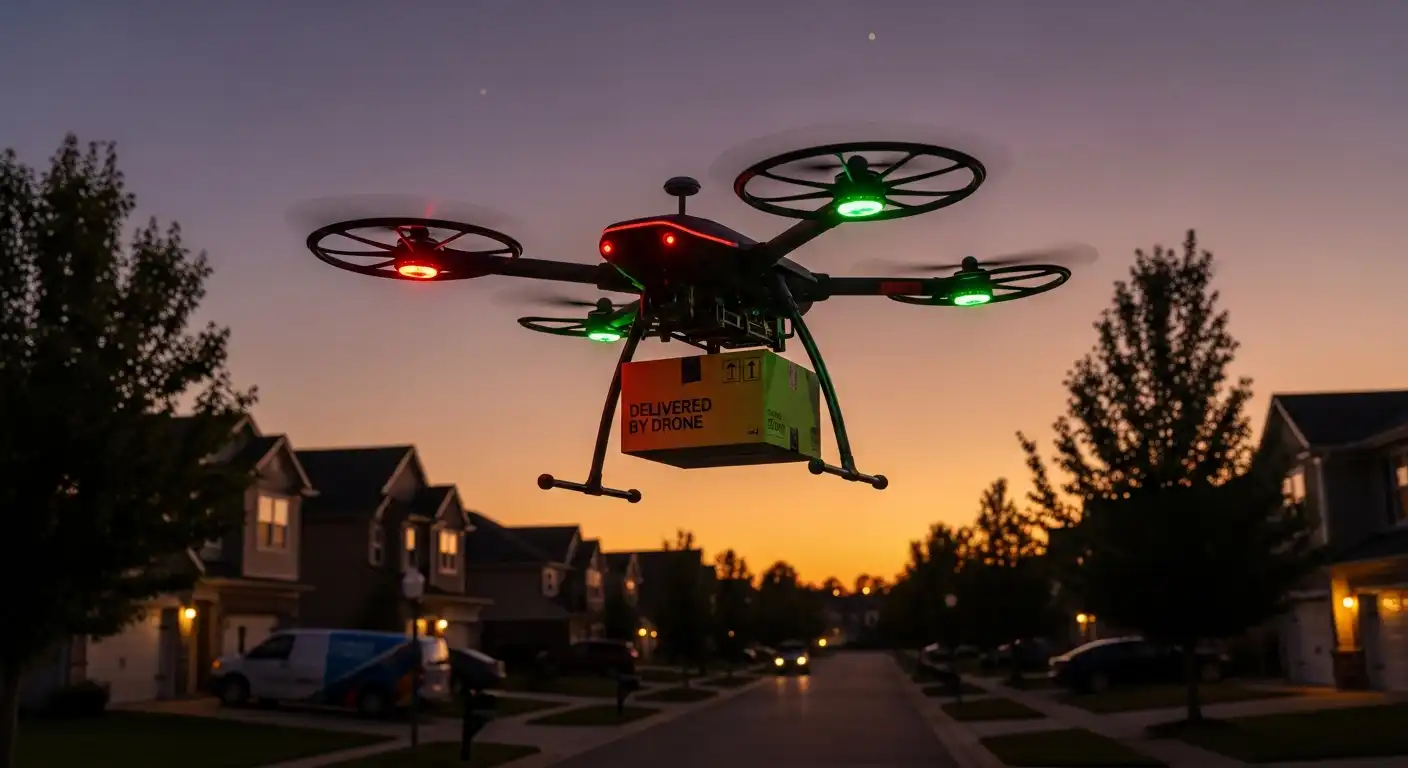
The global delivery market is preparing for its most significant technological and operational realignment. On August 17, 2026, technology giant Uber Technologies Inc. and commercial drone leader Zipline announced a landmark, long-term strategic partnership to integrate autonomous drone delivery directly into the Uber Eats platform. The bold alliance has established an incredibly ambitious corporate target: to reach one million completed drone deliveries every single day by the end of 2029.
To support this rapid, national expansion, Uber is making an undisclosed, strategic equity investment in Zipline, proving that the ride-hailing and delivery pioneer views autonomous aviation not as a temporary, speculative experiment, but as a central pillar of its future logistics network. By combining Uber’s massive consumer-facing marketplace—which connects millions of active users with hundreds of thousands of local merchants—with Zipline’s highly advanced, automated flight hardware, the partnership wants to create a highly efficient, silent, and sustainable transport network that bypasses the traditional limitations of urban road congestion.
This historic alliance comes at a critical inflection point for the global logistics industry. For years, the delivery of small-ticket items like hot meals, forgotten groceries, and medicine relied exclusively on human couriers operating massive, carbon-heavy vehicles. By taking to the skies, Uber and Zipline want to prove that the final-mile delivery can be executed in minutes, completely re-engineering the economics of the digital marketplace and establishing a new global standard for how physical goods move through modern cities.
Deconstructing the One-Million-a-Day Target: The Mechanics of the Partnership
The proposed target of one million daily drone deliveries represents an unprecedented scale of automation, requiring the two companies to build a highly integrated, automated dispatch-and-flight network.
Integrating Zipline’s Autonomous Fleet with the Uber Eats Platform
Under the terms of the agreement, the first commercial deployments will begin later this year in U.S. markets where Zipline already maintains active, certified flight operations. The companies specifically identified the high-volume Dallas-Fort Worth metroplex, Houston, Texas, and Pea Ridge, Arkansas, as the initial launch regions.
Once these initial integrations are stabilized, the partners plan to aggressively expand the service into dozens of additional U.S. cities over the next three years.
For consumers in participating neighborhoods, the ordering process will remain highly familiar. When placing an eligible order for food, groceries, or household essentials through the standard Uber Eats app, users will have the option to select drone delivery.
Once the merchant prepares the order, they will load it into a specialized Zipline delivery capsule.
An autonomous drone will then lift off from a local launching hub, fly silently to the customer’s location, and lower the package precisely onto their lawn or driveway using a high-precision tether system, completing the entire process without a single human driver touching the order.
Shifting from Niche Medical Logistics to Mass-Market Consumerism
The partnership represents a major commercial pivot for Zipline, which has spent much of its first decade operating as an essential public utility rather than a consumer delivery service.
Founded in 2014, the company built its global reputation by constructing life-saving medical logistics networks across four continents, serving over 5,000 hospitals, flying more than 135 million autonomous miles, and saving over 12,000 lives annually by delivering blood, vaccines, and emergency medicine in record time.
The alliance with Uber accelerates Zipline’s transition into the high-volume consumer retail space, which the company began exploring through pilot programs with Walmart and Chipotle.
With its automated fleet currently making a commercial delivery somewhere in the world every 20 seconds, the company has already completed over 2.7 million commercial flights.
By integrating this proven, highly reliable hardware platform with Uber’s massive consumer network, Zipline can scale its operations rapidly, transitioning its medical-grade technology into a ubiquitous consumer utility that can deliver everyday items to millions of households.
The Technological Edge: Speed, Precision, and Bypassing the Gridlock
The primary competitive advantage of autonomous drone delivery is its unmatched operational speed, which allows merchants to bypass the physical bottlenecks of traditional urban transportation.
Slicing Delivery Times to Under Ten Minutes
Traditional, road-based delivery remains a slow and highly unpredictable process, with an average click-to-delivery time of 30 to 45 minutes in most American cities. Traditional couriers must navigate traffic congestion, search for parking spaces, and deal with construction delays, making it exceptionally difficult for merchants to guarantee that hot meals or cold desserts will arrive in optimal condition.
Zipline’s autonomous drones completely eliminate these physical bottlenecks. Flying at a secure altitude of several hundred feet above the traffic, the company’s electric drones can travel directly from the merchant to the customer’s home at speeds exceeding 100 kilometers per hour.
This direct, low-altitude flight path allows the company to complete local deliveries in as little as 5 to 10 minutes, with a current U.S. average click-to-delivery time of just 18 minutes.
This rapid speed is highly attractive to consumers, ensuring that fresh food arrives hot and frozen items remain solid, while providing a level of convenience that traditional car-based delivery simply cannot match.
Solving the Physical Constraints of the Urban Roadway
The environmental and physical benefits of transitioning to low-altitude drone delivery are immense. Every year, consumers and businesses in the United States execute approximately 5.5 billion local deliveries.
Alarmingly, almost all of these small-ticket deliveries—representing light packages like a single burrito, a bottle of medicine, or a pint of ice cream—are transported using a 4,000-pound, gasoline-powered passenger car.
This reliance on heavy vehicles for light-packet logistics is exceptionally inefficient, contributing directly to urban road damage, gridlock, and high greenhouse gas emissions.
By shifting these small-ticket deliveries to lightweight, fully electric autonomous drones, the Uber-Zipline alliance wants to remove millions of car trips from the roads.
This transition not only lowers corporate carbon emissions but also reduces municipal traffic congestion, representing a significant 1.5% national productivity gain if scaled across major metropolitan areas, and proving that the virtual convenience of on-demand delivery can be achieved without destroying the physical quality of urban life.
The Squeeze on Gig Workers: What Happens to the Human Driver?
While the technology and investment communities are celebrating the long-term benefits of autonomous drone delivery, the rapid shift toward automation is raising deep, highly sensitive questions regarding the future of the gig economy.
Navigating the Labor Transition in the Algorithmic Economy
For nearly two decades, Uber’s business model relied on its ability to mobilize a massive, flexible network of independent gig workers to drive passengers and deliver food.
This freelance workforce provided the company with the extreme operational agility needed to scale its services globally, turning the platform into a household name.
The rapid integration of autonomous drones, combined with parallel partnerships to deploy autonomous robotaxis developed by companies like Lucid and Momenta, indicates that Uber’s long-term corporate strategy is focused on reducing its reliance on human labor.
While the company insists that drone delivery will initially operate as an optional, complementary feature designed for small-item orders in suburban areas, the long-term trend points toward a significant consolidation of the human delivery force.
As autonomous drones become increasingly capable of carrying heavier payloads and operating in diverse weather conditions, they will inevitably squeeze out human drivers from the most profitable, short-haul urban routes.
Shifting Corporate Expenses from Payroll to Capital Assets
The transition from human couriers to autonomous drones represents a fundamental shift in corporate finance for delivery platforms.
When a company relies on human drivers, its operating costs scale linearly with its delivery volume, as it must pay drivers for their time, provide commercial insurance, and offer financial incentives during periods of high demand.
By investing in an autonomous drone fleet, Uber can shift its corporate expenses from volatile, recurring labor costs to stable, depreciable capital assets.
While building and maintaining a national network of drone launching hubs requires a substantial, upfront capital investment, once the physical infrastructure is in place, the ongoing cost per delivery drops to near-zero.
This high operating leverage allows the platform to capture a significantly larger share of the delivery fee, improving its long-term profit margins and satisfying Wall Street’s demands for sustained corporate profitability, even as it creates profound economic uncertainty for the millions of freelance drivers who depend on the platform for their livelihoods.
The Battle for the Skies: Sizing up the Competitive Field
The strategic alliance between Uber and Zipline is not occurring in a corporate vacuum. It represents a major, high-stakes battle to dominate the low-altitude airspace of the world’s most lucrative consumer markets.
The Dual-Oligopoly of Low-Altitude Airspace
The primary competitive threat to the Uber-Zipline partnership is a separate, highly aggressive alliance formed by rival delivery platform DoorDash and Google-parent Alphabet’s drone subsidiary, Wing.
DoorDash and Wing pioneered commercial drone delivery, launching their first joint operations in Australia in 2022 before expanding to the United States, where they recently expanded their service footprint to the Atlanta metropolitan area.
This competitive dynamic is setting up a high-stakes, dual-oligopoly battle for the skies.
Just as Uber and DoorDash spent the past decade competing for dominance on the streets, they are now deploying their multi-billion-dollar balance sheets to secure the exclusive right to operate autonomous flight paths over major American suburbs.
The company that can build the largest, most reliable, and quietest drone delivery network will capture an insurmountable lead, locking in local merchant partnerships and establishing its platform as the default, invisible utility of the skies.
The Race to Secure Federal Aviation Administration Approvals
While the technology is ready and the capital is available, the ultimate speed of the drone delivery rollout remains heavily dependent on securing complex regulatory approvals from the Federal Aviation Administration.
Operating an autonomous drone network in a dense, highly populated urban area requires securing a Part 135 beyond visual line of sight (BVLOS) certification, which requires proving to federal regulators that the drones can navigate around trees, power lines, and other aircraft safely without human intervention.
This regulatory hurdle is exceptionally difficult to clear, requiring years of rigorous safety testing, data collection, and redundant systems development.
By securing a strategic investment from Uber—which is part of a broader, multi-billion-dollar funding landscape where single deep-tech startups regularly raise over $1 billion—Zipline has secured the financial leverage and political backing needed to navigate these complex regulatory audits.
The company’s flawless safety record of flying over 135 million autonomous miles without a single serious incident provides a vital, non-negotiable proof of concept to federal regulators, ensuring that the partnership can secure the required BVLOS approvals and scale its operations ahead of its competitors.
Reforming the final-mile Delivery Network
The completed signing of the strategic partnership between Uber Technologies Inc. and Zipline is a historic milestone in the financial and technological evolution of the global logistics industry. By committing to an ambitious target of one million daily drone deliveries through the Uber Eats platform by the end of 2029, the two industry leaders have proven that autonomous aviation is transitioning from an experimental novelty into a mainstream public utility.
While the rapid shift toward automated delivery will continue to raise deep, highly sensitive questions regarding the future of gig workers and the economic survival of freelance drivers, the strategic and environmental benefits of the alliance are immense.
The partnership secures a highly efficient, low-carbon, and ultra-fast shipping rail that bypasses the traditional, physical constraints of urban road congestion, ensuring that consumers can access meals, groceries, and daily essentials within minutes.
As the first joint deployments begin in Dallas, Houston, and Pea Ridge later this year, the success of this high-volume rollout will determine the structure, the standards, and the capabilities of the automated final-mile delivery network of the future.