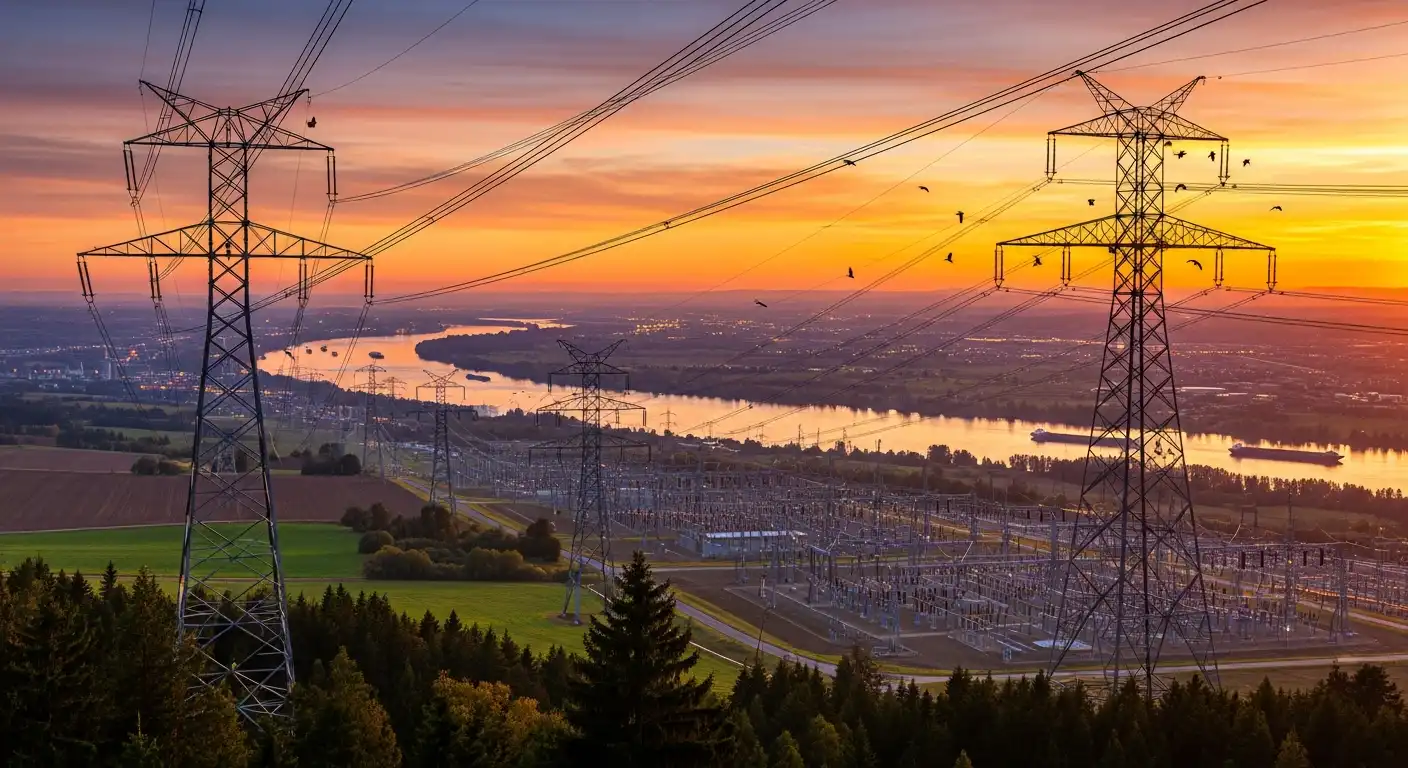
The physical limits of the United States electrical grid are facing an unprecedented challenge. In August 2026, the U.S. Energy Information Administration published its latest Short-Term Energy Outlook, revealing that national electricity consumption will climb to consecutive record highs over the next two years. The main drivers of this relentless demand are the rapid expansion of high-density artificial intelligence data centers, a surge in cryptocurrency mining, and a broad-based transition toward electrification across the residential and commercial sectors of the economy.
According to the official projections, U.S. power demand will rise to an all-time high of 4,268 billion kilowatt-hours in 2026, before climbing further to a staggering 4,391 billion kilowatt-hours in 2027. These historic figures represent a massive expansion compared to the previous record of 4,195 billion kilowatt-hours consumed in 2025. The rapid acceleration of the power curve proves that the virtual services of the modern digital age remain completely anchored in the physical concrete, wires, and power plants of the material world.
This sustained growth in power demand is forcing utility companies, grid operators, and state regulators to radically rethink their resource planning. As the country’s electricity consumption outruns its traditional infrastructure capacity, the industry must invest heavily in expanding and upgrading its transmission networks. This massive capital campaign is transforming the utility sector from a stable, low-growth dividend play into a highly active, capital-intensive heavy industry, raising significant concerns about grid reliability, power prices, and national security.
The Driving Forces of the Surge: Artificial Intelligence and Electrification
The primary catalyst for the historic power demand projection is the rapid, highly concentrated buildout of advanced digital infrastructure. To support the global transition into the automated machine age, technology firms must construct computer campuses at an unprecedented scale.
The Massive Appetite of High-Density GPU Data Centers
Traditional data centers, which were engineered to host standard web applications and basic cloud storage, required relatively modest amounts of power, typically consuming 5 to 10 kilowatts per server rack. In sharp contrast, modern data centers dedicated to artificial intelligence training and high-frequency cryptocurrency operations require specialized, high-density graphics processing units that consume up to 100 kilowatts per rack.
These advanced processors operate at extreme temperatures, requiring massive, continuous liquid cooling systems and heavy electrical transformers to function.
This technological shift has turned single data center campuses into massive industrial energy consumers, with some planned facilities requiring up to one gigawatt of dedicated power—enough electricity to support a medium-sized city of one million residents.
The rapid proliferation of these gigawatt-scale sites is driving a massive concentration of power demand across key technological hubs, straining local transmission systems and forcing utilities to scramble to secure new generation sources.
Electrification of Transport and Home Heating Systems
Beyond the digital economy, traditional businesses and domestic households are also driving up national power consumption through a sustained transition toward electrification.
Consumers are increasingly abandoning traditional fossil-fuel heating systems and gasoline-powered vehicles, choosing highly efficient electric heat pumps and electric vehicles instead.
This structural transition is transforming how energy is consumed across the country. In the past, a significant portion of residential and commercial energy demand was satisfied directly through the local burning of natural gas, heating oil, or gasoline.
As these sectors transition to electric alternatives, that energy demand is shifted directly onto the local power grid. This double-sided pressure—where the economy is simultaneously adding massive new digital workloads while translating its existing physical heating and transport systems into electric demands—is pushing the national grid to its absolute limits, proving that even a minor 1.5% increase in transmission efficiency can save grid operators billions of dollars annually.
The Texas Shock: Grid Anxiety Prompts Regulatory Pauses
The rapid acceleration of power demand has created severe regulatory and operational anxieties across several states, leading to sudden policy changes that are forcing the Energy Information Administration to adjust its long-term forecasts.
Governor’s August Third Pause on Data Center Permits
Nowhere is the grid anxiety more pronounced than in Texas, which operates its own independent electrical grid managed by the Electric Reliability Council of Texas. The state has historically served as a primary destination for energy-intensive cryptocurrency mining operations and massive data centers, attracted by the state’s abundant land, cheap power, and relaxed regulatory environment.
However, the sheer speed of the technology buildout has threatened the stability of the local grid. On August 3, 2026, the Governor of Texas announced a temporary pause on all new data center development approvals throughout the state.
The administration stated that the freeze was necessary to allow regulators and utility operators to collect more detailed information about projects currently undergoing review, ensuring that the state can protect its residents from catastrophic grid failures and winter blackouts before approving further industrial data center permits.
Slashing the Texas Electricity Load Projections for 2027
The sudden regulatory intervention in Texas has had an immediate impact on national energy models. Following the governor’s announcement, the Energy Information Administration made a significant downward revision to its long-term power demand forecast for the state.
In its August outlook, the agency slashed its projected 2027 electricity load growth rate for Texas to a modest 6%. This represents a massive reduction from its previous forecast, which had projected that the state’s electricity demand would grow by an extraordinary 14% in 2027.
This significant downward adjustment proves that the availability of physical power has become the primary bottleneck limiting the growth of the digital economy. If regional grids cannot guarantee a stable, uninterrupted supply of electricity, local governments will step in to protect their citizens, forcing technology companies to scale back their data center ambitions or find other, more accommodating regional partners.
Deconstructing the Sector-Specific Power Demands
The Energy Information Administration’s Short-Term Energy Outlook provides a highly detailed, sector-specific breakdown of how this historic power demand is distributed across the American economy.
Commercial Sector Surpasses Residential Consumption
A key milestone in the August projections is the performance of the commercial sector, which includes office buildings, retail establishments, and most importantly, commercial data center campuses. The agency forecasts that commercial electricity sales will rise to a record 1,545 billion kilowatt-hours.
This rapid growth means that for the first time in United States history, electricity demand in the commercial sector is on track to outpace residential power consumption.
Historically, domestic households represented the single largest source of power demand in the country. The fact that commercial consumption is overtaking residential sales proves that the collective computing and cooling demands of the digital economy have surpassed the energy needs of the entire American population, marking a major turning point in the history of national energy development.
Flatlining Residential Sales and Steady Industrial Base
In sharp contrast to the high-growth commercial sector, residential power sales are expected to experience a minor, temporary contraction. The agency projects that residential electricity sales will decline slightly to 1,514 billion kilowatt-hours, down from the record 1,515 billion kilowatt-hours consumed in 2025.
This minor decline is primarily driven by milder weather forecasts and continuing efficiency improvements in household appliances and air conditioning systems.
At the same time, industrial power sales are expected to hold steady at 1,064 billion kilowatt-hours, reflecting a stable, highly resilient base of traditional manufacturing activity.
This sector-specific data highlights that the massive, historic rise in national power demand is being driven almost entirely by the unique, high-density requirements of the commercial technology sector, rather than a broad-based increase in domestic household energy consumption.
The Changing Fuel Mix: Coal Slides as Renewables and Gas Hold Firm
To satisfy this historic, consecutive surge in electricity consumption, the United States utility sector must deploy every available energy source, completely reconfiguring the national generation mix to balance environmental commitments with grid reliability.
The Structural Decline of Coal in the Energy Grid
The Energy Information Administration’s projections confirm that the long-term, structural decline of coal-fired power generation is continuing at a steady pace. As utility companies continue to retire older, inefficient coal plants and replace them with cleaner alternatives, coal’s share of the national generation mix is slipping:
- In 2025, coal accounted for 17% of total United States utility-scale electricity generation.
- The agency projects that coal’s share will decline to 16% in 2026.
- By 2027, coal-fired generation is expected to slide further to 15% of the national total.
This steady decline represents a major environmental milestone, helping to reduce national carbon emissions even as overall power demand hits record highs. However, to prevent these coal retirements from destabilizing the grid during periods of peak demand, utilities must rapidly scale up alternative sources of reliable baseload power.
Natural Gas Maintains a Forty Percent Share
To fill the gap left by coal retirements and support the rapid integration of intermittent renewable energy, natural gas remains the indispensable workhorse of the United States power grid. The agency forecast that natural gas will maintain a solid 40% share of the national electricity generation mix through 2027, matching the record levels achieved in 2025.
Natural gas power plants are highly valued by grid operators because of their ability to ramp up production within minutes, providing a vital, high-capacity backstop when solar and wind generation drops off.
Despite the rapid expansion of renewable energy capacity, the absolute volume of natural gas burned for electricity generation is expected to rise to record levels, ensuring that the country can meet its peak-hour power demands without risking widespread blackouts.
Scaling Up Wind, Solar, and Utility-Scale Battery Storage
The fastest-growing segment of the United States energy sector is renewable energy, driven by massive investments in utility-scale solar and wind projects. The agency projected that the share of renewable generation will rise from approximately 24% in 2025 to 25% in 2026, before climbing further to 27% in 2027.
To support this rapid expansion of intermittent renewable energy, the industry is investing billions of dollars to construct massive, utility-scale battery storage facilities.
According to the agency’s data, U.S. battery storage capacity has grown at an extraordinary annual average rate of 70% over the last three years, reaching 43.6 gigawatts of operational capacity by the end of 2025.
During the first half of 2026 alone, operators added another 8.3 gigawatts of capacity, bringing total U.S. battery storage capacity to nearly 52 gigawatts.
With operators planning to add 26 gigawatts in 2027 and 14 gigawatts in 2028, these massive battery systems will allow grid operators to store excess solar and wind energy generated during the day and discharge it during peak evening hours, providing a stable, clean, and highly reliable source of electricity for the modern machine economy.
Reconfiguring the Grid for the Machine Age
The latest Short-Term Energy Outlook published by the Energy Information Administration represents a landmark moment in the history of national infrastructure development. By demonstrating that U.S. power demand will hit consecutive record highs through 2027, reaching a staggering 4,391 billion kilowatt-hours, the agency has proven that the digital economy has permanent, physical consequences for the global energy supply chain.
While the sudden regulatory pause in Texas and the structural bottlenecks of transmission capacity have created significant near-term friction, they have also successfully forced the utility sector to accelerate its modernization plans.
By investing in high-capacity natural gas generation, expanding utility-scale solar and wind networks, and deploying massive battery storage facilities, the industry is building a highly resilient, modern power grid.
These large-scale grid upgrades, requiring over $1 billion in capital investments, are essential for ensuring that the United States can successfully satisfy its peak-hour computing demands without risking national security, paving the way for a more stable, clean, and connected future.