Key Points:
- China’s Ministry of Commerce warned it will resolutely take countermeasures if the EU introduces new discriminatory trade restrictions.
- The warning follows a high-level European Commission meeting where officials labeled the trade relationship with Beijing “not sustainable.”
- European planners are drafting an “overcapacity instrument” to impose import quotas and tariffs on Chinese clean tech, metals, and chemicals.
- Chinese trade bodies warned that erecting new trade barriers would primarily harm Europe by driving up import costs for local consumers.
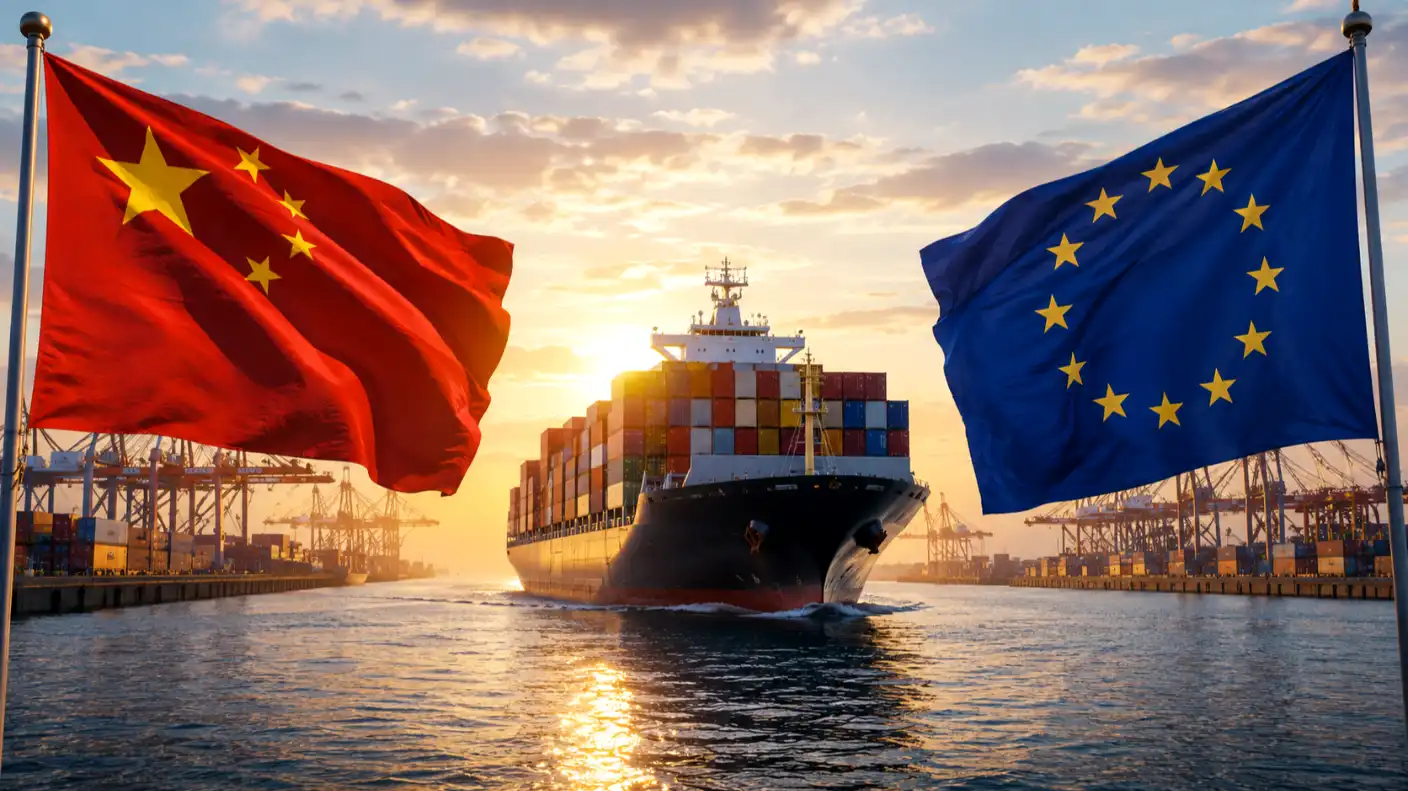
The economic standoff between the world’s major trading powers has intensified as Beijing officially warned the European Union of firm retaliation if Brussels goes ahead with new trade restrictions. On Saturday, May 30, 2026, a spokesperson for China’s Ministry of Commerce (MOC) said at a press conference that the country will take resolute countermeasures to safeguard its interests. The stern warning followed closely watched discussions among European Union commissioners, who met on Friday to debate expanding the bloc’s trade defense arsenal to limit Chinese industrial imports.
The growing China-EU trade tensions come as the European Commission has taken a much tougher, more combative stance in its relationship with Beijing. Following the Friday meeting in Brussels, the EU executive issued an official statement declaring that the current trade and investment relationship with China is “not sustainable.” While the commissioners did not finalize any concrete legislative proposals on Friday, the high-level discussions will serve as the core basis for upcoming talks at the mid-June Group of Seven (G7) summit and the European Council summit on June 18–19.
European policymakers are currently designing a sweeping “overcapacity instrument” to shield local manufacturers from heavily subsidized Chinese imports. The proposed mechanism would empower Brussels to cap imports and impose sector-wide tariffs on critical foreign goods. This new trade defense tool would target Chinese industrial exports in key, high-growth markets, including electric vehicles, solar panels, steel, and advanced chemical products. To block potential loopholes, an informal French-led proposal—backed by Spain, Italy, the Netherlands, and Lithuania—seeks to make it much faster to launch investigations and impose emergency duties.
However, Beijing has made it clear that it will not passively accept these unilateral restrictions. The Chinese commerce ministry urged the EU to abide by World Trade Organization (WTO) rules, uphold the principles of free trade and fair competition, and actively oppose protectionism and unilateral measures. The spokesperson emphasized that China and the EU remain vital economic and trade partners. To manage their differences, the ministry noted that both sides are currently exploring the creation of a formal bilateral consultation mechanism to discuss trade and investment issues, and hope that European officials will meet China halfway.
Earlier on Thursday, Chinese Foreign Ministry spokesperson Mao Ning also criticized the EU’s recent protectionist rhetoric. Responding to media queries regarding the proposed import quotas, Mao argued that regardless of the terms Western officials use—whether they call it “de-risking,” “reducing reliance,” or “addressing trade imbalances”—these measures are entirely protectionist. She warned that erecting trade barriers will only hurt European consumers, raise operating costs for European companies, and severely weaken the continent’s industrial competitiveness in the long run.
Furthermore, business organizations representing Chinese enterprises in Europe have expressed deep concern over the escalating trade barriers. The China Chamber of Commerce to the EU (CCCEU) warned in an email statement that restricting market access will directly translate into higher import costs for European industries and consumers. The business body noted that the overextension of such trade defense tools risks undermining the EU’s own competitiveness and its attractiveness as an open investment destination. This warning is particularly critical as China continues to expand its market share in Europe, with Chinese-built hybrid cars accounting for nearly 40% of all new European car registrations so far this year.
The proposed trade restrictions arrive at a moment of severe geopolitical and macroeconomic strain. The ongoing war in the Middle East has closed the critical Strait of Hormuz, driving global energy costs past $100 per barrel and raising fears of a prolonged inflation shock. This energy-driven inflation has already squeezed corporate profit margins, prompting European companies to demand relief. If the EU imposes new tariffs and quotas on cheap Chinese industrial parts, the combined shock of high energy and material costs could drag down Europe’s GDP growth, forcing central banks to keep interest rates higher for longer.
Historically, the European Union’s trade deficit with China has been a major point of political friction, reaching an unsustainable €360 billion (approximately $388 billion) in 2025. This massive deficit has prompted EU Industry Commissioner Stéphane Séjourné to demand more robust, proactive trade defenses. To preserve their economic sovereignty and protect their manufacturing centers, Western governments are working to reduce offshoring to China, a trend that peaked in the early 2000s. These decoupling efforts could require European firms to diversify their supply chains, potentially costing the corporate sector more than $1 billion in restructuring costs.
As both sides prepare for the upcoming G7 and European Council summits in June, the path forward remains highly uncertain. If the European Commission refuses to freeze its plans and unilaterally introduces discriminatory restrictions, the resulting tit-for-tat trade war, which could drag down bilateral trade growth by 1.5% or more, will severely disrupt the global technology and manufacturing supply chains. Finding a delicate balance between protecting domestic industrial capacity and maintaining cooperative trade relations with China will remain the defining challenge for European policy planners as they navigate this highly volatile economic landscape.