The global health of marine ecosystems is facing unprecedented pressure. For decades, rapid and uncoordinated coastal development, intensive aquaculture, overfishing, and rising ocean temperatures have severely degraded vital marine habitats. Coastal ecosystems that once thrived with biodiversity have shrunk significantly, leaving underwater environments as mere shadows of their former glory. Because these marine habitats serve as critical carbon sinks, nurseries for commercial fish species, and natural barriers against coastal erosion, their decline represents a severe threat to both ecological stability and global economic security.
To counter this environmental crisis, China has initiated a massive, scientifically coordinated pivot toward marine civilization and green development. Rather than relying solely on passive conservation, Chinese researchers, universities, and local government bodies are executing active, high-tech intervention programs to rebuild damaged marine ecosystems.
These efforts are highly visible in two distinct, pioneering projects: the massive restoration of temperate seagrass meadows in the northern Changdao Islands of Shandong Province, and the construction of the nation’s first tropical marine ranch at Wuzhizhou Island in southern Hainan Province. By combining advanced, indoor-cultivated seed banks with artificial reef deployments, these projects are successfully restoring the natural food chain, proving that targeted human assistance can catalytically accelerate the self-healing power of nature.
Rebuilding the Submerged Grasslands of the Bohai and Yellow Seas
At the intersection of the Bohai Sea and the Yellow Sea lies the Changshan Islands, commonly known as Changdao. As the largest island group in the region, Changdao historically possessed vast, lush underwater meadows of seagrass. However, decades of unregulated nearshore farming and aquaculture hatcheries rapidly whittled away these delicate habitats, leaving the surrounding waters biologically impoverished.
The Critical Ecological Role of Seagrass Meadows
Seagrasses are unique, highly evolved flowering plants that complete their entire life cycle—including pollination, seed formation, and germination—entirely underwater. They serve as the foundational infrastructure for temperate marine life.
A single seagrass meadow the size of a standard football field can support approximately 80,000 fish and more than 100 million small invertebrates.
These “submerged grasslands” act as natural water filtration systems, trapping suspended sediments, absorbing excess nutrients, and stabilizing the seabed to prevent coastal erosion during severe storms.
When these meadows are destroyed, the local marine food chain collapses, leading to a rapid decline in fish populations and exposing coastal communities to increased storm damage.
The Yantai University Biodegradable Turf Model
To reverse this decline, the Changdao National Marine Park Management Center partnered with local universities to develop an innovative, highly successful seagrass restoration model.
Wu Zhongxun, the deputy director of the management center, explained that the joint program, developed alongside researchers from Yantai University, relies on a highly controlled, multi-stage cultivation process.
First, the team establishes artificial seed banks to preserve precious genetic material, or germplasm, from native seagrass species.
Next, technicians sow these preserved seeds onto specialized, biodegradable “turf” mats.
These seeded mats are kept indoors in temperature-controlled tanks, where researchers raise the young plants until they reach a height of over 20 centimeters.
Once the plants are strong enough to survive the natural ocean currents, divers lay the biodegradable turf mats directly onto the seabed like a carpet.
According to Xiao Shengzhi, a seagrass cultivation technician on the project, the actual transplanting process is highly sensitive to seasonal changes. The team begins laying the seagrass carpets in late May, specifically waiting until regional seawater temperatures rise above the critical threshold of 16 degrees Celsius to ensure maximum survival and growth rates.
Restoring the Migratory Food Chain for Pacific Spotted Seals
The successful restoration of the seagrass meadows has had an immediate, highly positive impact on the region’s apex predators. Every year, between March and May, more than 400 Pacific spotted seals migrate from Liaodong Bay to the sunlit reefs of the Changdao Islands to rest and feed.
In the past, the lack of local fish and shrimp forced the migrating seals to travel further or struggle to find enough food.
As the seagrass and seaweed beds make a quiet comeback, they provide highly secure spawning grounds and nurseries for small fish and shrimp.
This surge in lower-trophic-level biomass has restored the local food chain, ensuring that the migrating Pacific spotted seals have a plentiful, reliable food source when they arrive in Changdao, demonstrating how target-level habitat restoration can successfully support migratory species across thousands of miles.
Tropical Marine Ranching: The Blue Carbon and Coral Reconstruction in Sanya
While researchers in northern China focus on temperate seagrasses, an equally significant, high-tech ecological transformation is unfolding in the tropical waters of southern China, off the coast of Wuzhizhou Island in Sanya, Hainan Province.
China’s First Tropical Marine Ranch at Wuzhizhou Island
In 2010, the management of the Wuzhizhou Island tourism zone partnered with Hainan University to launch China’s very first tropical marine ranch project.
Marine ranching is a highly sophisticated ecological engineering concept that operates much like grazing livestock on land.
Instead of relying on wild, unmanaged oceans, researchers farm marine life by actively constructing artificial habitats, restoring the natural food chain, and transplanting key species to build a self-sustaining, highly productive ecosystem.
Before the project began, the coral reefs surrounding Wuzhizhou Island were severely degraded due to illegal fishing, tourism pressure, and rising sea temperatures, which triggered widespread coral bleaching.
By launching the marine ranch, the joint team aimed to build a physical and biological shield around the island, restoring its biodiversity while creating a sustainable model for eco-tourism and blue carbon sequestration.
Deploying Eighty Thousand Cubic Meters of Artificial Reefs
The physical scale of the Wuzhizhou Island marine ranch is extraordinary. Since the project’s inception, researchers and engineers have deployed more than 80,000 cubic meters of artificial reefs and shipwreck reefs onto the seabed.
The construction of these reefs requires precise engineering.
Since 2011, the team has installed nearly 3,000 custom-designed concrete reef units and 21 decommissioned shipwreck reefs across the sandy, barren areas of the seafloor.
These artificial structures are designed to alter local hydrological currents, creating calm, protected upwelling zones that trap nutrients and organic matter.
This nutrient concentration attracts microscopic plankton, which in turn draws small fish and shellfish.
According to long-term monitoring data, this physical habitat construction has successfully increased local fish resources by five to ten-fold, extending significant ecological benefits to nearly 10,000 mu, or approximately 666.67 hectares, of the surrounding tropical waters.
Overcoming the Coral Survival Barrier: From Forty to Seventy Percent
The physical framework of the artificial reefs serves as the ideal foundation for the most critical phase of the tropical marine ranch: coral transplantation. Coral reefs are often called the rainforests of the sea, providing shelter, food, and breeding grounds for more than 25% of all marine species.
To accelerate the recovery of these fragile organisms, the Wuzhizhou Island protection team, led by marine department head Wang Fengguo, has transplanted more than 66,000 individual corals, successfully restoring over 61,000 square meters of the seabed.
Historically, transplanting delicate coral fragments onto artificial reefs was highly risky, with survival rates frequently hovering around a modest 40% due to storm damage, algae competition, and water quality fluctuations.
To overcome this barrier, the research team developed and introduced a new, highly advanced cultivation technique. This proprietary method provides better structural attachment for the young coral fragments, protecting them from physical wave action during their early, high-risk growth phases.
The implementation of this technique successfully boosted coral survival rates from 40% to over 70%.
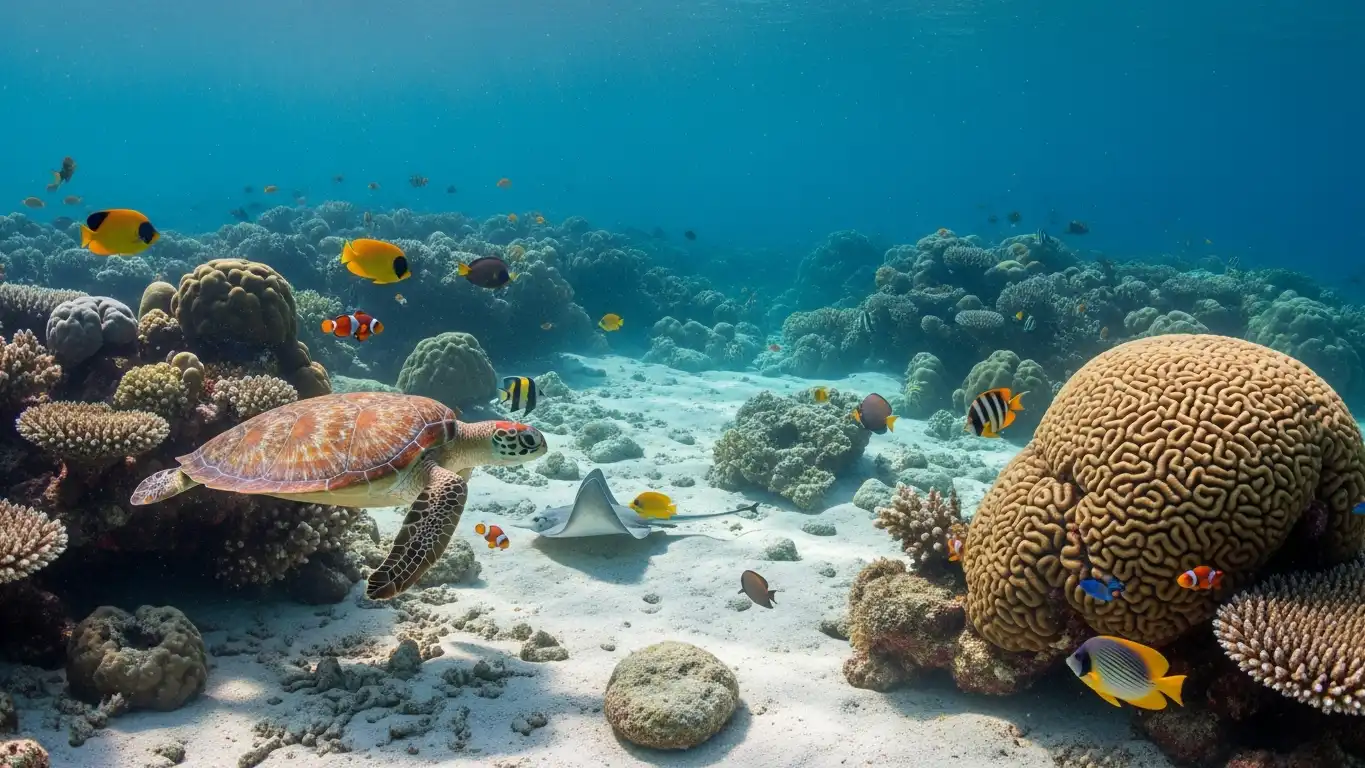
Today, the restored marine ranch records 116 distinct species of corals and 265 fish species, with rare and endangered hawksbill turtles becoming regular residents, and wild dolphins making multiple, high-profile appearances in the area, providing clear, undeniable proof that the tropical marine ecology is undergoing a profound recovery.
The Science of “Underwater Afforestation” and Natural Recovery
The dual successes of the northern seagrass restoration and the southern tropical marine ranch highlight a fundamental, highly sophisticated philosophy that is redefining modern ecological science.
The Philosophy of Respecting Nature’s Self-Healing Capacity
Wang Aimin, a 65-year-old pioneer of the Wuzhizhou Island project who is affectionately known as an “underwater afforestation worker,” emphasized that the ultimate credit for ecological recovery belongs to nature itself.
He pointed out that while human engineering is essential to jumpstart the recovery process, the ocean’s internal self-healing capacity is far greater than any human intervention.
The role of the marine restoration technician is not to permanently manage the ecosystem, but to act as a temporary catalyst.
By deploying artificial reefs, scientists are essentially providing the raw, physical framework that nature requires to rebuild its own food chains.
Once the structural framework is in place and the early-stage species are successfully established, the natural ecosystem takes over.
The organisms interact, reproduce, and adapt, gradually building a complex, self-sustaining trophic web that can survive future environmental changes without needing continuous, expensive human maintenance, proving that the most effective ecological engineering is that which respects and collaborates with the laws of nature.
Economic and Carbon Sequestration Benefits of Marine Ranches
Beyond the obvious environmental benefits, the successful implementation of marine ranches delivers significant economic and climate mitigation returns, making the projects highly attractive to both governments and private investors.
Restoring 10,000 mu of tropical waters at Wuzhizhou Island has successfully created a premium destination for sustainable eco-tourism, generating millions of dollars in annual tourism revenue and proving that environmental protection and economic development can support each other.
Furthermore, healthy seagrass meadows and coral reefs act as highly efficient “blue carbon” sinks.
These coastal marine ecosystems can sequester and store carbon dioxide from the atmosphere at rates up to ten times faster than mature tropical rainforests, making marine ranching an indispensable tool in the global fight against climate change.
By investing in these advanced, underwater afforestation projects, nations can successfully protect their coastal infrastructures, support their local tourism and fishing industries, and meet their international carbon reduction commitments simultaneously, paving a highly integrated, sustainable path for global environmental finance.
A Unified Framework for Global Marine Conservation
The successful marine restoration initiatives playing out off the coasts of Shandong and Hainan provinces prove that the global community can successfully reverse the decline of our oceans. By showing that temperate seagrass meadows can be systematically rebuilt using indoor-cultivated biodegradable turf, and that tropical coral reefs can be successfully scaled using advanced, high-survival transplantation techniques on artificial reefs, these projects have provided a highly replicable, scientifically rigorous framework for global marine conservation.
While the physical challenges of managing marine operations, rising ocean temperatures, and local regulatory compliance remain significant, the collaborative efforts of researchers, universities, and local enterprises offer real hope.
By treating the ocean’s self-healing capacity with deep respect, utilizing target-level human assistance, and building secure, long-term funding models, these pioneers are proving that we can successfully restore the fragile blue heart of our planet.
As the new seagrass meadows continue to expand and the coral reefs of Sanya thrive, they will continue to demonstrate that the future of ecological prosperity is fundamentally tied to the raw, self-healing forces of nature, ensuring a cleaner, richer, and more sustainable world for generations to come.