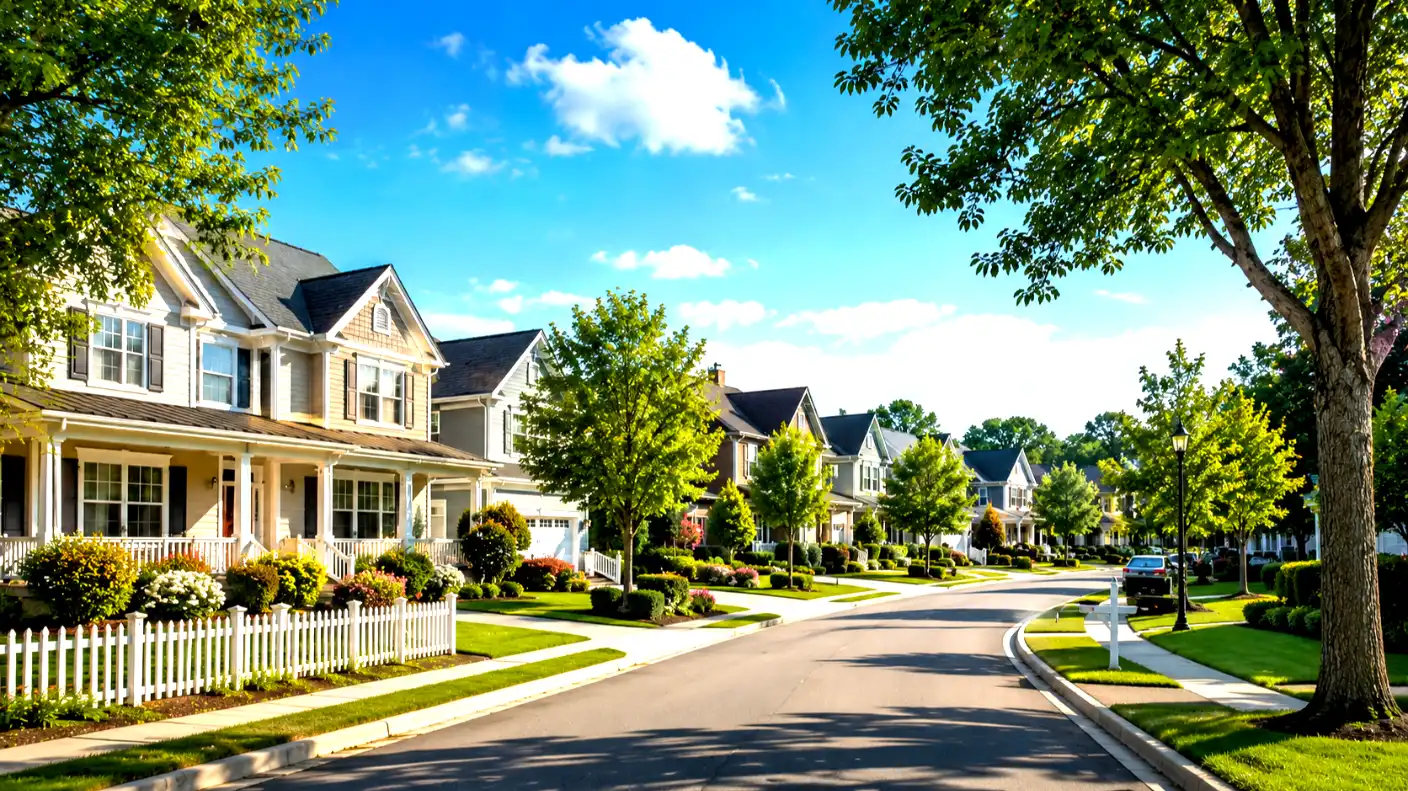
The cost of purchasing a home in the United States has taken another painful step upward, pushing the dream of homeownership further out of reach for millions of American families. According to the latest weekly Primary Mortgage Market Survey released by Freddie Mac, the average interest rate on a 30-year fixed-rate mortgage has climbed to 6.55 percent. This increase represents a significant, highly disruptive trend that has frozen the existing home sales market and driven housing affordability to its lowest level in nearly three decades.
This latest rate hike comes after several weeks of volatile bond market trading, which has seen yields on U.S. Treasury notes swing rapidly in response to shifting macroeconomic data and unscripted central bank communications. The 30-year fixed rate rose to 6.55 percent, up from 6.47 percent the previous week. This upward movement has completely erased the brief pricing relief that homebuyers enjoyed during the late spring, locking in a high-cost borrowing environment that shows no signs of easing ahead of the fall home-buying season.
For the broader American economy, the persistence of these elevated borrowing costs is creating a severe, highly visible structural divide. The housing market has split into two distinct, unequal realities: a completely paralyzed resale market, where existing homeowners refuse to sell their properties to protect their low-rate mortgages, and a highly expensive new-home market, where massive corporate homebuilders are using their deep pockets to artificially buy down interest rates for qualified buyers. For the average retail consumer, however, navigating this high-rate environment has become an exercise in extreme financial frustration, forcing a major re-evaluation of how wealth is accumulated in the modern era.
The Financial Squeeze: Decoding the Six-Point-Five-Five Percent Reality
To understand why a mortgage rate of 6.55 percent has such a devastating impact on the housing market, one must analyze the raw financial math of home buying. Over the past decade, consumers became accustomed to historically low borrowing costs. During the height of the pandemic in 2021, the average interest rate on a 30-year fixed-rate mortgage fell to an all-time low of 2.65 percent, allowing buyers to secure massive properties with highly affordable monthly payments.
The rapid rise to 6.55 percent has destroyed that purchasing power. For example, if a homebuyer purchases a median-priced home with a $400,000 mortgage at a 3.0 percent interest rate, their monthly principal and interest payment sits at a highly manageable $1,686.
If that same buyer purchases the same home today with a $400,000 mortgage at the current rate of 6.55 percent, their monthly principal and interest payment jumps to an astronomical $2,542.
This represents an increase of more than $850 per month, translating directly to an extra $10,200 in out-of-pocket housing expenses every single year.
Over the 30-year lifespan of the loan, the homebuyer will pay an extra $308,000 in interest alone. This massive cost increase has forced millions of prospective buyers to abandon their house-hunting plans entirely, causing home purchase applications to plummet to their lowest levels since 1995.
Compounding the Pain with the Fifteen-Year Fixed Rate
The financial squeeze is not confined to the 30-year fixed-rate product. Homeowners who prefer to pay off their properties faster are also facing significantly higher borrowing costs.
The average interest rate on a 15-year fixed-rate mortgage climbed to 5.80 percent, up from 5.73 percent the previous week.
While a 15-year mortgage allows buyers to build home equity much faster and save thousands of dollars in total interest payments over the long term, the combination of high home prices and a 5.80 percent interest rate results in an incredibly high monthly payment.
This high payment barrier has locked middle-class and first-time buyers out of the short-term mortgage market, forcing them to rely on longer-term loans that carry significantly higher total interest burdens.
The Near-Total Collapse of Mortgage Application Volumes
The immediate consequence of these rising interest rates is a near-total collapse in mortgage application activity. The Mortgage Bankers Association reported that its weekly index of home purchase applications fell by an additional 3.1 percent, continuing a multi-month downward trend that has seen application volumes scrape 28-year lows.
This lack of demand is a direct reflection of a market that has hit an affordability wall. With overall home prices remaining highly elevated due to a severe shortage of available inventory, the addition of a 6.55 percent mortgage rate means that the household income required to purchase a median-priced home has skyrocketed past $120,000.
Because the median household income in the United States sits far below this threshold, the vast majority of renting families are physically unable to qualify for a standard home loan, forcing them to remain in the rental market and driving lease prices higher across the country.
The Bond Yield Transmission: Why Mortgage Rates are Climbing
To understand why mortgage rates continue to march upward despite signs of cooling inflation, investors must look at the underlying mechanics of the financial markets. Mortgage rates do not move in response to direct actions by the Federal Reserve. Instead, they are highly correlated with the yield on the benchmark 10-year U.S. Treasury note.
When financial institutions originate a 30-year mortgage, they rarely hold that loan on their books for thirty years. Instead, they package the loan together with thousands of others into a financial security known as a Mortgage-Backed Security (MBS), which is then sold to global investors.
Because investors view Mortgage-Backed Securities as low-risk assets similar to government debt, the yield they demand to buy an MBS is directly tied to the yield of the 10-year Treasury note, plus a premium spread to account for the risk of early prepayment. When Treasury yields rise, mortgage rates rise immediately to match them.
The Impact of Unscripted Federal Reserve Communication
The primary driver of the recent upward pressure on bond yields is the radical new communication strategy implemented by the Federal Reserve under its new chairman, Kevin Warsh. Since taking the top job, Warsh has systematically dismantled the central bank’s legacy practice of providing explicit “forward guidance,” refusing to offer Wall Street any pre-written roadmaps regarding future interest rate decisions.
This unscripted, data-dependent approach has injected a massive wave of volatility into the bond markets. Without the central bank whispering the answers ahead of time, traders must revalue Treasury notes in real-time as fresh economic data is released.
When international energy shocks or sticky inflation indicators surprise the market, yields jump rapidly. This volatility has caused the interest-rate spread between the 10-year Treasury and the 30-year mortgage to widen to historically high levels, forcing homebuyers to pay an extra premium for their loans to protect lenders from sudden interest-rate swings.
The Massive Deficit Burden and the Supply of Sovereign Debt
The second, structural force driving bond yields and mortgage rates higher is the massive, peacetime fiscal deficit currently being run by the United States government. The federal government is borrowing trillions of dollars annually to fund its spending programs, requiring the Treasury Department to issue an unprecedented volume of new debt every single month.
This massive, continuous supply of new Treasury notes has created a supply-and-demand imbalance in the bond markets. To convince global investors to buy this mountain of paper, the government must offer higher yields, permanently pushing up the cost of borrowing across the entire economy.
Financial analysts warn that this structural deficit acts as a permanent, upward floor on interest rates. Even if the Federal Reserve eventually decides to cut its short-term policy rate, the sheer volume of government borrowing will keep long-term Treasury yields and mortgage rates elevated for years, locking the housing market into a high-cost environment for the foreseeable future.
The Golden Handcuffs: The Lock-In Effect Freezing Home Sales
The most bizarre, counterintuitive characteristic of the modern U.S. housing market is that despite a near-total collapse in buyer demand, home prices have remained remarkably resilient. In a normal economic cycle, a sharp drop in demand causes home prices to plunge as sellers compete for a shrinking pool of buyers.
This traditional pricing correction has failed to materialize because the supply of available homes has collapsed even faster than the demand. This supply crisis is driven entirely by a phenomenon known as the “lock-in effect,” or more colloquially, the “golden handcuffs.”
The Staggering Percentage of Mortgages Locked Under Five Percent
The lock-in effect is a direct consequence of the massive, low-rate refinancing wave that occurred during the pandemic. Real estate database audits reveal that over 80 percent of existing homeowners in the United States currently hold active mortgages with interest rates below 5.0 percent.
Even more strikingly, nearly 60 percent of these homeowners are locked in at rates below 4.0 percent, with millions of families enjoying historic, fixed rates near 3.0 percent.
These low interest rates represent an extraordinary financial asset for these families. If an existing homeowner decides to sell their current house and buy a new one, they must give up their 3.0 percent mortgage and take on a new loan at the current rate of 6.55 percent.
This financial transition makes absolutely no sense for the average family. Moving to a comparable or even slightly smaller home would cause their monthly housing payments to skyrocket by hundreds of dollars, trapping them in their current properties and preventing them from moving.
The Near-Total Collapse of Existing Home Inventory
This lock-in effect has created an absolute freeze in the existing home sales market. The volume of resale listings across the country has plummeted to historic lows, as families choose to stay in their current homes rather than trade their “golden handcuffs” for a high-cost mortgage at 6.55 percent.
This inventory freeze has significant, far-reaching consequences for the broader economy. It severely limits labor mobility, as workers cannot easily relocate to high-growth states like Texas, North Carolina, or Florida if it means sacrificing their low-rate mortgages.
It also harms young, growing families who need larger spaces, forcing them to remain in cramped starter homes and delaying the normal, healthy transition of housing wealth across generations.
With virtually no existing homes coming onto the market, prospective buyers are being forced to turn exclusively to the new-home market, completely changing the business dynamics of the construction industry.
The Homebuilder Solution: Bypassing the Rate Shock with Buy-Downs
The freezing of the existing home market has created a massive, highly profitable opportunity for the nation’s largest corporate homebuilders. With the supply of resale homes virtually non-existent, buyers who are determined to purchase a property have no choice but to buy a newly constructed home.
This geographic monopoly has allowed major homebuilders—such as Lennar, D.R. Horton, and Toll Brothers—to maintain high sales volumes and expand their market share even as interest rates climb.
However, to convince buyers to sign on the dotted line, these builders must help them overcome the massive interest-rate hurdle.
They achieve this through a highly successful promotional strategy known as a mortgage rate buy-down.
Spending Billions to Buy Down Interest Rates
A mortgage rate buy-down is a financial transaction where the homebuilder pays a lump sum of cash directly to its in-house mortgage subsidiary or a partnering bank at the closing of the sale. This upfront payment is used to permanently or temporarily lower the interest rate on the buyer’s mortgage.
Using this strategy, homebuilders can offer qualified buyers a 30-year fixed rate in the 5.0 percent to 5.5 percent range, while traditional buyers using independent mortgage brokers are stuck paying the full market rate of 6.55 percent.
These buy-down programs cost homebuilders thousands of dollars per home, but they are highly effective. For a buyer who is desperate for a home but cannot afford a monthly payment at 6.55 percent, securing a builder-subsidized rate at 5.25 percent makes the purchase financially viable, allowing the builders to keep their inventory moving.
The Resilience of Homebuilder Profit Margins
The financial strength of the homebuilding sector is particularly impressive when looking at its corporate earnings reports. While spending thousands of dollars per home on rate buy-downs would normally destroy profitability, homebuilders have managed to maintain highly resilient operating margins, which consistently track between 18 percent and 21 percent.
Homebuilders can afford these expensive buy-downs because they are operating with massive economies of scale and enjoying lower raw material costs.
As lumber and industrial equipment prices have normalized following post-pandemic inflation, builders have used these construction savings to fund their promotional programs.
Furthermore, because they build entire master-planned communities from scratch, they can optimize their manufacturing processes and reduce their construction timelines, allowing them to remain highly profitable while independent home sellers are completely locked out of the market.
Strategic Outlook: Is There a Pathway to Housing Relief?
As the 30-year fixed mortgage rate hovers near 6.55 percent, the near-term outlook for the U.S. housing market remains highly challenging. For the market to experience a meaningful, long-term recovery, mortgage rates must return to a more balanced level, ideally returning to the 5.0 percent to 5.5 percent range that homebuilders have proved is the sweet spot for sustainable demand.
However, achieving this relief requires a significant de-escalation of the global and domestic forces driving bond yields. Investors must closely watch a series of upcoming economic and political milestones over the coming months:
- The June Consumer Price Index Report: Providing the first concrete measure of whether the recent Middle East energy shocks have started to infect the broader consumer basket.
- The July 28–29 FOMC Meeting: Where investors will parse Chairman Kevin Warsh’s statements for fresh clues on the central bank’s interest rate path.
- The Federal Budget Deficit Negotiations: Where any progress toward long-term fiscal discipline would immediately ease the upward pressure on Treasury yields.
The global economy is entering a challenging, unpredictable era defined by persistent inflation, high borrowing costs, and structural changes in trade and demographic policies.
In this environment, the housing market will continue to serve as a primary indicator of national economic health.
While the new-home sector will likely remain resilient on the back of corporate buy-down programs, the frozen existing home market will continue to drag on labor mobility and middle-class wealth accumulation.
For prospective homebuyers, the message is clear: the era of cheap, easy credit is over, and navigating this high-cost landscape requires extreme patience, careful financial planning, and a realistic understanding that the rules of home buying have been permanently rewritten for the digital age.