The global transition to sustainable energy has entered its most capital-intensive, industrial-focused era. Across emerging markets, the primary challenge of the green transition has shifted away from simply building utility-scale solar farms to supply residential electricity. Instead, the focus has moved to a far more complex, high-stakes objective: decarbonizing the heavy, energy-intensive industries that form the backbone of global manufacturing. In a major development that highlights the growing private equity-led push for industrial decarbonization, KKR-backed Serentica Renewables is in advanced negotiations to secure a massive $450 million syndicated loan to fund its multi-gigawatt clean energy expansion.
The proposed transaction, which was disclosed recently on a Monday in mid-July, represents one of the largest green utility financing deals of the year in the South Asian market. Serentica, an Indian decarbonization and industrial green power platform, is in active discussions with a powerful consortium of international and domestic commercial banks—including Mitsubishi UFJ Financial Group, Sumitomo Mitsui Banking Corporation, Rabobank, and the State Bank of India—to structure the multi-year syndicated loan. The proceeds will fund the rapid construction of high-capacity wind, solar, and hybrid power projects designed to deliver clean, round-the-clock electricity directly to heavy industrial clients.
For the international private equity sector, the scale of this transaction is a powerful validation of KKR’s long-term infrastructure investment strategy. KKR, one of the most prominent global investment firms on Wall Street, has spent the past four years building a formidable presence in the Indian renewable energy market, investing more than $650 million in Serentica since late 2022. By helping the company secure this new $450 million, or approximately 37.5 billion Indian rupees, credit facility, KKR is proving that green industrial utility infrastructure has officially transformed from a high-risk, speculative venture into a highly stable, investment-grade asset class capable of drawing in the world’s most conservative commercial banks.
The Strategic Shift: Decarbonizing the “Hard-to-Abate” Industrial Sector
To understand why the proposed loan has generated such immense interest among international lenders, one must analyze the unique, highly targeted business model of Serentica Renewables. Unlike traditional green energy developers that build solar or wind farms to sell electricity directly to state-owned distribution companies—which are often heavily indebted and slow to make payments—Serentica focuses exclusively on the commercial and industrial sector.
The company targets what environmental scientists and policy planners call the “hard-to-abate” industries. These include heavy, energy-intensive sectors like steel manufacturing, aluminum smelting, cement production, mining, and industrial chemical processing. Together, these heavy industries consume massive amounts of electricity and account for a significant percentage of global greenhouse gas emissions.
With governments around the world implementing strict new carbon border taxes and corporate boards demanding absolute compliance with net-zero sustainability targets, these industrial conglomerates face immense, immediate pressure to eliminate fossil fuels from their operations. Serentica provides the physical, off-grid solution that allows these industrial giants to transition their heavy machinery to clean power immediately, protecting their export competitiveness and significantly reducing their operational carbon footprints.
Breaking the Intermittency Barrier: The Round-the-Clock (RTC) Green Power Moat
The primary engineering obstacle that historically prevented heavy industries from transitioning to renewable energy was the physical limit of intermittency. A steel mill or an aluminum smelter operates continuously, running massive, high-temperature furnaces twenty-four hours a day.
They cannot afford to shut down their production lines simply because the wind stops blowing or the sun goes down.
A traditional, isolated solar farm or wind farm cannot supply the highly stable, continuous baseload power these factories require.
By designing and deploying highly sophisticated “round-the-clock” hybrid energy systems, Serentica has successfully broken this technological barrier, establishing an impenetrable competitive moat that traditional green developers cannot easily match.
The Power of Hybrid Wind-Solar Architectures
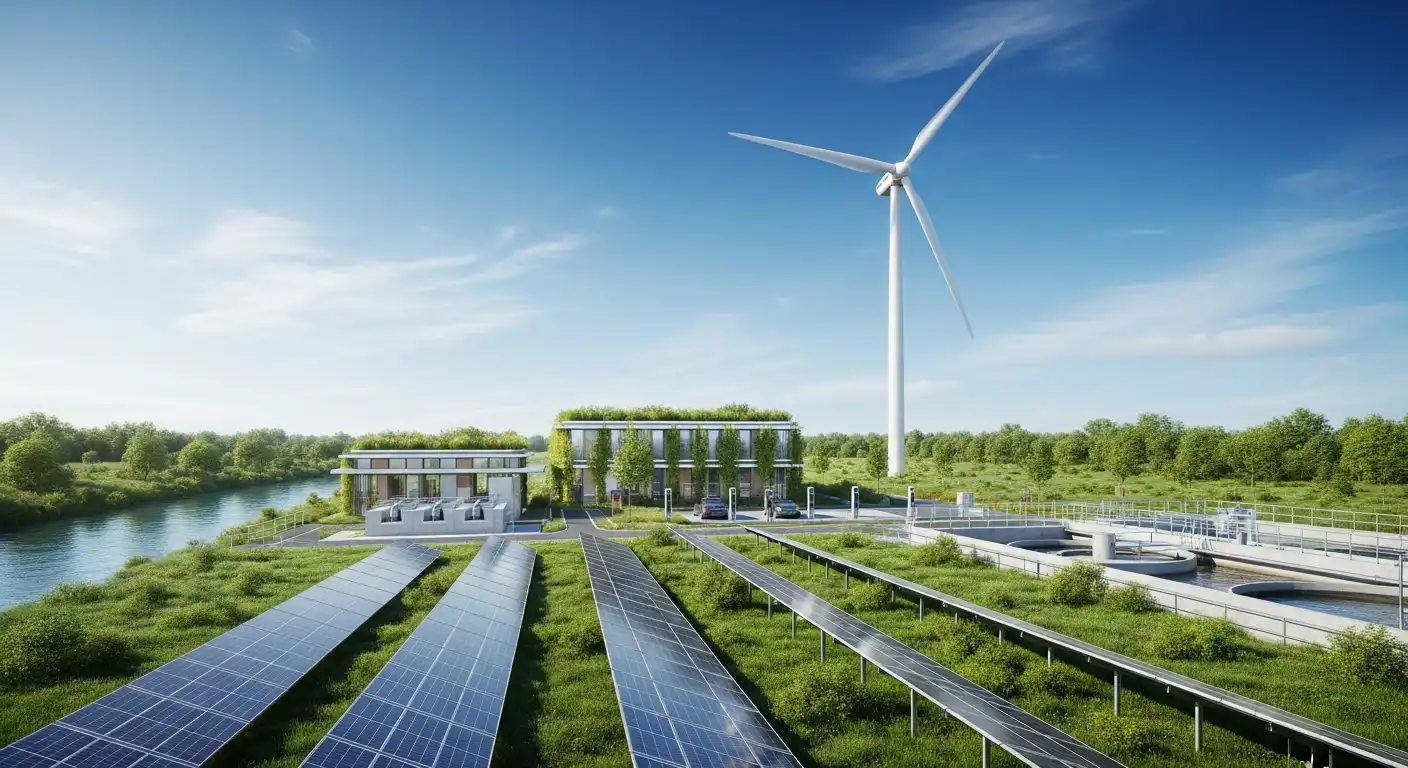
The first key pillar of Serentica’s round-the-clock strategy is the physical co-location and integration of wind and solar assets. By building hybrid projects that combine wind turbines and solar panels on the same regional grid infrastructure, the company can successfully smooth out the power generation curve.
During the midday sun, the solar panels produce maximum power. Later in the evening, when solar output collapses, regional wind speeds typically pick up, allowing the wind turbines to take over and keep the electricity flowing.
Co-locating these assets also delivers massive, multi-million-dollar capital savings, as the two systems can share the same high-voltage transmission lines and substation interconnections, dramatically lowering the overall cost of grid delivery.
Deploying Advanced Battery Storage to Flatten the Grid Curve
While hybrid wind-solar systems significantly improve the stability of the power supply, they still cannot guarantee the 99.9% uptime required by heavy industrial plants. To achieve absolute reliability, Serentica is integrating advanced, utility-scale Battery Energy Storage Systems (BESS) directly into its hybrid grids.
These massive, lithium-ion battery installations serve as the ultimate shock absorber for the power system. During peak sun and wind hours, when generation exceeds the factory’s immediate demand, the battery system absorbs and stores the excess electricity.
Later, during windless nights, the system releases the stored energy back into the network, keeping the industrial furnaces running without interruption.
By utilizing these advanced battery storage solutions, Serentica can guarantee its corporate clients a stable, uninterrupted supply of clean power, transforming renewable energy into a viable, high-performance alternative to traditional coal-fired electricity.
Targeting Hard-to-Abate Heavy Industries
The corporate customers that Serentica serves represent some of the largest, most successful industrial conglomerates in India, including Vedanta Limited, one of the world’s leading natural resource groups.
These companies are signing long-term, 25-year Power Purchase Agreements (PPAs) with Serentica, committing to buy billions of kilowatt-hours of clean electricity annually.
For these industrial clients, transitioning to Serentica’s clean energy network is a highly logical financial decision.
Not only does it allow them to satisfy their strict environmental compliance goals, but it also protects them from the highly volatile, unpredictable price fluctuations of the traditional fossil-fuel-powered utility grid.
Because wind and solar energy have zero fuel costs, Serentica can offer these 25-year agreements at highly stable, predetermined prices, allowing corporate CFOs to accurately forecast their long-term energy expenses and lock in significant operational savings over the life of the contract.
The Global Private Equity Wave: Why KKR is Betting on Indian Infrastructure
The successful scaling of Serentica is a prime example of a massive, structural trend currently reshaping the global energy markets: the rise of private equity-led infrastructure finance. Over the past several years, prominent global asset managers—including Brookfield, Blackstone, Macquarie, and KKR—have systematically shifted their capital away from traditional real estate and public equities to invest heavily in the clean energy infrastructure of emerging markets.
The primary destination for this capital is India, which has established some of the most ambitious renewable energy targets in the world. The Indian government has pledged to achieve a staggering 500 gigawatts of non-fossil fuel capacity by 2030, a goal that requires an estimated $300 billion in cumulative investments.
This massive capital requirement has created a highly lucrative opportunity for foreign infrastructure funds, who are attracted by the country’s stable regulatory frameworks, strong contract-enforcement laws, and rapidly expanding industrial energy demand.
By investing over $650 million in Serentica through its Asia Pacific Infrastructure Fund, KKR has secured a premier platform to participate in this high-growth market, capitalizing on the transition of the country’s industrial engine to build a highly valuable, cash-generative green utility.
Navigating the Rising Cost of Debt and Global Interest Rate Shocks
While the long-term growth story for Indian renewables is highly compelling, developers must navigate a challenging macroeconomic environment characterized by rising borrowing costs and global interest rate shocks.
To fund its multi-gigawatt projects, Serentica relies heavily on debt financing, making the interest rates it secures on its loans a primary driver of its overall profitability.
To manage this risk, Serentica’s financial team has negotiated a highly sophisticated, syndicated loan structure. By assembling a diverse consortium of international and domestic commercial lenders—including major Japanese, European, and Indian banks—the company can secure highly competitive interest rates that are far lower than the pricing available from smaller, localized commercial lenders.
This syndicated approach allows the company to spread its debt risk across multiple global institutions, ensuring that its massive $450 million expansion remains financially sustainable even if global central banks choose to keep interest rates elevated for longer.
The Industrial open-access Regulation Advantage
The rapid growth of companies like Serentica is also being heavily supported by progressive regulatory reforms enacted by the Indian government. The most critical policy driver is the “open-access” regulation, which legally permits private power producers to utilize the national transmission grid to deliver electricity directly to corporate and industrial customers, bypassing the state-owned distribution monopolies entirely.
This open-access framework has completely unlocked the private power market. It allows a developer like Serentica to build a massive solar farm in a high-sun region like Rajasthan and transmit that clean electricity through the national grid directly to a steel mill located in a distant industrial zone, while paying a transparent, government-regulated transit fee.
This policy has created a highly efficient, national marketplace for clean energy, giving private-sector developers the operational freedom and regulatory security they need to scale their businesses with absolute confidence.
The successful progress of Serentica Renewables’ $450 million syndicated loan negotiations represents a defining milestone for the global clean energy transition. By proving that hybrid wind-solar systems paired with advanced battery storage can successfully deliver stable, round-the-clock clean electricity to the world’s most carbon-intensive heavy industries, the company is pointing to a practical, highly profitable path toward global decarbonization.
As the construction crews expand the new wind and solar farms across India, and the first wave of heavy factories completes its transition to clean power, the program will ensure that the vital systems keeping the industrial economy running remain secure, resilient, and fully prepared to support a sustainable, fossil-fuel-free future.
For KKR, the international banking consortium, and the people of South Asia, Serentica’s success proves that when private capital, advanced engineering, and progressive government policy work together, a society can successfully build a faster, cleaner, and infinitely more prosperous world for generations to come.