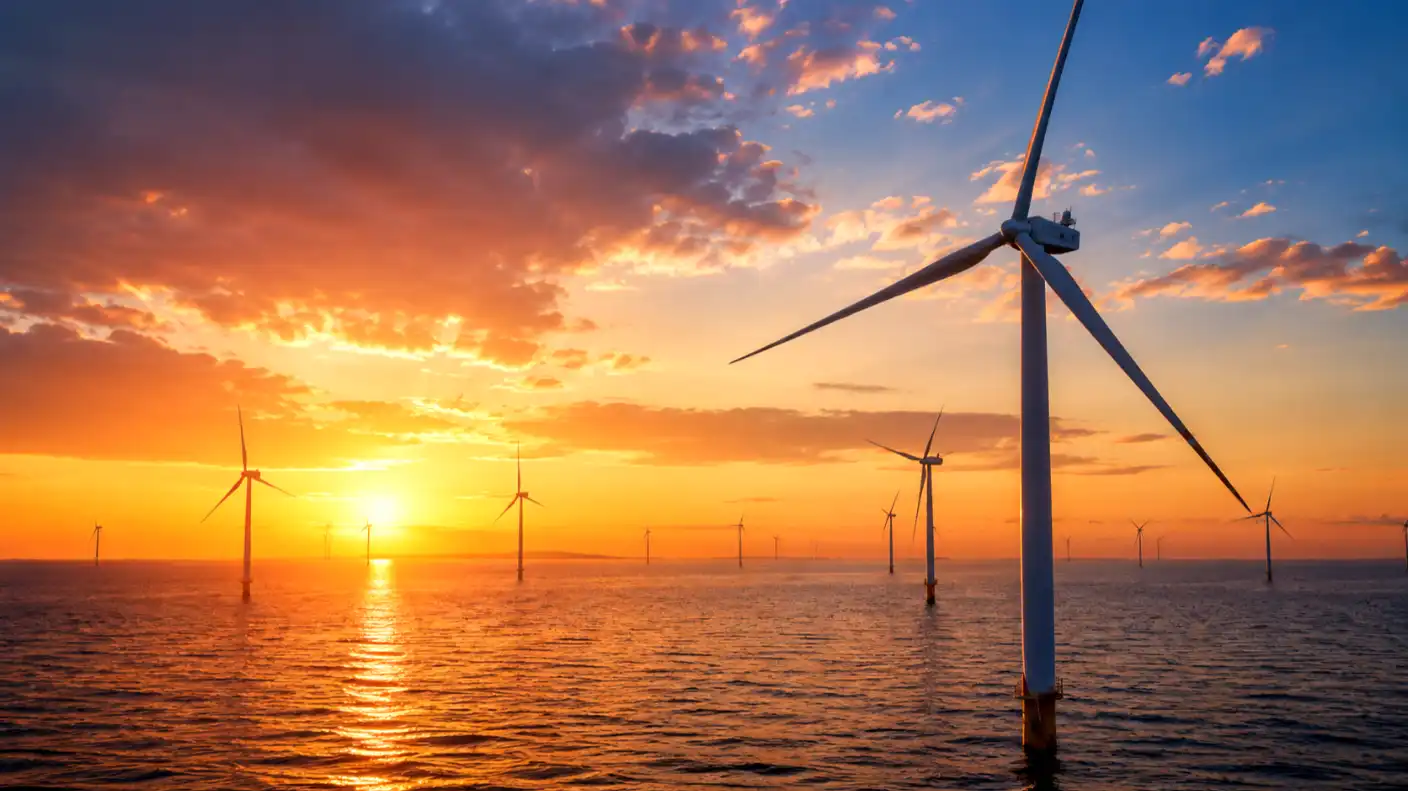
Taiwan has unveiled a major update to its long-term energy strategy, establishing a national target to boost its offshore wind generation capacity nearly eightfold by 2039. Under the government roadmap, the self-governed island plans to scale its installed offshore wind capacity from current operational levels near 3 gigawatts up to an ambitious 21 to 25.6 gigawatts over the next decade and a half. The massive expansion forms the cornerstone of Taiwan’s plan to achieve net-zero carbon emissions by 2050 while securing a stable, domestic supply of green electricity for its world-leading semiconductor manufacturing industry.
The aggressive offshore wind target responds directly to surging power demand from advanced silicon foundries, led by Taiwan Semiconductor Manufacturing Company. Modern chip fabrication plants operating extreme ultraviolet lithography machines consume immense volumes of electricity. At the same time, global technology giants including Apple, Nvidia, AMD, and Qualcomm are requiring their supply chain partners to transition to 100% renewable energy. To maintain its dominance in advanced semiconductor manufacturing, Taiwan must deploy gigawatt-scale clean energy assets at an unprecedented pace.
Beyond supporting the semiconductor supply chain, the eightfold wind expansion addresses acute domestic energy security challenges. Taiwan currently relies on imported fossil fuels for more than 96% of its total primary energy needs, leaving its economy vulnerable to international maritime shipping blockades and global commodity price shocks. By harnessing high-velocity wind resources in the Taiwan Strait, the island aims to replace retiring nuclear reactors and aging coal plants with domestic, zero-emission marine electricity generation.
TechGolly provides a detailed analysis of Taiwan’s offshore wind expansion target, evaluating semiconductor power requirements, floating turbine technology, regulatory localization reforms, subsea grid modernization, project financing dynamics, and long-term clean energy trade flows across East Asia.
Unpacking the 2039 Offshore Wind Expansion Roadmap
Taiwan’s Ministry of Economic Affairs designed the 2039 energy roadmap to transition the island from early-stage demonstration projects into a mature, high-volume offshore wind market. The official strategy establishes clear intermediate milestones, targeting 5.6 gigawatts of operational capacity by the end of initial buildout phases, expanding to 13.1 gigawatts by 2030, and ultimately reaching between 21 and 25.6 gigawatts by 2039. Looking further ahead, long-term climate planning envisions deploying up to 40 to 55 gigawatts of offshore wind capacity by 2050.
To hit these capacity targets, Taiwanese energy authorities are organizing structured annual auction rounds under Phase 3 Zonal Development programs. The government plans to award approximately 1.5 gigawatts of new grid capacity allocations each year through the 2030s. This steady, predictable procurement pipeline provides long-term market visibility, encouraging global turbine manufacturers, marine engineering contractors, and subsea cable suppliers to establish permanent regional operational bases in Taiwan.
The geographical features of the Taiwan Strait provide an exceptional natural resource base for offshore wind energy. The narrow body of water separating Taiwan from the Asian mainland acts as a natural wind tunnel, funneling strong, consistent seasonal winds down the island’s western coastline. Marine survey data confirms that average wind speeds in the Taiwan Strait exceed 11 to 12 meters per second during peak winter months, yielding capacity utilization factors above 45% to 50%—performance metrics that rival the world’s best wind sites in the North Sea.
Achieving the 2039 expansion plan will require an estimated total capital expenditure exceeding $60 billion to $80 billion across project development, offshore construction, port infrastructure, and electrical grid upgrades. The sheer financial scale of the buildout makes Taiwan one of the largest single offshore wind investment destinations globally, attracting institutional capital from European energy majors, global infrastructure funds, and Asian commercial banking syndicates.
Semiconductor Clean Energy Demands and TSMC RE100 Pledges
The single most powerful economic force driving Taiwan’s renewable energy push is the power consumption of its semiconductor ecosystem. Taiwan manufactures over 60% of the world’s semiconductors and more than 90% of the most advanced microprocessors used in artificial intelligence servers, smartphones, and supercomputers. A single advanced semiconductor fabrication plant can consume as much electricity as a small city, with total tech sector electricity usage accounting for more than 10% of Taiwan’s total electrical grid demand.
Taiwan Semiconductor Manufacturing Company, which produces cutting-edge processors for global tech leaders, has committed to the international RE100 initiative, pledging to power 100% of its global operations with renewable energy. To accelerate its environmental transition, TSMC moved up its target date for achieving 100% renewable electricity from 2050 to 2040. Meeting this accelerated deadline requires TSMC to procure tens of billions of kilowatt-hours of clean electricity annually over the next 15 years.
To secure its clean energy supply, TSMC has pioneered massive Corporate Power Purchase Agreements with offshore wind developers. In a landmark corporate energy transaction, TSMC signed a 20-year contract to purchase 100% of the electricity output from Ørsted’s 920-megawatt Greater Changhua 2b and 3 offshore wind farms. Similar multi-gigawatt corporate power purchase deals are being negotiated for upcoming wind projects, effectively transforming chip manufacturers into the primary financial underwriters of Taiwan’s offshore wind farms.
Global technology buyers are enforcing strict environmental accounting across their supply chains. Tech firms that purchase chips from Taiwanese foundries are requiring audit-verifiable proof that manufacturing processes utilize zero-emission energy sources. Consequently, providing abundant offshore wind power is no longer merely an environmental policy preference for Taiwan; it is an absolute requirement for maintaining the commercial competitiveness of its export-driven economy.
Policy Shift: Easing Localization Mandates to Attract Global Capital
A major catalyst enabling Taiwan’s accelerated 2039 wind target is a fundamental policy shift regarding domestic content requirements. In the early stages of its offshore wind program, Taiwan enforced strict localization rules requiring international developers to procure up to 60% of their project components—including steel jacket foundations, nacelles, turbine blades, and subsea cables—from local Taiwanese manufacturers.
While intended to build a domestic supply chain, strict localization rules created severe project bottlenecks. Local manufacturing capacity struggled to scale fast enough to meet demand, leading to manufacturing delays, component quality disputes, and severe capital cost inflation. High local procurement expenses pushed project capital expenditures up to 30% above global averages, depressing project internal rates of return and prompting several European developers to pause new investments.
Following formal trade consultations with the European Union and discussions at the World Trade Organization, Taiwanese energy regulators announced a significant relaxation of local content mandates for upcoming Phase 3 auction rounds. Under updated guidelines, developers gain substantial flexibility to source high-tech components, heavy installation vessels, and raw materials from international suppliers, provided projects meet baseline safety and grid integration standards.
Relaxing local content rules has injected fresh momentum into Taiwan’s clean energy sector. International wind developers—including Denmark’s Ørsted, Copenhagen Infrastructure Partners, Corio Generation, and local champion Synera Renewable Energy—have welcomed the regulatory flexibility. Lowering procurement barriers reduces project capital expenditure costs by an estimated 15% to 25%, restoring project economics and allowing international developers to deploy capital efficiently toward the 2039 target.
The Frontier Phase: Transitioning to Deep-Water Floating Offshore Wind
As Taiwan exhausts available shallow-water seabed sites near its western coast, reaching its 21 to 25.6 gigawatt target requires expanding into deeper ocean waters. Near-shore seabed areas with water depths under 50 meters—suitable for traditional fixed-bottom steel jacket foundations—are rapidly being filled by Phase 1, Phase 2, and early Phase 3 projects.
To unlock vast untapped wind resources further offshore, Taiwan is preparing a major technological transition toward floating offshore wind platforms. In deep waters ranging from 50 to more than 100 meters in depth, floating platforms anchored to the seabed via high-strength synthetic mooring lines offer the only viable engineering solution. Floating wind farms can be positioned 20 to 50 kilometers offshore, capturing stronger, more consistent ocean winds while minimizing visual impact from coastal communities.
Taiwan’s Ministry of Economic Affairs is preparing to launch its first dedicated floating offshore wind demonstration auction, offering capacity allocations designed to test floating platform designs in local ocean conditions. These pilot projects will evaluate various floating foundation architectures—including semi-submersible steel hulls, concrete spar buoys, and tension-leg platforms—equipped with next-generation 15-megawatt to 20-megawatt mega-turbines.
Deploying floating wind technology in the Taiwan Strait requires solving unique engineering challenges. Floating platforms must be engineered to withstand severe marine environments, including seasonal summer typhoons, high-velocity subsea currents, and seismic activity from deep-sea earthquakes. Successful commercialization of floating wind between 2028 and 2035 will open up over 90 gigawatts of technical wind potential in deep waters, guaranteeing that Taiwan can sustain its wind capacity growth well past 2039.
Energy Security, Nuclear Phase-Out, and Grid Infrastructure
Taiwan’s ambitious wind energy roadmap is deeply intertwined with a structural overhaul of its national energy generation mix. The island nation is executing a policy to phase out nuclear power, shutting down legacy reactors as their 40-year operating licenses expire. The closure of reactors at the Kuosheng and Maanshan nuclear power plants has removed gigawatts of baseload electricity from the national grid, creating an urgent need for replacement zero-carbon generation.
Simultaneously, Taiwan’s extreme reliance on imported fossil fuels poses a severe national security risk. Over 80% of Taiwan’s current electricity is generated by burning imported coal and liquefied natural gas delivered on foreign cargo tankers. In the event of regional geopolitical tensions or naval blockades, domestic natural gas stockpiles could be depleted within weeks, threatening to paralyze the power grid.
Offshore wind offers an ideal indigenous energy solution that enhances national energy sovereignty. Wind power generated in sovereign coastal waters cannot be blockaded or intercepted by foreign navies. Operating thousands of offshore wind turbines connected to mainland electrical hubs creates a decentralized, resilient power supply that secures national electricity generation during international security crises.
However, integrating tens of gigawatts of intermittent offshore wind power requires massive modernizations to Taiwan’s electrical grid. State-owned utility Taipower is executing a multi-billion-dollar grid reinforcement plan, constructing high-voltage direct current subsea transmission lines, expanding coastal electrical substations, and deploying utility-scale battery energy storage systems. Upgrading transmission infrastructure ensures that high-volume wind power generated off western coasts can be transmitted efficiently to major industrial processing centers in northern and southern Taiwan without causing grid instability.
Project Financing, Capital Markets, and Merchant Risk
The commercial execution of Taiwan’s 2039 wind roadmap reflects an evolving landscape in international project finance. In early development phases, wind projects relied on generous government-backed Feed-in Tariffs (FiTs) that guaranteed fixed, high electricity purchase prices for 20 years. As the local market matured, Taiwan phased out government FiTs, transitioning Phase 3 projects toward competitive merchant pricing and private Corporate Power Purchase Agreements.
Transitioning to corporate off-take models alters project risk profiles for international lenders. Rather than relying on state utility credit guarantees, project finance syndicates must evaluate the long-term creditworthiness of private corporate off-takers like TSMC, ASE Technology, and international tech firms. Fortunately, the high credit ratings and immense cash flows of top-tier semiconductor companies provide strong security for international bondholders and commercial banks.
Managing macroeconomic headwinds remains a key focus for wind farm financial modeling. Rising global interest rates, inflation in specialized offshore installation vessel charter costs, and fluctuations in raw material prices have increased debt servicing expenses for capital-intensive marine projects.
To mitigate financing risks, international export credit agencies (ECAs) from Europe, North America, and East Asia are providing critical loan guarantees and political risk insurance for Taiwanese offshore wind developments. Partnering with domestic Taiwanese commercial banks, these international financial consortia are structuring non-recourse debt packages that allow developers to finance multi-billion-dollar wind farms while maintaining healthy equity returns.
Strategic Outlook for the Asian Offshore Wind Market
Taiwan’s successful execution of its offshore wind strategy positions the island as the pioneer and operational hub for offshore marine engineering across the Asia-Pacific region outside China.
By establishing early, clear regulatory frameworks and long-term procurement targets, Taiwan attracted major European wind developers, engineering firms, and specialized maritime contractors to East Asia. The local technical expertise, port infrastructure at Taichung Port, and specialized installation fleets developed in Taiwan are now serving as a regional blueprint for neighboring Asian economies—including Japan, South Korea, Vietnam, and the Philippines—that are launching their own offshore wind development programs.
Looking ahead to the 2039 milestone and the ultimate 2050 net-zero target, Taiwan’s offshore wind sector will continue to evolve into a fully integrated, high-technology industrial sector. The combination of fixed-bottom and floating wind farms, powered by mega-turbines and connected via smart subsea grids, will supply the clean energy foundation required to power future generations of artificial intelligence processors, autonomous mobility systems, and advanced electronics.
By linking its clean energy transition directly to the electricity demands of its semiconductor industry, Taiwan has created a mutually reinforcing industrial strategy. Offshore wind power secures the future of advanced chip manufacturing, while chip manufacturing provides the long-term commercial capital needed to finance the green energy transformation of Taiwan’s economy.
Key Takeaways for Tech Executives and Clean Energy Investors
The expansion of Taiwan’s offshore wind target to an eightfold increase by 2039 delivers critical strategic insights for technology leaders, corporate energy procurement managers, and international clean energy investors.
First, green energy availability is now a primary determinant of technology supply chain security. Technology corporations evaluating semiconductor manufacturing capacity must audit the underlying electrical grid of vendor countries, ensuring that regional utilities can supply sufficient zero-carbon electricity to satisfy corporate RE100 commitments.
Second, regulatory flexibility is essential for scaling complex infrastructure. Taiwan’s decision to relax rigid local content rules demonstrates that removing protectionist procurement barriers accelerates project deployment, lowers capital expenditure costs, and attracts global institutional capital to emerging clean technology markets.
Third, deep-water floating technology represents the next major growth frontier in marine renewables. Energy investors and equipment manufacturers should position capital to capture early commercial opportunities in floating offshore wind, which will unlock vast new deep-water energy markets across Asia, Europe, and the Americas over the coming decade.
Finally, long-term policy clarity enables massive private capital formation. By establishing a clear, multi-decade capacity target extending to 2039, Taiwan has provided international developers and financial markets with the regulatory stability required to invest tens of billions of dollars into building a cleaner, more resilient global energy future.