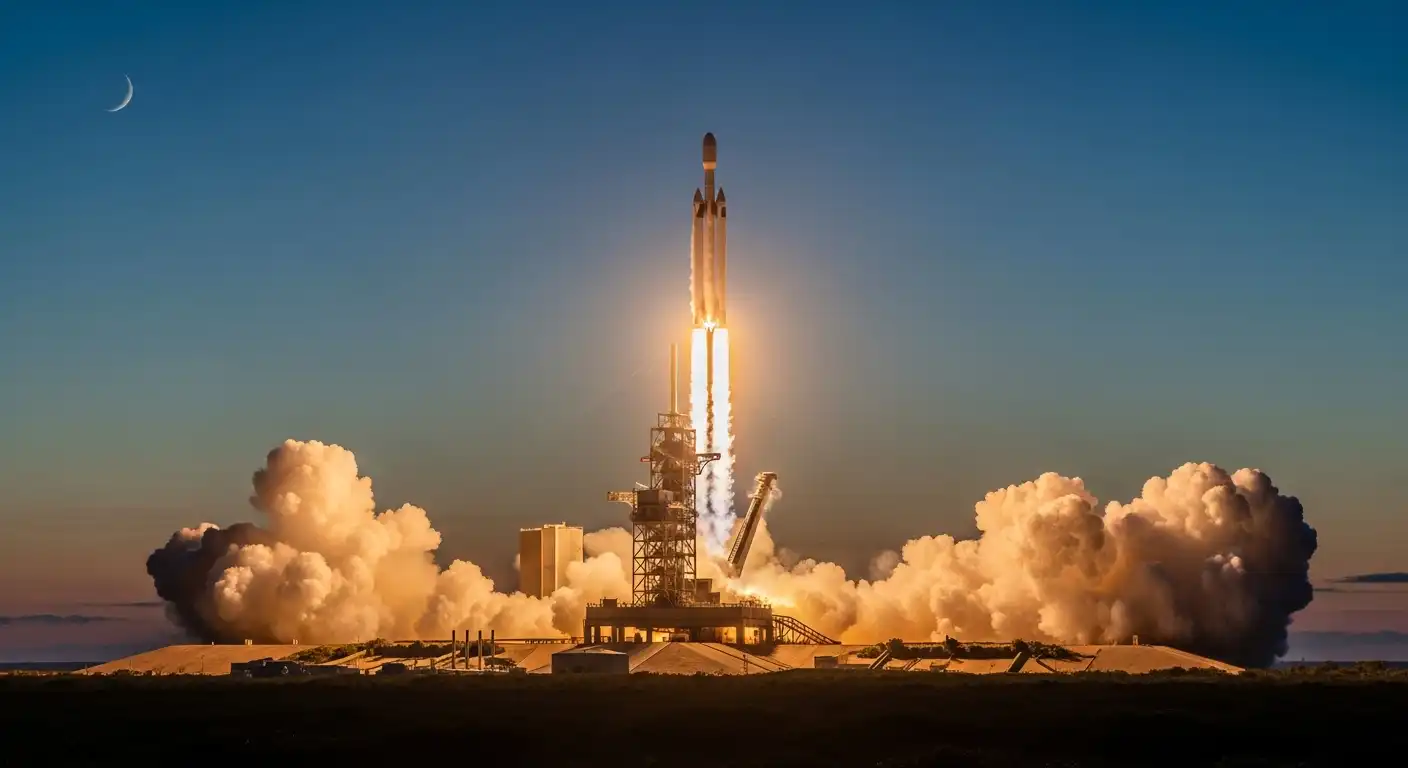
A major diplomatic and commercial rift has erupted across the transatlantic aerospace sector as premier American space companies, including Elon Musk’s SpaceX and Jeff Bezos’ Blue Origin, abruptly canceled their scheduled participation in French President Emmanuel Macron’s International Space Summit in Paris. The high-profile boycott follows direct pressure from the White House, where federal science and national security officials warned corporate executives that attending the gathering could be interpreted as an endorsement of European Union industrial policies designed to undermine American aerospace dominance.
The sudden cancellations were formally confirmed by the French Ministry of Higher Education, Research and Space, dealing a significant blow to the Elysee Palace’s flagship diplomatic event at the Grand Palais. Alongside SpaceX and Blue Origin, rocket manufacturer Stoke Space and orbital data center startup Starcloud notified French authorities that they were withdrawing from the summit. Officials from the White House Office of Science and Technology Policy held private briefing calls with American aerospace leaders, warning that the Paris summit’s agenda was designed to promote anti-competitive European procurement rules, marginalize American commercial contributions, and provide a global platform for geopolitical adversaries, most notably China.
The confrontation highlights the growing friction between Washington and European capitals over the future of the multi-hundred-billion-dollar global space economy. While French President Emmanuel Macron has championed European space sovereignty, pledging over €10.2 billion in military space spending to break the continent’s reliance on American rocket launchers and satellite constellations, the United States is moving aggressively to protect the market share of its domestic launch industry. By pushing private American aerospace champions to boycott the Paris gathering, the Trump administration has signaled that space exploration and satellite communications are no longer neutral domains of international scientific cooperation, but core arenas of commercial and national security competition.
A Diplomatic Rupture in Transatlantic Aerospace Cooperation
The International Space Summit in Paris was designed by French diplomats to serve as a premier global platform, convening heads of state, military commanders, space agency directors, and corporate chief executive officers to negotiate international standards for orbital traffic management, lunar exploration rules, and space sustainability. The gathering was structured to showcase Europe’s technological capabilities, featuring keynote addresses from President Emmanuel Macron and European Commission President Ursula von der Leyen.
However, the event has instead triggered an intense diplomatic dispute between two historic allies. French government spokespeople acknowledged the coordinated American withdrawals, expressing frustration that political pressure from Washington had disrupted commercial partnerships.
French officials stated that while France remains committed to collaborating with American partners and international allies, sudden policy shifts and geopolitical pressures are making transatlantic cooperation needlessly complex.
The withdrawal of the four American aerospace corporations leaves the summit’s commercial program heavily tilted toward European aerospace conglomerates, frustrating French organizers who spent months seeking to broaden the event beyond traditional European industrial players.
Unpacking the Cancellations by SpaceX, Blue Origin, Stoke Space, and Starcloud
The list of American companies pulling out of the Paris summit represents the absolute pinnacle of private launch capacity and orbital innovation. Over the past decade, private American enterprises have revolutionized global spaceflight, driving commercial launch costs down by more than 90% and launching thousands of operational satellites into low Earth orbit.
The coordinated withdrawals dismantled key segments of the summit’s commercial program:
- SpaceX, the world’s dominant commercial launch provider, withdrew its executive delegation, canceling planned panel presentations on heavy-lift orbital transport and Starlink satellite constellation integration.
- Blue Origin, the space enterprise founded by Jeff Bezos, withdrew from the event, canceling a scheduled public announcement of a strategic industrial partnership with French defense contractor Safran.
- Stoke Space, an emerging rocket developer building fully reusable medium-lift orbital launch vehicles, withdrew its executive representatives following federal guidance.
- Starcloud, a venture-backed startup developing high-capacity space-based artificial intelligence data centers, canceled its participation in commercial orbital infrastructure roundtables.
While commercial corporate executives withdrew, official delegations from the United States government—including senior representatives from NASA, the State Department, the Department of Commerce, and the White House Office of Science and Technology Policy—confirmed that they still plan to attend the summit to present official American positions.
Behind the Closed-Door Calls from the White House Science Office
The corporate exodus was initiated during a confidential conference call organized by senior leadership within the White House Office of Science and Technology Policy. Federal officials summoned executive leadership and government affairs directors from prominent American aerospace firms to deliver an explicit policy briefing.
Participants on the call confirmed that federal officials delivered pointed warnings regarding the diplomatic and commercial consequences of attending:
- Officials warned that sending corporate delegations to Paris would be interpreted internationally as tacit support for European Union policy positions that directly conflict with American strategic interests.
- The White House accused the French government of failing to coordinate the summit agenda with Washington, asserting that panel discussions were engineered to exclude the American perspective.
- Federal briefers argued that the summit’s programming was designed to diminish American commercial achievements while promoting state-subsidized European champions.
- Officials expressed deep concern over the prominent participation of Chinese space agency officials and state-backed aerospace enterprises at the Paris symposium.
While administration officials avoided issuing formal, legally binding executive orders prohibiting travel, corporate attendees described the briefing as an unmistakable signal that attending the event would damage their standing with federal defense and civilian procurement agencies.
Core Grievances Behind Washington’s Warning to US Space Leaders
The White House’s aggressive intervention reflects deep-seated grievances regarding how European institutions regulate and procure commercial technology. In recent years, European Union policymakers have enacted protective regulations, including the Digital Markets Act and the EU AI Act, which American officials view as protectionist tools designed to penalize successful American technology platforms.
The United States administration is determined to prevent similar regulatory models from spreading into the commercial space sector.
Federal officials argue that European initiatives promoting strategic autonomy are thinly veiled attempts to erect trade barriers against American launch providers and satellite operators who built superior, lower-cost commercial technologies.
By advising American companies to skip the Paris summit, Washington is pushing back against European efforts to establish international space governance norms that could restrict American commercial flexibility in orbit.
Accusations of Anti-Competitive European Procurement and Panel Bias
A primary grievance articulated by the White House centers on European public procurement rules that exclude American aerospace corporations from competing for European government and commercial launch contracts. Despite American launch providers offering significant cost advantages, European institutions frequently mandate that public payloads must fly exclusively on European-built rockets.
The Trump administration highlighted several specific commercial grievances:
- Accusing the European Union of practicing anti-competitive procurement by enforcing “Buy European” mandates that reserve government scientific and defense satellites for domestic launchers.
- Objecting to European regulatory proposals that seek to impose mandatory orbital sustainability fees and carbon border taxes on commercial satellite launches conducted outside the European Union.
- Criticizing summit organizers for stacking panel discussions with European state officials and legacy aerospace executives who advocate for restrictive space traffic regulations.
- Pointing out that European institutions contracted American launch providers like SpaceX only when domestic European rockets experienced multi-year development delays.
American officials argued that private American corporations should not lend their brand prestige to an international conference designed to build political momentum for regulations that would harm American commercial competitiveness.
Concerns Over Chinese State Participation and Lunar Competition
A secondary national security issue driving the American boycott is the formal inclusion of Chinese government officials and state-owned aerospace delegations at the Grand Palais summit. The United States and China are engaged in an intense, high-stakes space race to land human astronauts on the lunar surface, construct permanent research bases at the lunar south pole, and extract critical off-world resources.
The United States Congress has strictly prohibited NASA and American defense agencies from engaging in bilateral space cooperation with China under the Wolf Amendment since 2011:
- American intelligence officials warned that multilateral summits provide Chinese state intelligence operatives with opportunities to gather technical insights into Western aerospace supply chains.
- The White House objected to French efforts to position Europe as a neutral diplomatic bridge between the United States and China on space exploration governance.
- National security officials argued that international space rules should be negotiated through the American-led Artemis Accords, which have been signed by more than 40 allied nations.
- Allowing Chinese state space officials to co-lead global governance discussions in Paris undermines Western efforts to establish democratic norms for outer space activities.
Washington maintains that international space diplomacy must align with national security alliances, rejecting European attempts to establish parallel multilateral forums that include strategic adversaries.
Sinking Bilateral Commercial Announcements Including Safran Partnerships
The abrupt withdrawal of American aerospace corporations produced immediate collateral damage, disrupting multi-million-dollar commercial agreements that were scheduled for formal signing during the summit.
The most prominent casualty of the boycott was a major transatlantic partnership between Jeff Bezos’ Blue Origin and French aerospace and defense conglomerate Safran.
Blue Origin and Safran had spent months negotiating a comprehensive industrial cooperation agreement:
- The proposed partnership aimed to integrate Safran’s advanced aerospace equipment, specialized valves, and high-precision sensors into Blue Origin’s New Glenn heavy-lift orbital rocket and Blue Moon lunar lander.
- The deal was structured to provide Blue Origin with access to established European defense supply chains while securing high-value manufacturing contracts for French aerospace facilities.
- The agreement was scheduled to be signed by executive leadership in Paris as a premier showcase of transatlantic commercial cooperation.
- Following the White House briefing, Blue Origin canceled the signing ceremony, forcing corporate executives on both sides of the Atlantic to put the partnership on indefinite hold.
The cancellation illustrates how geopolitical friction between national governments can instantly derail private-sector commercial alliances, leaving corporate leadership trapped between political directives and international business expansion.
Emmanuel Macron’s Push for European Space Sovereignty
The political backdrop driving the Paris summit is French President Emmanuel Macron’s long-term campaign to achieve European strategic autonomy in space. For decades, France has served as the undisputed leader of Europe’s space program, hosting the European Space Agency’s primary spaceport in French Guiana and housing major manufacturing facilities for ArianeGroup and Thales Alenia Space.
However, the European space sector has suffered severe setbacks in recent years. Technical delays in the development of the Ariane 6 heavy-lift rocket, combined with the loss of access to Russian Soyuz launchers following the outbreak of war in Ukraine, left Europe without independent access to space for over two years.
During this capability gap, European governments and commercial satellite operators were forced to purchase launch services from SpaceX, paying millions of dollars to an American competitor to deploy critical European navigation, scientific, and defense satellites.
Macron organized the Paris summit to reassert European leadership, mobilize billions of euros in public capital, and build an independent space industrial base capable of operating without American reliance.
Expanding French Military Space Outlays by €4.2 Billion Through 2030
A central component of France’s space sovereignty drive is a massive expansion of national defense spending dedicated to military space operations. Under France’s updated Military Planning Law covering the 2024 to 2030 period, President Macron authorized an unprecedented increase in defense funding.
The French military space budget reflects an aggressive modernization roadmap:
- Earmarking an additional €4.2 billion in dedicated military space funding between 2026 and 2030, bringing total French military space investments to over €10.2 billion.
- Constructing next-generation Syracuse IV secure military telecommunications satellites equipped with anti-jamming and anti-cyberattack protections.
- Deploying advanced space-surveillance radar networks and optical patrol satellites capable of detecting and tracking adversary spacecraft in geostationary orbit.
- Developing active defensive capabilities, including ground-based laser dazzling systems and specialized patrol satellites armed with non-destructive kinetic deterrents.
- Establishing a specialized French Space Command headquarters in Toulouse, integrating over 500 dedicated military space specialists.
France aims to ensure that European armed forces maintain sovereign space situational awareness and secure communications during international military conflicts, independent of foreign infrastructure.
Breaking Dependence on SpaceX Launchers and Starlink Satellites
A primary strategic vulnerability alarming European defense planners is the continent’s heavy reliance on private American technology platforms, most notably Elon Musk’s SpaceX and Starlink satellite internet network. In modern warfare, high-speed satellite broadband has become the indispensable nervous system of military command, drone control, and battlefield intelligence.
European defense officials recognize the strategic risks of depending on a single foreign billionaire:
- Musk’s unilateral decisions to restrict Starlink satellite coverage during critical military operations in Eastern Europe proved that private commercial platforms can dictate sovereign military outcomes.
- European commercial satellite operators like Eutelsat and SES were forced to book dozens of Falcon 9 launches to deploy commercial satellites due to the absence of European rockets.
- European defense ministries expressed deep concern that critical European military communications could be monitored or restricted by foreign governments during geopolitical crises.
- Siphoning hundreds of millions of euros in European launch spending to American corporations drained financial resources away from domestic European aerospace engineering teams.
President Macron argued that Europe cannot remain a credible geopolitical power if its access to space and satellite communications depends entirely on the goodwill of American corporate executives.
Scaling Ariane 6, Vega-C, and the IRIS² Sovereign Satellite Constellation
To achieve true strategic autonomy, European nations are investing tens of billions of euros to deploy sovereign space transportation and telecommunications systems. The flagship project anchoring Europe’s independent space strategy is the IRIS² multi-orbital satellite constellation.
The European space industrial roadmap focuses on three foundational capabilities:
- Deploying the IRIS² (Infrastructure for Resilience, Interconnectivity and Security by Satellite) constellation, a €16 billion public-private multi-orbital network designed to provide secure, encrypted broadband to European governments, military forces, and commercial enterprises by 2030.
- Scaling commercial launch cadences for the Ariane 6 heavy-lift rocket, manufactured by ArianeGroup, with production plans targeting up to ten launches annually from French Guiana.
- Modernizing the light-lift Vega-C rocket to provide dedicated, low-cost orbital access for small scientific and Earth-observation satellites.
- Funding private European commercial rocket startups, including Isar Aerospace, Rocket Factory Augsburg, and Maiaspace, through competitive challenge grants to foster domestic launch competition.
By building its own launch vehicles and sovereign satellite constellations, Europe aims to construct a closed-loop space ecosystem that insulates the continent from foreign trade barriers and geopolitical leverage.
Commercial Realities: US Launch Dominance Versus European Independence
While European political leaders champion the concept of space sovereignty, the commercial and physical realities of modern spaceflight present severe economic challenges for European plans. The global commercial space market is dominated by the extraordinary scale and low cost of American reusable launch systems.
SpaceX alone launched more than 130 orbital missions in a single calendar year, deploying thousands of satellites and carrying more than 85% of all global payload mass delivered to orbit.
The company’s reusable Falcon 9 boosters and upcoming Starship heavy-lift system have established a cost baseline that expendable European rockets cannot match.
Attempting to build independent European space capabilities requires European taxpayers to provide massive, ongoing public subsidies to offset the higher costs of domestic launch hardware.
Sourcing Hardware Across Borders in a Multi-Billion-Dollar Market
The tension between sovereign independence and commercial economics is visible in how private companies source aerospace components. Modern space technology is not manufactured within a single country; it relies on an interconnected international supply chain spanning precision machine shops, semiconductor cleanrooms, and chemical processing plants worldwide.
The cross-border nature of the industry creates complex commercial dependencies:
- European satellite manufacturers like Thales Alenia Space and Airbus Defence and Space rely heavily on specialized American radiation-hardened microchips, high-efficiency solar cells, and optical sensors.
- American launch providers, including Blue Origin and Stoke Space, procure specialized valves, composite structures, and propulsion components from certified European aerospace suppliers like Safran and MTU Aero Engines.
- Enforcing strict national procurement quotas raises the cost of building satellites, making European commercial satellite makers uncompetitive against American and Asian rivals.
- Commercial satellite operators operate under severe budget constraints, compelling them to purchase the most affordable and reliable launch services available on the global market regardless of national origin.
Industry executives emphasize that cutting off transatlantic commercial collaboration will raise costs for everyone, slowing the overall growth of the global space economy.
Evaluating the Awkward Position of American Aerospace Executives
The White House’s intervention placed American aerospace executives in a delicate and uncomfortable corporate position. For founders like Elon Musk and Jeff Bezos, participating in international summits is essential to market commercial launch services, negotiate international satellite spectrum rights, and secure export contracts from foreign governments.
American space leaders must balance complex commercial and political interests:
- Commercial space companies generate billions of dollars in revenue by selling satellite broadband and commercial launch capacity to European corporate and government clients.
- At the same time, American aerospace firms depend heavily on multi-billion-dollar national security launch contracts and research grants awarded by the Department of Defense, NASA, and the United States Space Force.
- Corporate executives recognized that defying direct guidance from White House science and national security officials could jeopardize pending federal defense contract awards.
- Private companies were forced to find graceful, diplomatic ways to withdraw from the Paris summit without permanently alienating European customers and regulatory agencies.
The episode proves that as the commercial space sector becomes increasingly integrated with national defense strategy, aerospace executives must navigate complex geopolitical minefields to protect corporate revenues.
Strategic Implications for the Future of Global Space Governance
The breakdown of transatlantic collaboration ahead of the Paris space summit carries profound consequences for the future of international space governance. The rapid commercial industrialization of low Earth orbit—with tens of thousands of active satellites operating in crowded orbital corridors—demands coordinated global management to prevent catastrophic collisions and manage orbital space debris.
However, as major spacefaring powers retreat into competing geopolitical blocs, reaching international consensus on orbital traffic rules, radio frequency allocations, and lunar resource extraction is becoming increasingly difficult.
The fragmentation of global space diplomacy threatens to turn outer space into an unregulated frontier characterized by strategic competition, orbital weaponization, and escalating geopolitical friction.
Fragmenting International Norms on Orbital Management and Lunar Exploration
The collapse of unified Western space diplomacy accelerates the division of the international space community into competing regulatory and legal frameworks. The peaceful exploration of space historically relied on the foundational principles established under the United Nations 1967 Outer Space Treaty.
Today, global space governance is fracturing along distinct geopolitical fault lines:
- The Artemis Accords Coalition: Led by the United States, promoting a market-driven governance framework that recognizes private property rights for extracted space resources and establishes localized safety zones on the lunar surface.
- The International Lunar Research Station Alliance: Led by China and Russia, establishing a competing lunar exploration and base-construction coalition that rejects American-led governance frameworks.
- The European Strategic Autonomy Framework: Advocating for centralized, multilateral regulatory oversight through United Nations bodies while enforcing strict environmental sustainability and space debris mitigation rules.
- Emerging Space Nations: Developing countries in Africa, Latin America, and Southeast Asia seeking affordable access to satellite technology while resisting alignment with either major superpower bloc.
Without direct, high-level dialogue between the United States, Europe, and international partners, establishing universal, legally binding rules for space traffic management and resource extraction remains an elusive goal.
The Long-Term Horizon for Transatlantic Defense and Aerospace Alliances
Despite the immediate political friction surrounding the Paris summit, the long-term structural alliance between the United States and Europe in defense and aerospace remains indispensable. As democratic nations confront escalating geopolitical threats from authoritarian powers, maintaining joint technological superiority in space is a non-negotiable requirement.
Key strategic priorities that will shape the future of the transatlantic space alliance include:
- Interoperable Space Defense Architectures: Integrating American and European space surveillance radar networks, missile-warning satellites, and tracking systems under NATO Space Center operational commands.
- Joint Deep-Space Scientific Missions: Continuing major multi-billion-dollar scientific collaborations, including the NASA-ESA Artemis lunar program and deep-space planetary exploration probes.
- Standardized Cybersecurity Protocols: Establishing unified, cross-border encryption and cybersecurity standards to protect commercial and military satellites from state-sponsored cyberattacks.
- Reciprocal Market Access Frameworks: Negotiating bilateral trade accords that eliminate protectionist procurement barriers while ensuring fair market competition for American and European aerospace companies.
By moving beyond short-term political disputes and recognizing their shared strategic interests, the United States and its European allies can build a resilient, competitive, and secure aerospace foundation capable of leading the exploration and development of outer space for generations to come.
The decision by SpaceX, Blue Origin, Stoke Space, and Starcloud to withdraw from President Emmanuel Macron’s Paris Space Summit under White House pressure marks a defining turning point in the geopolitics of the global space economy. By warning American space leaders against endorsing European Union industrial policies and highlighting concerns over Chinese participation, the United States has demonstrated that commercial space dominance is now a central pillar of national security. As France mobilizes over €10.2 billion in military space investments to build European strategic autonomy and deploy sovereign satellite networks, the era of frictionless international space cooperation has given way to intense industrial competition. While political friction disrupts commercial signing ceremonies and fractures international summits, the physical realities of the space race remain clear: the nations and corporations that master low-cost, reusable launch technology and deploy resilient orbital infrastructure will command the high ground of the twenty-first-century economy.