The global technology sector is undergoing an unprecedented structural transition, shifting from a software-first era into a capital-intensive physical infrastructure sprint. For the past three years, the public conversation around artificial intelligence has focused almost exclusively on large language models, natural language processing, and virtual software capabilities.
But as the market matures, the physical reality of running these models at a planetary scale has brought a severe, highly expensive bottleneck into focus. The digital brain of artificial intelligence requires an immense, highly specialized physical foundation to exist.
This hardware foundation has become the primary battlefield for the world’s largest technology companies. As social media giant Meta, Google, Microsoft, and Amazon race to capture the market, they are rapidly shifting their financial resources away from traditional software development and toward heavy industrial infrastructure.
Led by Meta’s massive data center buildouts, this physical gold rush is being driven by the brutal, soaring costs of what economists call “inference economics.” To survive this transition, companies are spending hundreds of billions of dollars to build liquid-cooled data centers, design homegrown silicon accelerators, secure massive amounts of renewable electricity, and even train thousands of local blue-collar workers to keep their systems running.
Understanding the Shift to Inference Economics
To appreciate the scale of the current hardware sprint, we must first understand how the computational demands of artificial intelligence have evolved. During the early stages of the AI boom, the industry’s mental model for energy and computing demand was anchored to the “training” phase.
Training an advanced model like Meta’s Llama series is an incredibly compute-heavy, one-time task. It requires connecting tens of thousands of expensive GPUs in a massive, centralized cluster for several months, consuming millions of kilowatt-hours of electricity to process massive datasets and build the model’s neural pathways.
But once a model is successfully trained, the economic battlefield shifts entirely to “inference.” Inference is the process of actually running the trained model in real time to answer user queries, rank social feeds, recommend content, translate languages, and execute automated actions.
While training is a temporary, one-time capital expense, infrastructure is a permanent, continuous operational expense. If a company serves billions of active users daily, the cumulative cost of running billions of real-time AI calculations every second quickly becomes a massive financial burden.
This is the reality of inference economics. For a platform like Meta, which serves over 3.5 billion daily active users across Facebook, Instagram, WhatsApp, Messenger, and Threads, the demand for inference is growing exponentially.
Every time a user scrolls through their feed, views an ad, interacts with a generative assistant, or receives a personalized video recommendation, the platform must execute a series of deep learning calculations in milliseconds. Managing this planetary-scale workload with traditional, off-the-shelf graphics processing units (GPUs) is economically infeasible, forcing hyperscalers to redesign their physical hardware and data centers.
Key Components of Next-Generation AI Hardware Infrastructure
To build a computing platform capable of supporting millions of concurrent, real-time AI interactions, infrastructure engineers rely on several critical technical layers:
- Domain-Specific Custom Silicon: Designing custom Application-Specific Integrated Circuits (ASICs) optimized for specialized workloads like content ranking, ads targeting, and low-latency inference.
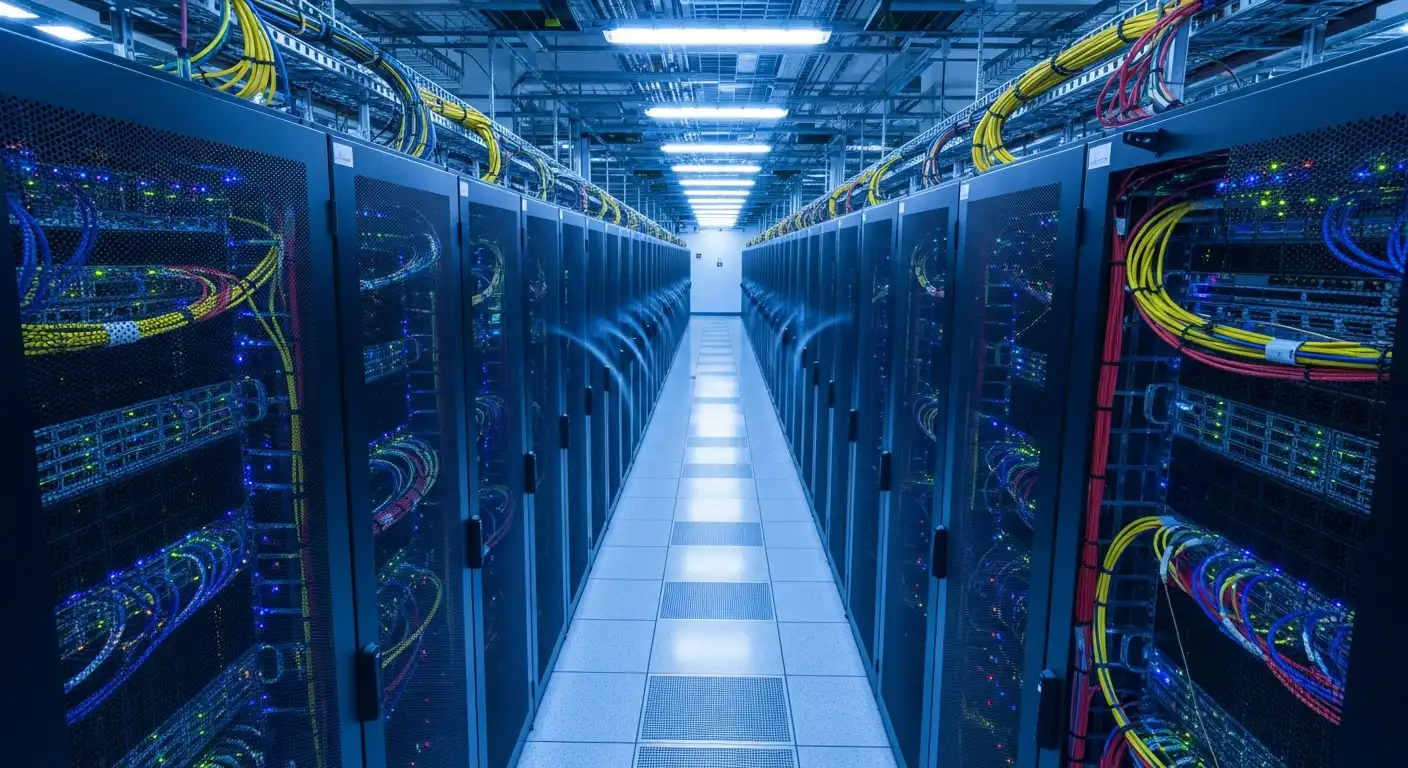
- Liquid-Cooled Server Racks: Replacing traditional air-cooling fans with advanced liquid-to-air cooling systems capable of handling extreme heat dissipation from high-density server clusters.
- Grid-Scale Renewable Interconnections: Securing dedicated access to hundreds of megawatts of wind, solar, or nuclear power to run high-density data centers continuously.
- Ultra-High Bandwidth Networks: Linking separate data center buildings with low-latency fiber optic arrays to allow seamless parallel computing across massive physical campuses.
- Modular Data Center Architecture: Designing standardized, repeatable building footprints that allow companies to rapidly swap out older server generations without rebuilding the physical structure.
Meta’s Insane Capital Spending Spree
The financial scale of this infrastructure buildout has completely rewritten Silicon Valley’s balance sheets. Tech companies with some of the cleanest cash reserves in corporate history are taking on massive debt and cutting their free cash flows to finance their data center expansions.
Meta is leading this spending sprint with extraordinary aggression. The company officially raised its capital expenditure (CapEx) guidance to a staggering range of $125 billion to $145 billion. This represents a massive jump from its previous capital budget of over $70 billion, driven primarily by higher component pricing, advanced silicon procurement, and the rapid expansion of its global data center footprint.
This capital investment is part of a broader, historic commitment. Meta has pledged to invest a massive $600 billion in United States infrastructure and jobs over three years to build out the gigawatt-scale data center campuses required to power its advanced AI agent technologies.
This astronomical spending has initially spooked Wall Street investors, compressing the company’s valuation multiples and putting near-term pressure on its free cash flows. However, Mark Zuckerberg has defended this aggressive strategy as a necessary “front-loading” of computing capacity.
In Zuckerberg’s view, the company must build the physical infrastructure today to secure its position in the upcoming era of “superintelligence,” recognizing that the winners of the AI race will be determined by who owns the most silicon, the most concrete, and the most electrical megawatts.
The MTIA Roadmap: Four Generations of Custom Silicon in Two Years
The core challenge of inference economics is that general-purpose GPUs, while highly powerful, are incredibly expensive to purchase and highly inefficient to run for specialized, everyday tasks. A general-purpose GPU spends a massive amount of electricity on raw mathematical floating-point operations that go completely unused when running a social media platform’s content ranking or ads targeting models.
To address this efficiency bottleneck, Meta has executed one of the most aggressive custom-silicon programs in the technology industry. Known as the Meta Training and Inference Accelerator (MTIA), this family of homegrown AI chips is co-developed in close partnership with semiconductor giant Broadcom.
Rather than relying on the traditional, slow-moving two- to three-year silicon design cycle, Meta is executing an unprecedented, rapid six-month release cadence, introducing four new generations of MTIA chips (MTIA 300, 400, 450, and 500) over a brief two-year window.
These custom chips are designed specifically to run Meta’s deep learning recommendation models and generative AI inference workloads with maximum efficiency.
This custom silicon strategy delivers massive, real-world cost advantages:
- Workload Optimization: Because the MTIA architecture is tailored specifically to Meta’s content ranking and ads algorithms, it achieves significantly higher compute efficiency than general-purpose chips, dramatically lowering the total cost of ownership.
- Seamless Software Integration: The MTIA software stack runs natively on PyTorch, vLLM, and Triton, allowing Meta’s engineers to deploy production models simultaneously on both third-party GPUs and custom MTIA chips without needing to rewrite complex software code.
- Modular Infrastructure Compatibility: Every new generation of the MTIA family is designed to fit into the same physical chassis, server rack, and networking infrastructure. This modular design allows Meta to rapidly swap out older chips for next-generation silicon without needing to reconstruct the physical data center, enabling a continuous, low-cost upgrade cycle.
By deploying hundreds of thousands of these custom MTIA chips across its global data centers, Meta has successfully reduced its reliance on expensive third-party GPU providers. This custom hardware strategy is further supported by a massive, long-term $100 billion AI infrastructure agreement with advanced chipmaker AMD, ensuring that the company maintains a highly diversified and cost-effective silicon portfolio.
The Grid Energy Bottleneck: Global Data Center Consumption Soars
As tech giants deploy millions of advanced processors across their global data centers, they are encountering a massive, highly restrictive physical barrier: electricity consumption. Data centers are no longer just software hubs; they are massive industrial energy sinks that are beginning to strain local utility grids worldwide.
The scale of this energy demand is bending vertically. According to market research reports, global data center energy consumption jumped to a staggering 565 terawatt-hours (TWh), representing an extraordinary 26% year-on-year increase from 447 TWh.
To put this number in perspective, the entire state of California consumes roughly 280 TWh of electricity per year, meaning global data centers now consume nearly twice the electricity of America’s most populous state.
Market analysts project that as the AI buildout accelerates, data centers will consume between 8% and 9% of all United States electricity by 2030, up from just 3% today, turning clean energy security into the ultimate constraint of the technology sector.
The Landmark Reliance-Meta India Deal
To bypass local energy bottlenecks in Western markets, tech companies are rapidly expanding their infrastructure footprints into emerging international markets with abundant resources. A prime example of this geographic expansion is Meta’s landmark infrastructure deal with Indian industrial giant Reliance Industries.
The two companies agreed to construct a massive, state-of-the-art 168-megawatt (MW) AI-enabled data center in Jamnagar, located in the western Indian state of Gujarat. Under the terms of the agreement, Reliance will manage the physical construction, connectivity, and day-to-day operations of the facility. At the same time, Meta will lease the capacity to power its growing compute-intensive workloads across its Asian products.
The Jamnagar facility represents the cutting edge of sustainable high-density data center design. To address the massive power and water requirements of AI computing, the entire campus will run on dedicated, local renewable energy sources and utilize desalinated seawater for cooling, bypassing local utility grids and protecting the region’s scarce freshwater resources.
This strategic partnership demonstrates how the “cloud-based” AI boom remains anchored to physical, localized geography, with companies spending billions to secure land, water, and power rights in emerging markets to keep their systems running.
Humanizing the Hyperscale: America’s Workforce Academy
A common misconception among the public is that modern hyperscale data centers are completely automated, “lights-out” warehouses that require virtually no human workers once construction is complete. In reality, these massive campuses are active, highly complex industrial ports that require a continuous, daily cycle of maintenance, hardware refreshes, and skilled-trades support.
To build the massive labor pipeline required to support its rapid construction schedule, Meta announced a historic $115 million investment to stand up a cost-free training program called America’s Workforce Academy.
In partnership with the Associated Builders and Contractors trade group, the program is designed to provide comprehensive, generalist training for thousands of local data center technicians, critical-facility operators, and electricians across the United States.
Crucially, Meta has committed to offering all graduates of the academy guaranteed full-time job offers with its general contractors. This investment shows that the artificial intelligence revolution is not just a digital software story; it is actively building a durable, middle-class, skilled-trades economy in the rural and mid-sized regions that host these massive data center campuses.
From electricians and cooling technicians to heavy equipment operators, the physical maintenance of the AI infrastructure has become a major engine of local job creation.
The Sustainability and Financial Viability Question
Despite the incredible momentum of the global data center buildout, several prominent Wall Street analysts and economic researchers are beginning to raise serious questions regarding the long-term financial sustainability of this $800 billion infrastructure bet.
While investors have rewarded every technology company willing to pledge more silicon and more megawatts, the fundamental financial math remains highly unproven.
Currently, no frontier artificial intelligence company relying on third-party data centers is generating a net profit. The capital costs required to develop, train, and run these models remain significantly higher than the revenues generated from current enterprise and retail users.
Furthermore, as the market transitions from flat-rate subscriptions to consumption-based token pricing, some analysts warn that corporate clients may scale back usage to control IT budgets, potentially leaving hyperscalers with massive amounts of overbuilt, underutilized data center capacity.
But for leaders like Mark Zuckerberg, the risk of under-investing in physical infrastructure is far higher than the risk of over-building. In their view, those who lack the raw computing capacity, custom silicon, and power interconnections will be permanently locked out of the next era of technological sovereignty.
By building massive, renewable-powered data centers, designing the custom MTIA chip families, and training the physical workforce needed to run their systems, tech giants are placing their trillion-dollar bets squarely on the physical reality of the machine, ensuring they have the hardware foundation to power the future of global intelligence.
Conclusion
The global artificial intelligence boom is no longer just a software revolution; it is an active, industrial-scale hardware construction sprint. As the soaring cost of inference economics forces technology giants to process billions of real-time calculations every second, the physical limits of raw silicon, electrical grids, and water resources have become the ultimate determiners of market success. By raising its capital expenditures to an extraordinary $125 billion to $145 billion, designing four generations of custom MTIA chips within a tight two-year window, and partnering with Reliance to build a green 168 MW data center in India, Meta is demonstrating the extraordinary scale required to survive the new era of computing. While Wall Street remains cautious about near-term profitability, these massive physical investments are transforming the global technology sector from the ground up. Ultimately, the future of artificial intelligence will not be decided by virtual code alone, but by the physical, concrete, custom silicon, and megawatt-scale power grids that form the physical foundation of the digital mind.