
The global cloud computing market has experienced rapid growth in recent years and is expected to continue expanding in the foreseeable future. With the increasing demand for cloud services across various industries, the market is expected to reach new revenue and market share heights. As businesses adopt cloud computing technologies to enhance operations, improve efficiency, and reduce costs, the global cloud computing market is poised for significant growth and innovation.
Cloud Computing Market Analysis
The approximate decision of the Techgolly market analysis team is that the global cloud computing market size was valued at least USD 995 billion in 2026 and is projected to reach up to USD 3783.95 billion by 2035. The growth is expected to continue at a compound annual growth rate (CAGR) of 14% to 16% from 2025 to 2035.
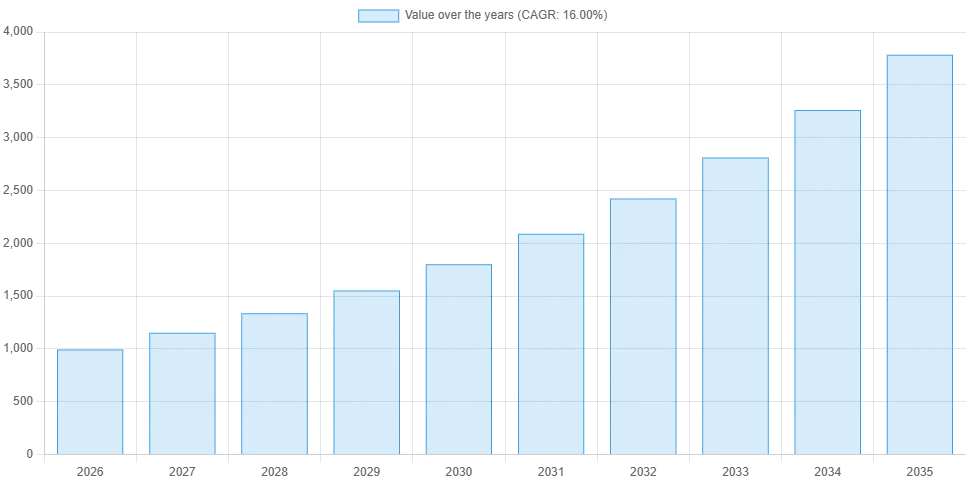
According to Fortune Business Insights, the global cloud computing market was valued at USD 569.31 billion in 2022 and is expected to reach USD 2,432.87 billion by 2030. According to Grand View Research, the global cloud computing market size was valued at USD 483.98 billion in 2022 and is projected to reach USD 1,554.94 billion by 2030.
Reasons for Cloud Computing Market Growth
Here are some primary reasons for the significant growth of the cloud computing market.
Scalability and Flexibility
Cloud services enable businesses to scale their resources up or down according to their needs. This flexibility eliminates the need for large upfront investments in hardware and infrastructure, making it easier for businesses to adapt to changing demands.
Cost Efficiency
Cloud services operate on a pay-as-you-go model, allowing businesses to pay only for the resources they use. It eliminates the need for expensive hardware procurement, maintenance, and data center management, resulting in cost savings.
Accessibility and Remote Work
Cloud services provide remote access to resources and data from anywhere in the world with an internet connection. It became particularly crucial during the COVID-19 pandemic, enabling seamless remote work and collaboration.
Reduced Time-to-Market
Cloud computing enables businesses to rapidly deploy applications and services, eliminating the delays typically associated with traditional infrastructure setup. It accelerates development cycles and brings products to market more quickly.
Elasticity and Performance
Cloud services can automatically adjust resources to handle fluctuations in demand, ensuring optimal performance during peak periods and preventing overprovisioning during quieter times.
Innovation and Rapid Prototyping
Cloud computing enables developers to utilize tools and platforms that facilitate experimentation, innovation, and rapid prototyping of new applications and services, thereby fostering creativity and experimentation.
Global Reach and Accessibility
Cloud providers operate data centers in various locations, enabling businesses to reach a global audience with reduced latency and improved user experience.
Data Security and Compliance
Many cloud providers offer advanced security features and compliance certifications that can be costly and complex to implement on-premises. It makes it easier for businesses to secure their data and meet regulatory requirements.
Disaster Recovery
Cloud services offer robust backup, disaster recovery, and failover options, enabling businesses to recover quickly from data loss or system failures.
Environmental Sustainability
Cloud providers often invest in energy-efficient data centers and share resources among multiple customers, reducing carbon footprints compared to traditional IT infrastructure.
AI and Big Data Integration
Cloud platforms provide the computational power and storage necessary for processing and analyzing large datasets, making them ideal for AI, machine learning, and big data applications.
Platform-as-a-Service (PaaS) and DevOps
PaaS offerings in the cloud simplify the development and deployment of applications. At the same time, DevOps practices are enhanced by the cloud’s automation and collaboration capabilities.
Legacy System Modernization
Cloud computing enables businesses to migrate and modernize their legacy applications and infrastructure, thereby reducing technical debt and enhancing overall efficiency.
Key Market Players
The major vendors offering Cloud computing solutions and services are Adobe Inc., Alibaba Group Holding Ltd., Amazon.com Inc., Google LLC, International Business Machines Corporation, Microsoft Corporation, Oracle Corporation, Salesforce.com Inc., SAP SE, Workday Inc.