

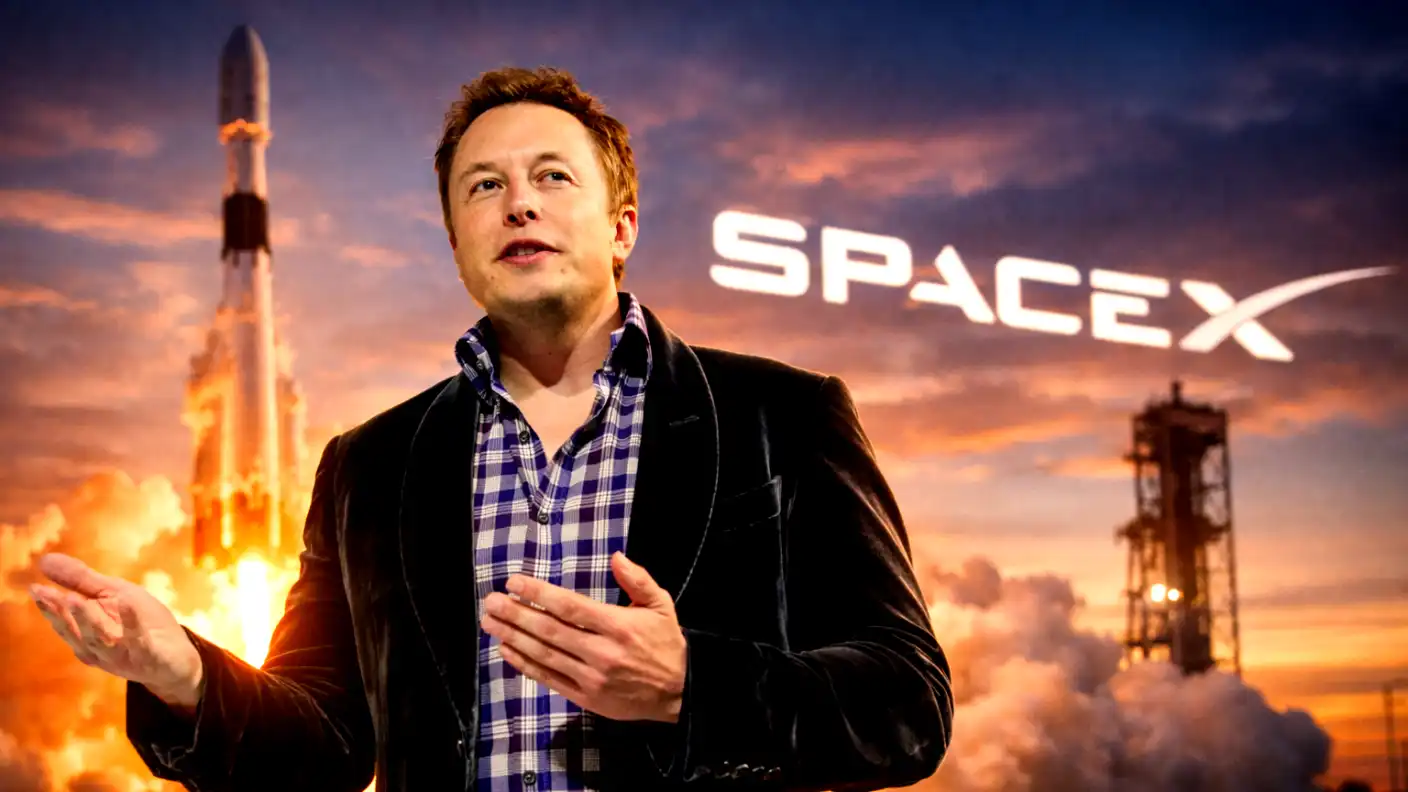
The global financial landscape witnessed a historic milestone recently as the combined valuation of the ventures controlled by the world’s richest man officially crossed the trillion-dollar threshold. This financial leap was cemented by the highly anticipated public listing of his rocket, satellite, and artificial intelligence company on the Nasdaq. Raising an unprecedented $75 billion, the company closed its first day of trading at just under $161 per share, implying a total market value of $2.1 trillion. The blockbuster initial public offering did more than just break Wall Street records; it officially minted its founder as the world’s first-ever trillionaire.
The scale of this wealth accumulation is unlike anything the modern economy has ever seen. His personal net worth, which crossed the $500 billion mark in late 2025, has now soared to an estimated $1.1 trillion. While many of his critics point to the massive capital requirements and unproven technologies underpinning his ventures, investors have repeatedly demonstrated their willingness to bet on his vision. Today, his sprawling network of companies spans electric vehicles, aerospace engineering, social media, artificial intelligence, underground transit, and neurotechnology, reshaping multiple global industries simultaneously.
The Genesis of His Fortune: Early Ventures
To understand the mechanics of his modern empire, one must trace his journey back to his early days as a software programmer. Born in Pretoria, South Africa, in 1971, his first commercial success occurred at the age of 12, when he sold the source code for a space-themed video game called Blastar to a computer magazine for about $500. This early triumph set the stage for a lifetime of digital entrepreneurship.
His first major business venture was Zip2, an online publishing and business-directory company he co-founded with his brother, Kimbal, in 1995. The company helped traditional newspapers bring local business listings, directories, and mapping systems online. Writing much of the software himself during the early days of the internet, he eventually guided Zip2 to a highly profitable acquisition. In 1999, the personal computer manufacturer Compaq purchased Zip2 for $307 million. The transaction earned him a personal payout of $22 million, providing the seed capital for his next disruptive idea.
Rather than taking his millions and retiring, he immediately invested $12 million of his proceeds to co-found X.com, an online financial services and e-payment company. At a time when online banking was met with extreme consumer skepticism, X.com grew rapidly. In 2000, the company merged with its direct competitor, Confinity, which owned a popular money-transfer system called PayPal. The combined entity was eventually renamed PayPal, and under his leadership, it became the global standard for digital payments.
When eBay acquired PayPal in 2002 for $1.5 billion, he was the company’s largest individual shareholder. The deal landed him roughly $176 million. By the age of 31, he had realized nearly $198 million from the businesses he had built and sold. Yet, the vast majority of the fortune that would later make him the wealthiest person in history did not come from cashing out of his creations. Instead, it was built by holding onto massive equity stakes in two companies that would go on to disrupt global transport and aerospace: Tesla and SpaceX.
SpaceX: The Multi-Trillion-Dollar Giant
In 2002, he founded Space Exploration Technologies Corp., better known as SpaceX, with the ambitious goal of reducing the cost of space transport and eventually making human life multiplanetary. In its infancy, the venture came perilously close to bankruptcy, suffering three successive rocket launch failures that nearly exhausted his remaining personal capital. However, a successful fourth launch of the Falcon 1 rocket in 2008 secured a critical $1.6 billion cargo resupply contract from NASA, saving the company from financial ruin.
Over the next two decades, SpaceX revolutionized the aerospace industry by developing reusable rocket boosters, which dramatically cut the cost of sending payloads into orbit. Today, the company is the undisputed leader in commercial spaceflight, acting as the primary launch partner for governments, satellite operators, and scientific organizations worldwide.
Starlink’s Crucial Revenue Engine
While rocket launches capture global headlines, the true financial engine of SpaceX is Starlink, its low-Earth orbit satellite internet constellation. Starlink was conceived to provide high-speed, low-latency internet access to underserved and remote regions of the planet, but it has quickly evolved into a massive global utility.
Last year, Starlink generated a staggering $4.4 billion in operating income, providing the stable, recurring cash flow that has allowed the broader company to fund its expensive developmental projects. With millions of active subscribers worldwide, Starlink’s orbital network has become an essential piece of global telecommunications infrastructure. The success of this satellite division has comforted Wall Street investors, proving that the rocket manufacturer is capable of generating massive, sustainable operational profits alongside its deep-space ambitions.
The Integration of xAI and the Social Media Platform X
The road to the historic Nasdaq IPO was also paved by a series of bold corporate consolidations. In February of this year, SpaceX completed a merger with xAI, its artificial intelligence startup, in a transaction that initially valued the combined company at $1.25 trillion. This merger brought several of his key technology ventures under one corporate roof, creating a unified aerospace, communications, and artificial intelligence giant.
As part of this consolidation, the social media platform X, formerly known as Twitter, was integrated into the xAI umbrella. He had purchased Twitter for $44 billion in late 2022, parking it under his new AI startup to utilize its massive, real-time public data feed to train his proprietary large language model, Grok.
Financially, both xAI and X remain heavy money losers, with xAI reporting an operational loss of $6.4 billion last year, and X continuing to struggle with a significant decline in advertising revenue. Despite these operating losses, the market hype surrounding artificial intelligence and the promise of Grok was enough to whip up extraordinary investor demand. The public listing of the combined entity surpassed the expectations of many Wall Street analysts. The massive influx of public capital raised $75 billion for the company, money that will be essential to fund its long-term plans of building orbital data centers and sending human beings to Mars.
Tesla: The Electric Vehicle and Automation Pioneer
While SpaceX has grabbed recent headlines, Tesla remains a cornerstone of his massive paper wealth. He joined the electric car company in 2004 as its chairman and majority shareholder after leading its initial investment round with $6.3 million. In 2008, he assumed the role of CEO, a position he has held during a period of unprecedented expansion and market volatility.
Tesla single-handedly transformed the global automotive industry, proving that electric vehicles could be profitable, high-performing, and highly desirable. The company’s market capitalization soared past $1 trillion during the pandemic stock boom, trading at a valuation that exceeded the combined worth of most legacy automakers. This valuation was driven not just by car sales, but by the belief that Tesla was fundamentally a technology and energy company rather than a traditional manufacturer.
Navigating Intense Global EV Competition
In recent years, Tesla has faced a far more challenging operating environment. The global electric vehicle market has transitioned from a niche segment with limited choices to a highly competitive, crowded arena. Traditional automakers have caught up in manufacturing capabilities, while a wave of agile Chinese competitors, such as BYD, Geely, and Xiaomi, has flooded the global market with high-tech, low-cost electric cars.
This fierce competition has forced Tesla to engage in global price-cutting wars, which have compressed its automotive profit margins. While the company continues to deliver more than 1.8 million vehicles annually, its stock price has experienced significant volatility. Despite these headwinds, Tesla’s valuation continues to trade at a massive premium compared to legacy rivals. This premium is sustained by his promises of a transition from a simple automaker to an autonomous driving and artificial intelligence powerhouse.
The Promise of Autonomous Tech and Humanoid Robotics
To justify its elevated stock price, the company has increasingly focused its messaging on autonomous driving technology and robotics. He has repeatedly asserted that the true value of Tesla lies in its Full Self-Driving software and its upcoming network of autonomous robotaxis. The company is pouring billions of dollars into its Dojo supercomputer to train its neural networks, aiming to solve the complex engineering challenge of vision-based autonomy.
Furthermore, the company is developing the Optimus humanoid robot. Designed to perform repetitive, dangerous, or boring tasks, the robot represents a massive new market opportunity in industrial automation and consumer services. He has predicted that the humanoid robot business could eventually surpass the automotive division in value. While these technologies remain in the developmental phase, the promise of these automated systems continues to attract tech-focused investors, keeping Tesla’s market value far above its physical manufacturing peers.
Neuralink and The Boring Company: The Frontier Tech Bets
Beyond electric cars and rockets, his business empire includes several private startups dedicated to solving fundamental human and engineering challenges. These companies represent his most speculative, high-risk, and futuristic ventures.
He co-founded Neuralink in 2016 with an initial personal investment of $100 million. The neurotechnology company is developing ultra-high-bandwidth brain-computer interfaces to connect the human brain directly to computers. The company’s initial goal is to help paralyzed individuals regain their independence by allowing them to control digital devices, such as computers and smartphones, using only their thoughts.
Following successful regulatory approvals, Neuralink has progressed with clinical trials, successfully implanting its chip in human subjects who have shown the ability to control external devices with high precision. In the long term, he envisions the technology as a way to enhance human cognition, allowing humans to keep pace with the rapid advancement of artificial intelligence.
In the physical world, he founded The Boring Company to address urban traffic congestion. The company designs and manufactures advanced tunnel boring machines to construct safe, low-cost transit tunnels beneath major cities. The Boring Company has constructed several functional tunnels, including a passenger transit system beneath the Las Vegas Convention Center. While the dream of a nationwide network of hyperloop transport systems remains unrealized, the company continues to develop faster, more efficient excavation technologies to make underground transit a viable alternative to congested city streets.
The Economic and Political Implications of a Trillionaire
The emergence of the world’s first trillionaire has reignited intense debates over economic inequality, regulatory oversight, and the influence of ultra-wealthy individuals. The sheer scale of his wealth gives him geopolitical influence that rival those of sovereign nations. His control over Starlink, for instance, has made him a vital player in global telecommunications, with both the U.S. military and international governments relying on his satellite network for critical security and communication infrastructure.
His financial milestone has also drawn sharp criticism from progressive political leaders. Critics argue that such an extreme concentration of wealth in the hands of a single individual is a symptom of a broken tax system. Many are calling for the implementation of a national wealth tax to address economic inequality and fund public services.
Conversely, his supporters argue that his wealth is entirely on paper, tied to the valuations of companies that are actively building the future of humanity. They point out that his ventures have successfully revitalized the American space program, accelerated the global transition to sustainable energy, and pushed the boundaries of medical science.
The public listing of SpaceX has also tied the financial futures of millions of ordinary citizens to its business empire. Because the company is now a major component of the Nasdaq, its shares will inevitably find their way into mainstream index funds, mutual funds, and retirement accounts. Whether the public approves of his lifestyle or political views, the health of his business empire will now directly impact the retirement savings of everyday workers.
The Path Forward for a Sprawling Empire
Managing a multi-industry corporate empire valued at over a trillion dollars represents an extraordinary administrative challenge. He continues to serve as the CEO, product architect, or majority shareholder across several distinct corporations, raising persistent questions about his ability to distribute his time and focus effectively.
Many of his ventures are heavily reliant on his personal brand and public image. His frequent, outspoken, and often polarizing commentary on social media has occasionally drawn the ire of regulators, advertisers, and shareholders. However, his ability to rally public enthusiasm and attract top engineering talent remains his greatest asset.
Ultimately, his business empire is built on the promise of solving some of humanity’s most difficult technical challenges. Whether he can successfully colonize Mars, transition the world to autonomous energy, or safely merge human brains with computers remains to be seen. What is undeniable is that his ventures have permanently disrupted multiple global industries, creating a trillion-dollar legacy that will shape the course of technology and human progress for generations to come.






