

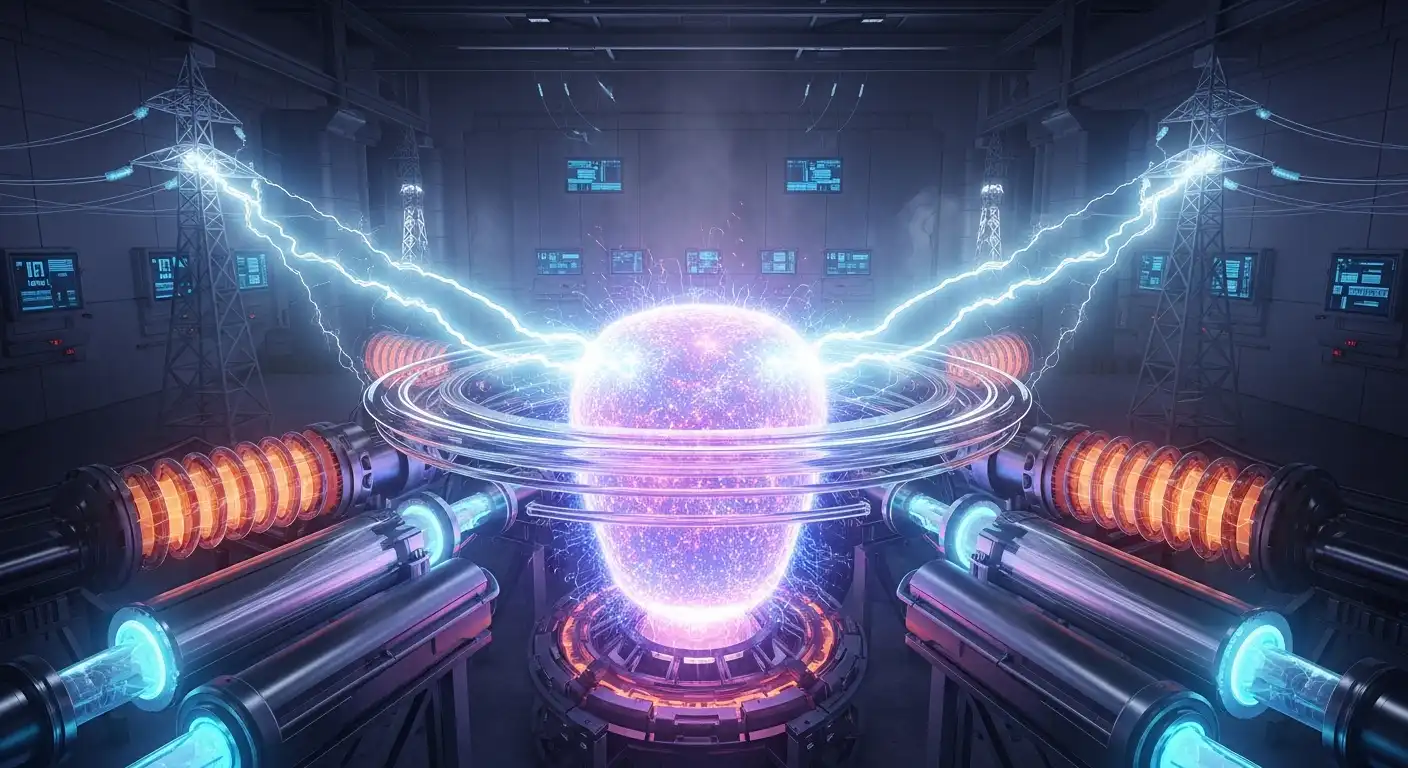
The boundary between speculative science fiction and public equity markets has officially dissolved. In a historic milestone for the global clean energy transition, General Fusion Group Ltd. made its highly anticipated market debut on the Nasdaq exchange. By completing its business combination with the special purpose acquisition company Spring Valley Acquisition Corp. III, the Vancouver-based company became the world’s first publicly listed, pure-play fusion energy developer, trading under the ticker symbol GFUZ.
The first day of public trading on Monday, July 13, 2026, treated investors to a wild ride. The stock opened at $12.80 per share and quickly shot up to more than $22 before plunging below $10 and ultimately stabilizing around $12 by midday. This dramatic volatility perfectly illustrates the intense mix of excitement and skepticism surrounding the commercialization of nuclear fusion.
Entering the public markets with approximately $150 million in fresh cash, General Fusion is attempting to do what has eluded the world’s finest physicists for more than half a century: harness the energy that powers the sun to deliver an abundant, safe, and entirely carbon-free source of baseload electricity. The company’s public listing marks a major turning point, moving fusion energy out of the quiet realms of venture capital and government laboratories and into the daily, numbers-driven scrutiny of public stock markets.
The Return of the Steampunk Approach: Magnetized Target Fusion
For decades, the dominant approach to nuclear fusion relied on massive, capital-intensive designs like tokamaks. These systems, represented by multi-billion-dollar international projects like ITER in France, utilize powerful superconducting magnetic arrays to contain a superheated doughnut of plasma. While scientifically advanced, tokamaks are incredibly expensive, complex to construct, and difficult to scale down to a commercially viable size.
General Fusion completely rejects this design, opting instead for a proprietary method known as Magnetized Target Fusion. This unique technology, which some industry observers have affectionately dubbed a “steampunk” approach, combines the best elements of magnetic containment and inertial confinement.
By avoiding the need for expensive, delicate superconducting magnets, the company believes its technology can achieve commercial viability faster and at a fraction of the construction cost of traditional tokamak systems.
The Mechanics of Mechanical Pistons and Liquid Metal
The physical process behind Magnetized Target Fusion is an elegant combination of mechanical engineering and advanced plasma physics. The reactor’s core design features a central sphere filled with a rapidly spinning vortex of liquid metal, typically a mixture of lead and lithium.
A specialized injector shoots a magnetized target of superheated deuterium-tritium plasma into the empty cavity at the center of this spinning liquid vortex.
Once the plasma is positioned inside the cavity, an array of hundreds of steam-driven pistons mounted around the exterior of the sphere strike simultaneously. These coordinated mechanical impacts generate a massive shockwave that collapses the liquid metal vortex inward, compressing the magnetized plasma target to the extreme densities and pressures required for fusion to occur.
The resulting fusion reactions release high-energy neutrons, which are absorbed by the surrounding liquid metal wall. This process generates intense heat, which is transferred to an external steam turbine to produce clean, reliable electricity, while also breeding tritium fuel to sustain the reactor’s long-term operations.
The Lawson Machine 26 and the 2028 Commercialization Milestones
To prove that this mechanical compression model can scale to commercial viability, General Fusion is currently executing its rigorous “Lawson program.” The company recently hit a major milestone on June 22, 2026, when its magnetized target fusion demonstration device, the Lawson Machine 26, successfully demonstrated compressional plasma heating at its Vancouver facility.
The machine achieved internal plasma temperatures of approximately 0.72 kiloelectron volts, validating the company’s numerical simulation models and proving that the mechanical compression system can effectively heat and compress a magnetized plasma target at a commercially relevant scale.
The company intends to use the $150 million in cash secured from its Nasdaq listing to fund the next critical phase of the Lawson program. The core strategic goal is to complete a series of major technical milestones by 2028, with the ultimate objective of demonstrating and de-risking the magnetized target fusion technology in a commercially relevant way.
If General Fusion can successfully hit these milestones on schedule, it will clear the path for the construction of its first commercial power plant, transforming the company from a pre-revenue research laboratory into a dominant player in the global utility market.
The Trillion-Dollar Power Crunch: Why AI and Crypto Are Chasing Fusion
The intense investor interest in General Fusion’s public debut is heavily driven by a massive, structural energy crisis currently facing the global technology sector. The rapid rise of generative artificial intelligence and high-performance computing has created an insatiable demand for electricity.
Major technology giants are building massive, gigawatt-scale data center clusters that require constant, uninterrupted baseload power to run advanced artificial intelligence models and process complex transactions.
Traditional renewable energy sources like wind and solar are highly intermittent, relying on favorable weather conditions to produce electricity. This intermittency makes them ill-suited for powering sensitive, always-on data centers that cannot tolerate even a millisecond of power disruption.
Consequently, tech companies are desperately searching for abundant, zero-emission, baseload power alternatives. This search has led them straight to nuclear fusion, which promises to deliver almost limitless, carbon-free energy without the radioactive waste or safety risks associated with traditional nuclear fission plants.
Feeding the Insatiable Power Appetite of Generative AI Data Centers
The scale of the technology sector’s energy requirement is staggering. Industry analysts estimate that global data center electricity consumption will grow significantly over the next decade, with some projects requiring up to 1,000 megawatts of dedicated capacity.
This power crunch has forced the world’s wealthiest technology companies to actively explore and fund early-stage nuclear fusion projects, transforming the energy sector’s long-term roadmap.
By establishing a public listing, General Fusion has created a direct, highly liquid entry point for technology investors and sovereign wealth funds looking to hedge their long-term energy exposure. If fusion energy can achieve commercial viability by the end of the decade, it will serve as the ultimate power source for the next generation of artificial intelligence data centers, unlocking a multi-trillion-dollar market and ensuring that the physical limitations of the electrical grid do not strangle the growth of the digital economy.
The Role of Bitcoin Miners in Underwriting Green Power
While data centers represent the high-value commercial opportunity, proof-of-work cryptocurrency mining operations serve as a natural partner for early-stage fusion deployment. Bitcoin miners are perpetually hunting for cheap, reliable, and off-peak power to run their energy-intensive rigs, making them excellent anchor customers for first-generation fusion plants.
By establishing supply agreements with cryptocurrency miners, early fusion power plants can guarantee demand for their electricity during off-peak hours, helping to stabilize their initial cash flows and offset high capital expenditure requirements.
This synergy is already driving strategic partnerships. Following its recent technological breakthroughs, General Fusion signed a landmark framework agreement with the Italian renewable energy developer Renexia on June 24, 2026, aimed at accelerating the commercial deployment of its technology across Europe. This agreement represents a major step forward, demonstrating that utility-scale power developers are actively preparing to integrate magnetized target fusion into their national grids.
The Global Corporate Race for Net-Zero Energy Hegemony
The public listing of General Fusion comes amid an intense, highly competitive race among a small group of well-funded private fusion companies. These startups are pursuing diverse, highly innovative reactor designs, each betting that their proprietary technology will be the first to demonstrate net energy gain, commonly known as scientific breakeven.
The competitive pressure is forcing companies to accelerate their development timelines and seek out massive capital injections. While General Fusion is the first pure-play company to hit the public markets through a SPAC merger, other major players are preparing similar capital strategies. The race is no longer confined to academic laboratories; it is now a highly competitive corporate battle to secure the intellectual property and manufacturing scale that will define the future of global energy production.
Helion Energy’s $15.5 Billion Valuation and the Microsoft Power Deal
The most formidable competitor in the private fusion sector is Helion Energy. Backed by prominent technology figures like Sam Altman, Helion achieved an extraordinary milestone in June 2026, closing a massive Series G funding round that valued the company at an eye-watering $15.5 billion.
Helion’s high valuation is supported by a landmark power purchase agreement signed with Microsoft. Under the terms of this deal, Helion has committed to delivering at least 50 megawatts of commercial fusion power to Microsoft’s data centers starting in 2028.
Unlike General Fusion’s mechanical target compression model, Helion utilizes a magneto-inertial fusion technology built on a Field-Reversed Configuration. This system shoots high-speed pulses of plasma together and directly recovers electrical energy using magnetic forces, bypassing the need for traditional steam turbines.
Helion’s aggressive timeline and massive financial backing from Silicon Valley have set a high bar for the rest of the industry, forcing General Fusion to use its public platform to accelerate its own development schedule and defend its market share.
TAE Technologies and the Six-Billion-Dollar Trump Media Merger
The public markets are also preparing for the arrival of another major fusion pioneer. In late 2025, California-based TAE Technologies announced a landmark merger with Trump Media & Technology Group Corp. in an all-stock transaction valued at more than $6 billion.
TAE Technologies, which has spent nearly three decades developing an advanced beam-driven field-reversed configuration reactor optimized for hydrogen-boron fuel, intends to use the merger to gain direct access to public capital markets and accelerate the construction of its next-generation Da Vinci prototype reactor.
The TAE-TMTG merger is scheduled to close in the coming months, creating another major, highly watched public entry point for retail and institutional investors.
By bringing TAE’s advanced physics and commercial subsidiaries—including its power solutions and life sciences divisions—to the public markets, the merger will further validate fusion energy as a viable, investable asset class, intensifying the battle for investor attention and capital allocation.
Navigating the Financial Realities of Pre-Revenue Speculation
The public listing of a pre-revenue, deep-tech company like General Fusion presents a unique set of challenges and risks for public market investors. For decades, the long-running joke in the scientific community has been that nuclear fusion is always twenty years away, and always will be.
By entering the public markets, General Fusion is forcing investors to confront this timeline risk directly, shifting the investment thesis from a multi-decade scientific endeavor to a near-term engineering challenge.
Public market investors operate on a much shorter, more demanding timeline than private venture capitalists. They expect regular, quarterly updates on progress, transparent capital allocation, and clear pathways to revenue generation.
If General Fusion suffers technical setbacks or fails to meet its 2028 Lawson program milestones, the public markets will likely penalize the stock severely, potentially restricting the company’s ability to raise the additional capital required to build its commercial-scale reactors.
Furthermore, the mechanics of SPAC mergers often introduce significant financial volatility. In the lead-up to General Fusion’s merger, the transaction faced high redemption rates from Spring Valley’s original trust shareholders, a common challenge in the current market environment.
While the company completed the merger and secured $150 million in cash, the final capital pool was significantly lower than the maximum theoretical trust value. This smaller capital cushion means that General Fusion must maintain absolute capital discipline, ensuring that every dollar is spent efficiently to hit the critical scientific milestones that will unlock future, non-dilutive financing rounds.
Overcoming the “Steampunk” Skepticism
As General Fusion begins its journey as a publicly traded company, the primary task facing CEO Greg Twinney and his engineering team is to prove the scientific validity of their unique technology. Some academic physicists remain skeptical of the mechanical target compression approach, arguing that using hundreds of individual pistons to compress superheated plasma is an incredibly complex engineering challenge that introduces significant risks of plasma instability and structural wear.
However, Twinney has aggressively defended the technology, pointing out that General Fusion brings more than twenty years of real-world testing, demonstration, and results to the table, including more than 200,000 individual plasma experiments.
By trading on the Nasdaq under GFUZ, the company is betting that its long operating history, verified technical milestones, and transparent public reporting will win the trust of the global investment community, paving the way for a clean energy revolution that will rewrite the rules of global commerce and secure a sustainable, fossil-fuel-free future for generations to come.
The era of nuclear fusion as a distant scientific dream is officially over. The global race to commercialize the energy of the stars has entered its most aggressive, public phase. Through strategic public listings, bold technological milestones, and massive capital injections, companies like General Fusion are proving that the future of clean energy is no longer twenty years away—it is unfolding in the public markets right now.






