Key Points:
- Japan’s space agency completed a vertical takeoff and landing flight test of its RV-X reusable rocket prototype.
- The 7.3-meter-tall prototype reached an altitude of 11 meters and traveled 16 meters horizontally during a 40-second flight.
- Data from the test will feed directly into the development of Callisto, a reusable rocket co-developed with France and Germany.
- The push for reusable technology aims to lower launch costs significantly, supplementing Japan’s expendable H3 rocket.
Japan’s national space program has completed a critical milestone in its push to lower the cost of orbital launches. The Japan Aerospace Exploration Agency successfully executed a vertical takeoff and landing test of its reusable rocket prototype, known as the RV-X, in Akita Prefecture. The flight represents a key step for the country as it seeks to master the complex software and mechanical systems required to land and reuse orbital boosters. By developing homegrown reusable technology, the nation aims to establish a more competitive presence in the rapidly growing global satellite launch market.
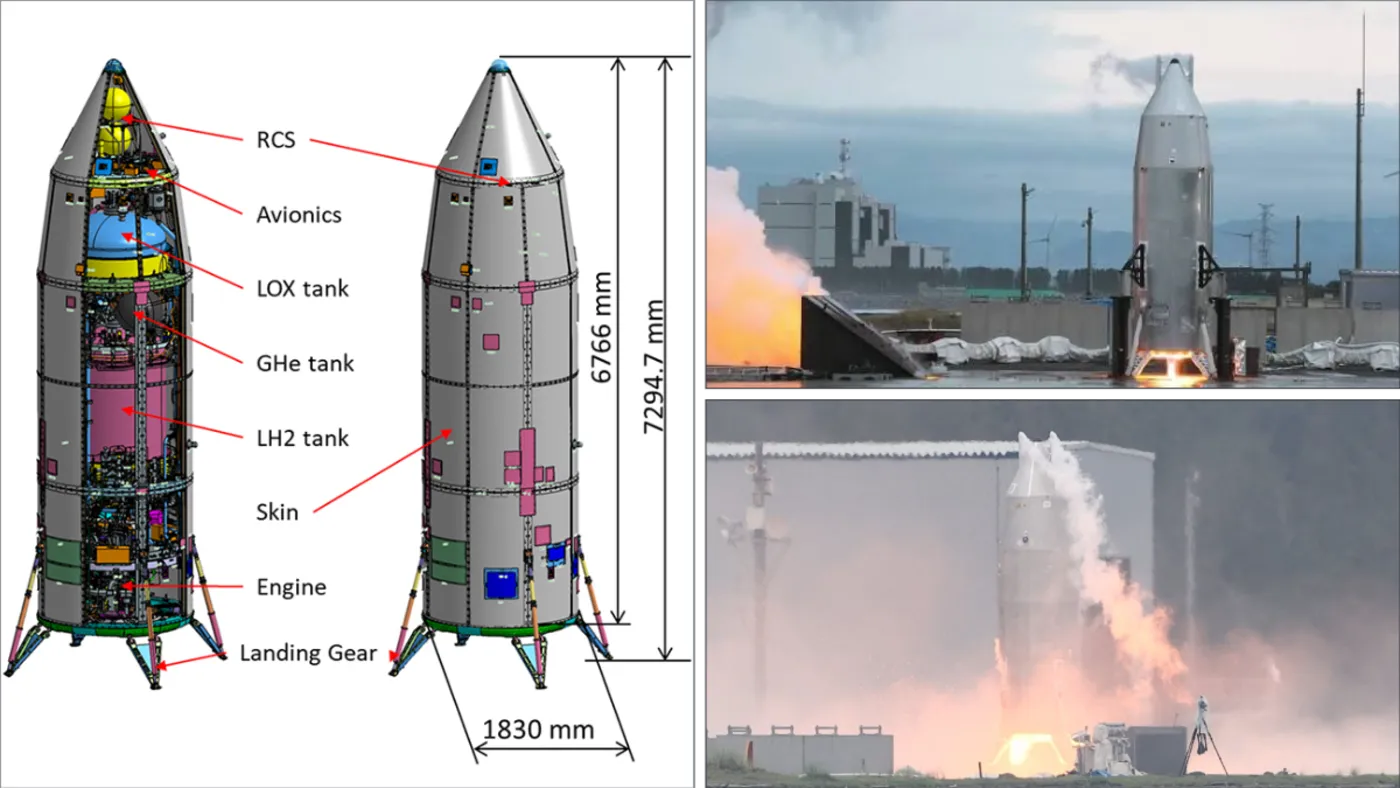
The localized flight test took place at a specialized research facility in the coastal city of Noshiro. During the 40-second flight, the prototype successfully ascended to a maximum altitude of approximately 11 meters. It then executed a controlled lateral maneuver, moving roughly 16 meters horizontally, before performing a precise, soft touchdown on its designated landing pad. Project Manager Takashi Ito expressed immense relief during a virtual media briefing, confirming that the test flight went exactly as planned and validated the vehicle’s automated guidance and thrust-vectoring systems.
The RV-X is a compact, highly advanced research vehicle designed specifically to test low-altitude vertical landing algorithms. The prototype measures approximately 7.3 meters in length and 1.8 meters in diameter, making it roughly the size of a small commercial truck. To absorb the impact of landing on concrete pads, the booster incorporates a specialized landing gear system comprised of four fold-out, shock-absorbing legs. The entire structure serves as a floating laboratory, packed with telemetry sensors, real-time computers, and custom thrust-vectoring actuators.
The data collected from the successful flight will feed directly into a larger, highly strategic international partnership. The national space agency is sharing its engineering findings to refine the design of Callisto, a larger reusable test vehicle that Japan is co-developing alongside the space agencies of France and Germany. The Callisto project represents a coordinated European-Asian effort to build a reliable, mid-sized reusable booster, leveraging shared development costs to compete against highly dominant private aerospace corporations in the United States.
The tri-national development team is currently working on an accelerated schedule to bring Callisto to the launchpad. The joint vehicle incorporates the same custom rocket engine validated during the recent Akita test, ensuring that the physical propulsion logic remains consistent. A critical high-altitude flight test for Callisto is scheduled to take place before next April, with the ambitious goal of attempting a controlled vertical landing from a significantly higher altitude than the initial low-level runs. This next phase will test the vehicle’s aerodynamic control surfaces under intense high-speed descent conditions.
Developing reusable booster technology is a critical priority for the nation’s long-term space strategy due to the limitations of its current fleet. The country’s mainstay heavy-lift space vehicle, the H3 rocket, is a highly capable and precise machine, but it operates on a traditional, expendable design. Every launch requires manufacturing an entirely new booster from scratch, which severely limits launch frequency and keeps average launch costs prohibitively high. Introducing reusable secondary stages or dedicated reusable boosters is essential to lower the cost of delivering payloads to orbit by up to 50%.
The national space agency is not the only entity in the country making rapid strides in reusable propulsion. Last year, Honda R&D, a specialized research subsidiary of automotive giant Honda Motor Company, completed its own private flight test of a reusable rocket prototype. The achievement marked the first time a private Japanese enterprise successfully designed and launched a vertical landing booster. This dual-track progress—combining state-backed research with private sector innovation—proves that the country is successfully cultivating a highly advanced domestic aerospace ecosystem.
This domestic push occurs against a global backdrop where reusable technology has rapidly become the minimum standard for commercial viability. United States aerospace giant SpaceX has successfully commercialized reusable rocket technology on a massive scale, using its two-stage Falcon 9 booster to dominate the international satellite launch market. By routinely landing and reusing its first-stage boosters over 20 times, the private company has driven launch costs down to levels that traditional, expendable rockets simply cannot match, forcing national space agencies worldwide to rapidly adapt to survive.
Ultimately, the successful landing of the prototype booster demonstrates the growing maturity of Japan’s aerospace engineering capabilities. While the initial 11-meter hop remains modest compared to the orbital returns executed by private American firms, it represents the critical first step in mastering the complex mathematics of vertical deceleration. As the joint engineering teams prepare to scale these systems up for the Callisto launch, the lessons learned in Noshiro will serve as the foundational building blocks for a more sustainable, affordable, and independent pathway to the stars.