Key Points:
- India’s data center capacity is projected to surge from 1.5 gigawatts to between 8 and 10 gigawatts by 2030.
- Electricity demand from computing facilities will jump nearly fivefold to 57 terawatt-hours, consuming up to 3% of national power.
- Global tech giants have committed over $67 billion, securing 15- to 20-year renewable power agreements for solar, wind, and battery storage.
- India added 44.6 gigawatts of solar capacity in a single year, crossing 300 gigawatts of total non-fossil power capacity.
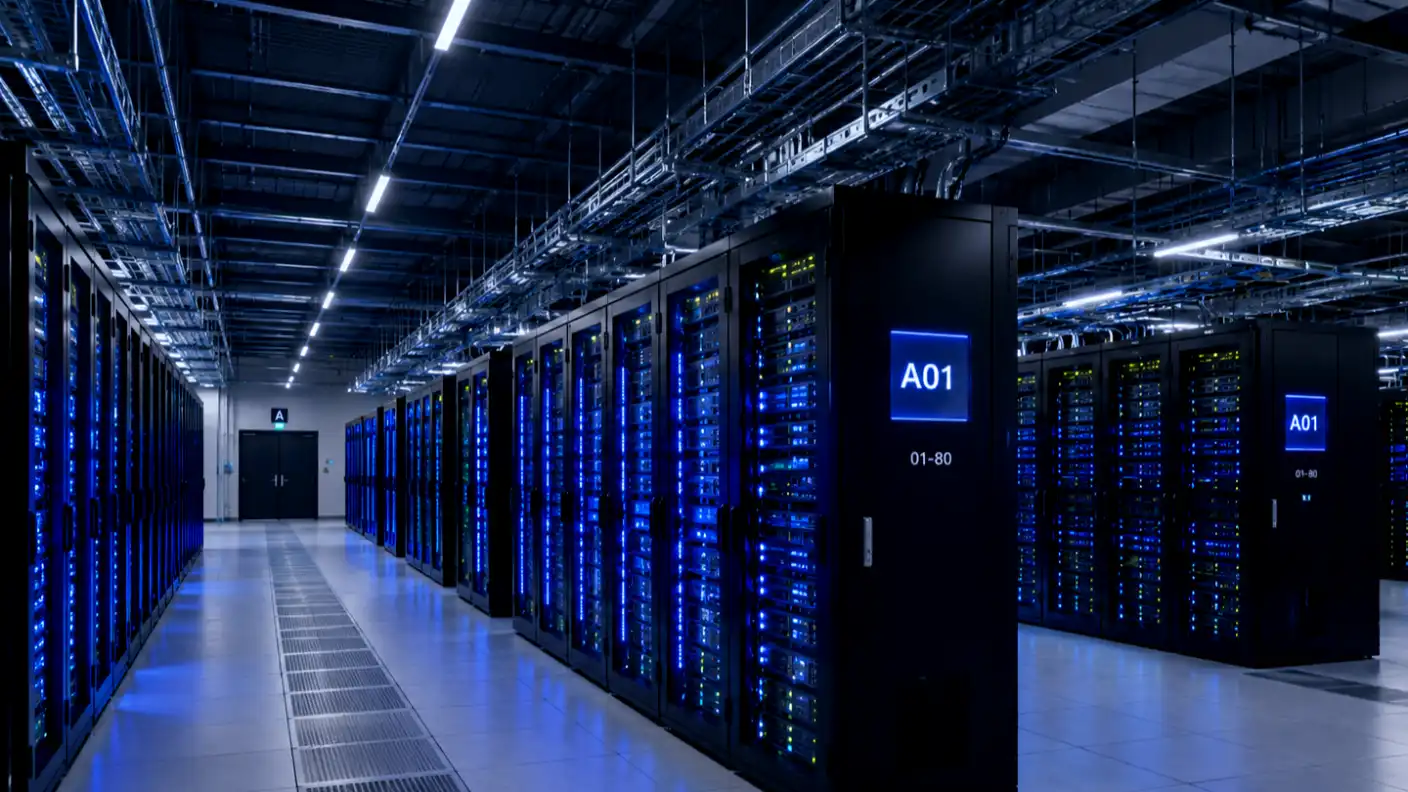
India’s rapid buildout of artificial intelligence data centers is emerging as a massive commercial catalyst for the country’s clean energy sector, driving unprecedented private investment into utility-scale solar farms, wind installations, and grid-scale battery storage. Global technology hyperscalers and domestic infrastructure conglomerates are committing more than $100 billion to expand digital infrastructure across Mumbai, Hyderabad, Chennai, and Bengaluru. Because international tech giants enforce strict corporate net-zero mandates, this unprecedented computing surge is supercharging India’s green power transition.
The nation’s data center capacity is expanding at a breakneck pace, on track to surge from roughly 1.5 gigawatts to between 8 and 10 gigawatts by 2030. Industry projections indicate that annual electricity consumption from data centers will quintuple from approximately 13 terawatt-hours to nearly 57 terawatt-hours by the end of the decade. This rapid load growth will increase the sector’s share of national power demand from 0.8% to as much as 3%, positioning data center operators among the largest commercial electricity buyers in the country.
The computing boom is uniquely transforming energy procurement dynamics across Asia. While neighboring Southeast Asian nations rely heavily on imported liquefied natural gas to power new data centers, India is using its low renewable energy tariffs and abundant sunlight to power hyperscale campuses with clean energy. India’s solar generation costs rank among the lowest in the world, allowing developers to generate clean electricity for less than $0.03 per kilowatt-hour, making green power significantly cheaper than fossil-fuel alternatives.
Big Tech conglomerates are anchoring this multi-billion-dollar clean energy wave through direct corporate power purchase agreements. American cloud giants Amazon Web Services, Microsoft, and Google have collectively pledged more than $67 billion toward Indian digital and cloud infrastructure. To guarantee that their high-density AI clusters run on clean energy around the clock, these corporations are signing 15- to 20-year power offtake contracts with independent renewable power producers, providing energy developers with long-term bankability to secure project financing.
The demand for continuous, uninterrupted electricity is accelerating the deployment of battery energy storage systems (BESS) and hybrid renewable architectures. Because solar power drops off at dusk and wind generation fluctuates, data center operators are contracting for firm and dispatchable renewable energy (FDRE). These hybrid projects combine solar arrays, wind turbines, and utility-scale lithium-ion battery packs to deliver steady baseload electricity 24 hours a day, solving the intermittency challenge without relying on coal generation.
India’s renewable energy manufacturing and installation capacity is breaking historic records to keep pace with demand. The country added 44.6 gigawatts of new solar capacity during the latest financial year alone, pushing India past Japan to become the world’s third-largest solar energy producer. Total non-fossil power generation capacity crossed 300 gigawatts, accounting for more than 54% of the nation’s total installed electricity grid. The unprecedented installation pace puts India on track to achieve its national target of 500 gigawatts of non-fossil capacity well before the 2030 deadline.
Supportive federal and state regulatory policies are facilitating direct corporate clean energy procurement. The central government’s Green Energy Open Access framework allows commercial and industrial power consumers to purchase renewable energy directly from private developers across state lines with reduced grid wheeling charges. At the state level, tech hubs like Maharashtra, Telangana, and Andhra Pradesh are offering stamp duty waivers, land concessions, and fast-track grid interconnection permits to attract green computing campuses.
Domestic industrial conglomerates are capitalizing on the dual expansion of data infrastructure and renewable energy. Heavyweights like Adani Group, Tata Power, and Reliance Industries are building vertically integrated green data center ecosystems. These corporate giants construct their own solar and wind parks to power their proprietary hyperscale data halls, allowing them to capture revenue across the entire digital value chain from clean kilowatt generation to cloud server hosting.
Despite the rapid expansion, developers face notable physical and environmental hurdles. Connecting multi-hundred-megawatt computing campuses to regional transmission corridors requires extensive substation construction and high-voltage line upgrades that can take years to energize. Furthermore, high-density server racks generate extreme heat, prompting facility operators to transition away from water-intensive evaporative cooling toward advanced closed-loop liquid cooling systems to protect local water tables in water-stressed districts.
As global artificial intelligence workloads accelerate, India’s convergence of digital computing and renewable power establishes a sustainable blueprint for emerging economies. By powering the data center revolution with low-cost solar, wind, and battery storage, India is proving that rapid digital industrialization can accelerate national decarbonization goals while creating thousands of high-tech engineering and clean energy jobs for decades to come.