

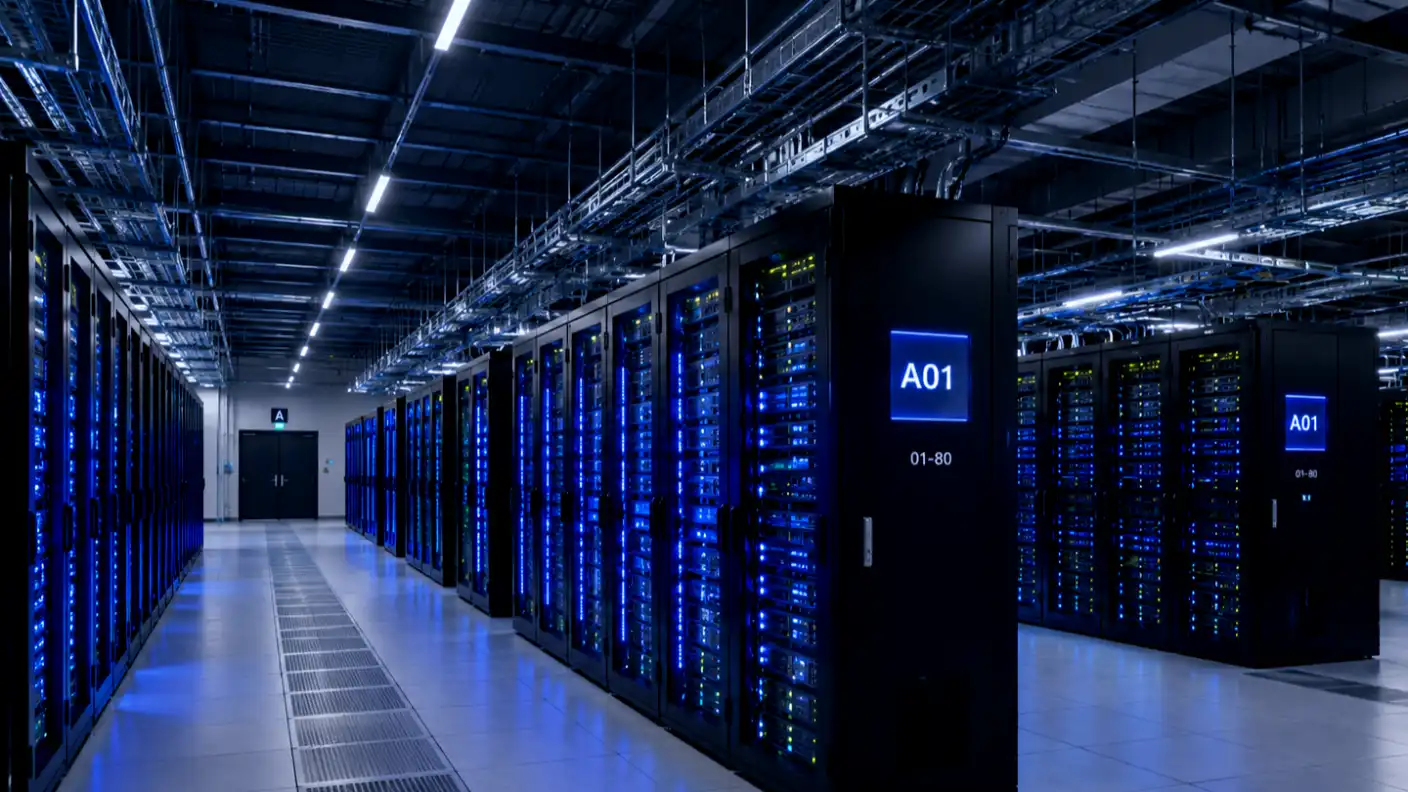
The artificial intelligence revolution is no longer just a digital or computational phenomenon. It has run headfirst into a harsh, physical reality: the rapid, unchecked expansion of advanced data centers has made them highly vulnerable to the very climate hazards that their global greenhouse gas emissions help to accelerate. As record-breaking summer heatwaves and severe droughts bake continents from North America to Europe, insurers, climatologists, and data center operators are simultaneously sounding the alarm.
A detailed report published by climate risk analytics firm First Street reveals that the global infrastructure supporting generative AI is facing an unprecedented level of exposure to extreme weather. The study warned that the traditional valuation models used by technology companies and real estate investors have treated climate risks as a secondary concern, focusing almost exclusively on market growth. Today, that short-sighted approach is proving highly dangerous, as extreme heat, water scarcity, wildfires, and flooding threaten to disrupt operations, increase offline times, and drive up insurance and repair costs for the world’s most valuable tech companies.
To survive in this warmer, more volatile climate, the digital infrastructure sector must undergo a rapid, fundamental transformation. Developers are racing to transition to an era of environmentally invisible computing, attempting to permanently decouple processing growth from natural resource consumption. By deploying advanced closed-loop liquid cooling, constructing undersea facilities, and designing highly energy-efficient silicon, the tech industry is attempting to build a resilient, water-secure future before the rising physical limits of the planet grind the AI revolution to a halt.
The Physics of the AI Heat Island Effect and Data Center Cooling
The primary reason why advanced computing infrastructure is so vulnerable to extreme weather is a direct result of the physics of modern silicon. Generative AI workloads are fundamentally different from traditional, cloud-hosting tasks. They require massive, specialized chips that perform thousands of complex calculations in parallel, generating an extraordinary amount of heat.
The Extreme Energy and Water Demands of Generative AI
Every time a user prompts an AI model to generate text, write code, or render an image, the request is routed to a high-density server rack operating in a massive data center. To prevent these specialized chips from overheating and melting, the facility must run continuous, high-capacity cooling systems.
These cooling systems are incredibly resource-intensive. According to research from the Environmental and Energy Study Institute, a single, large-scale AI data center can consume up to 5 million gallons of freshwater every day—enough to satisfy the basic domestic needs of a mid-sized city.
The most common cooling method, evaporative cooling, works by spraying water over the hot server racks, allowing the water to evaporate into the atmosphere and carry the heat away. While this method is highly efficient and cheap to run, it is also highly consumptive, permanently removing millions of gallons of water from local watersheds and placing an immense strain on municipal water resources during periods of drought.
The Data Heat Island Effect and Surrounding Ground Warming
The heat generated by these massive facilities is not just confined to the server rooms; it is actively warming the local environments surrounding the data centers.
A comprehensive study led by researchers at the University of Cambridge found that land surface temperatures around AI data centers rise by an average of 2 degrees Celsius, with some high-density areas recording temperature spikes as high as 9 degrees Celsius.
Researchers have dubbed this phenomenon the “data heat island effect.” By running thousands of high-performance servers 24 hours a day, data centers act as massive, localized thermal radiators, warming the ground and the air around them.
This localized warming increases the energy required to keep the facilities cool, as the incoming ventilation air is already pre-heated by the surrounding environment. It also triggers severe ecological consequences for local communities, drying out nearby soils, altering local microclimates, and increasing the risk of thermal stress for residents living near these massive industrial campuses.
Quantifying the Global Threat: The First Street and UNU Reports
The scale of this environmental crisis is detailed in two landmark scientific studies published in late June, which have provided the most comprehensive, highly timely assessment of the physical risks facing the global AI infrastructure.
First Street Data Shows Seventy-Nine Percent of Capacity Under Threat
The report from climate risk analytics firm First Street analyzed 97 of the most important global data center markets, revealing an extraordinary level of exposure to both acute and chronic climate hazards. The study concluded that 79% of global data center capacity faces a high risk of acute threats, including coastal flooding, extreme winds, and wildfires.
The geographical distribution of this risk is highly unequal. According to the First Street data, the Americas dominate the acute risk category, with 86% of the continent’s data center capacity located in elevated-risk markets, compared to 60% of capacity in the Asia-Pacific region.
Furthermore, the study found that 54% of global data center markets are facing chronic climate risks, specifically routine extreme heat and prolonged droughts.
Matthew Eby, the founder and CEO of First Street, warned that legacy financial models are completely inadequate for this new reality. He pointed out that the historical weather records that insurers and developers relied on for decades are no longer a reliable guide, as climate change is driving extreme events that bypass traditional probability models, exposing the entire AI ecosystem to unexpected financial and operational shocks.
UNU Warns AI Water Footprint Will Equal Domestic Needs of One Point Three Billion People
The long-term environmental cost of this computing boom is further highlighted by a comprehensive study published by the United Nations University (UNU). The report focuses on the cumulative resources required to sustain the rapid expansion of the global data center network through the end of the decade.
The UNU study projects that by 2030, the global data center network will consume approximately 945 terawatt-hours (TWh) of electricity annually—nearly tripling the combined annual electricity consumption of Pakistan, Bangladesh, and Nigeria, three nations that are collectively home to more than 650 million people.
More importantly, the study revealed that every unit of electricity consumed by a data center carries a massive, hidden “water footprint.”
The researchers estimate that by 2030, the cumulative water consumption of the global AI sector will reach 5 billion cubic meters annually, a volume that is equivalent to the basic annual domestic water needs of 1.3 billion people.
This staggering water footprint represents a severe threat to global resource stability, particularly in regions that are already facing chronic water scarcity due to climate change.
The Local Flashpoints: Water Scarcity and Community Backlash
The rapid, uncoordinated construction of AI data centers has turned resource allocation into a highly contentious, localized political issue, sparking intense resistance from local communities and environmental regulators.
UK Environment Agency Warns of Summer Spikes in Water-Stressed London
In the United Kingdom, the operational strain on local utility networks has reached a critical bottleneck. The UK Environment Agency released a technical report revealing that extreme summer temperatures are driving a massive, unexpected spike in data center water consumption.
This seasonal demand spike is heavily concentrated in the London and Southeast England regions, which are already classified as highly water-stressed areas due to dense populations and historically low rainfall.
The agency warned that during peak summer heatwaves, data centers are consuming an unsustainable share of the local public water supply, threatening to drain local reservoirs and compromise the water security of millions of residents.
This has prompted intense regulatory discussions, with the government reviewing proposals to implement strict, seasonal water caps on data centers and legally force operators to transition to non-consumptive cooling methods.
Local Council Bans and Withdrawn Projects Amid Grid Strains
This resource tension has triggered a powerful wave of community resistance across the United States. In many high-tech hubs, local citizens are actively lobbying their municipal governments to block new data center construction projects, citing concerns over noise, aesthetic disruption, and massive water and energy consumption.
In Fayetteville, Georgia, the local town council voted unanimously to ban any new data center construction within its borders, responding to intense pressure from residents who argued that a proposed facility would consume millions of gallons of precious local groundwater.
Similarly, in Buckeye, Arizona, a massive, planned $14 billion data center project was officially withdrawn by developers after the local water district refused to guarantee the continuous, multi-million-gallon daily water supply required to cool the facility.
These local battles prove that technology companies can no longer assume they will have unrestricted, cheap access to public water and energy, turning local community relations and resource compliance into major operational bottlenecks that can delay or completely kill advanced AI projects.
The Cooling Revolution: Decoupling Compute from Natural Resources
Faced with rising regulatory pressure, community backlash, and the very real threat of operational shutdowns during summer heatwaves, the technology industry is executing a rapid, multi-billion-dollar transition to revolutionize how it cools its data centers.
Transitioning to Liquid Cooling and Closed-Loop Systems
The primary technological trend in the data center sector is the rapid transition to liquid cooling systems. Unlike traditional air-blowing systems, which rely on evaporating water into the atmosphere to dissipate heat, liquid cooling uses a closed-loop system to circulate specialized fluids directly over the hot processing chips.
This closed-loop design represents an extraordinary, highly sustainable breakthrough. Because the cooling fluid is kept within a sealed, continuous loop, it does not evaporate into the atmosphere, allowing the data center to recycle 99% of its cooling liquid indefinitely.
Furthermore, because liquid is far more effective at absorbing and transferring heat than air, these systems can reduce a data center’s overall energy consumption by 30% to 40%.
Many advanced facilities are also integrating heat-reuse systems, taking the waste heat captured by the liquid loops and redirecting it to heat local municipal buildings, purify water, or power direct air capture (DAC) carbon-negative systems, turning a historically wasteful process into a circular, highly productive economic asset.
Qualcomm’s High Bandwidth Compute Chip as a Low-Power Solution
While data center operators focus on structural cooling upgrades, semiconductor companies are working to solve the energy crisis at the hardware level, designing advanced silicon that generates significantly less heat in the first place.
A prominent example of this hardware innovation is Qualcomm’s newly unveiled High Bandwidth Compute (HBC) chip.
While traditional AI accelerators rely on expensive, power-hungry high-bandwidth memory (HBM) architectures that generate intense heat during processing, Qualcomm’s HBC chip utilizes low-cost, highly energy-efficient mobile memory.
By prioritizing energy efficiency over brute-force processing speed, the HBC chip can run advanced, on-device AI workloads at a fraction of the power consumption of standard accelerators, dramatically reducing the heat output of the server racks.
This hardware-level efficiency lowers the overall cooling and water requirements of the facility, providing a highly scalable, low-power solution that allows the technology sector to continue expanding its computing capacity without exceeding the physical limits of the planet.
Securing the Digital Foundation
The successful publication of the First Street and United Nations University reports has made one thing undeniably clear: the global artificial intelligence revolution cannot continue to expand on its current, resource-intensive trajectory. By proving that 79% of global data center capacity is exposed to acute climate hazards, and that the AI water footprint is on track to equal the basic domestic needs of 1.3 billion people by 2030, these studies have delivered a powerful, highly urgent reality check to the tech industry.
While the physical challenges of managing massive grid upgrades, navigating local water scarcity, and overcoming regulatory bottlenecks remain significant, the rapid transition to closed-loop liquid cooling and highly efficient hardware architectures like Qualcomm’s HBC chip offer real hope.
By embracing these advanced, circular technologies, the tech industry can successfully transition to an era of environmentally invisible computing, decoupling digital growth from natural resource consumption.
As the first next-generation, water-positive data centers begin commercial operations, they will continue to demonstrate that the future of technological innovation is fundamentally tied to the physical limits of the planet, proving to the world that the only way to build a truly intelligent future is to build a sustainable, resilient, and highly resource-secure world first.






