

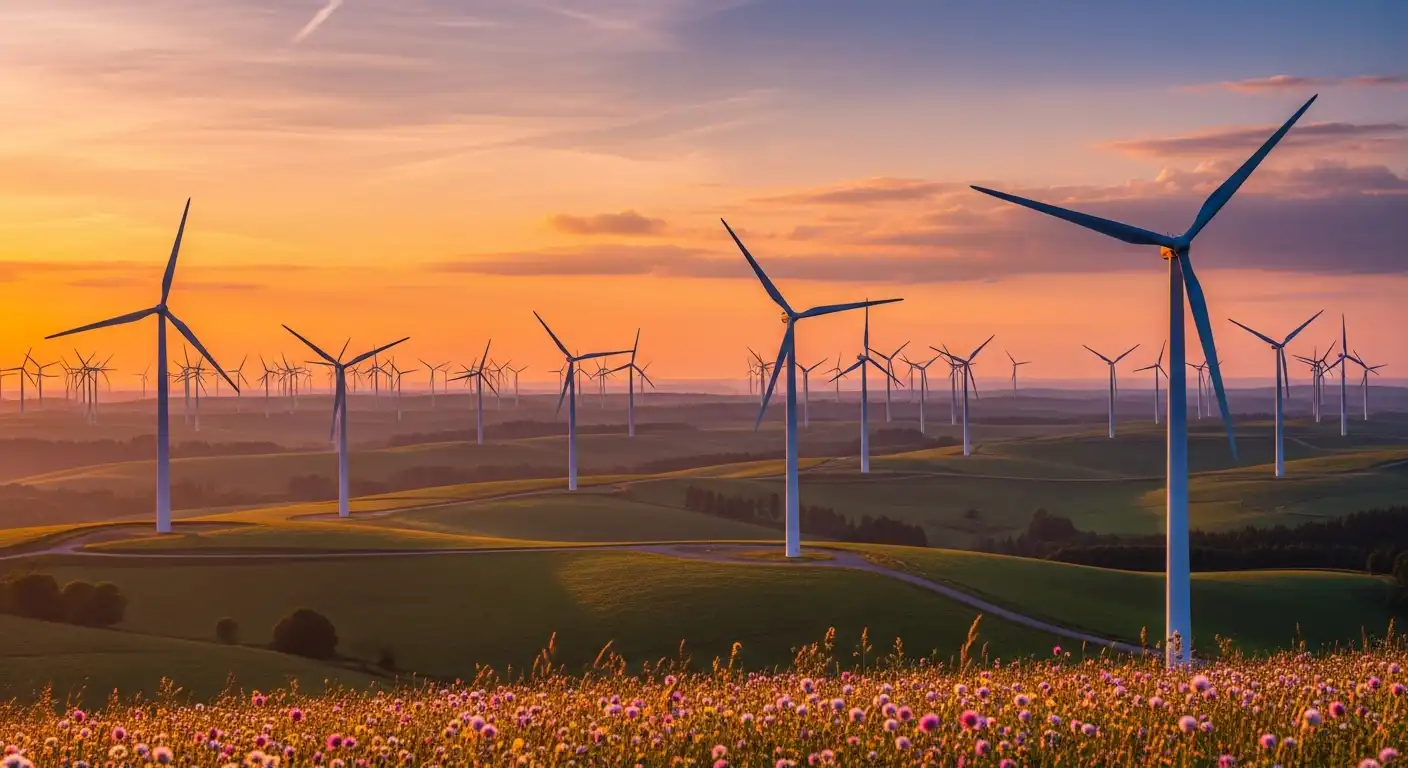
A historically violent summer storm system packing extreme straight-line winds slammed into central South Dakota, causing catastrophic physical damage to several of the state’s key renewable energy installations. Operating under the influence of powerful macrobursts, the storm produced measured wind gusts of up to 131 miles per hour (mph) on Monday, June 29, 2026. The extreme velocities, which are equivalent to Category 4 hurricane strength on the Saffir-Simpson scale, prompted the National Weather Service (NWS) to issue an immediate Civil Emergency Message for the affected regions.
The physical destruction was particularly severe across Hyde County, where the storm’s trajectory intersected directly with several major wind energy developments. Multiple wind farms experienced critical structural damage, including ENGIE North America’s 250-megawatt (MW) Triple H and 200-MW North Bend wind projects, as well as the historic South Dakota Wind Energy Center. As the clean energy transition accelerates, this dramatic event serves as a stark reminder that scale and green branding do not exempt industrial steel and fiberglass from the fundamental laws of physics.
The Anatomy of a Category 4 Straight-Line Windstorm
The severe weather event began to develop during the early morning hours of Monday, as a highly organized convective system swept across the plains of South Dakota. At approximately 6:15 a.m. local time, the storm system unleashed its full force on the town of Highmore and surrounding agricultural lands. The South Dakota Mesonet station at Highmore recorded sustained winds of 76 mph with a peak gust of 131 mph, capturing the extreme intensity of the event before power failures knocked local monitoring equipment offline.
Meteorologists analyzing the storm confirmed that the damage was caused by a series of powerful macrobursts—intense downdrafts of cold air that plunge from the base of a thunderstorm and push outward in all directions with immense velocity once they hit the ground. Unlike tornadoes, which damage areas along a narrow, twisting path, macrobursts produce straight-line winds that can flatten structures across a wide geographic corridor. The 131-mph winds left a trail of destruction through the town of Highmore, tearing the roofs off local homes, uprooting century-old trees, toppling power poles, and splitting the roof of St. Mary’s Catholic Church. Remarkably, despite the widespread physical devastation to homes, farms, and industrial wind turbines, local emergency services reported zero injuries.
The Impact on ENGIE’s Triple H and North Bend Wind Farms
Among the primary casualties of the storm system were two large-scale wind energy installations operated by French utility giant ENGIE North America. The Triple H Wind Project, a 250-MW facility commissioned in late 2020, and the nearby 200-MW North Bend Wind Project both suffered significant infrastructure damage. The two projects represent a massive capital investment for ENGIE, supplying clean electricity to regional grids and corporate power-purchase partners.
The extreme straight-line winds caused widespread damage across both properties:
- High winds tore the roofs and siding off operations and maintenance buildings, exposing sensitive electrical testing equipment to the elements.
- Enormous fiberglass blades were sheared off their rotor hubs, with debris scattered across surrounding agricultural fields.
- Multiple tubular steel towers suffered structural buckling, causing the heavy nacelles and rotor assemblies to sag or lean precariously.
- The storm damaged localized transmission lines and collector systems, forcing both facilities to completely disconnect from the regional grid.
In response to the incident, hardware supplier GE Vernova, which manufactured the turbines and electrical systems for both projects, confirmed that its engineering teams are working closely with ENGIE to conduct a comprehensive safety and damage assessment. The companies have established a secure perimeter around the affected sites, prioritizing the stabilization of damaged structures before starting the complex cleanup and repair process.
The Catastrophic Collapse of the Highmore Wind Energy Project
While ENGIE’s facilities suffered substantial infrastructure damage, the neighboring South Dakota Wind Energy Center—frequently referred to as the Highmore Wind Energy Project or Highmore Wind Farm—experienced a near-total operational collapse. Commissioned in 2003, the 40.5-MW facility holds a special place in the state’s history as South Dakota’s first major utility-scale wind project, operating 27 GE Vernova 1.5-megawatt (1.5s) turbines.
The storm’s 131-mph winds proved far too powerful for the aging structure of the state’s pioneering wind farm. According to local residents and storm chasers who documented the aftermath, over 20 of the project’s 27 giant turbines appeared to have suffered catastrophic failures. Multiple tubular steel towers snapped in half or bent over completely, leaving their heavy generators and crumpled fiberglass blades lying smashed across the prairie. The destruction was so severe that some local observers described the scene as looking like a giant, twisted playground of steel and fiberglass. At full capacity, the Highmore project generated enough clean electricity to power roughly 12,000 average homes, but the extensive physical damage means that the facility will likely remain entirely offline for many months as engineers evaluate whether the aging project is economically viable to rebuild.
The Engineering Limits of Wind Turbine Design
The physical destruction of over 20 turbines at the Highmore site has reignited a critical debate within the engineering community regarding the structural limits of modern wind turbines. Standard utility-scale wind turbines are highly advanced pieces of industrial machinery, engineered with sophisticated pitch-control systems that automatically rotate the blades to minimize aerodynamic drag when wind speeds exceed safe operational limits, usually around 55 mph.
However, these structural systems have their limits:
- Most conventional wind turbines are engineered to withstand maximum wind gusts of up to 110 to 120 mph, which corresponds to a Category 2 or 3 hurricane.
- When wind speeds exceed 130 mph, the immense aerodynamic and mechanical loads can surpass the yield strength of the tubular steel towers, causing them to buckle.
- The extreme lateral force can also shear the high-tensile steel bolts that connect the tower sections, leading to a catastrophic collapse of the entire structure.
- As climate-induced extreme weather events become more frequent and violent, engineering firms must re-evaluate these legacy design standards, building stronger, more resilient towers and blades capable of surviving Category 4 or 5 winds.
This storm proves that simply relying on standard safety systems is not enough to protect these multi-million-dollar assets from the extreme forces of nature, highlighting the need for a comprehensive revision of national wind turbine engineering codes.
The Clean Energy Grid Vulnerability Dilemma
The localized destruction of multiple wind projects in South Dakota highlights a broader, systemic vulnerability of the modern clean energy transition: grid reliability. As countries increasingly retire their traditional, highly resilient coal and natural gas plants to meet ambitious net-zero targets, they become heavily dependent on weather-dependent renewable resources like wind and solar.
While wind and solar are excellent for reducing overall carbon emissions, they are physically vulnerable to the very climate-induced extreme weather events they are designed to combat. If a single, severe storm system can physically take nearly 500 MW of renewable generation capacity offline in a matter of minutes, the regional grid must maintain a substantial, highly flexible backup capacity to prevent widespread blackouts. This reality requires utility companies to maintain a balanced, diversified energy mix that includes robust battery storage facilities, small modular nuclear reactors, and clean gas peaking plants, ensuring that the lights stay on even when the wind decides to harvest the very machines built to harvest it.
GE Vernova and the Task of Assessing Structural Integrity
As the primary hardware supplier for both ENGIE’s sites and the Highmore Wind Farm, GE Vernova faces a highly complex and demanding task. The company’s immediate priority is to conduct a thorough forensic engineering analysis to determine the exact sequence of events that led to the failures.
Engineers must analyze the flight data and internal sensors from the turbines to understand whether the automated pitch-control systems operated correctly before the storm hit, or if the sheer speed and suddenness of the macroburst overwhelmed the mechanical controls. Furthermore, technicians must conduct non-destructive testing, including ultrasonic scans, on the surviving turbine towers to check for microscopic cracks or structural fatigue that could lead to future failures, ensuring that the remaining assets are safe to restart. This detailed investigation is essential for identifying any potential design flaws and developing more robust hardware configurations for future high-wind installations.
The Financial and Insurance Toll on Wind Developers
The financial consequences of the South Dakota storm will be substantial, impacting both the project developers and the global insurance markets that underwrite renewable energy assets. Replacing a single, modern utility-scale wind turbine can cost anywhere from $30 million to $50 million, depending on the turbine model, shipping logistics, and foundation requirements.
When multiplying this cost across more than 20 destroyed or critically damaged turbines, the total cleanup and replacement bill for this single storm will easily exceed $60 million. This unexpected, massive loss will likely drive up insurance premiums for wind energy projects across the Midwest, altering the financial models of green energy developers. If insurance costs continue to rise due to increasing weather volatility, it could raise the cost of capital for new renewable projects, slowing down the pace of the clean energy transition and forcing developers to demand higher wholesale electricity prices to maintain their profitability.
Re-evaluating the Future of Homegrown Green Energy Infrastructure
The destruction of the Highmore Wind Farm and the damage to ENGIE’s assets serve as an important, sober lesson for policymakers and energy planners around the world. As the United States and the European Union accelerate their green transitions—such as the EU’s push to generate 46% of its net electricity from renewables—developers must focus on building resilient, highly secure infrastructure rather than simply chasing maximum volume at the lowest possible cost.
Building this resilience will require significant shifts in how clean energy projects are designed, financed, and deployed. Developers must be willing to invest in advanced, high-durability materials and stronger, reinforced tower designs, even if it raises the initial construction cost of the project. Furthermore, national regulators must establish more rigorous, weather-resistant building codes for wind and solar farms, ensuring that these strategic energy assets can withstand the extreme environmental stresses of a changing climate. By prioritizing physical resilience over low-cost volume, the clean energy sector can build a more secure, stable, and sustainable energy foundation that can support the global economy for generations to come.
Conclusion
The powerful storm system that slammed central South Dakota on June 29, 2026, delivering hurricane-force straight-line winds of up to 131 mph, has delivered a major wake-up call to the global renewable energy industry. By causing significant infrastructure damage to ENGIE’s 250-MW Triple H and 200-MW North Bend wind projects, and physically toppling over 20 giant turbines at the historic Highmore Wind Farm, the storm has exposed the physical vulnerabilities of the clean energy transition. While the absence of injuries is a major relief, the extensive destruction demonstrates that green branding and environmental ambitions do not exempt steel and fiberglass from the laws of physics.
As GE Vernova and ENGIE continue their complex forensic engineering and damage assessments, the focus of the energy sector must shift toward building more resilient, weather-resistant infrastructure. The financial and insurance toll of this single, $60 million-plus event will likely reshape the economics of wind energy development, driving up capital costs and insurance premiums across the Midwest. To build a truly secure, independent green energy grid, developers and policymakers must move past the focus on low-cost volume and invest heavily in structural durability, grid redundancy, and diverse baseload technologies, ensuring that the physical foundation of the digital age remains standing even when mother nature unleashes her most violent forces.






